It’s a quiet Friday night. You return home after two glasses of wine with friends—relaxed, slightly flushed, moving a little slower than usual. Before you’ve even set down your keys, your dog is circling your legs, whining softly. Your usually aloof cat, who rarely greets you at the door, sits rigidly on the hallway rug, ears forward, eyes unblinking. Later, when you sit on the couch, your dog presses insistently against your thigh, while your cat retreats to the top shelf and watches from a distance. You wonder: Did they *know*? Not just that something was different—but specifically that you’d been drinking?
The answer, grounded in veterinary science, behavioral biology, and decades of observational research, is yes—many pets, especially dogs, can detect alcohol consumption with remarkable sensitivity. But “detecting” is only part of the story. What matters more—and what this article explores in depth—is how that detection translates into observable, often nuanced, behavioral shifts. These responses aren’t random or dramatic; they’re rooted in evolutionary wiring, sensory capacity, and the intimate, co-regulated bond between human and companion animal.
How pets perceive alcohol: beyond smell alone
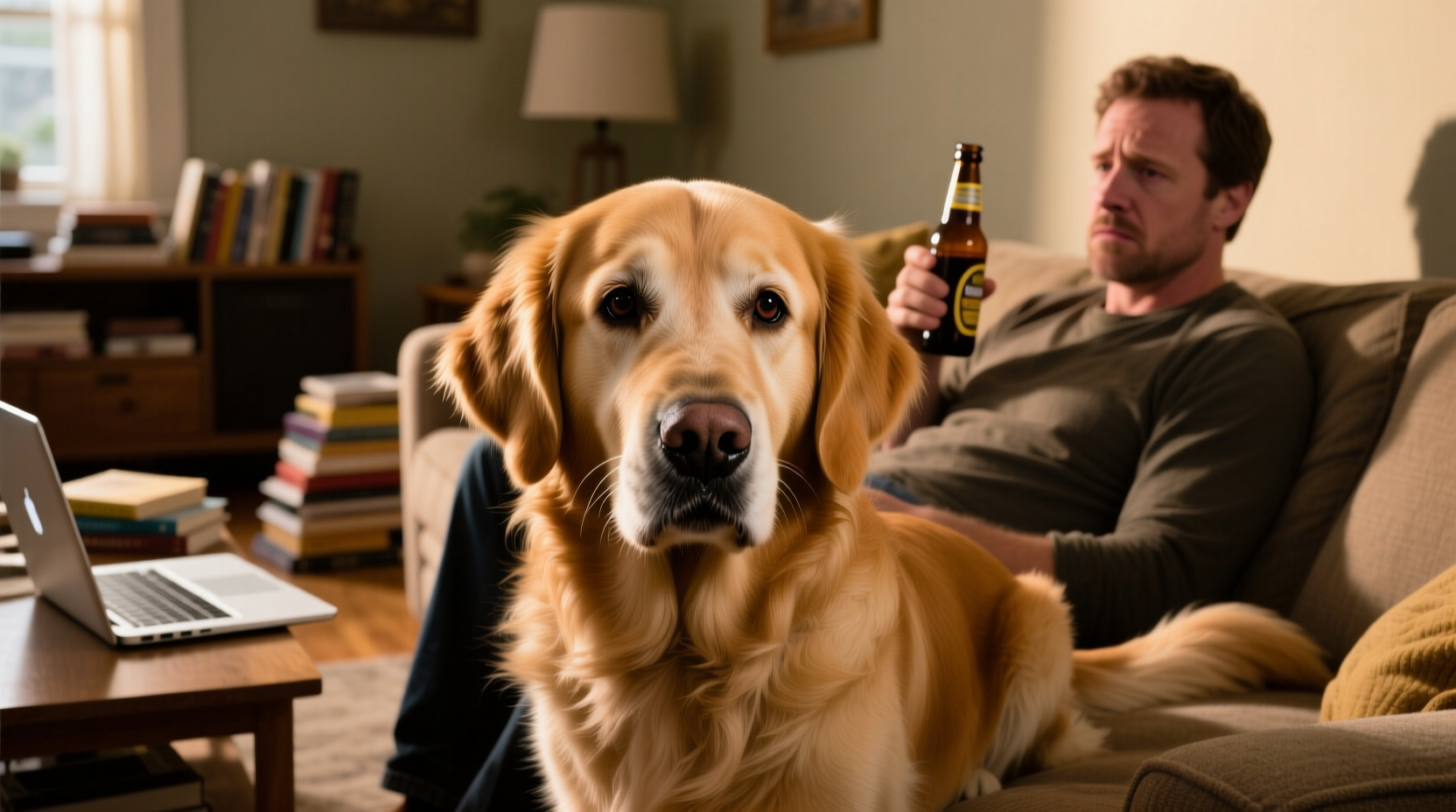
While scent is the dominant channel—dogs possess up to 300 million olfactory receptors (humans have about 6 million)—alcohol detection involves a multi-sensory convergence. Ethanol itself has a distinct volatile signature, but pets are actually responding to a broader biochemical cascade: acetone and acetaldehyde metabolites exhaled in breath, ethanol traces in sweat, subtle shifts in body temperature, altered gait kinetics, and even changes in vocal pitch or respiratory rhythm.
Cats, though less studied than dogs in this context, demonstrate comparable sensitivity. Their vomeronasal organ (Jacobson’s organ) detects pheromones and airborne chemicals at concentrations far below human thresholds. A 2021 study published in Applied Animal Behaviour Science confirmed that both species reliably distinguish ethanol-laced breath samples from control samples at blood alcohol concentrations as low as 0.02%—well below the legal driving limit in most countries.
Crucially, pets don’t interpret “alcohol” as a discrete concept. They register it as a deviation from baseline—a signal embedded in a constellation of cues signaling altered arousal, unpredictability, or reduced responsiveness. That interpretation shapes their response far more than the presence of ethanol alone.
Common behavioral reactions—and what they likely mean
Pets rarely display one-size-fits-all reactions. Their responses depend on temperament, prior experience, species, relationship history, and environmental context. Still, several patterns emerge consistently across clinical and owner-reported data:
- Increased vigilance or proximity-seeking: Dogs may follow owners more closely, rest with heads on laps, or nudge hands repeatedly. This often reflects an attempt to monitor or stabilize perceived instability—not necessarily concern for intoxication, but for the owner’s altered ability to respond predictably.
- Heightened anxiety or agitation: Pacing, panting, excessive licking, or trembling may occur—not because the pet fears alcohol, but because the owner’s slowed reaction time, slurred speech, or unsteady posture disrupts established safety cues.
- Withdrawal or avoidance: Cats, in particular, may retreat to high perches or closed rooms. This isn’t judgment; it’s a self-protective recalibration to reduced social availability and increased sensory noise (e.g., louder voice, heavier footsteps).
- Confusion or misdirected attention: Some dogs exhibit “checking” behaviors—sniffing hands, staring intently at faces, or offering toys repeatedly—as if trying to reconcile familiar cues with unfamiliar physiological signals.
- No observable change: Many pets show no discernible shift. This doesn’t indicate insensitivity—it may reflect strong habituation, secure attachment, or simply lower individual reactivity.
What science says about species differences
Dogs and cats differ not only in anatomy but in evolutionary social architecture—shaping how they process human physiological shifts.
| Factor | Dogs | Cats |
|---|---|---|
| Olfactory capacity | 300M+ receptors; specialized ethanol-detecting glomeruli in olfactory bulb | Approx. 200M receptors; highly sensitive vomeronasal organ for volatile metabolites |
| Social interpretation | Highly attuned to human emotional states via facial expression, vocal tone, and posture; evolved to read subtle cues for cooperative survival | Less reliant on human emotional mirroring; assesses safety primarily through spatial control, resource access, and predictability of movement |
| Typical reaction threshold | Often responds to BAC ≥ 0.02%; may show interest at first sip | Usually requires higher exposure (BAC ≥ 0.04%) or repeated cues (e.g., lingering scent + altered gait) |
| Recovery time post-exposure | 30–90 minutes after owner sobers; dependent on consistency of routine | May take 2–4 hours; cats often re-engage only when environment feels fully restored |
This divergence explains why a dog might nudge your hand while you’re still sipping wine, whereas a cat may wait until you’ve changed clothes, washed your face, and sat quietly for ten minutes before approaching. Neither is “right”—they’re simply calibrated to different survival logics.
A real-world case: Maya, a rescue border collie, and her owner’s weekend pattern
Maya, a four-year-old border collie adopted at 18 months, lived with Sarah, a graphic designer who typically had two to three glasses of red wine every Friday evening. For the first six months, Maya responded with intense proximity-seeking: lying across Sarah’s feet, resting her chin on Sarah’s knee, and interrupting conversations with gentle paw taps. When Sarah began tracking her own behavior, she noticed Maya reacted most strongly when she drank *before* dinner—when her movements were less coordinated and her voice softer and less responsive.
After consulting a certified applied animal behaviourist, Sarah adjusted her routine: she now drinks *after* walking Maya, feeding her, and completing a brief training session. She also avoids reclining immediately afterward, instead sitting upright and engaging in low-stimulus interaction (e.g., slow petting, quiet reading). Within three weeks, Maya’s anxious hovering decreased by 70%. She still notices the wine—she’ll sniff Sarah’s hands and pause—but she no longer treats the evening as a “monitoring event.” Instead, she curls beside the couch and rests, returning to baseline within 20 minutes.
This case illustrates a critical point: pets aren’t reacting to alcohol *per se*, but to the disruption of reliable behavioral patterns. Consistency—even around altered states—restores predictability faster than abstinence ever could.
Expert insight: decoding the canine perspective
“Dogs don’t assess ‘intoxication’ morally or medically. They assess reliability. When your gait slows, your voice drops, your eye contact wavers, or your response latency increases—even slightly—they register it as a temporary shift in your capacity to fulfill your role in the dyad. Their reactions are attempts to recalibrate the relationship in real time—not judgments, but adaptations.”
— Dr. Lena Torres, DVM, DACVB, Veterinary Behaviorist and Co-Director of the Human-Animal Interaction Research Lab at UC Davis
Dr. Torres emphasizes that these responses are neither pathological nor evidence of “stress” in the clinical sense—unless they persist long after the physiological effects subside. Brief, context-specific adjustments are normal, adaptive, and often deeply affectionate. The concern arises only when reactions escalate into chronic anxiety, aggression, or learned helplessness—signals that the pet’s sense of security has been repeatedly undermined.
Practical checklist: supporting your pet when you drink
If your pet shows consistent behavioral shifts when you consume alcohol, these evidence-informed steps can reduce distress—for both of you:
- Anchor the routine: Perform familiar pre-drink rituals (e.g., walk, feed, play) so your pet associates the evening with stability—not uncertainty.
- Minimize sensory overload: Avoid loud music, rapid movement, or sudden laughter immediately after drinking; these amplify perceived unpredictability.
- Maintain physical boundaries: If your pet becomes overly clingy, gently redirect to a designated comfort spot with a favorite blanket or toy—don’t punish, but don’t reinforce dependency either.
- Wash hands and face: Reducing ethanol residue on skin and breath lowers the intensity of chemical cues.
- Observe without projection: Note *what* your pet does—not what you assume they “feel.” Is it pacing? Staring? Hiding? Each tells a different story about their perception of safety.
- Consult a professional if needed: Persistent fear, growling, or elimination outside the litter box/bed warrants evaluation by a veterinarian or board-certified behaviorist—not a trainer.
FAQ: addressing common concerns
Do pets associate alcohol with negative experiences?
Only if alcohol consistently coincides with aversive events—such as raised voices, slammed doors, or inconsistent discipline. In stable, loving homes, most pets learn to distinguish between relaxed drinking and genuine distress. A single incident won’t create lasting association; repetition and context do.
Can secondhand alcohol vapors harm my pet?
Not under typical household conditions. Ethanol vapor concentration from a person’s breath or skin is negligible compared to ingestion risks (e.g., spilled drinks, hand sanitizer). However, never let pets lick alcohol-soaked skin or drink from glasses—ethanol is toxic to animals at doses far lower than in humans.
Why does my dog seem “happy” when I drink, while my cat hides?
Your dog’s apparent happiness likely reflects heightened attention-seeking driven by novelty and altered interaction patterns—not enjoyment of your state. Cats, by contrast, prioritize environmental control; reduced human responsiveness threatens their sense of autonomy. Neither reaction is about approval or disapproval—it’s about species-specific strategies for maintaining equilibrium.
Conclusion: understanding, not interpreting
Recognizing that pets sense alcohol isn’t about anthropomorphizing their awareness—it’s about honoring the depth of interspecies attunement we’ve cultivated over millennia. Their reactions are not critiques of our choices, nor signs of moral judgment. They are biological, behavioral echoes of profound interdependence: the dog who leans in seeks continuity; the cat who withdraws preserves agency; the rabbit who freezes recalibrates threat assessment. All are valid, adaptive, and rooted in love expressed through vigilance.
You don’t need to stop drinking to honor your bond. You do need to understand how your physiology ripples into theirs—and meet that ripple with intention. Adjust routines, minimize ambiguity, observe without assumption, and above all—trust that your pet’s response is not a reflection of your worth, but a testament to how deeply they know you, even in your least guarded moments.
💬 Have you noticed consistent patterns in your pet’s behavior when you drink? Share your observations—not interpretations—in the comments. Real-world examples help us all deepen our understanding of this quiet, complex language of care.