For decades, many people have reached for a glass of red wine in the evening believing it will ease them into restful sleep. The ritual feels soothing: the deep ruby color, the earthy aroma, the quiet moment of pause before bed. Popular culture reinforces the idea—red wine is frequently portrayed as a gentle, natural sedative, especially compared to caffeine or stimulants. But does this belief hold up under scientific scrutiny? Or is it a persistent myth rooted more in tradition and expectation than physiology?
The truth lies somewhere between folklore and pharmacology—and it’s far less comforting than the marketing suggests. While alcohol—including red wine—can make you feel drowsy and shorten the time it takes to fall asleep (sleep onset latency), it significantly disrupts the architecture and quality of sleep that follows. Understanding why requires looking beyond surface-level relaxation to how ethanol interacts with neurotransmitters, brainwave patterns, and circadian biology.
How Alcohol Affects Sleep Physiology
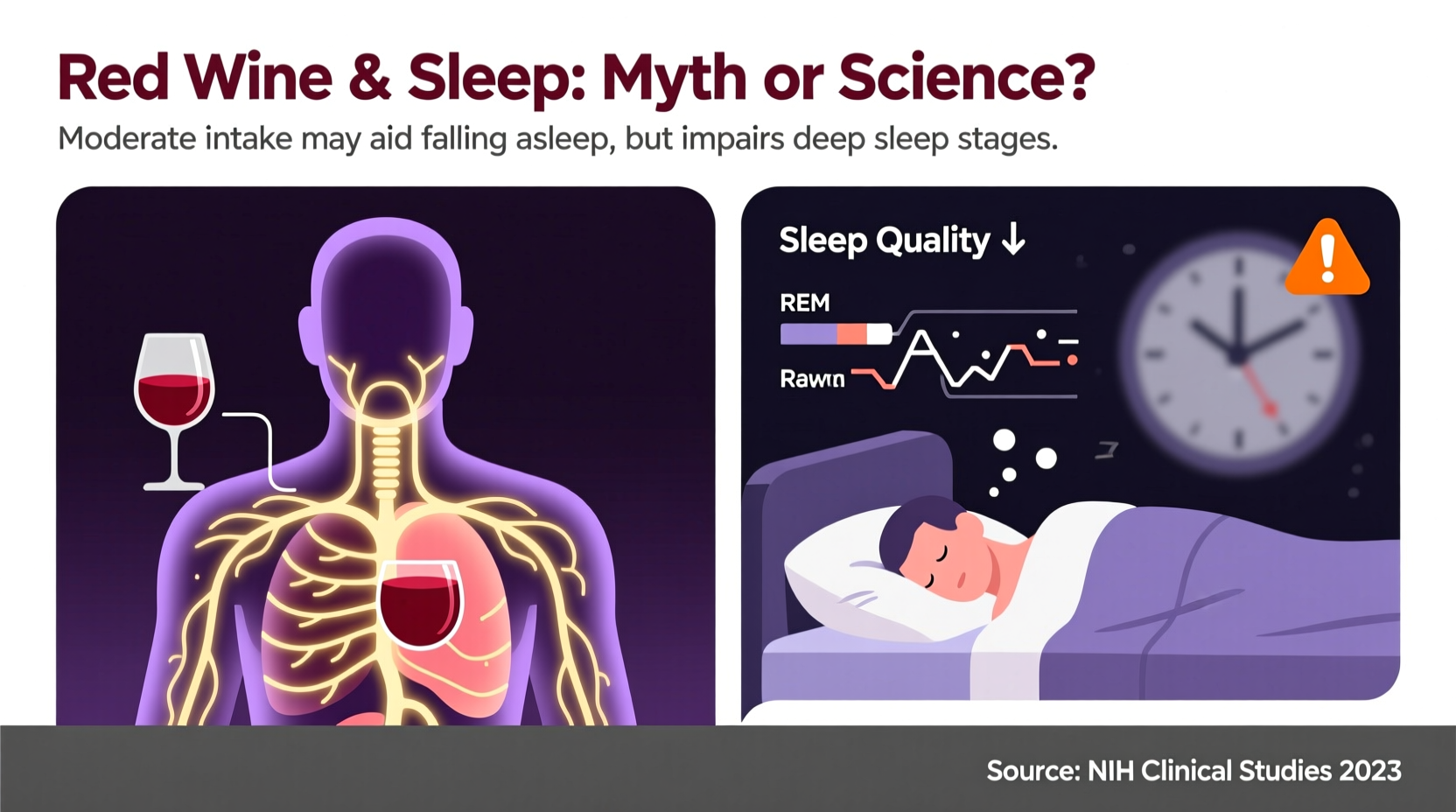
Alcohol is a central nervous system depressant. In low to moderate doses, it enhances the effects of gamma-aminobutyric acid (GABA), the brain’s primary inhibitory neurotransmitter. This GABA boost produces sedation, muscle relaxation, and reduced anxiety—explaining the initial “wind-down” effect many associate with a post-dinner glass of wine.
However, alcohol simultaneously suppresses glutamate—the brain’s main excitatory neurotransmitter—and interferes with acetylcholine, serotonin, and melatonin regulation. Crucially, it fragments the natural progression of sleep stages. A healthy night’s sleep cycles through non-REM (NREM) Stage 1 (light sleep), NREM Stage 2 (deeper, memory-consolidating sleep), NREM Stage 3 (slow-wave or deep restorative sleep), and REM sleep (vital for emotional processing and learning). Alcohol suppresses REM sleep early in the night and causes rebound REM disruption later—often manifesting as vivid dreams, nighttime awakenings, or early-morning wakefulness.
Studies using polysomnography (overnight sleep lab monitoring) consistently show that even one standard drink (5 oz of 12% ABV red wine) reduces total REM sleep by up to 20%. Two or more drinks can delay REM onset by over an hour and cut overall REM time by nearly half. Since REM and slow-wave sleep are when the body repairs tissue, regulates immunity, and consolidates memories, their suppression has measurable downstream consequences—even after just one night.
The Resveratrol Myth: Why “Healthy Compounds” Don’t Translate to Better Sleep
A common justification for red wine’s supposed sleep benefits centers on resveratrol—a polyphenol found in grape skins. Resveratrol has demonstrated antioxidant, anti-inflammatory, and potential neuroprotective properties in cell and animal studies. Some early rodent research suggested it might modestly improve sleep continuity in aged mice—but these findings involved high-dose purified resveratrol supplements, not dietary red wine.
In humans, resveratrol bioavailability from wine is extremely low: only about 1% is absorbed, and it’s rapidly metabolized and excreted. A typical 5-ounce glass of red wine contains roughly 0.2–2.0 mg of resveratrol—far below the 250–500 mg doses used in clinical trials exploring metabolic or cardiovascular effects. Moreover, no peer-reviewed human trial has ever shown that red wine consumption improves objective sleep metrics (e.g., total sleep time, sleep efficiency, or REM percentage) more than placebo or water.
The notion that resveratrol “offsets” alcohol’s negative impact on sleep is unsupported. Ethanol remains the dominant active compound in wine—and its pharmacological influence on sleep architecture overwhelms any subtle, unproven benefit from trace phytochemicals.
Tip: If you enjoy red wine socially, limit consumption to one glass at least three hours before bedtime—and never use it as a nightly sleep aid. Your brain needs uninterrupted REM and slow-wave cycles to recover.Real-World Impact: A Mini Case Study
Consider Maria, a 42-year-old project manager who began drinking one to two glasses of red wine most evenings after work. For years, she believed it helped her “switch off.” She reported falling asleep quickly but waking up tired, struggling with mid-morning brain fog, and experiencing frequent nighttime bathroom trips. After six months of tracking her sleep with a validated wearable device and keeping a log, she noticed clear patterns: nights with wine correlated with 27% less REM sleep, 19% more nocturnal awakenings, and a 14-minute reduction in total sleep time—even when she went to bed at the same time.
At her doctor’s suggestion, Maria conducted a two-week experiment: no alcohol for seven nights, followed by seven nights with her usual wine routine. During the alcohol-free week, her average sleep efficiency rose from 82% to 91%, her morning alertness improved measurably, and she reported fewer afternoon energy crashes. Her experience mirrors clinical findings: subjective sleep perception (feeling like you slept well) often diverges sharply from objective sleep quality—especially with alcohol.
What the Experts Say: Evidence-Based Consensus
Sleep medicine specialists uniformly caution against using alcohol as a sleep aid. The American Academy of Sleep Medicine (AASM) explicitly states in its clinical guidelines: “Alcohol may reduce sleep onset latency, but it impairs sleep maintenance and reduces REM sleep. Chronic use is associated with insomnia, fragmented sleep, and tolerance development.”
“People confuse sedation with sleep. Alcohol doesn’t give you restorative sleep—it gives you chemically induced unconsciousness followed by disrupted, shallow, and physiologically incomplete rest. Over time, this erodes sleep drive and worsens insomnia.” — Dr. Rebecca Lin, Board-Certified Sleep Physician and Director of the Stanford Sleep Disorders Center
Similarly, the National Institute on Alcohol Abuse and Alcoholism (NIAAA) emphasizes that while occasional light drinking may not cause acute harm for some adults, relying on alcohol to initiate or maintain sleep increases risk of dependence and masks underlying sleep disorders such as sleep apnea—which alcohol can exacerbate by relaxing upper airway muscles.
Practical Sleep Hygiene Alternatives to Red Wine
If your goal is truly restorative, sustainable sleep—not just faster sleep onset—there are evidence-backed alternatives that support natural circadian rhythms and deepen rest without compromising sleep architecture.
Do’s and Don’ts for Evening Wind-Down
| Action | Why It Helps | Risk if Done Incorrectly |
|---|---|---|
| Dim lights 90 minutes before bed | Signals melatonin release; supports circadian alignment | Bright overhead lighting suppresses melatonin for up to 90 minutes |
| Practice 4-7-8 breathing (inhale 4s, hold 7s, exhale 8s) | Activates parasympathetic nervous system; lowers heart rate and cortisol | Rushing or forcing breathwork increases anxiety |
| Drink tart cherry juice (½ cup, unsweetened) | Naturally contains melatonin and anthocyanins shown in RCTs to increase sleep duration by ~17 minutes | Excess sugar negates benefits; avoid commercial blends with added sugars |
| Read a physical book (not backlit) | Provides cognitive disengagement without blue-light exposure | Reading stressful or stimulating material raises arousal |
| Maintain consistent bedtime/wake time—even weekends | Strengthens circadian timing; improves sleep pressure regulation | More than 60 minutes of weekend sleep-in delays Monday-night sleep onset |
Step-by-Step Transition Plan: Replacing the Wine Ritual
- Week 1: Shift wine consumption to earlier in the evening (no later than 7:30 p.m.) and reduce volume to 3 ounces. Observe changes in nighttime awakenings and morning clarity.
- Week 2: Replace the pre-bed wine with warm herbal tea (chamomile, magnesium-rich lemon balm, or passionflower)—steeped 10+ minutes for optimal compound extraction.
- Week 3: Introduce a 10-minute gratitude journaling habit immediately after tea—writing three specific things you appreciated that day. This reduces rumination and lowers pre-sleep cortisol.
- Week 4: Add progressive muscle relaxation (PMR): systematically tense and release muscle groups from feet to face while lying in bed. Clinical trials show PMR improves sleep onset and reduces nighttime awakenings by 32% over four weeks.
- Ongoing: Track subjective energy, mood, and focus alongside objective metrics (if using a wearable). Celebrate improvements in mental sharpness—not just “falling asleep faster.”
FAQ: Addressing Common Questions
Does “moderate” red wine consumption still harm sleep?
Yes—even one standard drink (5 oz, ~14 g alcohol) alters sleep architecture. Moderate intake (up to one drink/day for women, two for men) may be acceptable for general health in low-risk adults, but it should never be considered a sleep-enhancing behavior. The dose-response curve for alcohol and sleep disruption is steep: the first drink causes measurable REM suppression, and additional drinks exponentially worsen fragmentation and reduce slow-wave sleep.
Are there any alcoholic beverages better for sleep than red wine?
No. All forms of alcohol impair sleep quality regardless of type—beer, spirits, or wine. Differences in congeners (byproduct compounds) may affect next-day fatigue (e.g., darker liquors like brandy contain more hangover-inducing congeners), but ethanol itself is the primary disruptor of sleep physiology. Claims about “low-histamine” or “biodynamic” wines improving sleep lack empirical validation.
Can I take melatonin instead—and is it safer?
Short-term, low-dose melatonin (0.3–1.0 mg) taken 60–90 minutes before bed is generally safe and effective for circadian rhythm adjustment (e.g., jet lag or shift work). Unlike alcohol, it does not suppress REM or cause dependence. However, it’s not a long-term solution for chronic insomnia and works best when combined with behavioral strategies. Always consult a physician before combining melatonin with prescription sedatives or antidepressants.
Conclusion: Prioritize Quality Over Quick Fixes
Red wine’s association with sleep is a compelling cultural narrative—but it’s one built on misinterpretation. Feeling drowsy after a glass is not the same as achieving restorative, biologically complete sleep. What begins as a seemingly harmless ritual can, over time, condition the brain to rely on chemical sedation rather than cultivating natural sleep drive and resilience. The irony is profound: the very substance people reach for to “unwind” actively undermines the body’s capacity to repair, consolidate memory, regulate emotion, and strengthen immunity—all core functions that occur during undisturbed, high-quality sleep.
You don’t need to eliminate red wine entirely to protect your sleep. You do need to separate social enjoyment from functional expectation. Reserve it for occasions—not routines. Choose intention over habit. And invest instead in practices that honor your biology: consistency, darkness, calm, and patience. Restorative sleep isn’t something you pour into a glass. It’s something you cultivate—night after careful night.
💬 Your sleep story matters. Have you experimented with replacing alcohol with other wind-down rituals? Share what worked—or what surprised you—in the comments. Let’s build a community grounded in evidence, not myths.