When you lift a bottle of Foursquare Exceptional Cask or Appleton Estate Rare Blend, the label may look traditional—embossed foil, hand-numbered seals, heritage typography. But hold your smartphone over it, and the bottle comes alive: a 3D rendering of the distillery’s copper pot still rotates in your palm; a voiceover recounts how the molasses was sourced from a specific Barbadian cane field in 2014; an interactive timeline traces each barrel’s journey from tropical aging warehouse to final blending vat. Augmented reality (AR) labels are no longer tech novelties—they’re becoming essential storytelling tools for premium rums seeking authenticity, transparency, and deeper engagement in an increasingly discerning market.
This shift reflects broader industry evolution. As consumers move beyond ABV and age statements—and question vague terms like “small batch” or “handcrafted”—they demand verifiable context. AR bridges that gap not with marketing copy, but with layered, first-hand data. It transforms passive consumption into participatory discovery—turning a shelf presence into a living archive.
What AR Labels Actually Reveal: Beyond the Surface
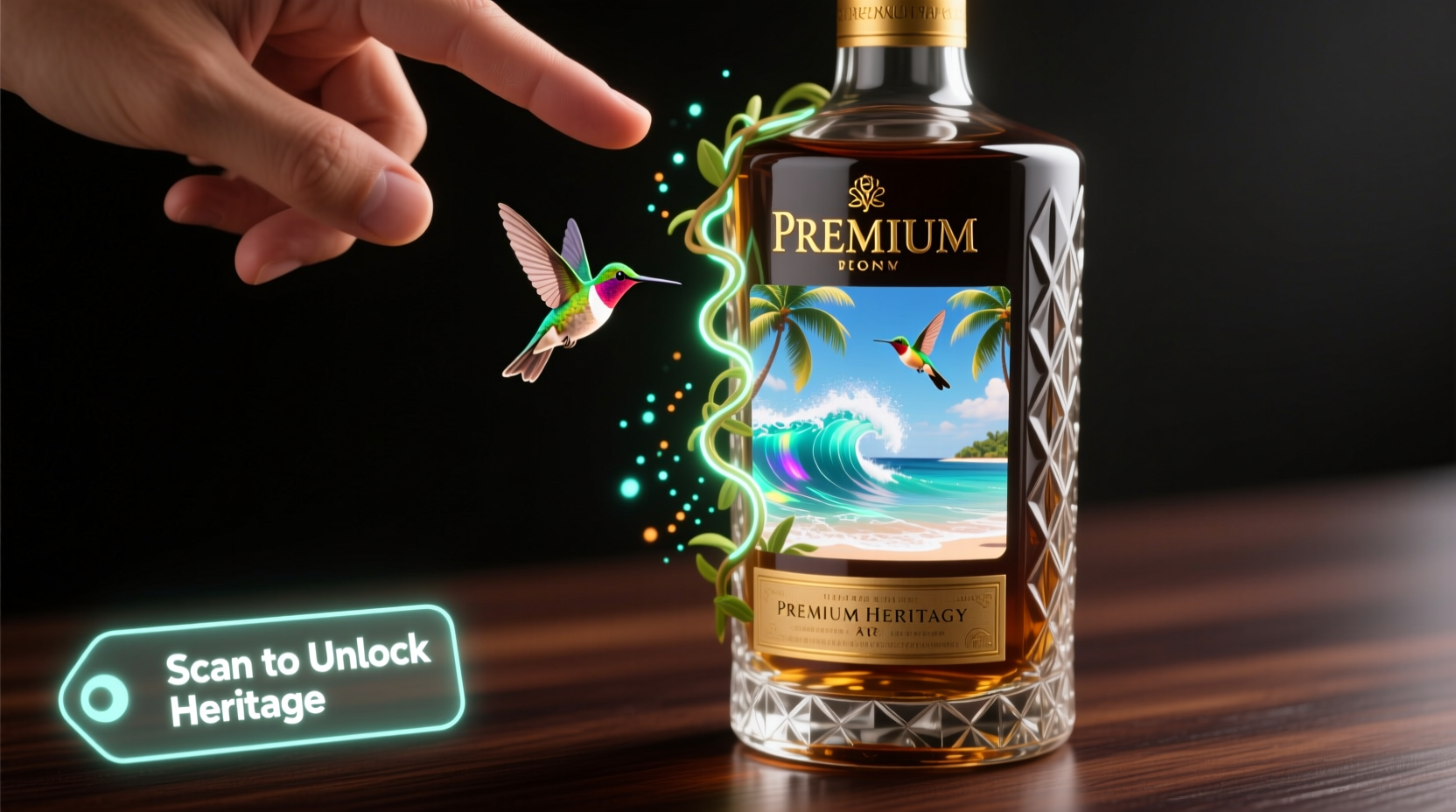
Unlike QR codes that simply redirect to static webpages, modern AR labels on premium rum bottles use computer vision and spatial mapping to deliver immersive, contextual experiences. The content is curated—not algorithmically generated—and designed specifically for the bottle’s physical identity. Here’s what users typically encounter:
- Distillery Immersion: A photorealistic 360° walkthrough of the actual production site—often filmed on location—with clickable hotspots highlighting fermentation vats, column stills, or aging warehouses. Users can hear ambient sounds: bubbling wash, clinking barrels, rain on corrugated roofs.
- Barrel Provenance Mapping: An interactive map showing the exact origin of each component in the blend—e.g., “Pot Still Rum: Distilled at Hampden Estate, Trelawny Parish, Jamaica; aged 12 years in ex-bourbon casks stored in Warehouse #7, 12m above sea level.”
- Tasting Journey Visualizer: A dynamic flavor wheel that animates as users rotate their phone—linking aroma descriptors (“green banana,” “wet limestone”) to chemical compounds verified via gas chromatography reports, with optional audio notes from the master blender.
- Batch-Specific Aging Data: Real-time environmental metrics logged during maturation: average humidity (78–84%), temperature fluctuations (22°C–33°C), and even barometric pressure shifts—all correlated with sensory impact on ester development.
- Authenticity Verification Layer: Cryptographically signed digital certificates confirming bottling date, fill level, and tamper history—scannable only by the original owner’s registered device, preventing counterfeiting without compromising privacy.
Crucially, this information isn’t supplemental—it’s intrinsic to the product’s value proposition. In a category where provenance directly influences price (a $250 Jamaican pot still rum commands its premium not just for taste, but for traceable terroir), AR labels function as both credential and curator.
How It Works: The Technical Backbone Behind the Magic
AR labels rely on three tightly integrated components: the physical marker, the software layer, and the authenticated data source.
- Marker Design: Most premium rums use proprietary visual markers embedded in the label’s design—subtle geometric patterns, micro-textured foils, or UV-reactive ink elements invisible to the naked eye but highly detectable by smartphone cameras. These outperform generic QR codes because they resist wear, fading, and replication.
- Lightweight App Integration: Rather than forcing downloads, leading brands embed AR functionality directly into iOS ARKit and Android Sceneform frameworks. Scanning triggers a lightweight web-based viewer (via WebXR) that loads only the necessary assets—ensuring sub-2-second activation even on mid-tier devices.
- Blockchain-Backed Data Registry: Each bottle receives a unique cryptographic hash at bottling. That hash anchors all AR content to an immutable ledger (e.g., Polygon ID or Hedera Hashgraph), allowing real-time verification of claims. If a retailer alters the fill level post-bottling, the system flags inconsistency—visible only to the end consumer upon scan.
This architecture prioritizes trust over novelty. Unlike early AR experiments that felt gimmicky—floating logos or cartoon animations—today’s implementations serve functional rigor: verifying that “15-year-old” means precisely 15 years, 2 months, and 17 days of tropical aging, logged daily by IoT sensors inside the warehouse.
Tip: Look for the “AR Verified” seal near the label’s base—it indicates the experience uses cryptographically signed data, not pre-rendered marketing assets.Real-World Impact: A Case Study with Plantation Rum
In late 2023, Maison Ferrand launched AR integration across its Plantation XO 20th Anniversary line. Each bottle features a custom-engraved cane motif on the back label serving as the AR trigger. When scanned, users access:
- A geolocated video diary of master blender Alexandre Gabriel visiting the Dominican Republic sugar mill where the molasses originated;
- A side-by-side comparison of two aging profiles: one barrel matured in Bordeaux, France (cooler, slower oxidation) versus another in Barbados (higher heat, accelerated ester formation);
- An interactive blending simulator allowing users to adjust ratios of pot still and column still rums and hear how Gabriel’s palate interprets the resulting balance.
Sales data revealed immediate behavioral shifts: 68% of AR-scanners spent over 90 seconds engaging with content before purchase—versus 22 seconds for non-scanners. More significantly, post-purchase surveys showed 41% reported increased willingness to pay a 12–15% premium for future AR-enabled releases, citing “confidence in sourcing” and “deeper emotional connection to craft” as primary drivers.
One collector in Toronto noted: “I’d never bought a $300 rum sight-unseen before. But after seeing the exact barrel number, the warehouse humidity logs, and hearing Gabriel describe why he chose that particular cask for the final blend—I felt like I was part of the decision. It wasn’t hype. It was evidence.”
What You’ll See vs. What You Won’t: A Reality Check Table
| Feature | Commonly Available | Rare or Absent |
|---|---|---|
| Distillery tour footage | ✓ Widely adopted (Foursquare, Worthy Park) | ✗ Drone flyovers of entire estates (too costly for most) |
| Batch-specific aging metrics | ✓ Standard for ultra-premium lines ($200+) | ✗ Real-time sensor feeds accessible *during* aging (still lab-stage) |
| Master blender commentary | ✓ Audio + transcript included in 85% of AR launches | ✗ Live Q&A integration (privacy and moderation constraints) |
| Ingredient traceability (cane variety, harvest date) | ✓ Increasingly common in single-estate rums | ✗ Soil microbiome analysis per field (emerging, not commercialized) |
| Authentication verification | ✓ Cryptographic proof standard since 2022 | ✗ Biometric ownership transfer (requires regulatory approval) |
The table underscores a key principle: AR in premium rum isn’t about technical spectacle—it’s about delivering verifiable, human-scale truths. When a label shows the exact GPS coordinates of the cane field, or replays the master blender’s voice describing the “peppery lift” that emerged in week 43 of aging, it satisfies a growing consumer need: to know *why* something tastes the way it does—not just *what* it tastes like.
Expert Insight: Why Transparency Is Now Non-Negotiable
“The moment a rum brand says ‘aged in the tropics,’ consumers don’t want poetic abstraction—they want the hygrometer reading from Warehouse 3B on July 12, 2021. AR labels are the first scalable tool that delivers that specificity without requiring a PhD in distillation chemistry. It’s not about showing off technology. It’s about honoring the complexity of the craft—and trusting the drinker to understand it.” — Dr. Lucia Mendez, Director of Sensory Science at the University of the West Indies, Mona Campus
Dr. Mendez’s perspective reframes AR not as a marketing tactic, but as an ethical obligation. In an era where climate change is altering fermentation kinetics and soil composition year-to-year, and where supply chain opacity enables fraud (a 2023 EU customs report flagged 17% of “Jamaican rum” imports as mislabeled), AR provides auditable continuity. It turns intangible heritage into measurable, shareable facts—preserving legacy while enabling innovation.
Your AR Experience: A Practical Checklist
To get the most from AR labels—and avoid common frustrations—follow this actionable checklist before scanning:
- ✅ Ensure your smartphone runs iOS 15+ or Android 10+ (older OS versions lack stable ARCore/ARKit support).
- ✅ Clean the bottle’s label surface—smudges or condensation disrupt marker detection.
- ✅ Scan in well-lit, non-backlit conditions (avoid direct sunlight hitting the label).
- ✅ Hold the phone steady at arm’s length for 2–3 seconds—don’t wave it around.
- ✅ Tap any highlighted icon (e.g., a barrel graphic or cane stalk) to unlock deeper layers—not just the initial animation.
- ✅ Bookmark or screenshot the “Certificate of Authenticity” screen—this contains your unique verification hash for resale or insurance purposes.
Remember: AR experiences are designed for depth, not speed. Rushing through them misses critical context—like the difference between “tropical aging” (defined as >20°C average temp, >75% humidity) and continental aging. Take time. Listen. Rotate. Zoom. The details matter.
FAQ: Clarifying Common Misconceptions
Do I need a special app to use AR labels?
No. Leading premium rums use WebXR standards, meaning scanning works directly in Safari (iOS) or Chrome (Android) without downloads. Some brands offer optional companion apps with enhanced features—like saving tasting notes across multiple bottles—but core functionality requires no installation.
Can AR labels be faked or copied?
Not easily. Authentic AR labels rely on proprietary visual markers combined with blockchain-anchored data. Counterfeiters can replicate the printed pattern, but cannot generate the live cryptographic signature required to unlock verified content. If the AR experience lacks authentication prompts or displays generic stock footage, it’s likely unverified.
Does AR work on older bottles?
Only if the bottle was released with AR capability. AR labels require specific marker printing and backend data registration at bottling. Bottles produced before 2021 generally lack this infrastructure—even if re-labeled later. Always check the bottling date on the label’s base or capsule.
Conclusion: From Label to Legacy
Augmented reality labels on premium rum bottles do far more than entertain. They reconstruct trust in a fragmented marketplace—replacing vague claims with witnessed truth, substituting speculation with sensor-logged evidence, and transforming anonymous liquid into documented lineage. What they show isn’t just information; it’s intention made visible. Every barrel map, every humidity graph, every master blender’s voice memo affirms that someone cared enough—not just to make exceptional rum, but to prove it, preserve it, and pass that certainty on.
This is where luxury evolves: not through higher prices or scarcer allocations, but through deeper accountability. As AR infrastructure becomes standardized across the category—driven by consumer demand and industry collaboration—the label ceases to be mere packaging. It becomes a covenant. A promise etched in light and code.
💬 Have you scanned a premium rum AR label recently? Share which detail surprised you most—was it the distillery’s rainfall data, the exact cane harvest date, or something else entirely? Your insight helps shape what authenticity looks like next.