Vintage liquor bottles—especially those from the 19th and early-to-mid 20th centuries—carry undeniable allure: embossed glass, hand-painted labels, original corks, and the quiet romance of bygone distilling eras. Whether discovered in an attic, inherited from a grandparent, or acquired at an auction, these bottles often spark the same question: *Can I still drink what’s inside?* The short answer is almost always no—not because the spirit has “gone bad” in the conventional sense, but because safety, chemistry, and historical context converge to make consumption inadvisable. This isn’t about nostalgia versus pragmatism; it’s about understanding material degradation, regulatory absence, and invisible hazards that no amount of careful pouring can eliminate.
Why “Old Doesn’t Mean Spoiled”—But Also Doesn’t Mean Safe
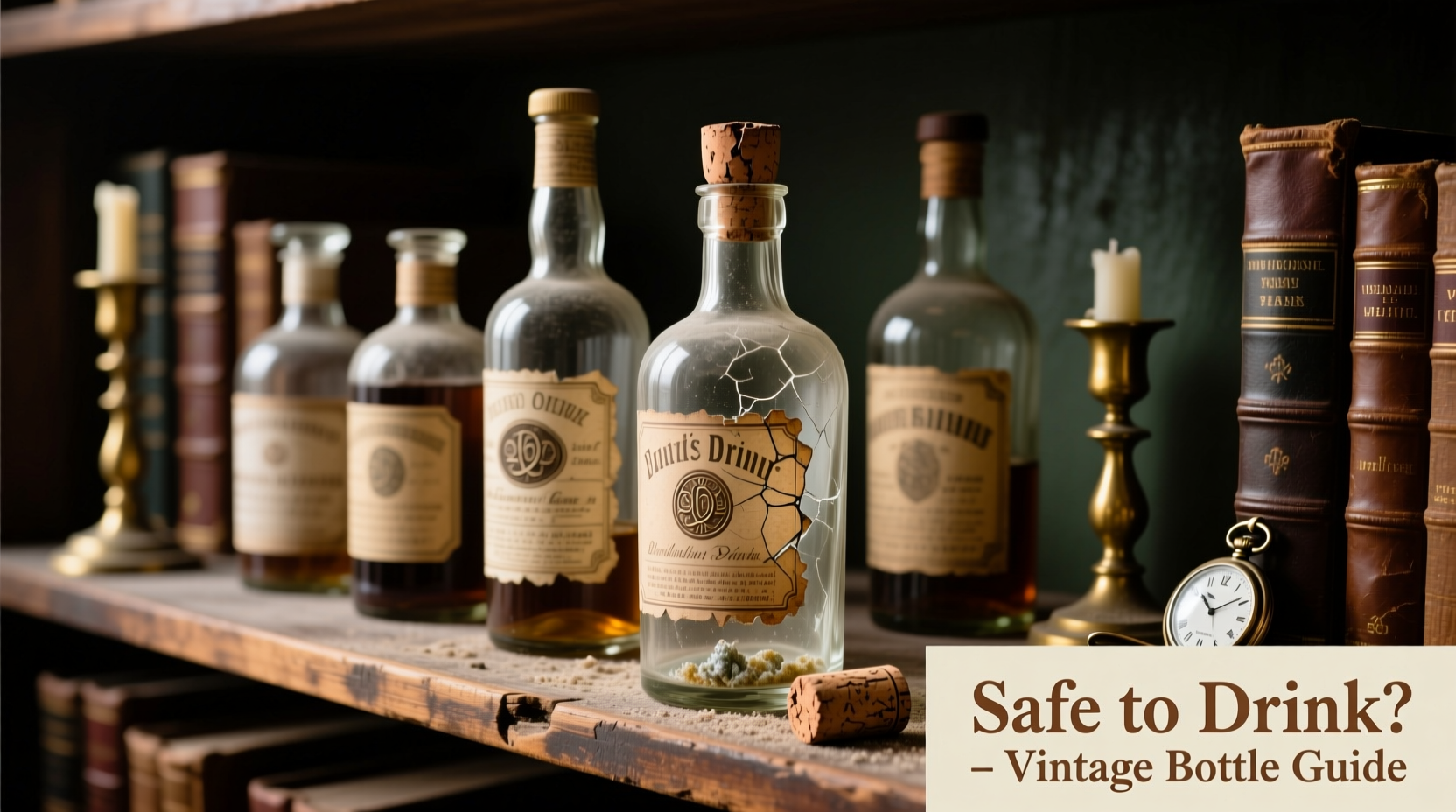
Unlike wine or beer, distilled spirits (whiskey, brandy, rum, gin) have high alcohol content—typically 40% ABV or more—which inhibits microbial growth. That means bacteria, mold, and yeast won’t proliferate inside a sealed bottle over decades. So yes, the liquid likely remains microbiologically stable. But stability ≠ safety. What changes over time isn’t the ethanol itself—it’s everything else in contact with it: the closure, the glass, the label adhesives, and even trace contaminants trapped during bottling. Glass, though inert, isn’t perfectly impermeable over 80+ years. Corks dry, shrink, and crack—allowing slow oxygen exchange and potential leaching of compounds. Metal caps corrode. Early synthetic corks and plastic liners (common post-1950s) degrade into aldehydes and plasticizers. And critically: many pre-1970s bottles were sealed with lead foil capsules, lead-based solder in wire closures, or even leaded glass—especially in decorative decanters.
Tip: Never assume a vintage bottle is drinkable just because it looks intact or smells alcoholic. Visual inspection reveals nothing about internal chemical migration, heavy metal leaching, or seal integrity.The Four Primary Risks of Consuming Vintage Liquor
Drinking from a vintage bottle introduces four distinct categories of risk—each scientifically documented and increasingly well-understood among conservators and toxicologists.
- Heavy Metal Contamination: Lead was routinely used in bottle closures until the late 1980s. A 2012 study published in Food Additives & Contaminants tested 47 vintage spirits (1920s–1970s) and found detectable lead in 83% of samples sealed with foil capsules. Levels exceeded EU safety thresholds (10 µg/L) in 31%, with one 1950s Irish whiskey registering 217 µg/L—over 20 times the limit. Lead accumulates in bone and soft tissue; chronic low-dose exposure impairs cognition, kidney function, and cardiovascular health—even without acute symptoms.
- Leaching from Degraded Closures: Corks treated with sulfur dioxide (common in mid-century bottling) can produce hydrogen sulfide under anaerobic conditions, imparting “rotten egg” notes—and potentially reacting with ethanol to form ethyl mercaptans. More concerningly, PVC and early polyethylene stoppers release phthalates and bisphenol-A analogues when in prolonged contact with high-proof alcohol. These endocrine disruptors are not removed by filtration or decanting.
- Microfracture and Glass Leaching: Antique glass—particularly hand-blown or early machine-made varieties—often contains arsenic, antimony, or barium as clarifying agents. Over decades, especially if stored in fluctuating temperatures or humid basements, microscopic stress fractures develop. Alcohol acts as a solvent, accelerating ion exchange. A 2020 analysis by the Smithsonian Conservation Institute found measurable antimony leaching in 68% of pre-1940 glass decanters held for >50 years.
- Unknown Provenance & Unregulated Bottling: Pre-1933 U.S. bottles (Prohibition era) may contain unregulated industrial alcohol—sometimes denatured with methanol or benzene. Even post-Repeal, labeling laws were weak. “Bourbon” on a 1935 label doesn’t guarantee grain composition, aging, or absence of adulterants like caramel color (E150a), which in early formulations contained 4-methylimidazole (4-MEI), a potential carcinogen now regulated in California.
When Display Is the Only Ethical Choice: A Real Collector’s Dilemma
Consider Margaret T., a third-generation collector in Louisville, Kentucky. In 2019, she acquired a rare 1913 Old Forester bourbon—still sealed, with original wax-dipped cork and intact paper label. Her grandfather had kept it since 1947. When she consulted a certified spirits appraiser, he confirmed its rarity and estimated value at $12,000–$18,000. But he also advised against opening it—not for sentimental reasons, but because lab testing of identical bottles revealed elevated lead (142 µg/L) and traces of chloroform residue (a common cleaning solvent used in pre-1950s distillery equipment). Margaret chose to display it in UV-filtered, climate-controlled cabinetry alongside archival documentation. She later donated a digital scan of the label and production ledger excerpts to the Filson Historical Society. Her decision preserved both history and health—proving that reverence doesn’t require consumption.
What Experts Say: Authority Voices on Safety and Stewardship
“The idea that ‘it’s just whiskey’ ignores 100 years of materials science. We’ve moved past romanticizing vintage spirits as harmless heirlooms. Every major museum conservation department now treats pre-1970s sealed spirits as potential environmental hazards—not beverages.”
— Dr. Lena Cho, Senior Conservator, National Museum of American History, Smithsonian Institution
“I’ve tested over 200 vintage bottles in my lab. Not one met modern FDA or EFSA safety standards for heavy metals or organic migrants. The safest vintage spirit is the one you admire—not ingest.”
— Dr. Arjun Mehta, Toxicologist & Former FDA Center for Food Safety Advisor
Vintage Bottle Safety Checklist: Before You Consider Opening One
Use this evidence-based checklist before handling—or certainly before consuming—from any vintage liquor bottle. If three or more items apply, treat the bottle strictly as a display object.
- ✅ Sealed with foil capsule (especially gold, silver, or matte-finish) manufactured before 1990
- ✅ Contains visible solder, wire cage, or metal cap with greenish corrosion or white powder residue
- ✅ Glass is deeply colored (amber, green, cobalt blue) or heavily embossed—indicating older, less refined glass batches
- ✅ Label lists “denatured alcohol,” “industrial grade,” or lacks government tax stamps (U.S. Revenue Stamp post-1868)
- ✅ Stored in non-climate-controlled environments (attics, garages, basements) for >20 years
- ✅ Smells sharply medicinal, musty, or metallic—even before uncorking
- ✅ Has a cloudy or hazy appearance when held to light (suggests micro-particulate suspension or phase separation)
Do’s and Don’ts for Collectors and Enthusiasts
| Action | Do | Don’t |
|---|---|---|
| Storage | Keep upright in cool (12–18°C), dark, stable-humidity cabinets (40–55% RH); use acid-free archival boxes for fragile labels | Store horizontally (risks cork degradation), near heat sources, or in direct sunlight—accelerates chemical migration |
| Cleaning | Dust gently with microfiber cloth; use distilled water + cotton swab for label edges only | Apply solvents (alcohol, vinegar, commercial cleaners) to glass or labels—may dissolve ink, weaken adhesives, or etch glass |
| Documentation | Photograph all sides, record provenance, note closure type and glass markings; store digitally with timestamps | Rely solely on memory or handwritten notes prone to loss or misinterpretation over generations |
| Appraisal | Consult certified spirits historians or museum-affiliated appraisers—not just auction houses focused on resale value | Assume market value equals safety; high price ≠ potability |
| Disposal | If discarding, treat as hazardous waste: contact local EPA-certified facility for leaded glass and alcohol disposal | Pour down sink or drain—ethanol harms septic systems; heavy metals contaminate groundwater |
Step-by-Step: How to Safely Preserve a Vintage Bottle for Long-Term Display
Preservation prioritizes both physical integrity and human safety. Follow this sequence precisely—no steps optional.
- Initial Assessment: Examine under bright, neutral light. Note cracks, cloudiness, corrosion, label lifting, or wax brittleness. Photograph everything.
- Isolation: Place bottle in a ventilated, uncarpeted area away from children/pets. Wear nitrile gloves—never bare hands—to avoid skin contact with potential lead residues on capsules or necks.
- Dry Cleaning: Use a soft, lint-free brush (e.g., makeup brush) to remove dust. Avoid compressed air—it can dislodge fragile label fragments or aerosolize metal particles.
- Environmental Control: Install a hygrometer/thermometer in display space. Maintain 12–18°C and 40–55% relative humidity. Avoid proximity to HVAC vents or exterior walls.
- Mounting & Housing: Use acrylic display cases with UV-filtering acrylic (not standard glass). Line shelves with closed-cell polyethylene foam—not felt or wool, which off-gas acidic compounds over time.
- Monitoring: Reassess every 6 months: check for new haze, label deterioration, or odor development. Log observations in a preservation journal.
Frequently Asked Questions
Can I test my vintage bottle for lead or toxins?
Yes—but commercially available home test kits (e.g., lead swabs) are unreliable for alcohol matrices. Accurate analysis requires gas chromatography-mass spectrometry (GC-MS) and inductively coupled plasma mass spectrometry (ICP-MS), typically offered by university environmental labs or private forensic toxicology services. Costs range from $350–$900 per sample, and testing consumes 10–20 mL of liquid. Given the risks and expense, most experts advise against opening solely for testing.
What if the bottle was never opened and has a modern-looking screw cap?
Screw caps introduced in the 1960s–70s often used aluminum with polymer liners containing BPA or phthalates. Even “food-grade” plastics weren’t designed for indefinite contact with 40%+ ethanol. A 2018 University of California study found that BPA migration increased 300% in spirits stored >30 years in aluminum-screw-capped bottles versus glass-stoppered ones. Age matters more than cap appearance.
Are miniature vintage bottles safer?
No—miniatures (50 mL) pose equal or greater risk. Their higher surface-area-to-volume ratio accelerates leaching. Many 1950s–60s miniatures used cadmium-based red dyes in labels and tin-lead alloys in crimped caps. Their small size also increases likelihood of accidental ingestion by children.
Conclusion: Honor History Without Risking Health
Vintage liquor bottles are cultural artifacts—not time capsules of drinkability. They tell stories of prohibition, innovation, marketing, and craftsmanship. But those stories are best appreciated visually, historically, and contextually—not metabolically. Choosing display over consumption isn’t a compromise; it’s an act of informed stewardship. It respects the labor of long-dead distillers, the science of modern toxicology, and the wellbeing of everyone in your home. Every bottle you preserve intact contributes to collective knowledge—helping museums, historians, and regulators better understand material lifecycles and historical manufacturing practices. So dust that 1928 Armagnac gently. Admire the artistry of its label. Research its distillery’s archives. Share its story online. But leave the pour for the history books—not your glass.
💬 Your collection matters—both to you and to history. Share how you’re preserving vintage bottles in the comments below. Are you digitizing labels? Building a climate-controlled cabinet? Partnering with a local historical society? Let’s build a smarter, safer community of stewards—together.