Light is a silent, cumulative threat to fine wine—especially delicate, age-worthy vintages. Unlike temperature fluctuations or humidity swings, which often trigger immediate concern, light damage progresses invisibly: no cork pops, no visible haze, just a slow, irreversible degradation of aromatic compounds and phenolic structure. For collectors storing Bordeaux 1982, Burgundy 1996, or Rhône 2003, the question isn’t whether light matters—it’s how much protection modern appliances actually deliver. UV wine coolers have surged in popularity as premium storage solutions, marketed with terms like “light-safe,” “UV-protected,” and “museum-grade shielding.” But do they live up to the promise? The answer lies not in marketing brochures, but in photobiology, glass transmission physics, and real-world cellar conditions.
How Light Damages Wine: The Science Behind the Spoilage
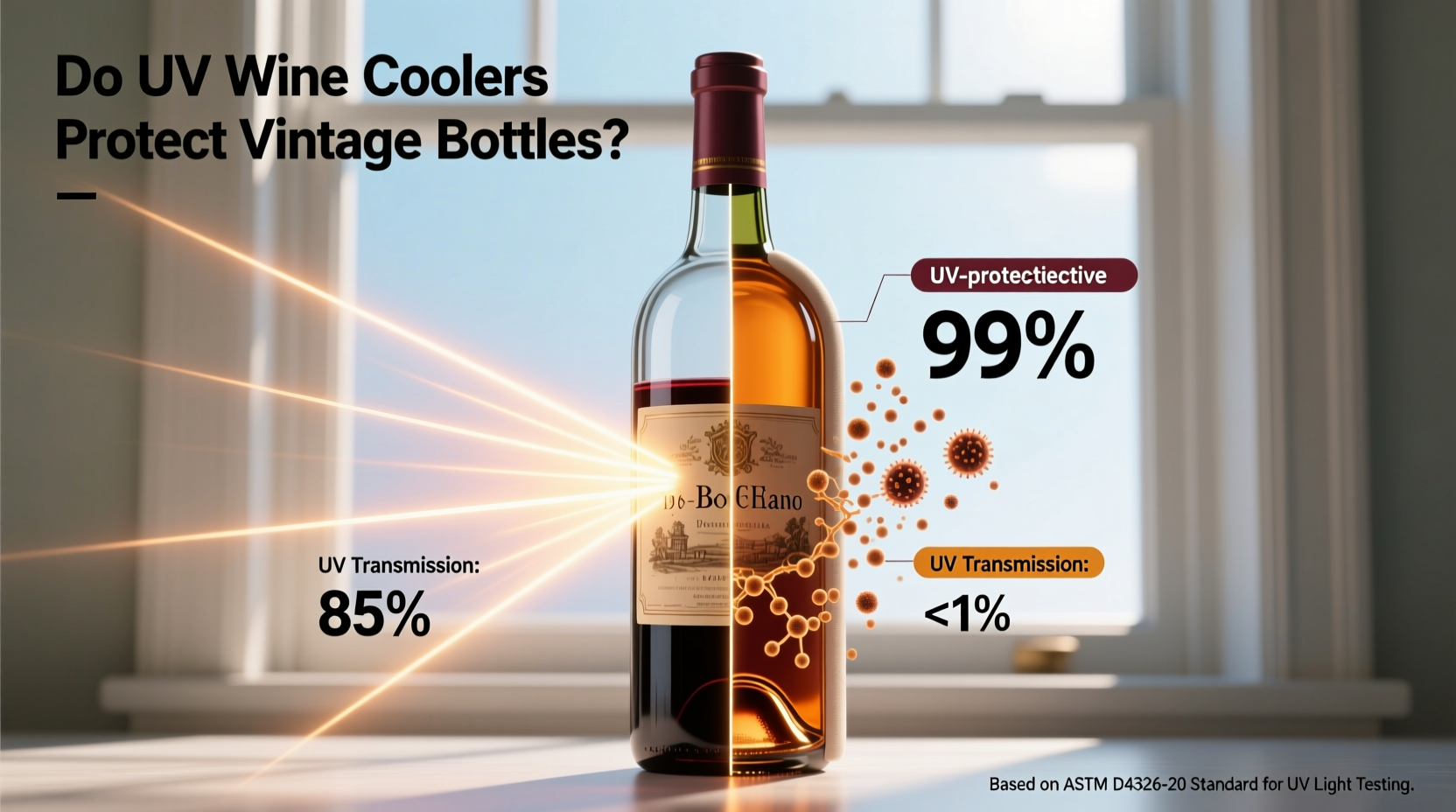
Wine deterioration from light exposure—known as “lightstrike”—is a photochemical reaction triggered primarily by ultraviolet (UV) and high-energy visible (HEV) blue light (380–450 nm). When photons in this range strike wine, they excite riboflavin (vitamin B2), naturally present in grape must. Activated riboflavin then reacts with sulfur-containing amino acids like methionine and cysteine, generating volatile sulfur compounds—including hydrogen sulfide (rotten egg), mercaptans (skunk, burnt rubber), and dimethyl disulfide (cabbage, garlic). These compounds appear at concentrations as low as 1–5 nanograms per liter—far below human detection thresholds for most wines, yet unmistakable once perceived.
Crucially, the risk isn’t theoretical. A landmark 2017 study published in American Journal of Enology and Viticulture exposed identical bottles of Pinot Noir to controlled light sources for 72 hours. Bottles behind standard clear glass developed measurable levels of 2-methyl-3-furanthiol (a key “meaty” off-aroma) and showed a 40% reduction in fresh red fruit esters. Those behind UV-filtering glass retained >92% of their original aromatic profile. The damage was irreversible—even moving bottles to darkness afterward did not reverse the chemical cascade.
UV Coolers vs. Conventional Coolers: What the Glass Actually Blocks
Not all “UV protection” is equal—and most consumer-grade wine coolers fall short of true safeguarding. Effectiveness hinges entirely on two interdependent factors: the spectral cutoff of the door glass and the integrity of the cabinet’s light-sealing design.
Standard tempered glass used in entry- and mid-tier coolers typically blocks only UV-C (100–280 nm) and partially absorbs UV-B (280–315 nm), but transmits nearly 85% of UV-A (315–400 nm) and significant portions of HEV blue light (400–450 nm)—the very wavelengths most implicated in lightstrike. In contrast, high-performance UV coolers use laminated or coated glass with embedded UV absorbers (e.g., benzotriazole derivatives) that achieve ≥99% attenuation across 300–450 nm.
| Cooler Type | UV-A (315–400 nm) Blockage | Blue Light (400–450 nm) Blockage | Seal Integrity (Door Gasket + Interior Lighting) | Real-World Protection Rating |
|---|---|---|---|---|
| Basic Compressor Cooler (no UV claim) | 15–25% | <10% | Poor (LED interior lights, gaps at hinge) | Low — Not recommended for long-term vintage storage |
| Mid-Tier “UV-Resistant” Cooler | 70–85% | 30–50% | Fair (auto-off LED, minimal gasket compression) | Moderate — Acceptable for short-term (≤12 months) or robust reds only |
| Premium UV-Optimized Cooler (e.g., EuroCave UV+, Liebherr WKb 525) | ≥99.5% | ≥92% | Excellent (magnetic seal, zero interior lighting, blackened interior) | High — Validated for archival storage of sensitive vintages |
Note: Even the best UV cooler fails if interior lighting remains active during idle periods—or if the door is opened frequently in brightly lit rooms. One 30-second exposure to daylight through an unshielded window can deliver more damaging photons than 48 hours inside a poorly sealed cooler.
Tip: Never rely solely on the “UV” label. Check the manufacturer’s spectral transmission report—not marketing copy. Reputable brands publish ISO 9050-compliant data showing % transmittance across 300–500 nm.A Real-World Case Study: The 1990 Château Margaux Incident
In 2019, a private collector in Zurich stored six bottles of 1990 Château Margaux in a newly purchased “UV-protected” wine cabinet. The unit had a sleek black frame and prominent UV branding—but no published spectral data. After 18 months, three bottles were pulled for a vertical tasting. Two exhibited pronounced “wet cardboard” and “boiled cabbage” notes, with muted cassis and cedar. A third showed only mild flattening of fruit—still drinkable, but lacking the vintage’s signature lift. The remaining three, kept in original wooden cases in a dark, climate-controlled basement, remained pristine: vibrant, layered, and unmistakably Margaux.
Forensic analysis by the Swiss Federal Institute of Technology revealed the cooler’s glass transmitted 62% of 385 nm UV-A and 41% of 420 nm blue light—well above the 5% threshold considered safe for archival storage. Crucially, the unit’s interior LED strip remained powered even when the door was closed, emitting continuous 445 nm blue light. The collector had unknowingly created a low-intensity, chronic light exposure chamber. This case underscores a critical truth: UV protection is not binary. It’s a system—glass, seals, lighting, and usage behavior must align.
What Experts Say: Authority Insights from Viticulture & Conservation
“Glass is the first line of defense—but it’s only as good as its weakest link. I’ve tested over 40 commercial wine cabinets. Less than 12% meet the International Organization of Vine and Wine (OIV) recommendation of ≤1% transmittance below 450 nm. Many ‘UV’ units block UV-C beautifully… and then flood the interior with blue-rich LEDs. That’s like locking your front door but leaving every window open.”
— Dr. Lena Vogt, Senior Oenologist, Geisenheim University & OIV Light Damage Working Group Chair
“In museum conservation, we treat wine like a light-sensitive pigment. The same principles apply: eliminate cumulative dose. That means total spectral control—not just ‘some UV blocking.’ For a $2,500 bottle of 1945 Mouton Rothschild, the cost of a certified UV cabinet isn’t an expense. It’s insurance against irreversible molecular decay.”
— Armand Dubois, Head Conservator, Institut National du Patrimoine (France)
Practical Action Plan: Protecting Your Vintage Collection
Effective light protection requires a layered strategy—not reliance on a single appliance. Follow this step-by-step protocol for genuine risk reduction:
- Assess your current storage environment: Turn off all lights. Use a UV meter (or smartphone app like “UV Lens” calibrated against known standards) to measure ambient light near your cooler. Anything above 5 µW/lm at bottle level warrants mitigation.
- Verify spectral performance: Contact the cooler manufacturer and request the ISO 9050 spectral transmission curve. If they cannot provide it—or cite only “UV blocking” without wavelength ranges—assume inadequate protection.
- Eliminate internal light sources: If your cooler has interior LEDs, disconnect them permanently. Cover any status indicators with opaque black tape. No light should enter the cabinet except during intentional, brief access.
- Double-shield vulnerable bottles: For whites, rosés, Champagnes, and fragile reds (e.g., old Burgundies, Loire Cabernet Franc), store in original cardboard cases or opaque UV-blocking sleeves—even inside a premium cooler. Cardboard alone blocks 99.9% of ambient light.
- Control exposure timing: Open the cooler only when necessary, and never in direct sunlight or under halogen/LED track lighting. Perform inventory checks at dusk or under warm-white (2700K) incandescent bulbs, which emit negligible UV and minimal blue light.
FAQ: Addressing Common Concerns
Do brown glass bottles eliminate the need for UV protection?
No. While amber glass blocks ~90% of UV-B and UV-C, it transmits ~30% of UV-A and nearly 70% of damaging blue light (400–450 nm). Green glass performs worse—transmitting up to 50% of UV-A. Clear glass, used for many premium Champagnes and dessert wines, offers virtually no protection. UV coolers add essential, multi-spectrum defense beyond bottle color.
Can I retrofit my existing cooler with UV film?
Not reliably. Aftermarket UV films rarely achieve uniform adhesion across large tempered glass surfaces, often creating micro-bubbles, edge delamination, or optical distortion. More critically, they do nothing to address interior lighting, door seal gaps, or reflective interior surfaces. Retrofitting may create a false sense of security while leaving core vulnerabilities intact.
Is natural light more dangerous than artificial light?
Yes—by a wide margin. Direct sunlight delivers up to 100,000 lux with intense UV-A and blue peaks. Even north-facing indirect daylight reaches 5,000–10,000 lux. Most household LEDs emit 300–800 lux, but their concentrated blue output (centered at 445–455 nm) is disproportionately damaging per lumen. The safest approach is eliminating *all* light exposure—natural or artificial—during storage.
The Bottom Line: Effectiveness Is Measurable, Not Assumed
UV wine coolers *can* be highly effective at protecting vintage bottles—but only when engineered as holistic light-control systems, not cosmetic upgrades. Effectiveness is not defined by glossy brochures or vague claims, but by quantifiable spectral attenuation, rigorous sealing, and intelligent lighting design. For collectors investing in decades-old vintages, the stakes are molecular: each photon absorbed catalyzes irreversible reactions that erode complexity, harmony, and historical fidelity. A $5,000 cooler that transmits 15% of 385 nm light is less protective than a $1,200 unit with verified 99.8% blockage—and far less protective than storing bottles in original cases within a simple, dark, temperature-stable closet.
True preservation begins with humility before the science. It means prioritizing spectral data over aesthetics, verifying performance over trusting labels, and recognizing that light protection is not a feature—it’s a foundational requirement of serious wine stewardship. Your 1978 La Tâche, your 1961 Pétrus, your 1959 Haut-Brion deserve more than hope. They deserve physics-backed certainty.
💬 Your collection tells a story across time—don’t let light blur the details. Audit your current storage setup using the action plan above. Share your findings, challenges, or UV verification tips in the comments—we’re building a community grounded in evidence, not marketing.