Autumn is the season of return—of roots, rust, and resonance. When the air turns crisp and the light slants gold, our palates instinctively seek depth: tannic apple skins, caramelized pear flesh, woodsmoke, and the quiet authority of aged fruit spirits. Two orchard-born brandies stand at the heart of this shift—American applejack and French calvados—but they speak different dialects of the same language. One whispers of colonial barns and Appalachian ridges; the other echoes centuries of Norman orchards and cellar-humid chalk caves. Neither is “better.” But one consistently feels more grounded—not just in geography, but in texture, intention, and tactile presence in a glass. That distinction isn’t poetic license. It’s measurable in distillation method, aging environment, varietal composition, and the very way each spirit interacts with bitters, vermouth, and cold-pressed cider in a stirred or shaken drink.
Terroir as Texture: How Origin Shapes Mouthfeel
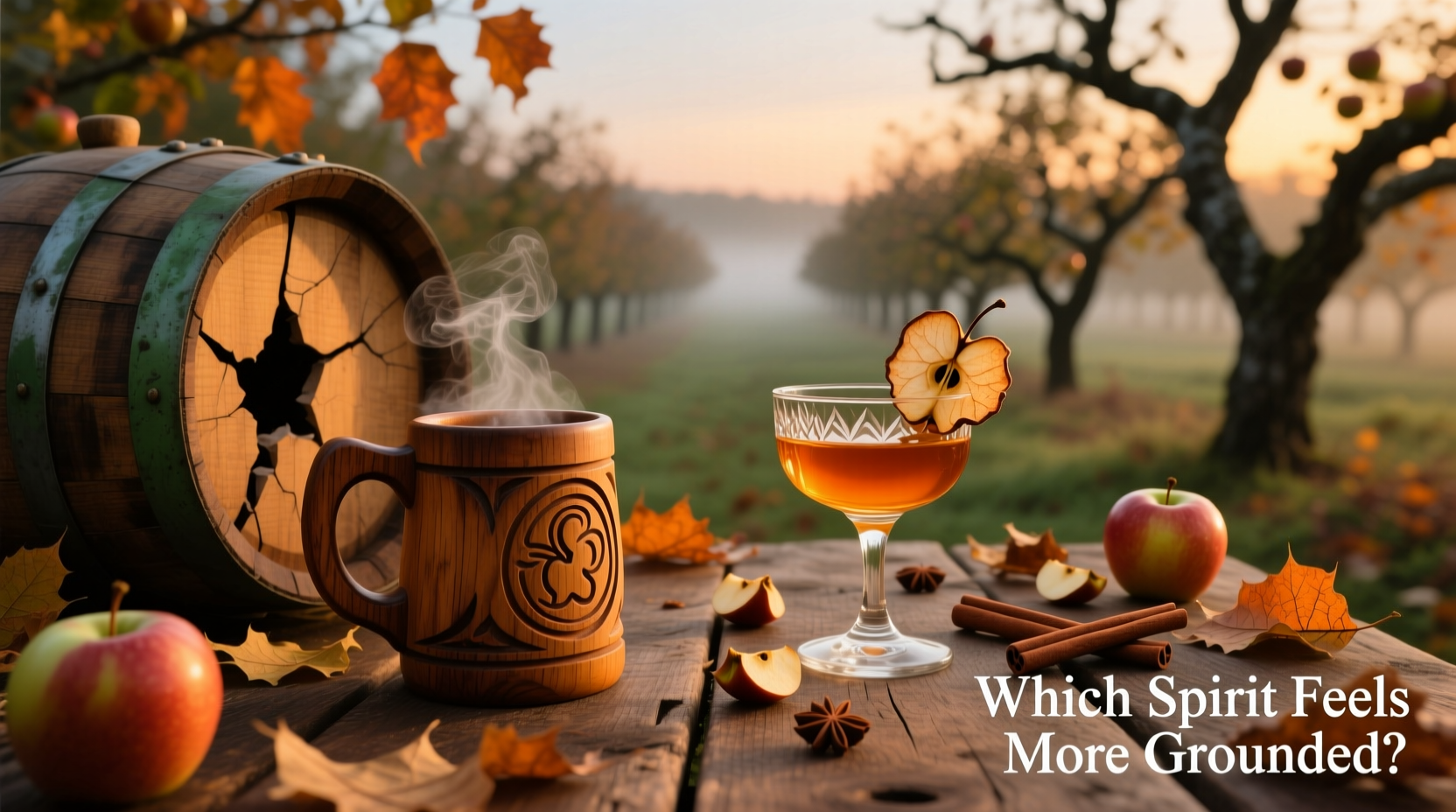
Groundedness begins underground—in soil, slope, and microclimate. Calvados is legally bound to Normandy, where clay-limestone soils, maritime fog, and a long, cool growing season produce apples with pronounced acidity, tannin, and aromatic complexity. The region mandates use of up to 30+ traditional cider apple varieties—bittersharps like ‘Binet Rouge’ and ‘Judeline’, and bittersweets like ‘Mettais’ and ‘Saint-Martin’. These aren’t dessert apples. They’re high-tannin, low-sugar fruits grown specifically for fermentation and distillation—not sweetness, but structure.
Applejack, by contrast, has no protected designation. Its historical heartland was New Jersey’s orchard belt—fertile, loamy, and warmer—but today it’s made across the U.S., often from eating or juice apples (‘Golden Delicious’, ‘Granny Smith’) or even concentrate. While craft producers like Laird’s (the oldest licensed distillery in America, founded 1780) and Catoctin Creek now source heirloom varieties and ferment whole-fruit cider on-site, the regulatory baseline remains loose. The result? A broader spectrum of expression—but less consistent anchoring in place-specific phenolics.
This divergence manifests directly in the glass. Calvados—especially AOC-calibrated expressions like Domaine Dupont’s VSOP or Christian Drouin’s Réserve—delivers a viscous, almost waxy mouthfeel. You feel the tannins coat the gums, the orchard floor funk (damp hay, wet stone, overripe quince), and a slow, savory finish that lingers like fallen leaves underfoot. Applejack tends toward brighter, leaner acidity and sharper ethanol lift—energetic, yes, but rarely heavy with the weight of its land.
Tip: For maximum groundedness in an autumn cocktail, choose calvados aged at least 4 years (VSOP or older). The extra time in humid, cool cellars softens harsh edges and deepens earthy, forest-floor notes.The Still and the Season: Distillation & Aging Realities
How a spirit is made determines how it settles into a drink. Calvados must be double-distilled in copper pot stills (for AOC Pays d’Auge) or single-distilled in column stills (for AOC Calvados)—but crucially, both methods begin with *cider*, not neutral apple wine. That raw, unfiltered, often wild-fermented cider carries yeast lees, pectin, and volatile esters that survive distillation, lending calvados its signature rusticity.
Traditional applejack began as “Jersey lightning”—a freeze-distilled cider where winter cold crystallized water, concentrating alcohol and flavor in the remaining liquid. Though modern applejack is almost exclusively pot-distilled, that legacy of concentration lives on: higher proof, less dilution, and a leaner profile. Most American applejacks are aged in new American oak, imparting bold vanilla, coconut, and char—flavors that read as assertive rather than integrated. Calvados, however, matures in used French oak (often ex-Cognac or ex-wine casks), in cellars where humidity hovers near 90%. This slows evaporation, encourages gentle oxidation, and fosters complex ester development—vanillin emerges subtly, alongside dried fig, walnut oil, and beeswax.
| Characteristic | Calvados (AOC Pays d’Auge) | Traditional Applejack (Craft) |
|---|---|---|
| Base Ferment | Wild-fermented, multi-varietal cider (no added sugar) | Often cultured-yeast fermented apple wine or juice |
| Distillation | Mandatory double pot-still; retains congeners & texture | Typically single pot-still; higher ABV cut points |
| Aging Vessel | Used French oak (Cognac/wine casks); humid cellars | New American oak; drier, warmer warehouses |
| Key Sensory Anchor | Tannic grip, orchard funk, oxidative depth | Bright acidity, toasted oak, linear fruit |
| Groundedness Factor | High: layered, slow-evolving, physically present | Moderate: lively, clean, but less textural weight |
Autumn Cocktails: Where Groundedness Becomes Functional
Groundedness isn’t abstract—it’s functional utility in mixing. In a stirred cocktail like a Norman Old Fashioned (calvados, maple syrup, black walnut bitters, orange twist), calvados’ tannins bind with the syrup’s viscosity and the bitters’ astringency, creating a cohesive, mouth-coating body that stands up to dilution without flattening. Its lower volatility (typically 40–45% ABV) allows subtler botanicals—like gentian or wormwood—to register clearly.
Applejack shines in brighter, more agile formats: the Applejack Sour (applejack, lemon, egg white, cinnamon syrup) or the Green Dragon (applejack, green chartreuse, lime, absinthe rinse). Its higher proof and cleaner profile cut through richness, but it lacks the structural heft to carry heavy modifiers like PX sherry or spiced rum without tipping into cloying or disjointed territory.
A real-world example illustrates this: At Bar Bête in Portland, Oregon, head bartender Lena Cho developed a fall menu centered on “orchard gravity.” Her Fall Lineage cocktail—a blend of 12-year Calvados, house-made quince shrub, blackstrap molasses syrup, and smoked black tea tincture—was praised for its “unshakeable center,” its ability to taste simultaneously ancient and immediate. When she substituted a 5-year applejack for testing, guests described it as “lovely, but floating.” The applejack’s brightness remained, but the molasses turned cloying, the tea tincture vanished, and the drink lost its gravitational core. The fix wasn’t more bitters or less syrup—it was returning to calvados. Groundedness here wasn’t aesthetic. It was the physical property enabling balance.
Expert Insight: The Weight of Time and Place
“Calvados doesn’t just taste of apples—it tastes of the damp earth beneath them, the mist that slows ripening, and the centuries of knowledge encoded in how we prune, ferment, and age. That’s why it feels grounded: it carries its landscape in its density, its tannins, its silence between sips. Applejack is brilliant, inventive, and deeply American—but it answers different questions. It asks, ‘What can we make?’ Calvados asks, ‘What does this land insist on saying?’”
— Olivier Groult, Master Blender, Domaine Dupont, Pays d’Auge
Groult’s distinction cuts to the heart of the matter. Groundedness arises not from age alone, but from *intentional constraint*: the AOC’s strict varietal rules, the mandatory double distillation, the humid aging environment—all designed to preserve and amplify terroir, not obscure it. Applejack’s freedom is its strength, but also its limitation when seeking profound rootedness.
Your Autumn Cocktail Toolkit: A Practical Guide
Choosing between applejack and calvados isn’t binary—it’s contextual. Use this step-by-step guide to match spirit to intention:
- Assess the modifier weight: If using rich elements (molasses, maple, PX sherry, roasted nuts, smoked tea), reach for calvados (VSOP or older). Its tannins and oxidative depth will integrate them.
- Evaluate acidity needs: For bright, citrus-forward drinks (sours, highballs), applejack offers cleaner, crisper lift—especially if you want the apple character to stay front-and-center without funk.
- Consider dilution method: Stirred, spirit-forward drinks benefit from calvados’ viscosity. Shaken, frothy, or carbonated drinks often favor applejack’s agility.
- Check your bitters: Earthy, root-based bitters (black walnut, gentian, celery) harmonize with calvados’ savory notes. Citrus or spice bitters (orange, cardamom, clove) pair elegantly with applejack’s brighter fruit.
- Taste the base: Before building, sip your spirit neat. Does it leave a lingering, textured impression on the tongue (calvados)? Or a clean, quick burst (applejack)? Let that sensation guide your build.
FAQ: Clarifying the Orchard Divide
Is applejack just “American calvados”?
No. While both are apple brandies, calvados is defined by appellation law, specific apple varieties, mandatory double distillation (in Pays d’Auge), and aging in used French oak. Applejack has no legal definition beyond being apple-derived and distilled—making it a category, not a terroir expression. Calling it “American calvados” overlooks centuries of divergent philosophy and practice.
Can I substitute one for the other in a recipe?
You can—but expect structural shifts. Substituting calvados for applejack in a sour may yield a heavier, more complex, slightly drier drink. Substituting applejack for calvados in a stirred old-fashioned may taste thin or unbalanced, lacking mid-palate weight. Adjust sweeteners downward by 10–15% when using calvados; consider adding a drop of gum syrup or orgeat for body when using applejack in rich builds.
Why does calvados cost more?
Three reasons: First, AOC compliance demands labor-intensive orchard management and traditional cider-making. Second, aging in humid cellars incurs higher “angel’s share” loss (up to 3% annually vs. 2% in drier climates), increasing scarcity. Third, limited global production—just 10 million liters annually versus over 100 million for Cognac—creates tighter supply.
Conclusion: Choose Your Ground
Groundedness in autumn cocktails isn’t about nostalgia or hierarchy—it’s about resonance. It’s the difference between a drink that sits comfortably in your hand and one that demands attention through volatility. Calvados, rooted in Norman soil, shaped by humid cellars and centuries of stewardship, delivers that rare combination: intensity without aggression, complexity without confusion, depth without heaviness. It doesn’t shout. It settles—in the glass, on the palate, in the memory.
That doesn’t diminish applejack. Its clarity, energy, and American ingenuity make it indispensable for vibrant, seasonal twists. But when you crave a cocktail that feels like walking a mist-laden orchard at dawn—where every note feels inevitable, earned, and inseparable from its origin—calvados is the spirit that answers. It doesn’t just taste of autumn. It tastes of the ground that grows it.
💬 Try it this week: Stir 2 oz calvados (VSOP or older), ¼ oz pure maple syrup, 2 dashes black walnut bitters, and 1 dash Angostura for 30 seconds with ice. Strain into a chilled coupe. Express an orange twist over the surface and discard. Notice how the weight holds the aroma, how the finish lingers like cool earth. Then tell us—did it feel grounded?👇 Share your tasting notes or favorite orchard cocktail in the comments.