At first glance, “apple cider vinegar” and “alcoholic cider” sound like siblings—same fruit, similar names, overlapping fermentation roots. But in practice, they occupy distinct biochemical, regulatory, and culinary universes. Confusion between them isn’t just semantic; it’s led to real-world missteps—from home fermentation attempts gone sour (literally) to unintentional alcohol exposure in children or those avoiding ethanol for health or religious reasons. This article cuts through the folklore with microbiology-backed clarity: what unites these two apple-derived products, where their paths diverge irreversibly, and why attempting to convert one into the other is neither practical nor safe without precise control, monitoring, and intent.
The Shared Origin: Fresh Apple Cider as the Common Ancestor
Both apple cider vinegar and alcoholic cider begin with the same raw material: freshly pressed, unfiltered apple juice—commonly called “sweet cider” in North America or “cloudy cider” in the UK. This juice contains natural sugars (fructose, glucose, sucrose), organic acids (malic acid dominates), trace minerals, and wild yeasts and bacteria clinging to apple skins. When left unpasteurized and unrefrigerated, this juice begins spontaneous microbial activity—setting the stage for two possible, competing fermentation pathways.
The divergence hinges on two sequential biological stages:
- Alcoholic fermentation: Yeasts (primarily Saccharomyces cerevisiae, but also Malolactobacillus and wild Candida strains) convert sugars into ethanol and carbon dioxide. This produces hard cider—typically 4–8% ABV, tart, effervescent, and stable for weeks when chilled and sealed.
- Acetic fermentation: If ethanol is present *and* oxygen is available, acetic acid bacteria (AAB)—most notably Acetobacter aceti and Gluconobacter oxydans—oxidize ethanol into acetic acid. This transforms hard cider into vinegar—sharp, pungent, and self-preserving at ≥4% acetic acid concentration.
Crucially, acetic fermentation *requires* ethanol as its substrate. You cannot make true apple cider vinegar from sweet cider alone—without first producing alcohol. That foundational dependency links the two products, but it does not make them interchangeable.
Key Differences: Composition, Regulation, and Intended Use
A side-by-side comparison reveals how profoundly different these products are—not just in taste or application, but in legal definition, safety profile, and microbial ecology.
| Characteristic | Alcoholic Cider (Hard Cider) | Apple Cider Vinegar (ACV) |
|---|---|---|
| Primary Active Compound | Ethanol (C₂H₅OH) | Acetic acid (CH₃COOH) |
| Typical Concentration | 4–8% alcohol by volume (ABV) | 5–6% acetic acid (by volume); often diluted to 4–5% in retail bottles |
| pH Level | 3.2–3.8 (acidic, but buffered by malic acid) | 2.4–2.8 (highly acidic due to acetic acid) |
| Regulatory Classification | Alcoholic beverage — subject to TTB (US), HMRC (UK), or equivalent excise controls | Fermented food product — regulated as vinegar under FDA 21 CFR §169.145 or EU Regulation (EC) No 1333/2008 |
| Microbial Stability | Requires refrigeration, sulfites, or pasteurization to prevent further fermentation or spoilage | Self-preserving at proper acidity; stable for years unrefrigerated |
| Common Uses | Consumed as a beverage; ingredient in cocktails, reductions, and marinades (for flavor, not preservation) | Culinary acidulant, preservative, cleaning agent, dietary supplement (with caveats); never consumed undiluted |
This table underscores a critical point: while both are fermented, their functional identities are defined by *what remains after fermentation*, not what began it. Alcoholic cider is valued for its ethanol content and sensory complexity; ACV is valued for its acetic acid—and the antimicrobial, pH-lowering properties that come with it.
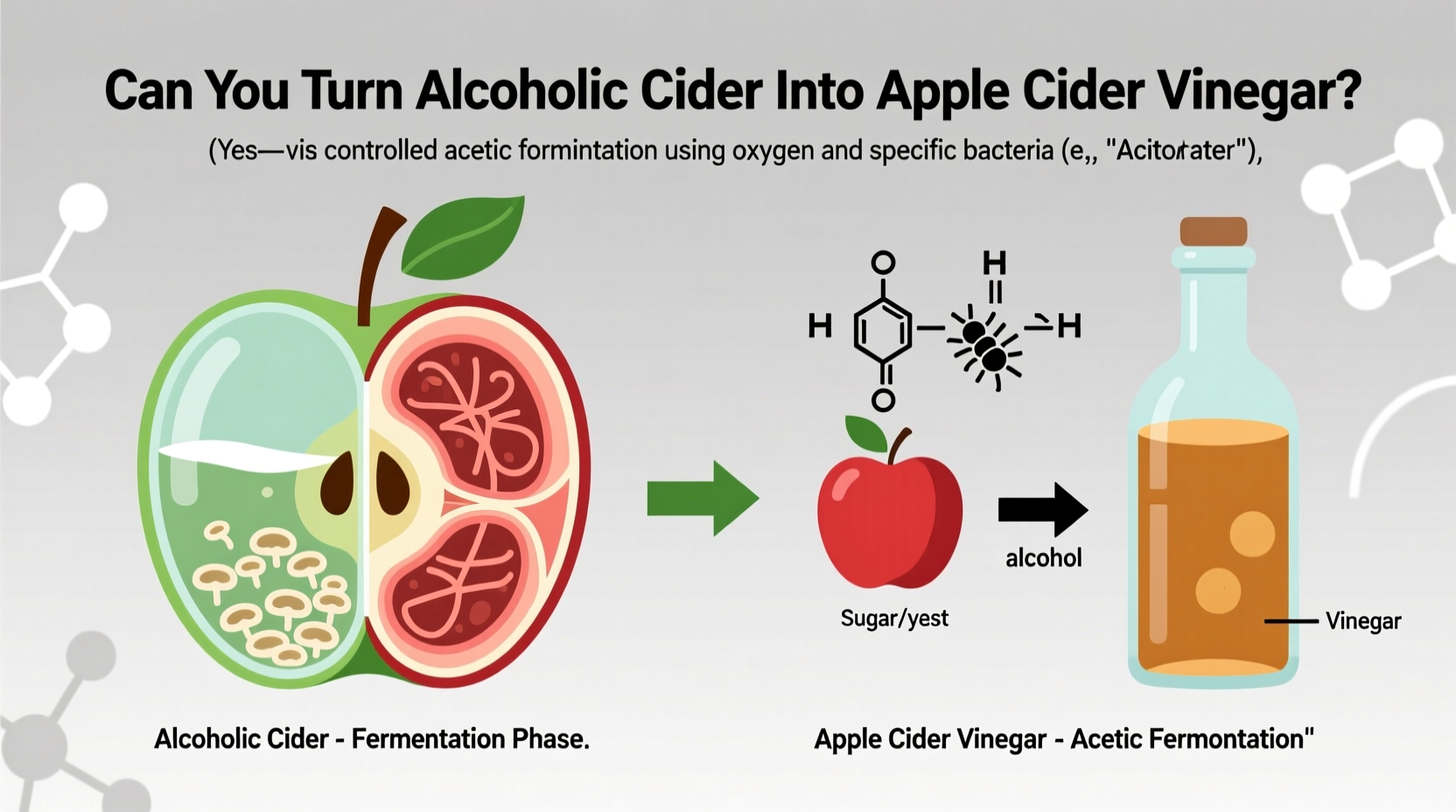
Can You Ferment Alcoholic Cider Into Apple Cider Vinegar? Yes—But Not Casually
Technically, yes: hard cider *is* the ideal starting material for making apple cider vinegar. In fact, commercial ACV producers almost always begin with fermented apple wine or hard cider—not fresh juice—because it provides the necessary ethanol substrate for acetic acid bacteria.
However, “yes” comes with stringent conditions:
- Oxygen must be abundant. Acetic fermentation is aerobic. Sealed carboys, airlocks, or tightly capped bottles will halt the process—or worse, encourage unwanted anaerobic bacteria (e.g., Clostridium) that produce off-flavors or toxins.
- Temperature must be controlled. Optimal AAB activity occurs between 25–30°C (77–86°F). Below 20°C, fermentation slows dramatically; above 35°C, AAB die off.
- No preservatives may be present. Sulfites (common in commercial ciders to stabilize flavor and prevent oxidation) inhibit AAB. Pasteurized cider lacks viable microbes altogether.
- Time and patience are non-negotiable. Conversion takes 3–8 weeks under ideal conditions—and requires periodic tasting and pH testing to confirm acetic acid development and rule out contamination (e.g., mold, slime, or foul odors).
Can You Ferment Apple Cider Vinegar Into Alcoholic Cider? No—And Here’s Why It’s Biologically Impossible
This is where confusion most dangerously crystallizes. Some assume that diluting ACV with water and adding yeast will “reverse” fermentation—recreating alcohol. It won’t. And attempting it risks harmful outcomes.
Acetic acid bacteria do not merely *produce* acetic acid—they actively *maintain* an environment hostile to yeast. The low pH (≤2.8), high acidity, and residual bacterial metabolites suppress yeast viability and fermentation efficiency. Even robust wine yeasts struggle to initiate alcoholic fermentation below pH 3.0. More critically: once ethanol is fully oxidized to acetic acid, the reaction is *not reversible* under normal fermentation conditions. Yeast cannot “reduce” acetic acid back into ethanol without specialized enzymes (e.g., alcohol dehydrogenase operating in reverse), extreme redox conditions, and laboratory-grade bioreactors—not kitchen jars.
What *can* happen instead is far less desirable:
- Yeast stress and autolysis: Struggling yeast cells rupture, releasing bitter compounds and off-flavors.
- Secondary contamination: Low-acid, nutrient-rich environments invite Lactobacillus, Pediococcus, or enteric bacteria—producing lactic acid, diacetyl (buttery off-note), or biogenic amines.
- No meaningful ethanol production: Any measurable alcohol would be negligible (<0.5% ABV) and unstable—quickly re-oxidized by ambient AAB.
“The idea of ‘reversing’ vinegar into alcohol reflects a fundamental misunderstanding of redox biochemistry. Fermentation is a cascade of irreversible, energy-yielding steps. Acetic acid sits at a thermodynamic ‘valley’—yeast lack the machinery to climb back out.” — Dr. Lena Torres, Microbiologist & Fermentation Science Lead, UC Davis Department of Food Science and Technology
Mini Case Study: The Home Brewer’s Misstep
In late 2022, a Portland-based home fermenter named Marcus attempted to “rescue” a batch of over-fermented hard cider he’d left uncovered for five weeks. It had developed sharp acidity and a faint vinegary tang—so he assumed it was “almost there.” He added champagne yeast, honey, and extra apple juice, sealed it in a carboy with an airlock, and waited 10 days. The result wasn’t sparkling cider—it was a cloudy, viscous liquid with a rancid, acetone-like aroma and visible white film. Testing revealed pH 2.5, no detectable ethanol (<0.2% ABV), and high levels of ethyl acetate (a solvent-like ester formed by stressed yeast). He discarded it—then consulted a local extension agent, who confirmed: the acidity had permanently inhibited yeast metabolism. What he’d created wasn’t cider or vinegar—it was an unstable, unbalanced microbial slurry unfit for consumption.
Step-by-Step: How to Safely Make Apple Cider Vinegar from Scratch (Not from ACV)
If your goal is authentic, raw, unpasteurized apple cider vinegar—not a shortcut using store-bought ACV—follow this evidence-based sequence:
- Source fresh, unpasteurized apple cider. Avoid preservatives (sulfites, potassium sorbate) and heat treatment. Local orchards or farmers’ markets are best.
- Initiate alcoholic fermentation. Pour cider into a clean glass or food-grade HDPE container (leave 20% headspace). Cover with cheesecloth. Store at 18–22°C (64–72°F) for 1–3 weeks until bubbling ceases and sweetness disappears (test with hydrometer: SG <1.000).
- Switch to aerobic conditions. Remove cheesecloth. Replace with a clean coffee filter + rubber band. Stir gently twice daily to oxygenate.
- Maintain temperature and monitor. Keep between 25–30°C. After 10 days, begin tasting weekly. At 3–4 weeks, test pH: target ≤3.0 and titratable acidity ≥4.5%. A mother (cellulose pellicle) may form—this is normal and beneficial.
- Strain and bottle. Once acidity stabilizes (no change over 3 days), strain through a fine-mesh sieve or cheesecloth. Bottle in sterilized glass. Store cool and dark. Refrigeration halts further activity but isn’t required for safety.
☐ Verified unpasteurized, unsulfited cider
☐ Clean, non-reactive container (glass or HDPE only)
☐ Thermometer and pH test strips (calibrated)
☐ Coffee filters + rubber bands (no metal contact)
☐ Patience—minimum 3 weeks, ideally 6 for depth
FAQ
Is “apple cider vinegar” just diluted alcoholic cider?
No. Diluting hard cider with water lowers alcohol content but does not create acetic acid or vinegar functionality. True ACV contains ≥4% acetic acid—a compound absent in alcoholic cider. Diluted cider remains an alcoholic beverage, not a vinegar.
Can I use apple cider vinegar in place of hard cider in recipes?
Rarely—and only when acidity is the goal, not alcohol or body. Substituting ACV for hard cider in a braise or reduction will add sharpness but eliminate depth, mouthfeel, and subtle esters. For non-alcoholic substitutions, use unsweetened apple juice + a splash of lemon juice—not vinegar.
Why do some ACV labels say “contains the mother” while others don’t?
The “mother” is a biofilm of cellulose and acetic acid bacteria. It appears only in raw, unfiltered, unpasteurized ACV. Pasteurized or filtered ACV removes it for clarity and shelf stability—but also eliminates live cultures. Neither version is unsafe; the choice depends on preference for probiotic potential versus consistency.
Conclusion
Apple cider vinegar and alcoholic cider are kin—but not twins. They share DNA in the form of pressed apples and microbial heritage, yet express entirely different traits shaped by oxygen, time, and human intention. One celebrates ethanol’s warmth and complexity; the other harnesses acetic acid’s preserving power and metabolic influence. Understanding that distinction isn’t academic—it’s essential for safe home fermentation, informed label reading, and responsible culinary substitution. Don’t treat them as interconvertible ingredients. Respect their unique roles. Ferment with purpose, not assumption. And when in doubt, reach for the pH strip before the airlock.
💬 Have you successfully made ACV from scratch—or learned a lesson the hard way? Share your experience, questions, or fermentation tips in the comments. Real stories help others navigate the science—and the surprises—of working with living food.