For over a century, absinthe has been less a spirit than a symbol — of rebellion, creativity, decadence, and danger. Its emerald hue, ritualistic preparation, and association with Van Gogh, Verlaine, and the Montmartre bohème cemented its status as the original “Green Fairy.” Yet today, when you order a “green anise drink” in a Paris bistro or a craft cocktail bar in Portland, what arrives is far more likely to be pastis — smooth, approachable, and legally unburdened by history’s moral panic. The question isn’t just botanical or regulatory; it’s cultural: Does the Green Fairy still matter? Not as a relic, but as a living reference point for how we understand authenticity, regulation, and the soul of a spirit.
The Botanical Divide: What Makes Each Spirit Tick
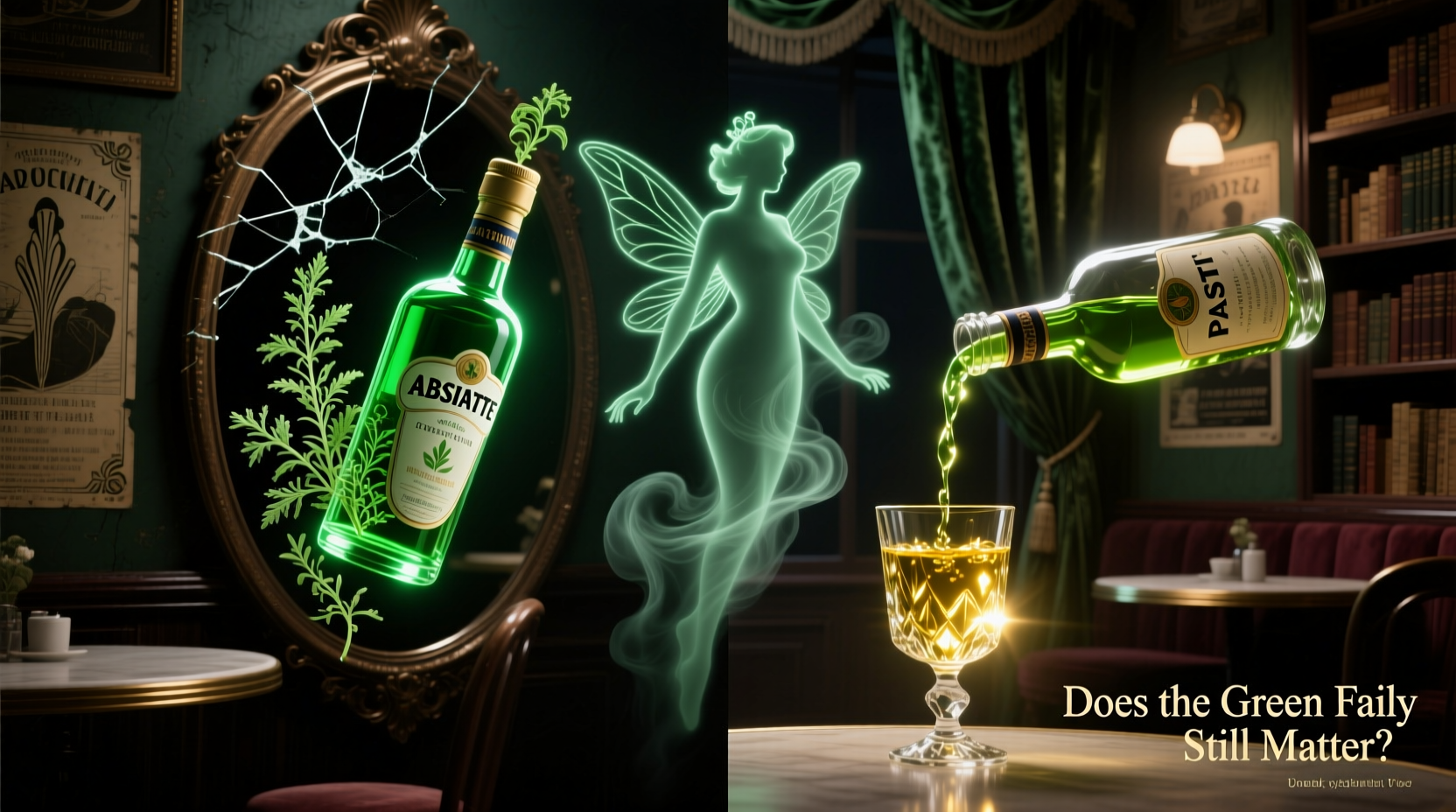
Absinthe and pastis both belong to the family of anise-flavored spirits known as *anisés*, but their composition, production philosophy, and regulatory DNA are fundamentally distinct. At the core lies one herb: grand wormwood (*Artemisia absinthium*). Its presence — and concentration — defines absinthe’s legal and sensory identity.
Absinthe must contain wormwood, fennel, and green anise — the “holy trinity” — and crucially, it must be distilled, not merely macerated. Traditional Swiss and French absinthes are double-distilled: first to extract alcohol and volatile oils, then again with fresh herbs to infuse color and complexity. The result is a high-proof (45–74% ABV), unsweetened, deeply aromatic spirit with pronounced bitterness, herbal depth, and a signature louche effect — the milky opalescence that appears when cold water is added, caused by essential oils precipitating out of solution.
Pastis, by contrast, emerged in 1915 — the year after France banned absinthe — as a legal workaround. It contains little to no wormwood (often none at all), relies heavily on star anise (which delivers sweeter, more licorice-forward notes), and is almost always sweetened with sugar or syrup. It’s typically made by macerating herbs in neutral alcohol, then filtering and diluting. At 40–45% ABV, pastis is lower in strength, rounder in mouthfeel, and designed for immediate, easy drinking — stirred into cold water without ceremony.
Tip: To tell them apart visually, skip the louche test — check the label. If it says “absinthe,” it must legally contain wormwood and be distilled. If it says “pastis,” it’s almost certainly sweetened, low-wormwood (or wormwood-free), and macerated.A Century of Suppression — And What It Cost
The 1915 French ban wasn’t about chemistry. It was a confluence of moral panic, wine industry lobbying, and wartime xenophobia. Absinthe — associated with Swiss immigrants, artists, and the urban poor — became a scapegoat for societal ills. A single glass was blamed for hallucinations, madness, and even murder. Modern toxicology has thoroughly debunked the “absinthism” myth: thujone (the compound in wormwood once thought neurotoxic) occurs in such minute quantities in properly distilled absinthe that you’d need to consume liters in rapid succession to approach any pharmacological effect — far before ethanol would incapacitate you.
What the ban did destroy was continuity. Generations of distillers, recipes, and regional expressions vanished. Vineyards planted to wormwood were ripped up. The knowledge of balancing bitter Artemisia with delicate fennel seed and floral anise oil — a skill honed over centuries in Val-de-Travers — went dormant. Pastis filled the void, but it did so by simplifying: removing bitterness, adding sugar, and standardizing flavor. Pernod Ricard’s Ricard (launched 1932) didn’t mimic absinthe — it replaced it with something safer, sweeter, and more commercially scalable.
“Absinthe wasn’t outlawed because it was dangerous. It was outlawed because it was inconvenient — inconvenient to the wine lobby, inconvenient to temperance movements, inconvenient to a state seeking cultural control. Its revival is less about nostalgia than about reclaiming a lost grammar of flavor.” — Dr. Marie Lefebvre, Historian of European Spirits, University of Neuchâtel
Modern Absinthe: Authenticity Reclaimed, Not Reconstructed
Since the EU lifted its thujone restrictions in 1988 (and France followed in 2011), absinthe has re-emerged — not as a carnival novelty, but as a serious category of artisanal distillation. Today’s leading producers — from Switzerland’s La Clandestine and France’s Duplais to the U.S.’s St. George and Spain’s Matacán — treat wormwood not as a gimmick, but as a terroir expression. They source *Artemisia absinthium* from specific microclimates, harvest at precise phenological stages, and calibrate distillation cuts to highlight camphoraceous lift or earthy depth.
This isn’t “vintage-style” replication. It’s evolution informed by archival research and sensory rigor. For example, Duplais’ Verte Suisse uses 12 botanicals and a 36-hour maceration before double distillation — yielding a spirit with pronounced mint and tarragon top notes, a clean anise mid-palate, and a lingering, dry, almost saline finish. It louche beautifully, holds structure with water, and rewards slow sipping — unlike pastis, which tends to flatten and cloy when diluted.
Pastis, meanwhile, has matured too — but along a different axis. Brands like Casanis and Henri Bardouin now use small-batch maceration, organic star anise, and subtle additions like citrus peel or licorice root. Yet they remain anchored in accessibility: bottled ready-to-drink, sweetened, and formulated for instant refreshment. Their role hasn’t changed — they’re the aperitif of the Mediterranean lunch, the companion to olives and baguette, not the muse for late-night poetry.
Practical Comparison: When to Choose Which — And Why It Matters
Choosing between absinthe and pastis isn’t about superiority — it’s about intention. The table below outlines key decision points grounded in real-world use, not romanticism.
| Factor | Absinthe | Pastis |
|---|---|---|
| Primary Use | Ritual aperitif (with water & sugar cube); base for classic cocktails (Sazerac, Death in the Afternoon) | Everyday aperitif (mixed 5:1 with cold water); casual spritzers |
| Sweetness | Unsweetened (dry) | Sweetened (10–30g/L residual sugar) |
| Alcohol Strength | 45–74% ABV (typically 55–68%) | 40–45% ABV |
| Key Sensory Trait | Bitter backbone, layered herbal complexity, drying finish | Sweet-anise forward, soft texture, quick finish |
| Serving Ritual | Requires slotted spoon, sugar cube, slow water drip (1:3–1:5 ratio) | Pour 30ml, add 150ml cold water — stir and serve |
Real-World Context: A Parisian Barkeep’s Perspective
At Le Très Petit Faubourg — a tucked-away bar in the 10th arrondissement known for its rigorous spirit list — owner Julien Moreau doesn’t stock both absinthe and pastis to offer variety. He stocks them to tell a story. “When a tourist orders ‘absinthe,’ I ask: Do you want the experience, or the idea?” he explains. “If they say ‘I saw it in a movie,’ I pour a pastis — Ricard, chilled, with water. It’s honest, refreshing, and introduces them to the category without pretense. But if someone asks why absinthe louche turns cloudy, or what thujone actually is, I open the bottle of La Clandestine. We do the full ritual — spoon, sugar, slow drip — and talk about how the bitterness cleanses the palate before dinner, how the herbs echo the Provençal garrigue.”
Last summer, Julien hosted a tasting comparing three expressions: a classic pastis (Ricard), a modern French absinthe (La Fée Verte), and a Swiss vintage-style absinthe (La Clandestine). Of the 24 attendees, 18 preferred the pastis for immediate drinkability. But 100% said the absinthe tasting changed how they understood flavor balance — “It’s not about being strong,” one designer remarked, “but about how bitterness can make sweetness more vivid, and how water isn’t dilution — it’s revelation.” That’s the Green Fairy’s quiet persistence: not in hallucination, but in attention.
Your First Steps Into the Category — A Practical Checklist
- Start with pastis if you’re new to anise spirits — try Ricard or Casanis chilled, mixed 1:5 with cold water. Note how the sweetness softens the anise and invites food pairing.
- Choose your first absinthe wisely — avoid cheap “boilermaker” brands. Opt for EU-certified labels (look for “absinthe” on front label, ABV >50%, and country of origin like Switzerland or France).
- Invest in the basics — a proper absinthe spoon (slotted metal), a sugar cube, and a carafe of ice-cold water. Skip the fountain unless you’re committed — a kettle with a fine spout works.
- Master the ratio — begin at 1 part absinthe to 3 parts water. Adjust to taste: some prefer 1:4 for more intensity, others 1:5 for gentler louche and softer bitterness.
- Pair intentionally — absinthe shines before rich meals (charcuterie, aged cheese, grilled meats); pastis sings alongside seafood, salads, or light appetizers.
FAQ
Is absinthe legal in the United States?
Yes — since 2007, when the U.S. TTB revised regulations to allow thujone levels up to 10 ppm (parts per million), well above the trace amounts found in traditional absinthe. All commercially available absinthe in the U.S. meets this standard and is fully legal for sale and consumption.
Does pastis contain wormwood?
Legally, no — and practically, almost never. French pastis regulations prohibit wormwood as a primary ingredient. Some artisanal versions may include a negligible amount for complexity, but it’s not perceptible and plays no functional role in flavor or effect.
Why does absinthe turn cloudy with water, but pastis doesn’t?
Absinthe’s louche occurs because its essential oils (anethole from anise, fenchone from fennel, thujone derivatives from wormwood) are soluble in high-proof alcohol but not in water. When diluted, they emulsify into tiny droplets, scattering light. Pastis contains far fewer of these hydrophobic oils — and often includes solubilizers like glycerol — so it remains clear or only slightly hazy.
Conclusion: The Green Fairy Endures — As a Question, Not a Answer
The Green Fairy never vanished. She simply retreated — from the bars into the archives, from the bottles into the debates, from the headlines into the quiet moments when someone pauses to watch anise oil bloom in cold water. Her relevance today isn’t measured in milligrams of thujone or liters sold, but in how she compels us to ask better questions: What do we mean by “authentic”? How much history should a bottle carry? When does regulation protect consumers — and when does it erase culture?
Absinthe matters because it refuses to be reduced to a party trick. Pastis matters because it proves that pleasure needn’t be complicated to be profound. Neither is obsolete. One is the scholar who cites sources; the other is the storyteller who knows when to pause for laughter. Both belong on the shelf — and on the table — not as rivals, but as complementary chapters in the same enduring story of human ingenuity, botanical curiosity, and the simple, radical act of savoring flavor with intention.
💬 Have you had a defining absinthe or pastis moment — a ritual, a discovery, a conversation sparked by the green glass? Share your story in the comments. Let’s keep the Green Fairy alive — not in myth, but in memory, taste, and dialogue.