There’s nothing more frustrating than unpacking your holiday lights only to find that a single dead bulb has plunged the entire strand into darkness. You check each bulb, replace one after another, and still—nothing. This common issue stems from how these strings are wired, but the behavior differs significantly between traditional incandescent and modern LED light sets. Understanding the electrical logic behind this phenomenon isn’t just fascinating—it can save you time, money, and seasonal stress.
The answer lies in circuit design: series versus parallel wiring, voltage distribution, and failure tolerance. While both types of bulbs can suffer from a single point of failure, their underlying technology determines whether one bad bulb truly dooms the rest. Let’s break down exactly why this happens—and what you can do about it.
How Light Strings Are Wired: Series vs. Parallel Circuits
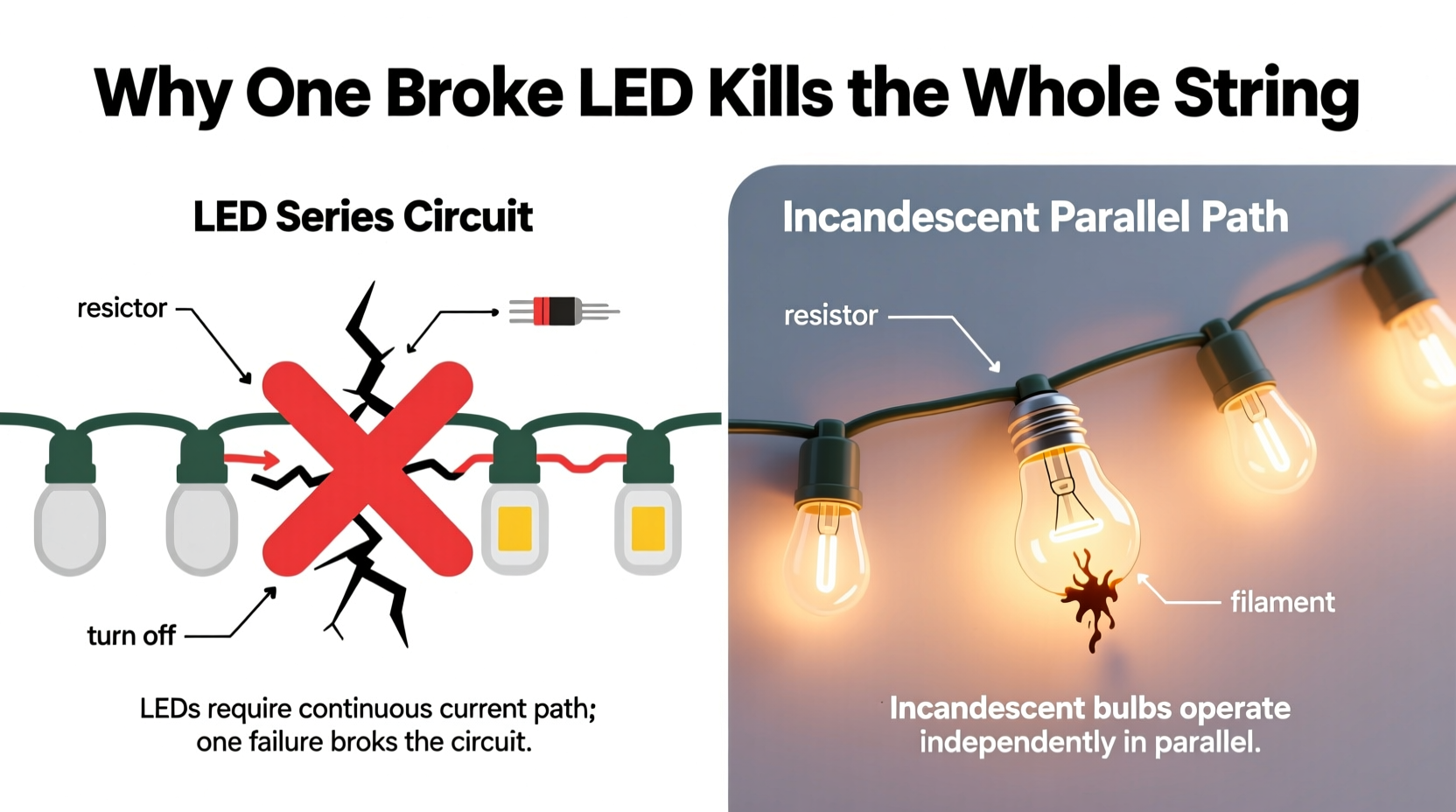
The fate of a light string hinges on its circuit configuration. Most inexpensive holiday light strands use a series circuit, where electricity flows through each bulb in sequence before returning to the power source. In this setup, every bulb acts like a link in a chain. If one breaks, the circuit is interrupted—just as cutting a chain at any point renders it useless.
In contrast, a parallel circuit allows current to flow through multiple independent paths. Each bulb connects directly to the main power line. If one fails, the others continue shining because the current bypasses the broken component entirely.
Unfortunately, cost and manufacturing constraints mean most consumer-grade light strings—especially older incandescent models—favor series wiring for simplicity and lower material costs. However, even many LED strings still use series configurations despite their energy efficiency.
Tip: Look for light strings labeled “shunt-protected” or “parallel-wired”—they’re less likely to fail completely due to a single bulb.Incandescent Strings: The Classic Single-Point Failure
Traditional incandescent mini-lights almost always operate in series. A typical 50-bulb strand runs on 120 volts, with each bulb receiving about 2.4 volts (120 ÷ 50). This low per-bulb voltage keeps them safe and cool while allowing mass production at low cost.
But here's the catch: when one filament burns out, it creates an open circuit. No current can pass beyond that point, so the entire string goes dark—even if the other 49 bulbs are perfectly functional.
Some incandescent strings include a clever workaround: shunted sockets. These have built-in bypass wires that activate when a bulb fails. When the filament breaks, the shunt—a small conductive coating inside the socket—melts or arcs over the gap, restoring continuity. Not all incandescent sets have this feature, though, especially older or budget models.
“Over 70% of incandescent Christmas light failures I see in repair clinics stem from a single open filament in a series circuit.” — Carlos Mendez, Holiday Lighting Technician with 15 years of experience
LED Strings: Smarter Design, But Still Vulnerable
LEDs (light-emitting diodes) are inherently more durable than incandescent bulbs. They consume less power, generate minimal heat, and last tens of thousands of hours. Yet, surprisingly, many LED light strings still go dark when one bulb fails.
Why? Because they often use series wiring too. While LEDs require far less voltage (typically 2–3 volts each), manufacturers group them in series to match household voltage without complex transformers. For example, a string of 35 LEDs might be wired in series, each getting ~3.4 volts from a 120V supply.
However, unlike incandescent filaments, LEDs don’t always fail by “opening” the circuit. Sometimes they short-circuit instead, which actually allows current to keep flowing. In such cases, the rest of the string may stay lit—albeit slightly brighter, since the same voltage now powers fewer active LEDs.
But not all LED failures are graceful. Physical damage, poor solder joints, or water intrusion can create true open circuits. And if the string lacks redundancy or protective shunts, the result is total blackout.
Do Modern LED Strings Solve This Problem?
Yes—but selectively. Higher-end LED strings increasingly use hybrid designs:
- Fully parallel wiring: Each LED connects independently to the power rails. One failure doesn’t affect others. More expensive due to increased copper and insulation needs.
- Series-parallel arrays: Groups of 3–5 LEDs wired in series, then those groups connected in parallel. This balances efficiency, cost, and fault tolerance.
- Integrated controllers: Some smart LED strings include microcontrollers that detect dead segments and reroute power or signal warnings via apps.
Still, the majority of affordable LED holiday lights sold today rely on simple series circuits. Don’t assume LED means foolproof.
Comparing Failure Modes: Incandescent vs. LED
| Feature | Incandescent Strings | LED Strings |
|---|---|---|
| Typical Circuit Type | Series | Series (common), Series-Parallel (premium) |
| Voltage Per Bulb | ~2–3V | ~2–3.5V |
| Failure Mode | Filament breaks → Open circuit → Whole string dark | May short (string stays lit) or open (string dark) |
| Built-in Bypass (Shunt) | Sometimes present in newer models | Rare; mostly in high-end versions |
| Lifespan | 1,000–2,000 hours | 25,000–50,000 hours |
| Energy Efficiency | Poor (most energy lost as heat) | Excellent (80–90% less power used) |
| Heat Output | High – fire risk near dry materials | Negligible – safer for indoor use |
| Troubleshooting Difficulty | High – requires bulb-by-bulb testing | Moderate – some models allow segment isolation |
How to Diagnose and Fix a Dead String
Whether dealing with incandescent or LED, a systematic approach saves time and prevents unnecessary replacements.
- Check the power source. Plug the string into a known-working outlet. Test with another device to rule out tripped GFCI or blown fuses.
- Inspect the fuse compartment. Many light strings have small fuses in the plug. Use a multimeter or visual inspection (look for discoloration) to test them.
- Look for visible damage. Check for cracked bulbs, loose sockets, frayed wires, or moisture exposure—especially in outdoor strings.
- Use a light tester. Commercially available tools like the \"LightKeeper Pro\" send pulses through the circuit to clear shunt gaps or identify breaks.
- Test individual bulbs. Remove suspect bulbs and test in a known-good socket. For incandescents, a multimeter on continuity mode works well.
- Segment isolation (for longer strings). If part of the string lights up, focus on the first unlit bulb—it’s likely the culprit.
Mini Case Study: The Haunted Porch Lights
Every December, Sarah decorates her porch with two long strands of 100-count incandescent lights. Last year, neither string lit up. She replaced the fuses—no change. After testing outlets and trying different combinations, she noticed one string flickered briefly when wiggled near the third bulb.
She removed the bulb and found the filament was broken, but the socket showed no signs of shunting. Using a spare bulb, she restored the circuit—and both strands lit up. The second string had failed for the same reason: a single broken filament without shunt activation.
Lesson learned: Even if a string looks intact, internal failures are invisible. A single weak link can break the whole chain.
Prevention Checklist: Maximize String Longevity
Follow this checklist to reduce the odds of total failure and extend the life of your light displays:
- ✅ Choose strings with shunted sockets or parallel wiring when possible
- ✅ Store lights coiled loosely around a cardboard reel—not wrapped tightly around sharp edges
- ✅ Keep strings dry during storage; use sealed bins with desiccant packs in humid climates
- ✅ Avoid yanking cords during installation—pull gently to prevent wire strain
- ✅ Inspect annually before use: look for corrosion, cracked insulation, or loose connections
- ✅ Use LED strings rated for outdoor use if exposed to weather
- ✅ Replace missing bulbs immediately to avoid overvoltage on remaining ones
FAQ: Common Questions About Light String Failures
Can a single LED really take down a whole string?
Yes—if it fails as an open circuit and the string is wired in series without redundancy. However, many LEDs fail by shorting internally, which allows the rest of the string to remain lit, sometimes even brighter than before.
Are there light strings that won’t die from one bad bulb?
Yes. Look for strings explicitly marketed as “parallel-wired,” “shunt-protected,” or “segmented.” Commercial-grade or smart LED strips often isolate faults automatically. Some brands, like GE’s “Minimum Maintenance” series, use advanced shunting to maintain continuity.
Why don’t all manufacturers build fault-tolerant strings?
Mainly due to cost. Parallel wiring uses more copper, increases complexity, and raises production expenses. For disposable-use holiday decor, many companies prioritize low upfront price over longevity. Premium options exist but come at a higher retail cost.
Expert Insight: The Future of Smart Lighting
As home automation grows, so does demand for intelligent lighting systems. Next-generation LED strings integrate diagnostics, self-healing circuits, and app-based monitoring.
“We’re moving toward lights that tell you which bulb failed—via Bluetooth or Wi-Fi alerts. Some already reroute current around dead nodes using embedded MOSFET switches.” — Dr. Lena Park, Electrical Engineer at SmartLume Labs
These innovations promise to eliminate the guesswork of troubleshooting. Until they become standard, however, consumers must understand the limitations of current technology.
Conclusion: Take Control of Your Light Strings
One broken bulb shouldn’t ruin your holiday display—but too often, it does. Whether you're using vintage incandescent strands or modern LED sets, the root cause usually traces back to series circuit design. Knowing how these systems work empowers you to choose better products, troubleshoot effectively, and store lights properly for lasting performance.
Don’t accept darkness as inevitable. Upgrade to shunt-protected or parallel-wired strings. Invest in diagnostic tools. Practice preventive maintenance. Small steps now can prevent frustration later.
🚀 Ready to upgrade your holiday lighting? Start by checking your current strings for shunted sockets or consider switching to modular LED strips. Share your favorite fix or brand recommendation in the comments below—help others light up smarter this season!