
If your kombucha smells sharply of vinegar—pungent, eye-watering, or reminiscent of pickling brine—before it’s even bottled, you’re not brewing failure. You’re witnessing a biochemical pivot: your culture has shifted from balanced fermentation toward acetic acid dominance. This isn’t inherently wrong, but it signals an imbalance in timing, temperature, or microbial ecology. Many home brewers misinterpret this as “spoiled” kombucha, when in fact, it’s a highly functional, acidic ferment—just one that may lack the nuanced sweetness, carbonation, and aromatic complexity expected from a well-executed second fermentation (F2). Understanding why this happens—and how to recalibrate F2 with intention—transforms vinegar-like batches from discard candidates into intentional learning opportunities.
The Science Behind the Vinegar Smell
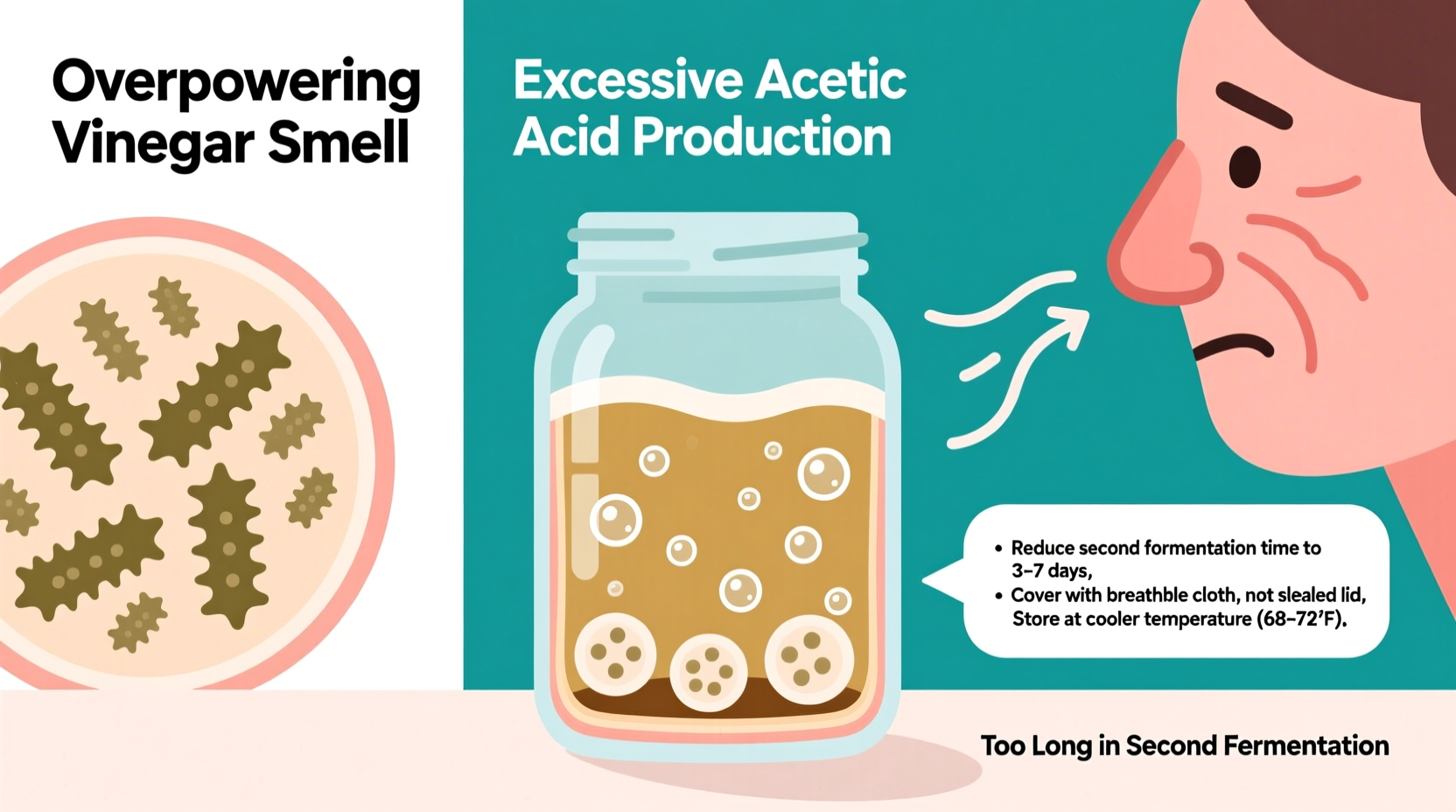
An overpowering vinegar aroma in kombucha arises primarily from excess acetic acid production by Acetobacter species—bacteria naturally present in SCOBYs and airborne environments. Unlike lactic acid bacteria (LAB) or yeast, which thrive in low-oxygen, mildly acidic conditions, Acetobacter are obligate aerobes: they require oxygen and convert ethanol into acetic acid most efficiently at warm temperatures (25–30°C / 77–86°F) and with prolonged exposure to air.
This becomes especially pronounced during second fermentation when bottles are sealed *after* primary fermentation is already extended. If your first fermentation (F1) ran too long—say, 12–14 days instead of the ideal 7–10—the base tea already contains elevated ethanol and reduced residual sugar. When you then add fruit or juice and seal the bottle, yeast activity drops off quickly due to rising CO₂ pressure and diminishing sugars—but Acetobacter, if present in the culture or introduced via non-sterile fruit/juice, continues converting remaining ethanol into acetic acid. The result? A sharp, volatile, almost solvent-like top note that masks delicate esters and overwhelms the palate.
It’s worth noting: true spoilage (e.g., mold, pink slime, foul rot) is rare in healthy kombucha. What many mistake for “bad” vinegar smell is actually robust, clean acetic fermentation—just unbalanced for drinking pleasure.
Why Second Fermentation Is the Critical Control Point
Second fermentation is where flavor, carbonation, and acidity harmony are decided—not during F1. While F1 establishes the foundational pH (ideally 2.8–3.4) and microbial profile, F2 is your precision tuning phase. It’s here that small variables exert outsized influence:
- Bottle seal integrity: A loose lid allows oxygen ingress, fueling Acetobacter.
- Fruit sugar type and quantity: High-fructose fruits (mango, pineapple, grapes) ferment faster and can spike ethanol before CO₂ builds, giving Acetobacter a brief window to act.
- Temperature consistency: Fluctuations above 28°C accelerate acetic pathways while suppressing yeast CO₂ production.
- Timing precision: F2 isn’t “set and forget.” Carbonation peaks between 24–72 hours for most batches; beyond 96 hours, acidity often climbs disproportionately.
Think of F2 not as passive waiting, but as active microbial choreography—where you direct the balance between yeast (CO₂ + subtle esters), LAB (lactic tang, mouthfeel), and Acetobacter (sharpness, preservation).
Tip: Always refrigerate bottles immediately after reaching peak carbonation—even if fermentation time hasn’t “expired.” Cold halts all microbial activity within hours, locking in balance.Step-by-Step: Adjusting Second Fermentation for Balanced Acidity and Flavor
Follow this precise, evidence-based protocol to prevent vinegar dominance and encourage rounded, effervescent kombucha:
- Verify F1 completion first: Use pH strips or a calibrated meter. Target pH: 3.0–3.3. If below 2.9, F1 ran too long—reduce next batch by 12–24 hours. Never begin F2 with pH < 2.8 unless intentionally making vinegar.
- Choose low-fermentability fruit: Prefer berries (strawberry, blueberry, blackberry), citrus zest, ginger, or herbs over high-sugar tropical fruits. For every 500 mL bottle, use ≤15 g fresh fruit or ≤10 mL 100% juice (no preservatives).
- Sanitize—not sterilize—fruit prep: Rinse fruit in vinegar-water (1:3 ratio), not bleach or alcohol. Avoid peeling unless necessary; beneficial microbes reside on skins.
- Fill bottles to 90% capacity: Leave 50–60 mL headspace. Too much space = more oxygen = more acetic acid. Too little = risk of over-pressurization.
- Ferment at stable 22–24°C (72–75°F): Use a wine fridge, basement corner, or insulated cooler with a thermometer. Avoid countertops near stoves or windows.
- Test daily after 24 hours: Open one test bottle gently (point away, towel over cap). Assess: Is it pleasantly fizzy? Does aroma show fruit/yeast notes (banana, pear, clove) alongside mild tartness? If it smells aggressively vinegary *before* carbonation builds, refrigerate all bottles immediately.
- Chill and decant: Once carbonated, refrigerate for ≥24 hours before opening. Cold improves mouthfeel and suppresses volatile acetic notes.
Do’s and Don’ts of Second Fermentation
| Action | Do | Don’t |
|---|---|---|
| Fruit Selection | Use organic, ripe-but-firm berries or grated ginger root | Use canned fruit in syrup, pasteurized juice with sulfites, or overripe bananas |
| Bottle Type | Glass swing-top bottles (e.g., Grolsch-style) with intact rubber gaskets | Plastic bottles (permeable to O₂), mason jars with metal lids (rust risk), or reused soda bottles with degraded seals |
| Timing | Start F2 within 2 hours of bottling; track time from sealing | Let bottled kombucha sit at room temp for >5 days without tasting |
| Temperature | Maintain 22–24°C day and night; use a min/max thermometer | Place bottles on top of refrigerator or near heating vents |
| Troubleshooting | If vinegar smell emerges early, chill immediately and use as salad vinegar or shrub base | Try “rescuing” by adding more sugar or fruit—it will worsen imbalance |
Real Example: How Maya Fixed Her Over-Acidic Blueberry Batch
Maya, a kombucha brewer in Portland, consistently produced batches with a harsh, nail-polish-remover edge—especially her popular blueberry F2. She assumed her SCOBY was “too strong,” so she diluted starter tea and shortened F1 to 6 days. The problem worsened: lower pH meant more free hydrogen ions, accelerating acetic acid formation during F2. After testing her ambient temperature, she discovered her kitchen hovered at 27.5°C during summer afternoons. She moved bottles to a north-facing closet (23.2°C average) and switched from whole blueberries to freeze-dried blueberry powder (lower water activity, less ethanol substrate). Most crucially, she began opening one test bottle every 18 hours starting at hour 24. At 42 hours, carbonation was lively and aroma showed bright berry and light brioche—no vinegar punch. She chilled immediately. Within three batches, her blueberry kombucha earned compliments for its “crisp, sparkling balance.” Her key insight? “The vinegar wasn’t the SCOBY’s fault—it was my timing and environment overriding its natural harmony.”
Expert Insight: What Microbiologists Observe in Home Ferments
“Overpowering acetic notes in home kombucha almost never stem from contamination. They reflect predictable metabolic responses to oxygen exposure and thermal stress. When we sequence home-brewed SCOBYs, Acetobacter orientalis and A. syzygii dominate only in samples fermented above 26°C with >3% headspace. Control those two levers, and balance follows—not because you suppress bacteria, but because you favor yeast and LAB kinetics.”
— Dr. Lena Torres, Senior Fermentation Microbiologist, Oregon State University Fermentation Science Lab
FAQ: Addressing Common Concerns
Can I fix a batch that already smells like vinegar?
Yes—but not by continuing fermentation. Refrigerate immediately to halt acid production. Use it as a culinary ingredient: replace apple cider vinegar in dressings (dilute 1:1 with olive oil), add 1 tsp to marinades, or mix with honey and water for a gut-friendly shrub. Its high acidity makes it exceptionally shelf-stable and functionally valuable—even if not ideal for sipping.
Does using a different SCOBY help prevent vinegar dominance?
Not significantly. All healthy SCOBYs contain Acetobacter. Strain differences matter less than process control. A “milder” SCOBY is usually just one adapted to cooler temps or shorter F1 times—not genetically distinct. Focus on environmental levers (temp, time, oxygen) before swapping cultures.
Why does my ginger F2 smell vinegary while my lemon-ginger doesn’t?
Ginger contains natural compounds (gingerols, shogaols) that can inhibit yeast slightly more than citrus acids do—slowing CO₂ production while allowing Acetobacter to act on available ethanol. Lemon juice’s citric acid also chelates trace metals that Acetobacter needs, subtly dampening its activity. Try grating ginger finely and adding lemon zest (not just juice) to restore balance.
Conclusion: Brew With Intention, Not Instinct
An overpowering vinegar smell isn’t a verdict—it’s feedback. It tells you precisely where your process diverges from the narrow corridor where yeast, bacteria, sugar, and oxygen coexist in delicious equilibrium. Second fermentation isn’t magic; it’s microbiology made accessible. Every variable you control—temperature stability, fruit choice, headspace, and, most critically, timing—is a dial you can turn toward complexity instead of sharpness. Stop treating F2 as a waiting game. Start treating it as a responsive dialogue with your culture. Measure pH, track ambient temperature, taste test deliberately, and trust data over tradition. Your next batch won’t just be less vinegary—it’ll be brighter, fizzier, and layered with aromas you’ve never tasted before. That transformation begins not with a new SCOBY, but with your next refrigerated bottle and the quiet confidence that balance is always within reach.
💬 Have you tamed a vinegar-heavy batch into something brilliant? Share your adjustment strategy—temperature tweak, fruit swap, or timing hack—in the comments. Your real-world fix could be the exact insight another brewer needs.








