It seems counterintuitive: you step into an air-conditioned room to escape the muggy heat, only to find your hair suddenly puffing up with frizz. If you’ve ever wondered why your strands misbehave indoors when the outdoor humidity is the supposed enemy, you’re not alone. The truth lies in a complex interplay between environmental moisture, hair structure, and indoor climate control. Air conditioning doesn’t just cool the air—it dramatically alters its moisture content and electrical properties, often creating conditions that are worse for curly, wavy, or chemically treated hair than humid summer days.
To understand this paradox, we need to look beyond surface-level assumptions about humidity and explore how dry, cooled air affects the keratin fibers that make up your hair. This article breaks down the science behind indoor frizz, examines the role of static electricity, and offers practical strategies to maintain smooth, healthy-looking hair—no matter the thermostat setting.
The Science of Hair and Humidity
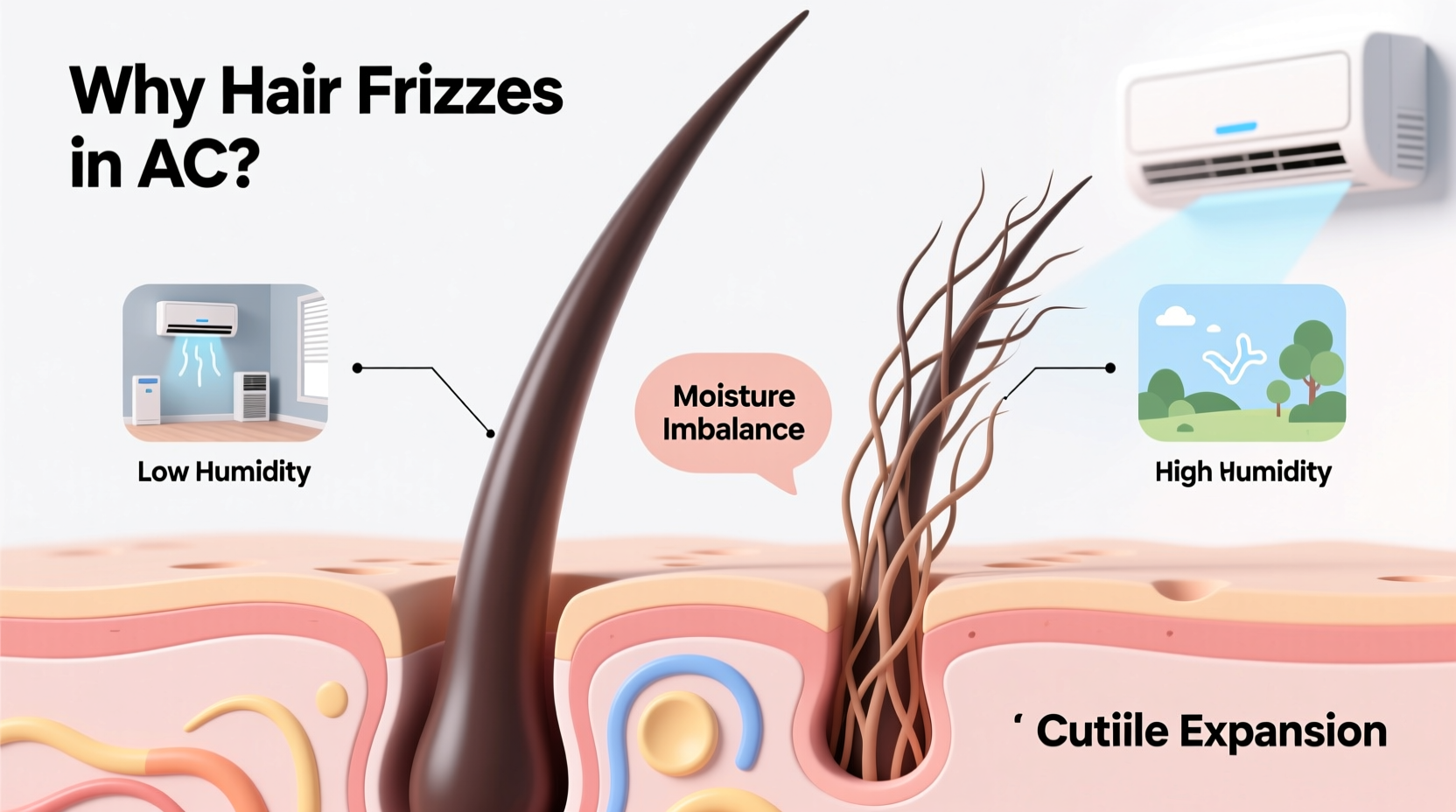
Hair is hygroscopic, meaning it absorbs and releases moisture from the surrounding environment. Each strand is made primarily of keratin, a protein that contains amino acids with hydrophilic (water-attracting) side chains. When humidity rises, these proteins attract water molecules from the air, causing the hair shaft to swell. This swelling disrupts the cuticle layer—the outermost protective coating—and leads to uneven texture, lift, and ultimately, frizz.
However, the opposite extreme—very low humidity—also causes problems. In dry environments, such as those created by air conditioning, hair loses moisture rapidly. As water evaporates from the cortex (the inner layer), the cuticle can become brittle and lift, exposing rough edges. This not only increases tangling but also sets the stage for another major culprit: static electricity.
“Low humidity doesn’t eliminate frizz—it just changes its cause. Dry air strips moisture and generates static, which repels individual strands and creates volume where you don’t want it.” — Dr. Lena Patel, Trichologist and Hair Research Scientist
How Air Conditioning Alters Indoor Air Quality
Air conditioners work by cooling warm air and removing excess moisture through condensation. While this process reduces relative humidity, it also creates a microclimate that’s significantly drier than natural outdoor conditions—even in tropical regions. Most AC systems lower indoor humidity levels to between 30% and 40%, sometimes even below 25%. For reference, optimal indoor humidity for human comfort and hair health ranges from 40% to 60%.
Beyond moisture reduction, air conditioning introduces additional stressors:
- Cooling-induced dehydration: Cold air holds less moisture, accelerating evaporation from hair surfaces.
- Recirculated air: HVAC systems often recirculate stale air, reducing fresh airflow and increasing airborne particles that can settle on hair.
- Temperature gradients: Rapid shifts between hot outdoors and cold indoors cause hair to expand and contract, weakening structural integrity over time.
Static Electricity: The Hidden Frizz Trigger Indoors
One of the most overlooked causes of indoor frizz is static buildup. In dry environments, electrons transfer easily between materials. When your hair rubs against synthetic fabrics (like polyester chair backs, wool hats, or nylon pillowcases), it gains a positive charge. Since like charges repel, each positively charged strand pushes away from its neighbors, resulting in flyaways and volume that defies styling products.
This phenomenon is especially common in office buildings, cars, and airplanes—all spaces heavily reliant on air conditioning. Synthetic flooring, plastic furniture, and low humidity create a perfect storm for electrostatic disruption. Curly and fine hair types are particularly susceptible due to their higher surface-area-to-mass ratio.
Interestingly, moderate humidity acts as a natural conductor, dissipating static charges before they accumulate. But when indoor RH (relative humidity) falls below 40%, there aren't enough water molecules in the air to neutralize these charges—leaving your hair standing on end, literally.
Do’s and Don’ts: Managing Hair in Air-Conditioned Environments
| Do’s | Don’ts |
|---|---|
| Use leave-in conditioners with humectants like glycerin (in moderation) | Overuse alcohol-based gels or sprays that dry out hair |
| Apply anti-static serums or facial mists lightly to dampen flyaways | Brush dry hair aggressively—this increases friction and static |
| Wear silk or satin scarves/scarves when sitting near AC vents | Leave hair exposed to direct cold airflow for extended periods |
| Hydrate internally—drink plenty of water to support hair moisture balance | Rely solely on heavy oils that may weigh hair down without addressing static |
| Use a humidifier in frequently occupied rooms | Ignore signs of brittleness or split ends—they worsen in dry climates |
Step-by-Step Guide to Preventing AC-Induced Frizz
Maintaining smooth hair in air-conditioned spaces requires proactive care. Follow this daily and weekly routine to minimize damage and keep frizz under control:
- Morning Prep – Seal in Moisture
After washing, apply a hydrating leave-in conditioner while hair is still damp. Focus on mid-lengths and ends. Follow with a lightweight oil or anti-frizz serum to lock in hydration. - Midday Refresh – Combat Static Buildup
Carry a travel-sized water-based mist (aloe vera or rosewater). Lightly spritz hands and gently smooth over flyaways. Avoid soaking hair, which can trigger new frizz if not dried properly. - Workstation Adjustment – Reduce Exposure
Position yourself away from direct AC airflow. If unavoidable, use a breathable scarf or hat made of natural fibers to shield hair. - Night Routine – Protect Against Dryness
Sleep on a silk pillowcase to reduce friction. Consider loosely braiding hair to prevent tangling and moisture loss overnight. - Weekly Maintenance – Deep Hydration
Use a deep conditioning mask once a week. Look for ingredients like shea butter, ceramides, and panthenol. Apply under a warm towel for enhanced penetration.
Real-Life Example: Sarah’s Office Struggles
Sarah, a graphic designer based in Mumbai, noticed her naturally wavy hair became unmanageable every afternoon despite looking flawless in the morning. She lived in a high-humidity city but worked in a tightly sealed, air-conditioned office building. Her hair would start frizzing around 2 PM, forming a halo of flyaways that resisted hairspray.
After consulting a trichologist, she learned her issue wasn’t humidity—but the drastic contrast between outdoor moisture and indoor dryness. The constant expansion and contraction of her hair fibers weakened the cuticle, making it prone to lifting. Additionally, her wool-blend office chair generated static when she leaned back.
She implemented several changes: switching to a silk-lined cap for her commute, using a glycerin-free moisturizer (since glycerin attracts moisture outdoors but pulls it out in dry air), and placing a small desktop humidifier near her workstation. Within two weeks, her midday frizz decreased by over 70%, and her hair felt stronger and shinier.
“Understanding the difference between ambient humidity and indoor climate control was a game-changer. I stopped blaming the weather and started fixing my environment.” — Sarah Mehta, Mumbai-based creative professional
Choosing the Right Products for Dry, Cooled Spaces
Not all anti-frizz products work equally well in air-conditioned environments. Many contain humectants designed for humid climates, which can backfire indoors by drawing moisture *out* of the hair when the air is too dry.
Look for formulas labeled “humidity-resistant” or “for dry climates.” Key ingredients include:
- Dimethicone or cyclomethicone: Silicones that coat the hair shaft, preventing moisture loss and reducing friction.
- Proteins (hydrolyzed keratin, wheat protein): Strengthen the hair structure and help retain internal moisture.
- Occlusive agents (jojoba oil, squalane): Form a protective barrier without greasiness.
- Anti-static polymers: Found in some smoothing sprays, these neutralize electrical charge buildup.
Avoid products with high concentrations of drying alcohols (e.g., ethanol, SD alcohol 40) unless used sparingly in styling aids. These evaporate quickly and can exacerbate dryness in already dehydrated environments.
Frequently Asked Questions
Can drinking more water really reduce indoor frizz?
Yes. While topical treatments address surface issues, internal hydration supports the scalp’s sebum production and maintains the hair’s natural moisture equilibrium. Dehydrated bodies produce drier sebum, which compromises the hair’s protective lipid layer—especially in dry, cooled environments.
Is it better to wear hair up or down in air-conditioned rooms?
It depends on exposure. If you're near a direct AC vent, wearing hair up in a loose bun or braid minimizes contact with cold, dry air. However, tight elastics increase tension and breakage. If your hair is down, use a light serum to prevent static from rubbing against clothing or chairs.
Why does my hair frizz more in the office than at home, even though both have AC?
Office HVAC systems typically run longer and cool larger spaces, leading to lower overall humidity. Add in carpeting, electronics, and synthetic materials—all contributors to static—and offices become high-risk zones for frizz. Homes usually have more variable airflow and fewer synthetic surfaces, making them slightly gentler on hair.
Conclusion: Take Control of Your Indoor Climate
Frizz in air-conditioned rooms isn’t a sign of bad hair care—it’s a symptom of environmental imbalance. By understanding how dry, cooled air disrupts your hair’s moisture and electrical stability, you can take targeted steps to protect your strands. From adjusting product choices to modifying your workspace setup, small changes yield significant improvements in texture and manageability.
🚀 Start today: Monitor your indoor humidity, switch to a silk pillowcase, and try a lightweight anti-static spray. Share your results or tips in the comments—your experience could help someone else finally conquer their AC-induced frizz!