
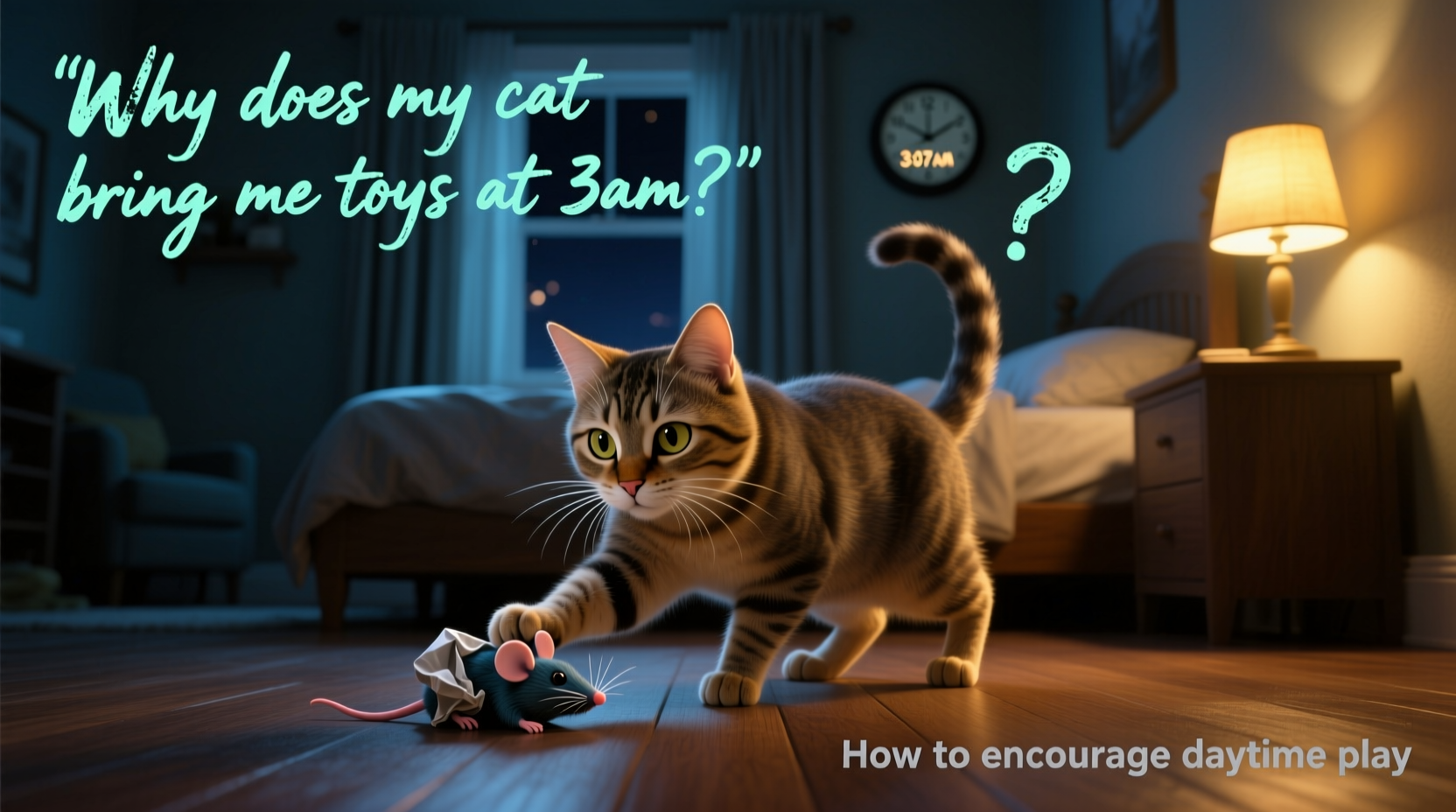
If you’ve ever been jolted awake at 3 a.m. by the soft thud of a crumpled paper ball hitting your face—or worse, a stuffed mouse dropped dramatically on your pillow—you’re not alone. Many cat owners find themselves on the receiving end of their feline’s pre-dawn “gifts.” While it might seem random or even mischievous, this behavior is deeply rooted in your cat’s instincts, energy levels, and relationship with you. The good news? With thoughtful adjustments to your cat’s routine, you can shift their peak activity to daylight hours and reclaim peaceful nights.
The Instinct Behind the 3 a.m. Toy Drop-Off
Cats are crepuscular by nature—meaning they are most active during dawn and dusk. This evolutionary trait stems from their wild ancestors, who hunted when prey was most abundant: just before sunrise and after sunset. Even indoor cats retain this biological rhythm, which explains why your cat may be wide awake and ready to “hunt” while you’re fast asleep.
When your cat brings you a toy at 3 a.m., they’re not simply trying to wake you up—they’re engaging in instinctual behaviors that mimic hunting and sharing prey. In the wild, cats often bring kills back to their social group as a form of contribution or teaching. Your cat likely views you as part of their colony, making you the recipient of their “successful hunt.”
“Cats don’t distinguish between real prey and toys when it comes to predatory sequences. The act of capturing, carrying, and presenting an object satisfies deep-seated behavioral needs.” — Dr. Sarah Thompson, Feline Behavior Specialist
This ritual isn’t about attention-seeking in the way we typically think. Instead, it’s a sign of trust and social bonding. Your cat feels safe enough to perform natural behaviors in your presence—and expects you to acknowledge their effort.
Tip: Never punish your cat for bringing toys at night. It reinforces fear and disrupts trust. Redirect the behavior with positive daytime alternatives instead.Why Nighttime Play Dominates (And How to Shift It)
Indoor cats often lack sufficient mental and physical stimulation during the day. If your cat sleeps most of the afternoon while you're at work or occupied, their energy accumulates and peaks overnight. Without structured play, they self-entertain—often at your expense.
The key to reducing 3 a.m. disruptions isn’t suppressing your cat’s instincts but redirecting them. By increasing engagement during daylight hours, you align your cat’s activity cycle more closely with yours. This doesn’t require constant interaction—just strategic, high-value play sessions that satisfy their need to stalk, chase, pounce, and “capture.”
Signs Your Cat Needs More Daytime Stimulation
- Excessive vocalization at night
- Bringing toys or knocking objects off surfaces to get attention
- Over-grooming or destructive chewing during the day
- Sleeping for long stretches during waking hours
- Hyperactive bursts of energy after midnight
These behaviors signal unmet enrichment needs. Addressing them proactively leads to calmer nights and a happier cat.
Step-by-Step Guide to Encourage Daytime Play
Transforming your cat’s schedule takes consistency, not complexity. Follow this five-step plan over two to three weeks to gradually shift their active periods to daylight hours.
- Establish a consistent evening play session: Begin each night with a 10–15 minute interactive play session using wand toys or laser pointers. Mimic prey movements—erratic scurrying, sudden stops—to trigger full predatory sequences. End with a “kill” (letting your cat catch the toy) followed by a small meal. This replicates the natural hunt-eat-sleep cycle.
- Incorporate morning and midday enrichment: Before leaving for work or during lunch breaks, engage your cat in short play bouts. Use puzzle feeders or treat-dispensing toys to extend mental engagement in your absence.
- Introduce scheduled feeding through play: Replace one or two free-feed meals with food puzzles or hide kibble around the house. This encourages natural foraging behavior and keeps your cat mentally occupied during quiet hours.
- Rotate toys weekly: Cats habituate quickly to static environments. Keep six to eight toys on rotation—introducing two new ones each week while storing others out of sight. Novelty reignites interest and prevents boredom.
- Leverage automation: Use timed toy dispensers or motion-activated toys set to activate during typical nighttime prowling hours. These provide distraction without reinforcing attention-seeking behavior toward you.
Creating an Enriched Daytime Environment
Play doesn’t have to mean direct interaction. A stimulating environment reduces your cat’s reliance on you for entertainment. Consider these enhancements:
| Feature | Benefit | Examples |
|---|---|---|
| Vertical space | Encourages climbing and observation | Cat trees, wall shelves, window perches |
| Interactive toys | Promotes independent hunting simulation | Motorized mice, rolling balls with bells |
| Scent enrichment | Stimulates natural curiosity | Catnip, silvervine, valerian root |
| Visual stimulation | Reduces boredom during solitude | Bird feeders outside windows, fish videos on TV |
| Safe outdoor access | Provides real-world sensory input | Catio enclosures, harness training |
Environmental enrichment works synergistically with scheduled play. A cat who spends the afternoon watching birds or exploring elevated platforms is less likely to channel pent-up energy into waking you at dawn.
Mini Case Study: Reducing Midnight Disruptions in a Busy Household
The Rivera family adopted Luna, a young tabby, six months ago. Within weeks, they were struggling with nightly disturbances—Luna would sprint down the hallway, leap onto the bed, and drop toys directly onto their faces between 2:30 and 4 a.m. Attempts to ignore her only led to louder meowing and pawing at their arms.
After consulting a veterinary behaviorist, they implemented a structured routine:
- A 15-minute wand toy session every evening at 8 p.m., ending with a measured portion of wet food.
- Two automated treat puzzles activated at 10 a.m. and 3 p.m. on weekdays.
- A rotating toy system with four new items introduced every Sunday.
- A window perch installed overlooking a bird feeder.
Within three weeks, Luna’s nighttime activity decreased significantly. She began sleeping through the night and showed increased interest in solo play during the day. The family reported improved sleep quality and a stronger bond with their cat.
Do’s and Don’ts of Managing Nocturnal Cat Behavior
| Do | Don't |
|---|---|
| Respond to 3 a.m. antics calmly—avoid eye contact or verbal engagement | Yell, clap, or physically push your cat away; this increases anxiety |
| Use automatic feeders or toys to simulate activity during your absence | Give treats or attention when your cat wakes you—it reinforces the behavior |
| Keep play sessions predictable and conclude with a “reward” | Play roughly or use your hands/feet as toys—this encourages biting |
| Provide multiple scratching posts and hiding spots | Confine your cat to another room long-term; it damages trust |
| Monitor changes in behavior—if new, consult a vet | Assume all nighttime activity is normal; medical issues like hyperthyroidism can cause restlessness |
Frequently Asked Questions
Is it normal for my cat to bring me toys every night?
Yes, especially in younger or highly bonded cats. It reflects natural hunting instincts and social behavior. While common, frequent disruptions can be minimized with proper enrichment and routine adjustments.
Will getting a second cat help reduce nighttime activity?
It can—but only if both cats are socially compatible. Some pairs groom and play together, reducing loneliness. Others may increase stress or competition. Introduce a second cat thoughtfully and only if you’re prepared for dual care responsibilities.
What kind of toys best satisfy my cat’s hunting drive?
Toys that mimic prey movement are most effective: feather wands, motorized mice, crinkle balls, and puzzle feeders. Avoid static plush toys unless paired with catnip or used in interactive play. Variety and motion are key.
Final Thoughts: Building a Balanced Routine
Your cat’s 3 a.m. toy deliveries aren’t a flaw—they’re a testament to their instincts and their connection with you. Rather than viewing this behavior as a nuisance, see it as an invitation to deepen your understanding of feline psychology. With intentional scheduling, environmental enrichment, and consistent routines, you can honor your cat’s natural drives while preserving your own rest.
The goal isn’t to eliminate your cat’s predatory play but to redirect it into appropriate times and formats. When daytime becomes more engaging, nighttime naturally becomes quieter. This balance benefits both of you: your cat enjoys a richer, more fulfilling life, and you enjoy uninterrupted sleep.
💬 Have a story about your cat’s 3 a.m. habits or a successful strategy you’ve used? Share your experience in the comments—your insight could help fellow cat owners create more peaceful homes.








