
Aaron, the elder brother of Moses and Israel’s first high priest, played a pivotal role in the Exodus narrative and the establishment of Israel’s religious system. His life was marked by divine calling, leadership, and moments of both faithfulness and failure. Yet when the time came for his death, it occurred under circumstances that raise questions: Why did Aaron die? Was it due to personal sin, divine judgment, or simply the fulfillment of God’s plan? Examining the biblical account reveals layers of historical, theological, and symbolic meaning behind his passing.
The Biblical Narrative of Aaron’s Death
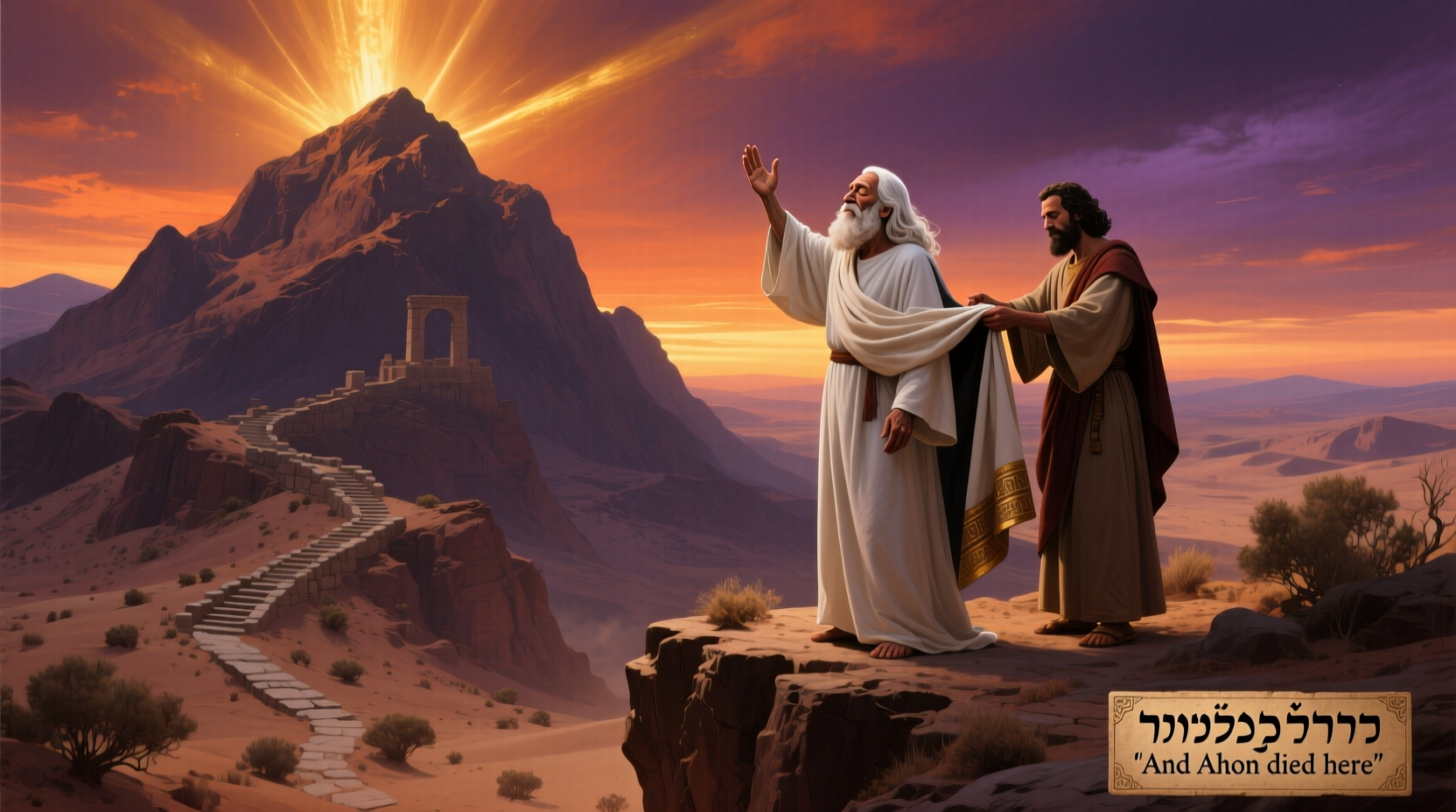
The final chapter of Aaron’s life is recorded in Numbers 20 and Deuteronomy 34. As the Israelites approached the borders of Canaan, they arrived at Mount Hor, near the border of Edom. There, God instructed Moses:
“Take Aaron and his son Eleazar and bring them up to Mount Hor. Remove Aaron’s garments and put them on his son Eleazar, for Aaron will be gathered to his people and will die there.” — Numbers 20:25–26
This moment marks the formal transfer of the high priesthood from Aaron to Eleazar. Moses obeyed, stripped Aaron of his sacred vestments, clothed Eleazar in them, and Aaron died on the summit of Mount Hor at the age of 123. The entire community mourned him for thirty days.
Unlike Moses, whose exclusion from the Promised Land is explicitly tied to an act of disobedience at the waters of Meribah, Aaron’s death is not directly framed as punishment. However, the context suggests deeper implications.
The Waters of Meribah: A Shared Judgment
Just before Aaron’s death, the Israelites quarreled with Moses and Aaron over the lack of water. God commanded Moses to speak to the rock so that water would flow. Instead, Moses struck the rock twice in anger, saying, “Must we bring you water out of this rock?” (Numbers 20:10).
God responded sharply: “Because you did not trust in me enough to honor me as holy in the sight of the Israelites, you will not bring this community into the land I gave them” (Numbers 20:12).
Though the rebuke was directed at Moses, Aaron stood beside him. Jewish and Christian traditions have long debated whether Aaron shared in the guilt. Some scholars argue that Aaron bore partial responsibility as co-leader; others suggest he was implicated by association, given his role in previous acts of compromise, such as the golden calf incident (Exodus 32).
Tip: When studying biblical figures, consider not only their actions but also their symbolic roles—Aaron represented priestly mediation, making his removal part of a larger spiritual transition.Theological Reasons Behind Aaron’s Death
Aaron’s death cannot be reduced to a single cause. Rather, it reflects multiple theological themes woven throughout the Pentateuch:
- Divine Holiness and Leadership Accountability: God holds leaders to a higher standard. Even minor lapses in faith or obedience carry consequences, especially when they undermine public trust in God’s holiness.
- Transition of Authority: Aaron’s death facilitated the orderly succession of the priesthood to the next generation, reinforcing the idea that spiritual offices are not personal inheritances but divine appointments.
- Human Limitation in a Sinful World: Despite being chosen by God, Aaron remained mortal. His death underscores that even the most anointed individuals are subject to the universal consequence of sin—death (Romans 5:12).
- Fulfillment of Covenant Structure: The old generation, including those who rebelled in the wilderness, were not permitted to enter Canaan. Aaron, born in Egypt and part of that generation, symbolically closed an era.
“Aaron’s death was not merely biological but typological—he embodied the temporary nature of the Levitical priesthood, which pointed forward to a greater High Priest.” — Dr. Michael Heiser, Biblical Scholar
Comparison: Aaron, Moses, and the Prohibition from the Promised Land
| Leader | Role | Reason for Not Entering Canaan | Biblical Reference |
|---|---|---|---|
| Aaron | High Priest | Associated with Meribah incident; part of disbelieving generation | Numbers 20:23–24 |
| Moses | Prophet & Leader | Struck the rock; failed to uphold God’s holiness | Numbers 20:12 |
| Miriam | Prophetess | Died earlier; part of the wilderness generation | Numbers 20:1 |
The table highlights that all three siblings—Moses, Aaron, and Miriam—died before entering Canaan. This was not coincidental but intentional: God ensured that the new generation, raised in the wilderness with fresh dependence on Him, would inherit the land.
Spiritual Legacy and Typology
Aaron’s death carries symbolic weight beyond the historical event. In Christian theology, Aaron serves as a type—a foreshadowing—of Christ, the ultimate High Priest. Yet the very fact that Aaron died emphasizes the limitation of the Old Covenant priesthood.
Unlike Jesus, who “holds his priesthood permanently, because he continues forever” (Hebrews 7:24), Aaron’s service ended in death. His mortality underscored the need for a better covenant, one mediated by a sinless, eternal priest.
Furthermore, the removal of Aaron’s garments and their transfer to Eleazar mirrors the biblical principle that earthly offices pass from one steward to another. No human priest, no matter how anointed, can permanently mediate between God and man.
Common Misconceptions About Aaron’s Death
Several misunderstandings persist about why Aaron died:
- Misconception 1: “Aaron died because of the golden calf incident alone.”
While Aaron’s role in the idolatry of Exodus 32 was serious, God forgave him and continued to use him (Exodus 32:35; Numbers 12). His death decades later was not a delayed punishment but part of a broader redemptive timeline. - Misconception 2: “Aaron was punished more harshly than Moses.”
Both were barred from Canaan. Moses received a vision of the land (Deuteronomy 34), while Aaron died on the mountain without it. But both faced the same core consequence: exclusion due to leadership failure at Meribah. - Misconception 3: “Aaron’s death was sudden and unexpected.”
Scripture indicates Aaron knew his end was near. The ritual transfer of garments suggests a dignified, divinely orchestrated conclusion to his life and ministry.
Step-by-Step: The Final Days of Aaron
- Arrival at Kadesh: The Israelites camped at Kadesh in the Desert of Zin; Miriam dies and is buried there (Numbers 20:1).
- Crisis at Meribah: People complain for water; Moses and Aaron seek God’s direction (Numbers 20:2–5).
- Divine Instruction: God commands Moses to speak to the rock; instead, he strikes it (Numbers 20:7–11).
- Divine Judgment: God declares neither Moses nor Aaron will lead Israel into Canaan (Numbers 20:12).
- Ascend to Mount Hor: Moses, Aaron, and Eleazar climb the mountain per God’s command (Numbers 20:22–23).
- Transfer of Priesthood: Aaron’s garments are removed and placed on Eleazar (Numbers 20:26–28).
- Aaron’s Death: Aaron dies on the mountain; Moses and Eleazar descend (Numbers 20:28).
- National Mourning: All Israel mourns Aaron for thirty days (Numbers 20:29).
Real Example: Leadership and Consequences in Ministry Today
Consider a modern church leader who, under pressure, makes a public statement that misrepresents biblical truth—not out of malice, but out of fear or poor judgment. Though repentant, the damage to trust and witness lingers. Like Aaron, such a leader may remain faithful in many ways but still face limitations in their future ministry.
This mirrors Aaron’s experience: not complete rejection, but a restriction on his ultimate destiny. It reminds today’s spiritual leaders that integrity, humility, and reverence for God’s holiness are non-negotiable.
FAQ
Did Aaron go to heaven?
The Bible does not explicitly state where Aaron went after death. However, as a man called by God, used in mighty works, and covered by sacrificial atonement, Jewish and Christian traditions generally regard him as righteous. In the broader biblical framework, salvation comes through faith in God’s provision—ultimately fulfilled in Christ.
Why wasn’t Aaron allowed to enter the Promised Land?
Primarily because of the incident at the waters of Meribah, where he and Moses failed to honor God’s holiness before the people. Additionally, he belonged to the generation that rebelled in Egypt and was thus not permitted to enter Canaan.
Was Aaron a good leader?
Aaron had strengths and weaknesses. He was instrumental in Israel’s worship system and served faithfully as high priest. However, he also showed weakness under pressure, as seen in the golden calf episode. His legacy is one of service tempered by human frailty.
Conclusion: Honor, Legacy, and the Call to Faithfulness
Aaron’s death was not a tragedy but a transition—a divinely ordered conclusion to a life of service. It teaches that leadership is sacred, accountability is real, and no earthly office lasts forever. Yet his legacy endures in the structure of worship, the lineage of priests, and the typology pointing to Jesus Christ.
💬 What lessons do you draw from Aaron’s life and death? Reflect on how faithfulness, even with imperfections, can leave a lasting spiritual legacy. Share your thoughts or insights with others seeking wisdom from Scripture.