The Pope, as the spiritual leader of over a billion Catholics worldwide, holds one of the most unique and influential positions in global religious life. One of the most visible aspects of his role is his celibacy—specifically, that he cannot marry. This has long intrigued both believers and non-believers alike. Why can't the Pope marry? The answer lies not in a single decree or moment, but in centuries of theological development, ecclesiastical discipline, and cultural evolution within the Roman Catholic Church.
Celibacy among clergy, especially at the highest levels of leadership, is often misunderstood as a divine commandment. In truth, it is a disciplinary rule—one deeply respected and historically reinforced, but not an article of faith like the divinity of Christ or the resurrection. Understanding the Pope’s inability to marry requires unpacking layers of doctrine, tradition, and practical governance that have shaped the Church for over a thousand years.
Theological Foundations of Clerical Celibacy
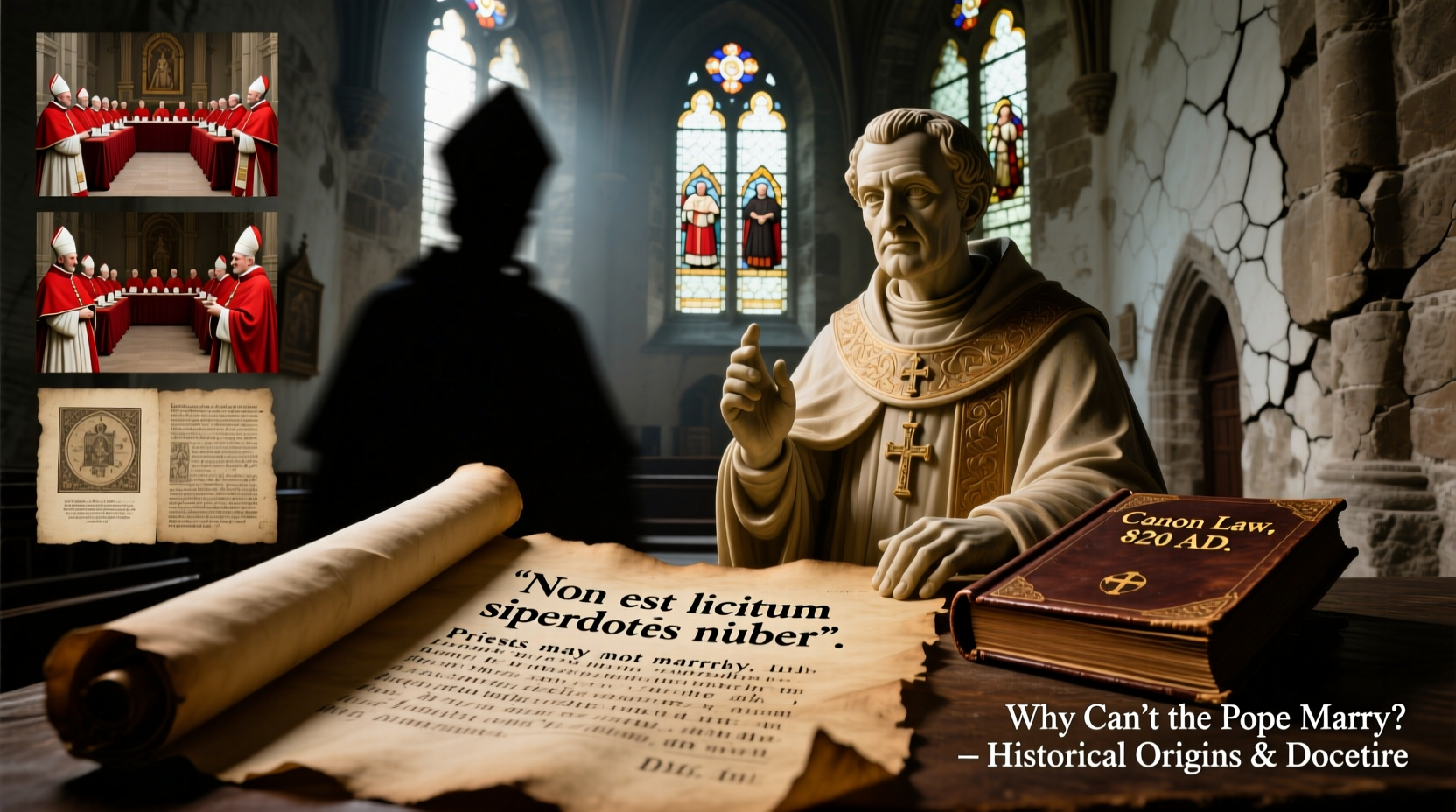
The roots of priestly celibacy stretch back to the early Christian era, though they are not explicitly mandated in Scripture. Jesus himself was unmarried, and Saint Paul praised celibacy as a way to focus fully on serving God (1 Corinthians 7:32–35). He wrote, “An unmarried man is concerned about the Lord’s affairs—how he can please the Lord. But a married man is concerned about the affairs of this world—how he can please his wife.” This passage became a cornerstone for later arguments in favor of clerical celibacy.
Early Church Fathers such as Augustine of Hippo and Jerome extolled virginity and celibacy as higher spiritual states. While bishops were often chosen from among married men (provided their wives were still alive), there was growing emphasis on sexual abstinence after ordination. By the fourth century, many bishops lived as if celibate, even if previously married.
The theology behind celibacy centers on consecration: giving oneself entirely to God and the Church. For the Pope—seen as the successor of Saint Peter and chief shepherd of the faithful—this total dedication is viewed as essential to his role. Marrying would, in symbolic and practical terms, divide his allegiance between family and flock.
“Celibacy is not a denial of love, but its fullest expression—directed toward the entire Body of Christ.” — Cardinal Joseph Ratzinger (Pope Benedict XVI)
Historical Development of Mandatory Celibacy
It’s important to clarify: the prohibition on marriage for popes and priests did not appear overnight. In fact, several early popes were married before their ordination. Pope St. Felix III (reigned 483–492) and Pope Adrian II (reigned 867–872) were both married men who served as pope while their wives were still living—an unthinkable scenario today.
The shift began in earnest during the 11th century under Pope Gregory VII (1073–1085), a central figure in the Gregorian Reforms. At a time when simony (the buying of church offices) and clerical marriage were widespread and often corrupt, Gregory sought to purify the clergy. He enforced strict celibacy, arguing that married priests could pass church property to their children, undermining ecclesiastical integrity.
The First Lateran Council in 1123 formally declared that married clergy could not perform sacraments, and the Second Lateran Council in 1139 made priestly celibacy a binding law of the Church. From then on, ordination required a vow of celibacy, effectively barring marriage after ordination—and since the Pope is always a bishop (and thus ordained), he must remain celibate.
Timeline of Key Events in Clerical Celibacy
- 1st–3rd centuries: Some apostles were married (e.g., Peter), but celibacy praised by Paul and Church Fathers.
- 4th century: Bishops expected to be chaste; some married men ordained if they agreed to abstinence.
- 11th century: Gregory VII enforces celibacy to combat corruption.
- 1123: First Lateran Council declares invalid marriages of clergy.
- 1139: Second Lateran Council makes celibacy mandatory for ordination.
- 1917 & 1983: Codified in modern Code of Canon Law (Canon 277).
Practical and Symbolic Reasons Behind the Rule
Beyond theology and history, there are pastoral and symbolic dimensions to the Pope’s celibacy. As the visible head of the Church, the Pope represents Christ—the divine bridegroom of the Church (Ephesians 5:25–27). His celibacy mirrors this spousal relationship, symbolizing undivided devotion to the Church as his spiritual bride.
Administratively, the papacy is a full-time, lifelong vocation with immense responsibilities. From leading global dioceses to guiding moral teaching and managing Vatican affairs, the role demands constant availability. Introducing familial obligations could complicate succession, decision-making, and public perception.
Moreover, celibacy serves as a witness in a secular age. In a culture where personal fulfillment is often tied to romantic relationships, the Pope’s choice to live without marriage stands as a counter-cultural testament to spiritual priorities.
Exceptions and Modern Debates
While the rule is firm, exceptions exist in practice. Anglican or Lutheran ministers who convert to Catholicism and are already married may be ordained as priests—and in rare cases, become bishops—under special dispensation. However, no married man has been elected Pope in modern times, and canon law does not allow a married priest to become bishop (and thus Pope) unless widowed before appointment.
In recent decades, debates over clerical celibacy have intensified, especially amid priest shortages and scandals. Some theologians and bishops have called for optional celibacy, particularly in remote regions. Pope Francis has acknowledged these discussions but reaffirmed celibacy as a valued discipline, not a dogma.
Still, the door remains open for discernment. As Cardinal Kasper noted, “Celibacy is a gift, not a law of nature. It must be lived with joy, not imposed with rigidity.” Yet any change would require broad consensus and would likely exclude the papacy due to its symbolic centrality.
Frequently Asked Questions
Could a married man become Pope?
Technically, yes—if he were a priest, but only if he were widowed. A currently married man cannot be ordained a priest in the Latin rite, which is a prerequisite for becoming bishop and eventually Pope. Eastern Catholic Churches allow married priests, but their bishops (including patriarchs) are chosen from the celibate clergy.
Have any Popes been married?
Yes, several early Popes were married before their ordination. The last known Pope who was married while in office was Pope Adrian II (died 872). After the 12th-century reforms, all Popes have been celibate, either never having married or being widowed long before election.
Is celibacy a sin if broken?
No, but breaking the vow of celibacy is considered a serious violation of canon law. Clergy who wish to marry must typically seek laicization (release from clerical duties). There is no penalty for the individual per se, but the act disqualifies them from exercising priestly functions.
Checklist: Understanding the Pope's Celibacy
- Recognize that celibacy is a discipline, not a doctrine.
- Understand that early Popes were sometimes married.
- Learn how the 11th-century reforms cemented mandatory celibacy.
- Appreciate the symbolic link between Christ and the Church.
- Acknowledge ongoing discussions about optional celibacy.
- Remember that the Pope’s role demands total availability and spiritual focus.
Conclusion: A Vow That Shapes Leadership
The Pope cannot marry because centuries of theological reflection, ecclesiastical law, and spiritual symbolism have woven celibacy into the fabric of papal identity. It is more than a rule—it is a witness, a sacrifice, and a sign of singular devotion to God and the global Church.
While the world changes, and questions about reform persist, the current structure remains intact. For now, the papacy continues to stand apart—a leadership model rooted not in lineage or family, but in service, prayer, and an ancient commitment to spiritual fatherhood.
💬 What do you think about clerical celibacy in the modern Church? Share your thoughts, questions, or reflections in the discussion below.








