In 1954, the United States Supreme Court delivered a landmark decision in Brown v. Board of Education of Topeka, declaring that racial segregation in public schools violated the Equal Protection Clause of the Fourteenth Amendment. This ruling dismantled the legal foundation of “separate but equal” established by Plessy v. Ferguson in 1896. More than six decades later, Brown remains a cornerstone of American civil rights jurisprudence, symbolizing both the power of judicial action and the long struggle for racial justice.
The significance of Brown extends far beyond classrooms. It reshaped national consciousness, energized the civil rights movement, and set a precedent for using the Constitution as a tool for social transformation. Its legacy is not merely historical—it continues to influence debates about equity, inclusion, and educational opportunity today.
The Legal Breakthrough: Ending \"Separate but Equal\"
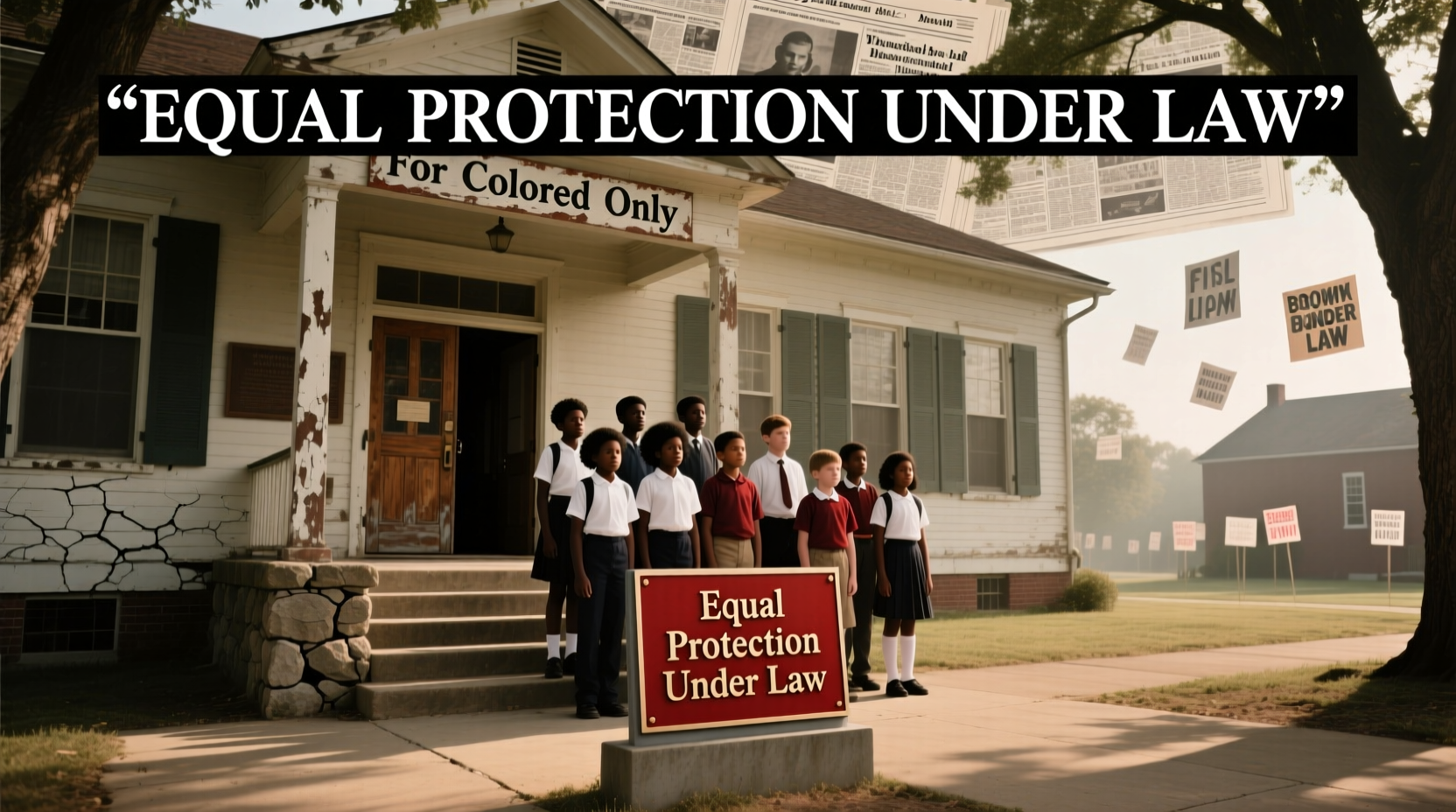
Prior to Brown, segregation was legally entrenched across much of the United States. The doctrine of “separate but equal,” upheld in Plessy v. Ferguson, allowed states to maintain racially segregated institutions as long as they were purportedly equal in quality. In practice, Black schools received drastically fewer resources, outdated materials, and inferior facilities compared to white schools.
The NAACP Legal Defense Fund, led by Thurgood Marshall, strategically challenged segregation through a series of cases culminating in Brown. Rather than arguing only that Black schools were unequal in funding, the legal team presented sociological and psychological evidence—most notably the famous doll tests conducted by Kenneth and Mamie Clark—that demonstrated how segregation harmed children’s self-esteem and sense of worth.
The unanimous 9–0 decision written by Chief Justice Earl Warren stated: “We conclude that in the field of public education the doctrine of ‘separate but equal’ has no place. Separate educational facilities are inherently unequal.” This powerful declaration marked a turning point in constitutional interpretation, affirming that equality must be substantive, not just formal.
“We conclude that in the field of public education the doctrine of ‘separate but equal’ has no place. Separate educational facilities are inherently unequal.” — Chief Justice Earl Warren, Brown v. Board of Education, 1954
The Ripple Effect on Civil Rights and Social Change
Brown did more than desegregate schools—it catalyzed a broader movement for racial justice. By challenging the legitimacy of state-sponsored segregation, the decision empowered activists to demand change in other areas, including transportation, housing, and voting rights.
One year after the ruling, Rosa Parks refused to give up her seat on a Montgomery bus, sparking the Montgomery Bus Boycott. Leaders like Martin Luther King Jr. cited Brown as moral and legal justification for nonviolent resistance. The decision also emboldened federal intervention in civil rights enforcement, paving the way for the Civil Rights Act of 1964 and the Voting Rights Act of 1965.
Yet progress was met with fierce resistance. In many Southern states, “massive resistance” campaigns closed public schools rather than integrate them. Federal troops were deployed to Little Rock, Arkansas, in 1957 to enforce desegregation at Central High School. These confrontations underscored both the transformative potential and the deep societal tensions unleashed by Brown.
Tip: Understanding Brown requires recognizing it not just as a legal case, but as a catalyst that redefined citizenship and belonging in America.Enduring Challenges: The Gap Between Law and Reality
While Brown outlawed de jure (legal) segregation, de facto (in practice) segregation persists due to residential patterns, economic inequality, and school district boundaries. Today, many public schools remain racially and economically isolated, often reflecting broader systemic inequities.
A 2019 report by the Government Accountability Office found that the number of K–12 public schools with high percentages of Black and Hispanic students had increased over the previous decade. These schools are more likely to have less access to experienced teachers, advanced coursework, and adequate funding.
Despite the legal victory, full integration has not been achieved. As scholar Derrick Bell observed, “Brown promised much but delivered unevenly.” The ruling changed the law, but transforming deeply rooted structures of inequality requires sustained political will and community engagement.
Key Developments After Brown: A Timeline
- 1954: Supreme Court rules in Brown I that segregation in public education violates the Constitution.
- 1955: In Brown II, the Court orders desegregation “with all deliberate speed,” delegating implementation to lower courts.
- 1957: Nine Black students (the “Little Rock Nine”) face violent opposition integrating Central High School; President Eisenhower sends federal troops.
- 1964: Civil Rights Act prohibits discrimination in public places and federally funded programs, reinforcing Brown’s principles.
- 1971: In Swann v. Charlotte-Mecklenburg Board of Education, the Court approves busing as a tool for integration.
- 2007: In Parents Involved in Community Schools v. Seattle School District, the Court limits the use of race in student assignment, signaling a shift in judicial attitudes.
Modern Relevance: What Brown Teaches Us Today
The principles at stake in Brown continue to inform contemporary debates. From efforts to ban critical race theory in schools to disputes over charter school equity and school funding formulas, the question of what equal educational opportunity means remains unresolved.
Moreover, Brown serves as a reminder that legal victories are only the beginning. Lasting change requires civic participation, policy reform, and cultural shifts. Communities that actively work toward inclusive zoning, equitable school funding, and diverse curricula honor the spirit of Brown in meaningful ways.
Recent movements advocating for culturally responsive teaching, restorative justice practices, and anti-bias training in schools reflect an ongoing commitment to the values Brown represented—dignity, fairness, and the belief that every child deserves a chance to succeed.
| Aspect | Progress Since Brown | Ongoing Challenges |
|---|---|---|
| Legal Segregation | Eliminated by law | De facto segregation remains widespread |
| School Funding | Greater awareness of disparities | Funding still tied to local property taxes |
| Access to Quality Education | Expansion of magnet, charter, and AP programs | Opportunity gaps persist by race and income |
| Civil Rights Enforcement | Federal oversight mechanisms exist | Enforcement varies by administration and region |
How Educators and Citizens Can Uphold Brown's Legacy
The responsibility to fulfill Brown’s promise does not rest solely with courts or policymakers. Teachers, parents, students, and community members play vital roles in advancing equity.
- Advocate for fair school funding models that reduce reliance on local property taxes.
- Support policies that promote socioeconomic and racial diversity in schools.
- Encourage inclusive curricula that reflect the histories and contributions of all Americans.
- Engage in local school board decisions and hold districts accountable for equitable outcomes.
- Challenge biased practices and language within educational environments.
“The arc of the moral universe is long, but it bends toward justice.” — Dr. Martin Luther King Jr., often invoked in discussions of Brown’s legacy
FAQ
Did Brown v. Board of Education immediately end school segregation?
No. While the 1954 ruling declared segregation unconstitutional, implementation was slow and met with resistance. Many districts delayed integration for years. The follow-up decision in 1955, known as Brown II, instructed desegregation to proceed “with all deliberate speed,” which allowed for prolonged delays.
Why is Brown considered a turning point in U.S. history?
Brown was the first major Supreme Court decision to directly challenge institutional racism in America. It provided legal and moral authority to the civil rights movement and redefined the role of the judiciary in protecting individual rights against state oppression.
Is segregation still a problem in U.S. schools today?
Yes. Although legally mandated segregation has ended, many schools remain highly segregated due to housing patterns, economic inequality, and district lines. Research shows that students in racially isolated schools often face fewer resources and lower academic outcomes.
Conclusion: A Living Legacy
Brown v. Board of Education was not the end of the struggle for educational equity—it was the beginning of a new chapter. Its enduring impact lies not just in the courtrooms or textbooks, but in the daily choices communities make about inclusion, justice, and opportunity.
The ruling reminds us that laws can open doors, but only sustained effort can keep them open. As new generations confront issues of race, class, and access, the principles of Brown remain essential guideposts. The fight for truly equal education continues—not in defiance of the decision, but in fulfillment of it.
🚀 Honor the legacy of Brown by getting involved in your local school system, supporting equitable policies, and speaking up for every child’s right to a quality education. Justice starts with awareness—and action.