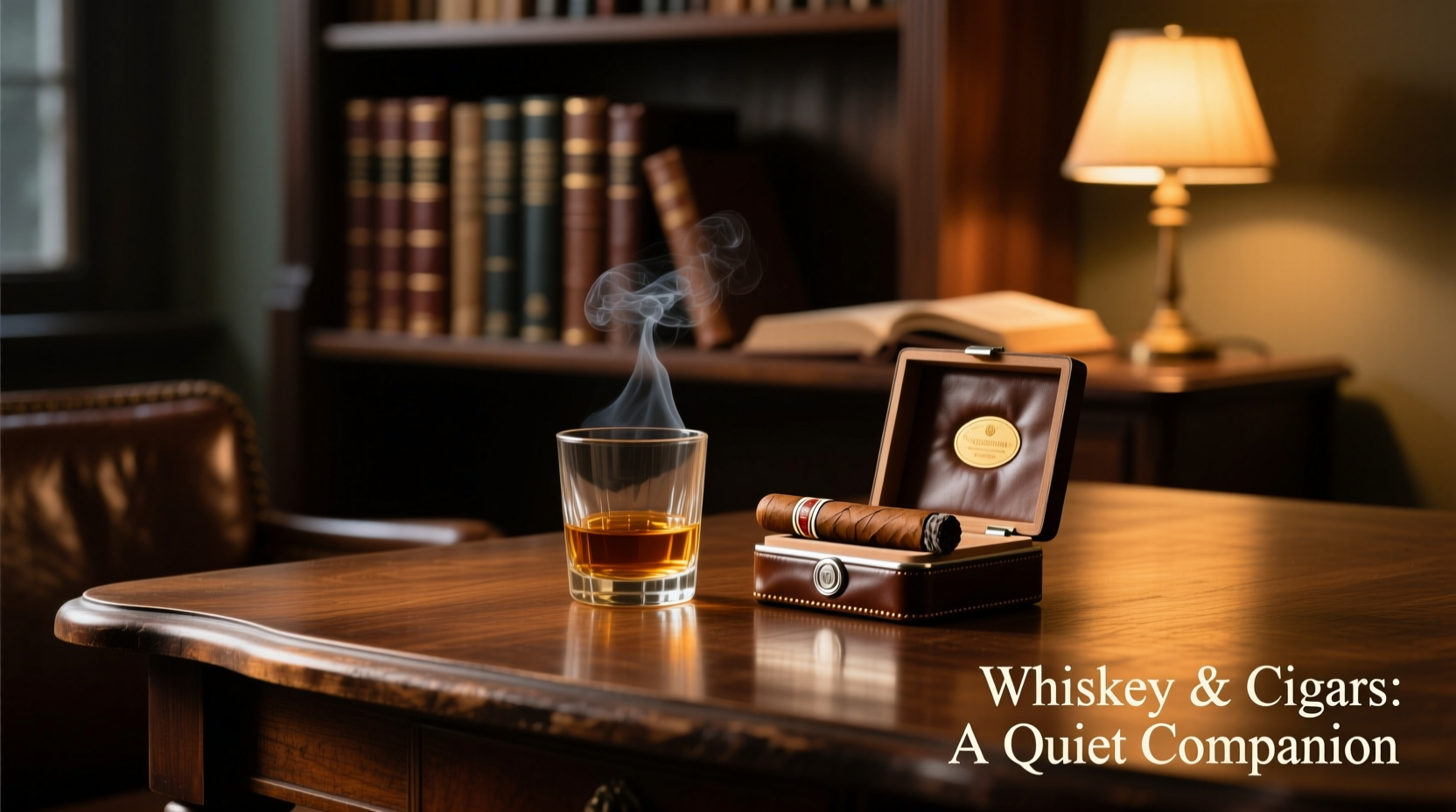
For the introvert, solitude isn’t emptiness—it’s intentionality. It’s the weight of a well-worn armchair, the soft crackle of a single log in the hearth, the silence that hums with presence rather than absence. In this space, whiskey and cigars aren’t social props or status symbols. They’re anchors—ritual objects that deepen attention, slow time, and invite sensory intimacy. This guide isn’t about impressing guests or mastering jargon. It’s about choosing spirits and smokes that honor your natural rhythm: low on stimulation, high on nuance; gentle in delivery, resonant in finish. No barstool banter required. Just you, a glass, a flame, and the quiet confidence of knowing exactly what you enjoy—and why.
The Introvert’s First Principle: Prioritize Comfort Over Complexity
Many pairing guides begin with geography—Scotch from Islay, Dominican cigars, etc.—but for the introverted palate, origin matters less than physiological resonance. A heavily peated Islay whisky may overwhelm if your nervous system prefers stillness over intensity. Likewise, a full-bodied Nicaraguan cigar can feel like shouting into a library. Start instead with three personal thresholds: alcohol tolerance (do you prefer 40–43% ABV for longer sipping?), smoke density (do you favor cool, thin draws or tolerate richer, slower-burning profiles?), and flavor sensitivity (are you drawn to subtlety—vanilla, dried apple, cedar—or do you seek contrast, like salted caramel or dark chocolate?). Your ideal pairing emerges not from textbook rules but from honoring these quiet signals.
Tip: Keep a small notebook by your chair. After each session, jot down one word for the whiskey’s mouthfeel (e.g., “silky,” “waxy,” “drying”), one for the cigar’s smoke (e.g., “creamy,” “earthy,” “spicy”), and one emotional note (“settled,” “brightened,” “grounded”). Patterns will reveal your true preferences—not what critics recommend.Five Grounded Pairings for Quiet Evenings
Below are pairings selected not for prestige, but for their structural harmony and low-demand elegance. Each balances richness with restraint, avoids aggressive tannins or sharp smoke, and rewards slow, reflective sipping and puffing.
| Whiskey Profile | Recommended Cigar Profile | Why It Works for Quiet Evenings |
|---|---|---|
| Light & Grain-Forward Bourbon (e.g., Maker’s Mark, Old Forester 86 Proof) |
Mild-to-Medium Dominican (e.g., Arturo Fuente Hemingway Short Story, Ashton Cabinet Selección) |
Soft corn sweetness meets gentle cedar and toasted almond. Neither overwhelms; both invite lingering. The bourbon’s approachable vanilla and caramel soften the cigar’s subtle spice without masking its creaminess. |
| Unpeated Highland Single Malt (e.g., Glenmorangie Original, Balblair 12 Year Old) |
Connecticut Shade Wrapper (e.g., Macanudo Café, Davidoff Signature No. 2) |
Creamy, citrus-tinged malt meets smooth, nutty, low-tar smoke. The cigar’s delicate wrapper complements the whisky’s floral lift and honeyed body—no clash, only quiet consonance. |
| Japanese Blended Whisky (e.g., Hibiki Harmony, Nikka Days) |
Peruvian or Ecuadorian Grown Wrapper (e.g., Tatuaje Cojonu 2012 Connecticut, Illusione Epernay Blanc) |
Harmonious, layered, and inherently balanced. These whiskies emphasize texture over power—think polished oak, green tea, and ripe pear. Paired with a refined, medium-bodied cigar grown at high altitude, the result is seamless integration: smoke and spirit breathe at the same pace. |
| Speyside with Gentle Sherry Influence (e.g., Glenfiddich 15 Year Solera, Aberlour A’Bunadh Batch Strength *diluted to 46%*) |
Medium-Bodied Honduran (e.g., Punch Gran Puro, Camacho Connecticut) |
When sherry cask influence is subtle—not syrupy but raisiny and spiced—the warmth pairs beautifully with a well-constructed Honduran that offers cocoa, roasted walnut, and a clean finish. Diluting cask-strength whisky preserves its depth while removing heat that could distract from calm focus. |
| Lowland Single Malt (e.g., Auchentoshan Three Wood, Rosebank 12 Year Old *if available*) |
Lightly Aged Maduro (not full-bodied) (e.g., Partagás Serie D No. 4 *rested 3+ years*, Romeo y Julieta Churchill *vintage 2018+*) |
Lowlands are traditionally floral, grassy, and delicately fruity. A mature, well-aged mild maduro adds gentle dark sugar, leather, and earth—never bitterness—creating a nuanced, evolving dialogue across 45–60 minutes of unhurried enjoyment. |
A Step-by-Step Ritual for One Person
This isn’t a performance. It’s a sequence designed to minimize friction and maximize presence. Follow it once—not as dogma, but as scaffolding until your own rhythm emerges.
- Prepare the space (5 minutes): Turn off notifications. Light a single beeswax candle—not for scent, but for focal warmth. Pour 1.5 oz of whiskey into a tulip-shaped nosing glass (or a sturdy tumbler). Let it rest uncovered.
- Choose and cut (2 minutes): Select your cigar based on today’s energy—not yesterday’s plan. Use a clean, sharp guillotine cutter. Cut squarely, just above the cap line. Avoid punching—it restricts airflow and increases heat.
- Toast and light (3 minutes): Hold the foot 1 inch from a wooden match or butane torch. Rotate slowly until the edge glows evenly orange. Draw gently while applying flame—don’t inhale deeply. Aim for an even burn before setting it down.
- First impressions (5 minutes): Sip the whiskey neat. Note temperature, weight, and first impression—not “Is it good?” but “Where does it land on my tongue? Does it feel expansive or contained?” Then take three slow, shallow puffs on the cigar. No rush. Let the smoke rest in your mouth before exhaling.
- Deepen the dialogue (20–40 minutes): Alternate: one sip, two puffs. Wait 15 seconds between each. Notice how the whiskey’s finish changes after smoke—does the oak soften? Does the cigar’s spice bloom? This is where quiet attention reveals synergy no review could predict.
What Not to Do: The Introvert’s Avoidance Checklist
- Don’t chase “rare” or “limited edition” bottles or cigars out of FOMO—scarcity contradicts the values of sufficiency and slowness.
- Don’t smoke immediately after eating a heavy meal—the digestive load competes with sensory clarity.
- Don’t pair two aggressively oaky elements (e.g., heavily charred bourbon + ligero-heavy cigar)—the tannins will dry your mouth and narrow your focus.
- Don’t feel obligated to finish either. A half-smoked cigar can be gently extinguished and stored in a cedar-lined tube for tomorrow. A partially poured whiskey can be recorked and savored later—its character often deepens with brief air exposure.
- Don’t compare your experience to others’. Your “perfect” pairing might be a $28 bourbon with a $6 machine-made cigar—if it delivers calm, consistency, and comfort, it is perfect.
Real Moment: Sarah’s Wednesday Stillness
Sarah, a university archivist and lifelong introvert, used to feel guilty about skipping faculty mixers. She’d return home drained, then pour a large glass of something strong—often too strong—to “unwind.” One rainy October evening, she decided to try something different. She pulled out a bottle of Glenmorangie Original she’d bought months earlier but never opened, and a box of Macanudo Café she’d received as a gift. She lit a candle, closed her office door, and followed the five-step ritual—not rigidly, but gently. She noticed how the whisky’s orange-blossom note bloomed after the cigar’s cedar aroma settled in her nose. How the smoke’s creaminess made the whisky taste rounder, less sharp. She didn’t think about work, or tomorrow’s meeting, or whether she “should” be networking. For 52 minutes, she was wholly in the architecture of flavor and sensation. Since then, she reserves Wednesday evenings—no exceptions—for this ritual. “It’s not indulgence,” she told a friend recently. “It’s recalibration. Like tuning an instrument before playing.”
Expert Insight: Sensory Integration and the Introverted Nervous System
“Introverts often process sensory input more deeply—and more exhaustively—than extroverts. That means pairings shouldn’t compete for attention; they should scaffold it. A successful quiet-evening pairing creates a ‘sensory loop’: the warmth of the spirit lowers physiological arousal, the rhythmic draw of the cigar regulates breath, and the shared aromatic compounds—vanillin, lactones, lignin derivatives—activate overlapping neural pathways. This isn’t luxury. It’s neurobiology supporting presence.” — Dr. Lena Torres, Cognitive Sensory Researcher, University of Edinburgh
FAQ: Questions Quiet People Actually Ask
Do I need a humidor for just one or two cigars?
No. A simple, airtight glass jar with a small, damp (not wet) cedar wood chip or a Boveda 65% humidity pack works perfectly for short-term storage—up to three weeks. The goal isn’t long-term aging; it’s preserving freshness so your next quiet moment feels as intentional as the first.
Can I pair whiskey with a non-traditional smoke—like a high-quality herbal cigarillo or even a fine pipe tobacco?
Yes—if it aligns with your sensory goals. Some introverts find traditional cigars too physically demanding. A well-crafted, additive-free herbal cigarillo (e.g., Zig-Zag Organic Hemp) offers aromatic complexity—licorice, anise, dried mint—with minimal nicotine and zero tar. Paired with a delicate grain whisky or aged rum, it creates a lighter, more meditative experience. Trust your body’s feedback over tradition.
What if I don’t like the taste of smoke at all—but love whiskey’s depth?
That’s valid—and common. Consider shifting from “pairing” to “complementing”: sip your whiskey while holding a small, unlit cigar in your hand. Inhale its aroma deeply—cedar, leather, dried fruit—as you sip. The olfactory connection alone can deepen appreciation without requiring combustion. Or choose a single-note accompaniment: a square of 70% dark chocolate, a few roasted almonds, or a slice of quince paste. Ritual doesn’t require fire.
Conclusion: Your Quiet Evening Is Already Enough
You don’t need a library of rare bottles or a walk-in humidor to honor your need for depth and stillness. You don’t need to master tasting notes or impress imaginary judges. What you already possess—the ability to sit, to notice, to return your attention again and again to the warmth in your palm, the weight on your tongue, the quiet expansion in your chest—that is the rarest ingredient of all. This guide isn’t about adding more to your life. It’s about refining what’s already there: choosing one whiskey that feels like coming home, one cigar that breathes at your pace, and giving yourself full permission to enjoy them—slowly, silently, and without apology. The most profound pairings aren’t found in catalogs or auctions. They’re discovered in the unobserved moments between sips, in the pause before the next puff, in the certainty that your quiet is not empty—it is full of everything that matters.
💬 Your turn. Try one pairing from the table this week—not to perfect it, but to witness it. Then, if you feel moved, share one sentence about what you noticed in the quiet. No reviews. No ratings. Just presence, passed gently forward.