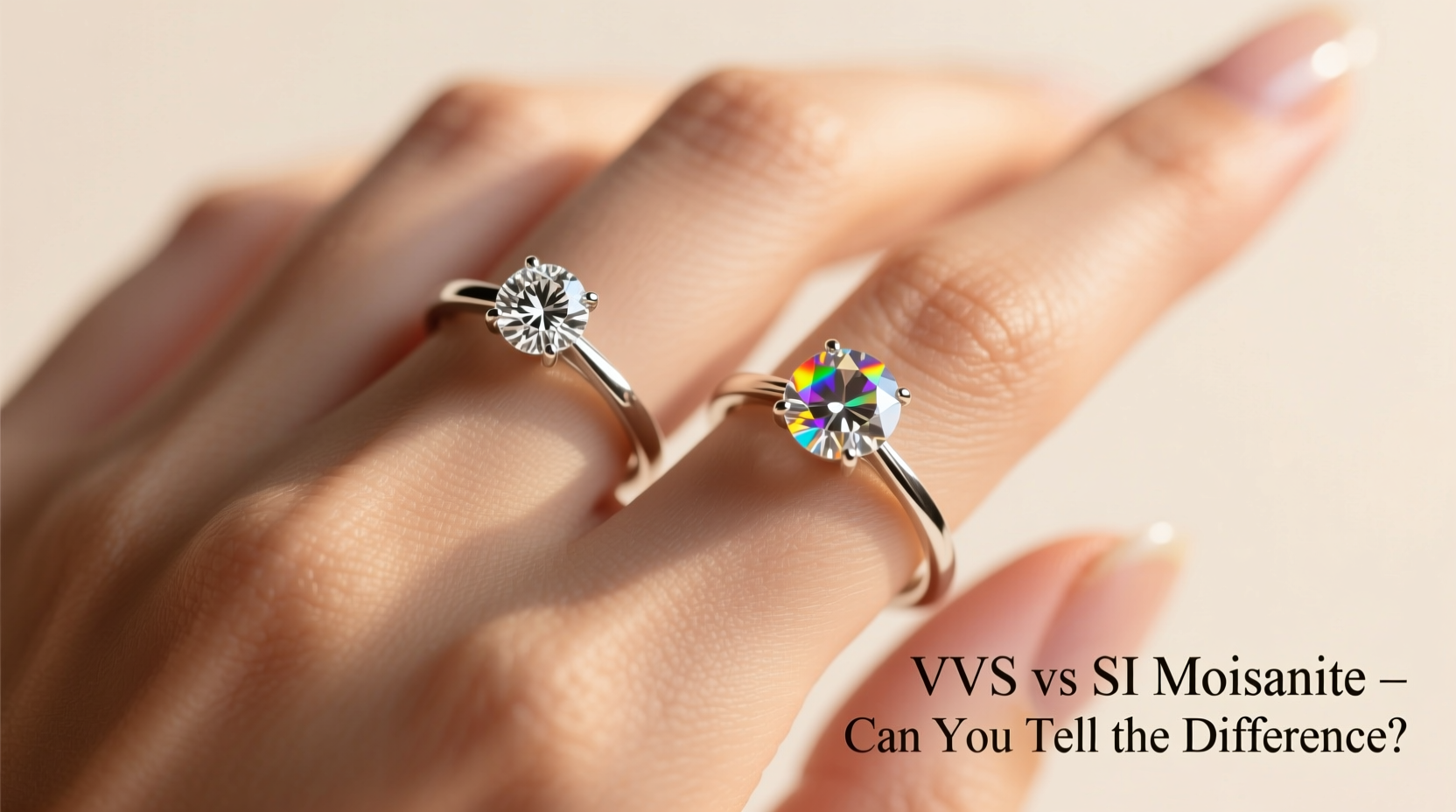
When shopping for a moissanite engagement ring, clarity is one of the first factors that comes into play—especially when comparing VVS (Very Very Slightly Included) and SI (Slightly Included) grades. With prices often differing significantly between these two, it’s natural to wonder: does the higher clarity actually matter? More importantly, will anyone—including you—really notice the difference once the ring is on your hand?
The short answer is no—not under normal circumstances. But understanding why requires looking beyond technical specifications and into how moissanite behaves in real life, how human eyes perceive detail, and what truly influences a ring’s brilliance.
Understanding Moissanite Clarity Grades
Unlike diamonds, which are graded on a strict GIA scale, moissanite clarity is typically assessed by manufacturers using diamond-like standards. VVS and SI are borrowed terms, but they apply differently due to moissanite’s unique composition.
Moissanite is a lab-created gemstone made of silicon carbide. Because it’s grown in controlled environments, most moissanite stones are inherently cleaner than even high-grade diamonds. That said, minor inclusions—such as tiny pinpoints or internal feathers—can still occur during crystallization.
- VVS Moissanite: Contains minute inclusions that are extremely difficult to detect, even under 10x magnification. Often marketed as “eye-clean” with near-perfect clarity.
- SI Moissanite: Has slight inclusions visible under magnification. In some cases, a trained eye might spot them at close range, but they rarely affect overall appearance.
Crucially, because moissanite has higher refractive index (2.65–2.69) than diamond (2.42), it disperses light more aggressively—creating more fire and sparkle. This intense brilliance often masks minor imperfections that would be more noticeable in a less fiery stone.
Tip: Focus on cut quality over clarity—poorly cut moissanite, even if VVS, will look duller than a well-cut SI stone.Will Anyone Notice the Difference on Your Finger?
In everyday settings—walking down the street, working at a desk, showing off your ring at dinner—no one will detect the difference between VVS and SI moissanite with the naked eye. Even up close, unless someone pulls out a jeweler’s loupe, inclusions in SI moissanite remain invisible to casual observers.
A study conducted by the Gemological Institute of America (GIA) found that the average person cannot reliably detect inclusions in stones smaller than 1 carat without magnification. Most moissanite engagement rings fall within the 0.75–2 carat range, meaning even SI-grade stones appear flawless in normal lighting and viewing distances.
“With high-refractive gemstones like moissanite, optical performance often overshadows clarity. A bright, well-proportioned SI stone can outshine a poorly performing VVS.” — Dr. Lena Torres, Gemologist & Materials Scientist
Real-World Example: Sarah’s Ring Choice
Sarah was set on a 1.5-carat round moissanite for her engagement ring. She initially leaned toward VVS, believing it was “premium.” After trying both VVS and SI versions side by side in natural light, she couldn’t tell them apart. Her jeweler explained that both were eye-clean and had identical cuts. She chose the SI option and saved $320—money she put toward a custom band design. A year later, no guest at her wedding, friend, or family member has ever questioned the stone’s quality. In fact, many assume it’s a high-clarity diamond.
Clarity Comparison Table: VVS vs SI Moissanite
| Feature | VVS Moissanite | SI Moissanite |
|---|---|---|
| Inclusions | Nearly undetectable, even under 10x magnification | Visible under magnification; usually not to naked eye |
| Price (Relative) | Higher (15–30% more than SI) | Lower, better value |
| Eye-Clean Appearance | Yes, consistently | Yes, in 95%+ of cases |
| Fire & Brilliance | Depends on cut, not clarity | Same potential as VVS if well-cut |
| Best For | Perfectionists, resale consideration | Budget-conscious buyers seeking maximum sparkle |
What Actually Affects How a Moissanite Looks on Hand?
While clarity grabs attention in product descriptions, several other factors have a far greater impact on how your ring appears in real life:
- Cut Quality: The proportions, symmetry, and polish determine how light enters and exits the stone. A superior cut maximizes brilliance and disguises any minor flaws.
- Setting Style: Prong settings expose more of the stone, enhancing sparkle. Bezel settings offer protection but may slightly reduce perceived fire.
- Finger Size & Skin Tone: Larger fingers may make inclusions harder to spot. Warmer skin tones can enhance the slight warmth in some moissanite, while cooler tones highlight its icy fire.
- Lighting Conditions: Natural daylight shows true color and sparkle. Indoor lighting, especially warm bulbs, may bring out faint hues in certain moissanite brands.
Step-by-Step Guide: Choosing Between VVS and SI Moissanite
Follow this practical sequence to make a confident decision without overspending:
- Define your budget. Determine how much you’re comfortable spending on the center stone.
- Prioritize cut over clarity. Look for ideal proportions, excellent symmetry, and top polish ratings.
- Compare SI and VVS side by side. If shopping online, request videos or high-res images in daylight.
- Ask about return policies. Ensure you can return or exchange the stone if it doesn’t meet expectations.
- Consider future resale. While rare, some buyers prefer VVS for perceived prestige if they anticipate selling later.
- Make your choice. In most cases, the SI grade offers indistinguishable beauty at a smarter price.
Frequently Asked Questions
Can a jeweler tell the difference between VVS and SI moissanite?
Only under magnification. A jeweler using a loupe can identify inclusions in SI stones, but even professionals can’t distinguish the grades just by looking at the ring on a hand.
Does SI moissanite get cloudy over time?
No. Unlike lower-quality cubic zirconia, moissanite does not cloud with age. Both VVS and SI grades retain their clarity and brilliance indefinitely with basic care.
Is VVS worth the extra cost?
Rarely. Unless you're particularly sensitive to perfection or plan to resell the stone, the added expense of VVS doesn't translate to visible improvement. You’re better off investing in a superior setting or larger carat size.
Final Verdict: Save Smarter, Sparkle Brighter
The idea that VVS moissanite is visibly superior to SI is largely marketing-driven. In reality, both grades deliver stunning, eye-clean beauty on the hand. The intense fire of moissanite overwhelms minor inclusions, and human vision simply isn’t equipped to detect microscopic features during everyday wear.
Choosing SI clarity isn’t compromising—it’s optimizing. You maintain identical visual impact while freeing up funds for a better band, an upgrade in carat weight, or even a honeymoon experience. Smart jewelry choices aren’t about chasing the highest grade label; they’re about maximizing joy per dollar spent.
“The most beautiful ring is the one that brings joy every time you glance at your hand—not the one with the fanciest certificate.” — Rafael Nguyen, Independent Jewelry Designer🚀 Ready to make a confident choice? Reallocate your clarity budget toward what truly matters—design, cut, and personal meaning. Your ring should reflect your story, not just a spec sheet.









