When it comes to making a bold impression in men’s or women’s tailoring, few garments command attention like a well-chosen blazer or jacket. Among the most distinctive options are the velvet blazer and the tweed jacket—two pieces rooted in tradition yet capable of delivering modern impact. While both offer texture, depth, and character, they speak different design languages and serve distinct aesthetic purposes. Choosing between them isn’t just about preference—it’s about understanding context, occasion, and personal style.
The question isn't simply which looks better, but which makes a stronger fashion statement. That distinction hinges on presence, intention, and how each fabric interacts with light, setting, and cultural connotation. To answer this definitively, we must examine their histories, tactile qualities, versatility, and how they’re perceived across settings—from boardrooms to cocktail parties.
The Texture Divide: Luminous Opulence vs Rustic Craftsmanship
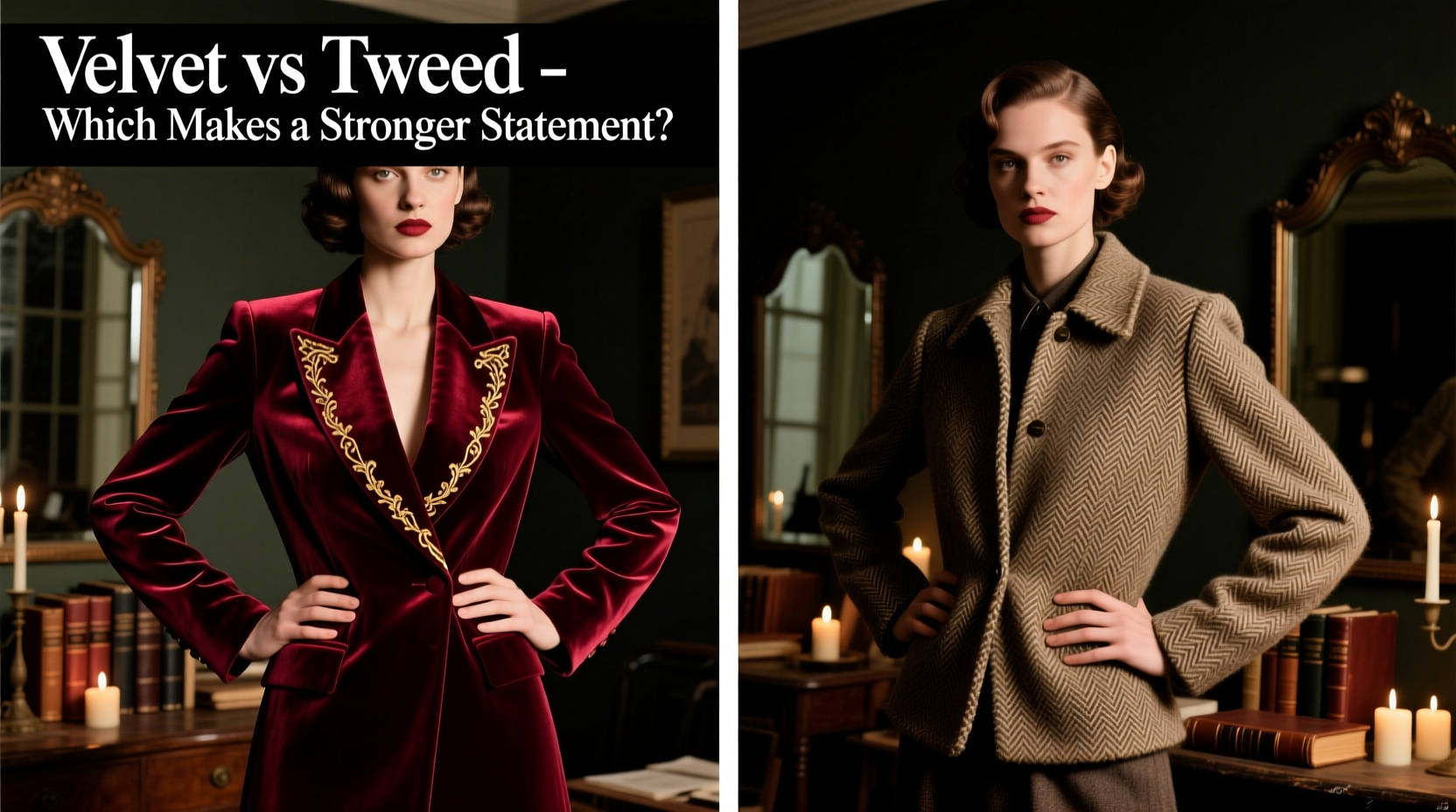
Venetian palazzos, 1970s disco lounges, and red carpet galas have all played host to the velvet blazer. Its surface is defined by a dense pile that reflects light dynamically, shifting in appearance depending on the angle. This lustrous quality gives velvet an immediate sense of luxury and drama. When tailored into a structured blazer, the contrast between its softness and sharp lines creates visual tension—a hallmark of strong design statements.
Tweed, by contrast, is inherently earthy. Woven from coarse wool, often in herringbone or check patterns, it evokes countryside estates, academic tradition, and rugged elegance. The fabric absorbs light rather than reflecting it, grounding the wearer in a sense of authenticity and heritage. A tweed jacket rarely shouts; instead, it whispers authority through craftsmanship and material honesty.
Tip: Velvet gains strength in low-light environments—think evening events—where its sheen becomes magnetic. Tweed excels in daylight, where its intricate weave reveals subtle detail.Historical Context: From Aristocracy to Academia
Venetian nobility wore velvet as early as the 13th century, using it to signify wealth and exclusivity. By the 18th century, European courts adopted richly colored velvet coats as symbols of status. In the 20th century, icons like David Bowie and Mick Jagger revived the velvet blazer as a tool of rebellion and theatricality. It became synonymous with artistic flair and gender-fluid expression—particularly in deep jewel tones like emerald, burgundy, or midnight blue.
Tweed’s roots lie in rural Scotland and Ireland, where it was developed for durability in harsh climates. The term itself comes from the River Tweed, but its association with British country life solidified in the 19th century. Landowners, hunters, and later university dons embraced tweed for its practicality and understated dignity. Today, it remains a staple of intellectual and conservative aesthetics, often seen in academia, law, and traditional menswear circles.
“Velvet announces arrival. Tweed suggests quiet competence. One says ‘Look at me.’ The other says ‘I belong here.’ Both are powerful—but in opposite directions.” — Julian Hart, Fashion Historian & Curator at the London Institute of Tailoring
Styling Scenarios: Where Each Jacket Shines
The strength of a fashion statement isn’t measured in volume alone, but in appropriateness and memorability within a given context. A velvet blazer worn to a garden party may seem out of place, while a tweed jacket at a black-tie gala could appear underdressed. Let’s break down real-world applications.
Evening Events & Creative Gatherings
In dimly lit venues—cocktail parties, art openings, music performances—the velvet blazer asserts dominance. Its reflective surface catches candlelight and chandeliers, drawing eyes without effort. Pair it with slim black trousers, a crisp white shirt, and polished oxfords (or loafers for a modern twist), and you project confidence layered with creativity.
A deep plum or forest green velvet blazer, especially in a shawl collar silhouette, recalls tuxedo jackets without mimicking them—making it ideal for “black tie optional” dress codes where individuality is rewarded.
Daytime Professional or Academic Settings
Here, the tweed jacket prevails. Its textured weave conveys seriousness and thoughtfulness. A herringbone brown or grey tweed paired with a turtleneck or button-down shirt communicates reliability and depth. In universities, editorial offices, or architecture firms, this look signals respect for tradition without appearing outdated.
Unlike velvet, which can feel costumey if not styled carefully, tweed integrates seamlessly into professional wardrobes. Add leather brogues and a wool scarf, and the ensemble feels both complete and timeless.
Seasonal Suitability
Versatility matters when evaluating impact. Tweed dominates autumn and winter due to its warmth and weather resistance. It pairs naturally with overcoats, flannel shirts, and boots. Velvet, though insulating, is more delicate and best reserved for indoor events during cooler months. Wearing a velvet blazer in direct rain or high humidity risks water spots and crushing the pile.
Tip: Always hang a velvet blazer on a wide-padded hanger to preserve shoulder shape and avoid creasing the nap.Comparative Analysis: Strength of Statement by Category
| Category | Velvet Blazer | Tweed Jacket |
|---|---|---|
| Visual Impact | High – Reflective, luxurious, eye-catching | Moderate – Subtle texture, nuanced patterns |
| Occasion Flexibility | Limited – Best for evening, creative, or festive events | High – Suitable for day, work, casual, and semi-formal |
| Cultural Symbolism | Drama, artistry, indulgence | Heritage, intellect, tradition |
| Wearability | Low – Requires careful handling and climate control | High – Durable, easy to maintain, seasonally versatile |
| Fashion Risk | High – Can appear excessive if mismatched | Low – Rarely misjudged when styled appropriately |
| Statement Strength | Stronger in short bursts – Immediate, unforgettable impact | Stronger over time – Builds credibility and consistency |
This comparison reveals a key insight: the velvet blazer wins in terms of raw, instantaneous statement power. It’s the equivalent of a bold headline in a magazine—designed to stop scrolling. The tweed jacket, however, functions more like a well-written essay—its influence grows with prolonged exposure.
Real-World Example: Two Professionals at a Gala
Consider two attendees at a charity gala: Marcus and Elena.
Marcus arrives in a deep navy velvet blazer with satin lapels, tailored to perfection. He wears it with black cigarette pants and patent loafers. As he enters the ballroom, multiple guests turn to look. A photographer snaps his photo unprompted. By midnight, three people have asked where he bought it. His jacket dominates conversation.
Elena wears a charcoal herringbone tweed jacket with a cream silk shell beneath. Her look is refined, slightly androgynous, grounded. She speaks on a panel about sustainable fashion. Throughout the evening, several professionals approach her for advice. One editor notes her “effortless authority” in a post-event recap.
Who made the stronger fashion statement? Marcus was more memorable in the moment. Elena was more influential in substance. If impact is defined by visibility, Marcus wins. If it’s defined by lasting impression and alignment with identity, Elena’s choice resonates deeper.
How to Wear Each for Maximum Effect
Neither garment achieves its full potential without thoughtful styling. Here’s how to elevate each for maximum impact.
Wearing a Velvet Blazer with Confidence
- Limit competing textures. Pair with smooth fabrics—silk, cotton poplin, or fine merino—to let the velvet stand out.
- Avoid loud patterns. Keep shirts and trousers neutral. A velvet blazer is the centerpiece; everything else should support it.
- Choose rich, saturated colors. Jewel tones enhance the fabric’s opulence. Black velvet can work, but risks blending into standard formalwear unless details (like peak lapels) distinguish it.
- Keep accessories minimal. A simple watch, cufflinks, or a pocket square in complementary color. Over-accessorizing distracts from the main event.
- Never machine wash. Dry clean only, and store flat or on a padded hanger away from moisture.
Wearing a Tweed Jacket with Authority
- Embrace pattern mixing—carefully. A subtle windowpane tweed pairs well with a micro-check shirt. Avoid clashing large motifs.
- Layer thoughtfully. A turtleneck adds modernity; a vest enhances formality. Avoid bulky sweaters underneath that distort the cut.
- Match footwear to the setting. Brogues or derbies for business-casual; suede chukkas for weekend outings.
- Let it age gracefully. Tweed develops a patina. Slight fading or wear adds character, unlike velvet, which degrades visibly when damaged.
- Brush regularly. Use a clothes brush to remove dust and maintain the fabric’s loft.
Checklist: Choosing Between Velvet and Tweed
- ✅ Is the event indoors and evening-focused? → Velvet blazer
- ✅ Do you want to be noticed immediately? → Velvet blazer
- ✅ Is the setting professional, academic, or daytime? → Tweed jacket
- ✅ Are you aiming for long-term wardrobe value? → Tweed jacket
- ✅ Do you prioritize ease of care and durability? → Tweed jacket
- ✅ Are you expressing creativity or theatrical flair? → Velvet blazer
Frequently Asked Questions
Can I wear a velvet blazer to work?
Only in highly creative industries (e.g., fashion, entertainment, design) and even then, sparingly. In conservative fields, it may be perceived as inappropriate or distracting. If attempted, pair it with muted tones and minimal embellishment to tone down the drama.
Is tweed outdated?
No. While associated with tradition, tweed has been reinterpreted by designers like Alessandro Michele at Gucci and Jonathan Anderson at Loewe. Modern cuts—cropped silhouettes, oversized fits, unexpected color dyes—keep tweed relevant. It’s less about the fabric and more about how it’s styled.
Can women wear velvet blazers or tweed jackets effectively?
Absolutely. Both fabrics transcend gender norms. Women have long used tailored jackets to assert presence in male-dominated spaces. A velvet blazer in wine red or teal can be empowering on stage or at a gala. A tailored tweed jacket with wide-leg trousers projects leadership and sophistication.
Final Verdict: Which Makes the Stronger Statement?
The velvet blazer makes the stronger *immediate* fashion statement. There is no fabric quite like it in its ability to captivate under light, to signal deviation from the norm, and to embody unapologetic self-expression. It is fashion as performance—a declaration of intent.
However, the tweed jacket makes the stronger *enduring* statement. It builds trust, commands respect, and aligns the wearer with enduring values: craftsmanship, intellect, resilience. Its power lies not in surprise, but in consistency.
If your goal is to be remembered in a single night, choose velvet. If your aim is to be respected across seasons and settings, choose tweed. The truly stylish know that sometimes, the boldest move isn’t to stand out—but to belong so completely that no explanation is needed.
“The strongest fashion statements aren’t always the loudest. Sometimes, they’re the ones that change how people see you—not just once, but every time.” — Naomi Pierce, Style Editor, *The Wardrobe Review*
Take Action: Define Your Statement
Don’t default to what’s safe. Ask yourself: What do I want people to feel when I walk into a room? Excitement? Respect? Curiosity? Choose your jacket accordingly. Try a velvet blazer for your next creative event. Invest in a classic tweed for daily influence. Better yet, own both—and master the art of strategic sartorial messaging.
💬 Which jacket aligns with your personal brand—velvet or tweed? Share your thoughts and styling tips in the comments below.