Finding the right jacket isn’t just about style—it’s about fit. A well-fitted jacket enhances posture, flatters your shape, and provides comfort and confidence in every movement. Yet, too many women settle for off-the-rack sizes that don’t align with their actual measurements. Whether you’re shopping online, ordering custom tailoring, or altering an existing piece, accurate body measurements are essential. This guide walks you through every step of measuring for a women’s jacket with precision, offering practical advice, real-world examples, and expert insights to ensure a flawless fit.
Why Accurate Measurements Matter
Standard clothing sizes vary widely between brands and countries, making them unreliable as standalone indicators. One brand’s size 8 may fit like another’s 10, especially across different garment types. Jackets, in particular, require precise alignment across shoulders, chest, waist, and sleeve length to maintain structure and proportion.
A poorly fitting jacket can bunch at the back, pull across the chest, restrict arm movement, or create unflattering gaps at the neckline. On the other hand, a properly measured and fitted jacket drapes cleanly, follows your natural contours, and elevates any outfit.
“Fit is the foundation of fashion. No amount of fabric or design can compensate for incorrect proportions.” — Lena Moreau, Master Tailor & Fit Consultant
Essential Tools for Accurate Measurement
Before taking measurements, gather the right tools:
- Tailor’s tape measure: Flexible and marked in both inches and centimeters.
- Mirror: Helps ensure the tape is level and positioned correctly.
- Fitting clothes: Wear form-fitting garments similar to what you’ll wear under the jacket.
- Pencil and paper: Record each measurement immediately.
- Assistant (optional but recommended): Some areas, like back length or shoulder width, are easier to measure with help.
Step-by-Step Guide to Measuring Key Areas
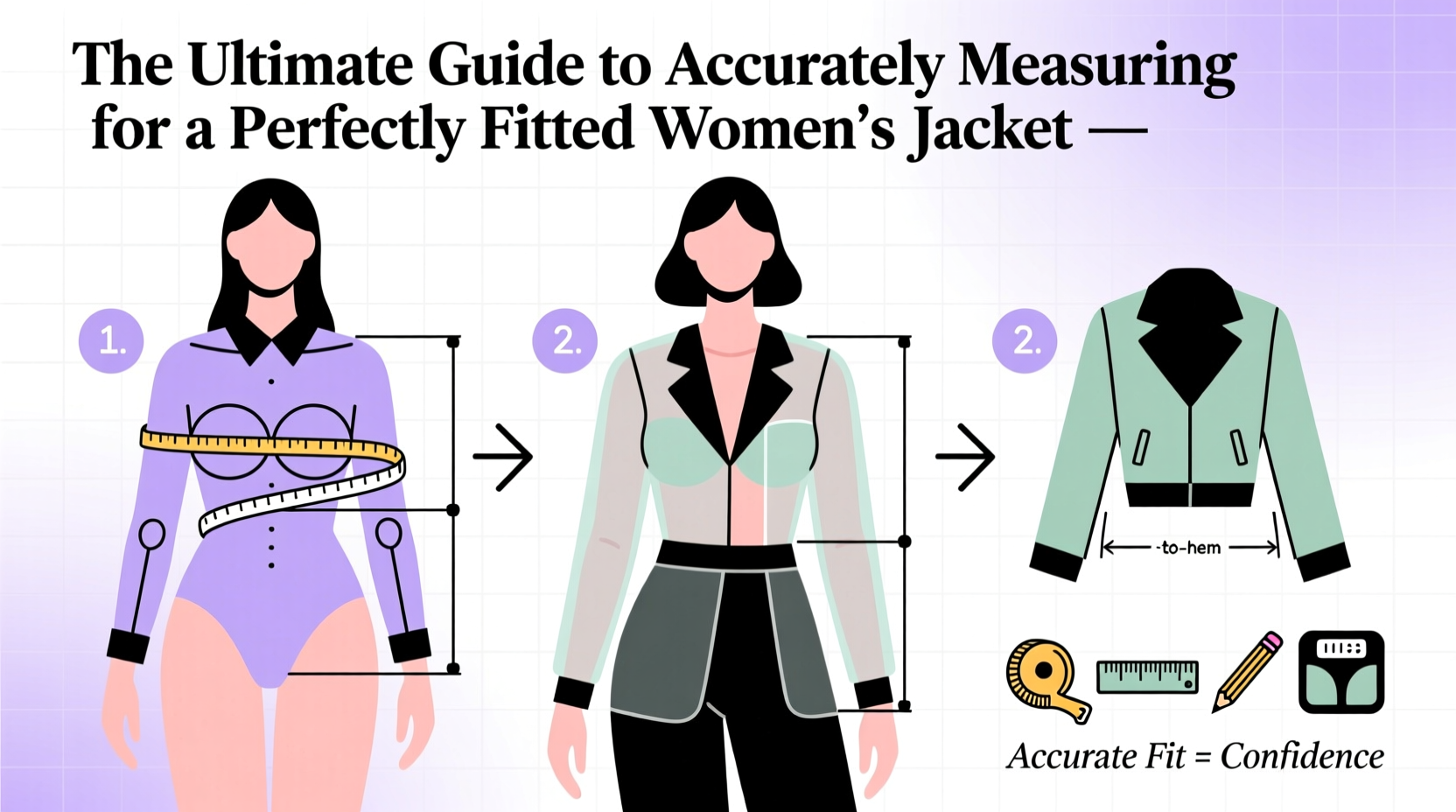
To achieve a tailored fit, measure these seven critical zones. Stand naturally—do not suck in your stomach or puff out your chest—and keep arms relaxed at your sides.
- Bust: Wrap the tape around the fullest part of the bust, typically at nipple level. Keep the tape parallel to the floor. Don’t hold your breath; breathe normally.
- Waist: Locate your natural waist—the narrowest part of your torso, usually just above the navel. The tape should sit snugly without digging in.
- Hips: Measure around the fullest part of the hips and buttocks, keeping the tape horizontal. This ensures the jacket hem won’t ride up.
- Shoulder width: From the edge of one shoulder bone (acromion) to the other, across the back. This determines whether the jacket’s shoulder seams will align correctly.
- Sleeve length: Start at the shoulder bone, go over the elbow, and extend to the wrist bone (for standard jackets) or slightly beyond (for longer styles). Bend your arm slightly for accuracy.
- Chest (high bust): Taken just under the armpits and across the upper chest, this helps differentiate between bust and chest volume—critical for avoiding gapping at the buttons.
- Back length: From the base of the neck (C7 vertebra) down the spine to the desired jacket hem. For hip-length jackets, stop at the top of the hip bone.
Common Fitting Challenges and How Measurements Solve Them
Different body shapes present unique challenges when it comes to jackets. Here’s how precise measurements address common issues:
| Body Type | Fitting Challenge | Measurement Solution |
|---|---|---|
| Pear-shaped | Jacket tight at hips, loose at chest | Measure full hip circumference to ensure adequate lower sweep |
| Apple-shaped | Tension across midsection and back | Compare high bust vs. full bust; prioritize ease in the upper torso |
| Hourglass | Lack of waist definition | Use exact waist measurement to tailor darts or shaping seams |
| Rectangle | Boxy appearance, no structure | Emphasize shoulder width and sleeve length to add balance |
Mini Case Study: Sarah’s Custom Blazer Journey
Sarah, a 34-year-old attorney, ordered a custom wool blazer online using only her dress size. When it arrived, the shoulders were too wide, the sleeves too long, and the waist too loose. Frustrated, she visited a local tailor who re-measured her. The issue? Her shoulder width was narrower than standard sizing assumed, and her torso was shorter than average. With corrected measurements—particularly back length and shoulder span—a new pattern was drafted. The second blazer fit impeccably, enhancing her professional presence without restricting movement during long court days.
Checklist: Pre-Measurement Preparation
Follow this checklist before you begin measuring:
- Wear smooth, close-fitting clothing (no bulky layers)
- Stand on a hard, flat surface
- Keep feet shoulder-width apart
- Ensure the tape measure is not twisted
- Have someone assist with back measurements if possible
- Record all numbers immediately after taking them
- Double-check each measurement for consistency
Do’s and Don’ts of Jacket Measurement
| Do’s | Don’ts |
|---|---|
| Measure over the undergarments you typically wear | Don’t measure over thick sweaters or padded bras |
| Use a flexible, non-stretch tape measure | Don’t use a metal ruler or rigid yardstick |
| Take measurements in front of a mirror | Don’t twist the tape or angle it diagonally |
| Allow 1–2 inches of ease for comfort and layering | Don’t aim for zero ease unless designing a compression garment |
“Most fit problems originate from inaccurate initial measurements—not poor construction.” — Rafael Torres, Bespoke Menswear & Womenswear Designer
FAQ: Common Questions About Measuring for Jackets
How much ease should I add to my measurements?
For a classic tailored jacket, add 2–3 inches to your bust measurement for comfort and layering. Slim-fit styles may require only 1–2 inches. Always consider the fabric: structured wools need more ease than stretch blends.
Can I measure myself alone?
You can self-measure for basic dimensions like bust, waist, and hips. However, back length, shoulder width, and sleeve curve are best taken by someone else for accuracy. If alone, use a full-length mirror and mark reference points lightly with chalk.
What if my measurements fall between sizes?
Always size up rather than down. It’s easier to alter a jacket that’s slightly large than to stretch one that’s too tight. Focus on the most critical area—usually the shoulders—as they cannot be easily adjusted.
Final Steps: Using Your Measurements Effectively
Once you’ve recorded your numbers, organize them clearly. Share them with tailors, stylists, or online retailers that offer size guides. Many made-to-order brands allow input of custom measurements for personalized patterns.
If buying off-the-rack, compare your measurements directly to the brand’s size chart—don’t assume your usual size applies. Pay attention to garment-specific details like center back length, sleeve inseam, and shoulder drop.
Conclusion
A perfectly fitted women’s jacket transforms not just your wardrobe, but your confidence. By investing time in accurate, thoughtful measurement, you unlock access to better-fitting clothing, reduced returns, and garments that truly reflect your personal style. Whether you're updating your workwear, investing in a winter coat, or commissioning a bespoke piece, precise data is your most powerful tool.
🚀 Start today: Pull out that tape measure, take your numbers, and never guess your size again. Share your experience or ask questions in the comments—let’s build a smarter approach to fit, one measurement at a time.