A minimalist capsule wardrobe is more than just a trend—it’s a lifestyle choice rooted in intentionality, sustainability, and personal clarity. The goal isn’t to wear fewer clothes out of restriction, but to wear better clothes that reflect who you are and serve your daily life. Yet many people abandon the idea after a few weeks, citing boredom or lack of variety. The truth? A well-designed capsule doesn’t sacrifice style for simplicity. When built thoughtfully, it offers endless combinations, reduces decision fatigue, and actually enhances self-expression.
This guide walks through a practical, sustainable approach to creating a capsule wardrobe that feels fresh, expressive, and deeply personal—without ever feeling repetitive.
1. Understand the Philosophy Behind Minimalism (And Avoid the Pitfalls)
Minimalism in fashion isn’t about owning ten identical black turtlenecks. It’s about curation: identifying what truly works for your body, lifestyle, and aesthetic, then eliminating everything else. The most common reason capsules fail is that they’re built on external ideals rather than internal alignment. You might see influencers wearing all-neutral palettes, but if bold colors energize you, forcing yourself into beige will feel stifling.
The key is balance: minimal in quantity, rich in quality and expression. As designer and slow-fashion advocate Anya Cheng puts it:
“Minimalism isn’t subtraction for the sake of emptiness. It’s editing with purpose so that what remains speaks louder.” — Anya Cheng, Sustainable Fashion Designer
To avoid burnout, start by defining what “minimalist” means for *you*. Is it 30 items? 40? Does it include outerwear and shoes? Are workout clothes separate? There are no universal rules—only personal ones.
Tip: Define your capsule size based on your climate and routine. Urban professionals may need fewer seasonal changes than parents in variable weather.2. Audit Your Current Wardrobe With Fresh Eyes
Before adding anything new, assess what you already own. This isn’t just a clean-out—it’s a diagnostic tool. Pull every clothing item from your closet and lay them out where you can see them all at once. Then, sort each piece into one of four categories:
- Loved & Worn: Items you reach for regularly and feel confident in.
- Liked But Not Loved: Clothes you keep “just in case,” but rarely wear.
- Kept for Sentiment: Pieces tied to memories but not suited to your current style.
- Neglected: Items untouched for over a year.
Pay attention to patterns. Which silhouettes do you gravitate toward? What colors appear most often in your “loved” pile? Are there gaps—like a missing blazer or versatile dress?
This audit reveals your authentic style preferences, not aspirational ones. Many people discover they’re drawn to relaxed tailoring or earth tones, even if they’ve been chasing trends online.
Common Mistakes During the Audit
| Mistake | Why It Happens | Better Approach |
|---|---|---|
| Holding onto “investment” pieces that don’t fit | Guilt over spending money | Donate or resell; true value comes from use, not ownership |
| Keeping items “for later” (e.g., post-pregnancy, weight loss) | Emotional attachment to future selves | Focus on dressing the body you have now |
| Ditching everything colorful because “minimalist = neutral” | Misunderstanding the trend | Include colors that energize you—even if they’re bright |
After sorting, set aside the “neglected” and “liked but not loved” piles. Revisit them in two weeks. If you haven’t missed anything, let them go. This creates space—both physically and mentally—for intentional additions.
3. Define Your Style Pillars and Daily Needs
Your capsule should reflect your life, not an Instagram grid. Start by outlining your non-negotiables:
- How many workdays per week?
- Do you commute, walk frequently, or drive?
- What’s your dominant climate?
- Are weekends active, social, or home-focused?
Then, identify three to five style pillars—core aesthetics that define your ideal wardrobe. These aren’t trends, but enduring themes. Examples:
- Modern Classic (tailored trousers, silk blouses, structured coats)
- Relaxed Elegance (linen, oversized knits, muted tones with texture)
- Urban Edge (black denim, leather accents, monochrome layers)
- Warm Minimalism (creams, rusts, oatmeals, natural fabrics)
These pillars become filters for every future purchase. They also help mix and match cohesively, since all pieces share a design language.
Tip: Take photos of your favorite outfits over two weeks. Look for recurring elements—those are clues to your real style.4. Build the Capsule: A 7-Step Process
Now, assemble your capsule using this structured approach. Aim for 30–50 core items depending on season and lifestyle. Include tops, bottoms, dresses, outerwear, and layering pieces—but exclude underwear, sleepwear, and workout gear unless worn publicly.
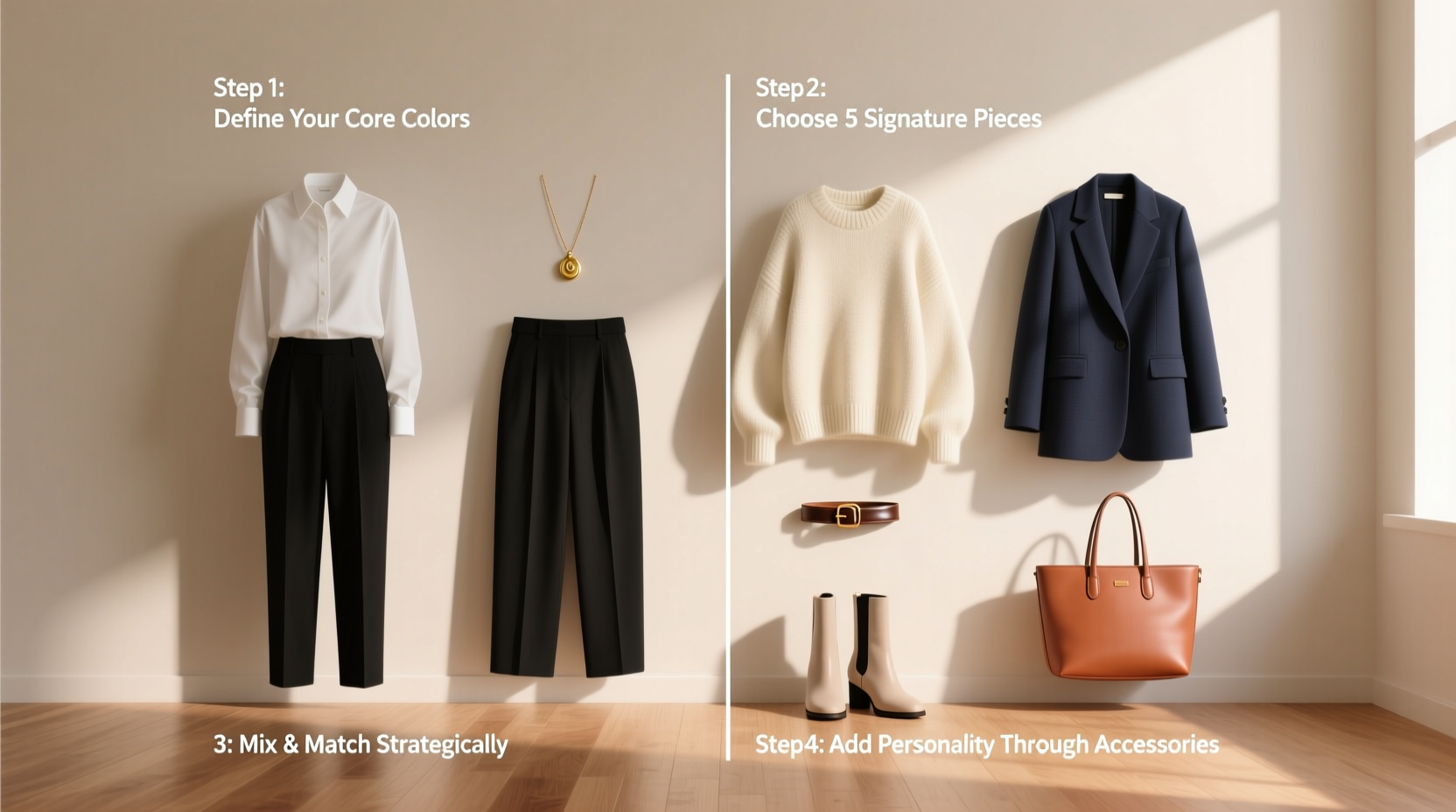
- Select a cohesive color palette. Choose 1–2 neutrals (e.g., charcoal, camel, cream) and 2–3 accent colors (e.g., olive, rust, navy). Ensure all colors coordinate so any top can pair with any bottom.
- Pick foundational basics. Start with high-quality essentials: a white button-down, dark jeans, black trousers, a neutral sweater, and a little black dress. These form the base of 80% of your outfits.
- Add signature statement pieces. Include 2–3 items with character: a patterned scarf, embroidered jacket, or textured coat. These prevent visual monotony.
- Incorporate varied textures. Mix linen, wool, cotton, and silk. Even within a neutral palette, texture adds depth and interest.
- Ensure layering compatibility. Test combinations: does your blazer fit over your chunky knit? Can your trench be worn over dresses? Layering multiplies outfit options.
- Limit footwear to 5–7 pairs. Focus on versatility: ankle boots, loafers, white sneakers, block heels, and one seasonal standout (e.g., sandals).
- Include one “joy” item. Something purely fun—a sequined top, red pants, or printed shirt. Boredom kills capsules; joy sustains them.
The result should be a collection where every piece works with at least three others. Use a simple chart to track combinations:
| Item | Neutrals It Pairs With | Accent Colors That Work | Layering Partners |
|---|---|---|---|
| Cream Wool Coat | Charcoal, Black, Beige | All | Sweaters, Dresses, Blouses |
| Olive Turtleneck | Beige, Black | Rust, Cream | Blazer, Denim Jacket |
| Black Wide-Leg Pants | All | Navy, Rust | Blazers, Knits, Button-Downs |
5. Keep It Dynamic: Rotate and Refresh Strategically
A static wardrobe grows stale. The secret to avoiding boredom is intentional rotation and micro-updates. Treat your capsule like a living system, not a fixed rule.
Seasonal transitions are ideal moments to reassess. Store off-season items properly (clean, folded or hung, in breathable containers), then re-evaluate what stayed in rotation during the previous season. Did that striped tee get worn only twice? Maybe it doesn’t earn its spot.
Introduce change through “capsule expansions”—small, deliberate additions. Allow yourself 1–2 new pieces per season, but only if they meet these criteria:
- Fills a functional gap (e.g., a raincoat for spring)
- Complements at least four existing items
- Is made from durable, ethical materials
- Excites you when you wear it
This controlled growth keeps the wardrobe feeling fresh without tipping into clutter.
“The best capsule wardrobes evolve slowly. They’re not frozen in time—they mature with you.” — Julian Reed, Wardrobe Consultant
Mini Case Study: Maya’s Transition to a Living Capsule
Maya, a 34-year-old project manager in Portland, tried a 30-item capsule twice before—it failed both times. The first attempt was too rigid (all black and gray); the second lacked structure (she kept adding pieces). On her third try, she followed the steps above.
She started by auditing her closet and discovered she loved soft textures and earth tones but avoided them, thinking they weren’t “professional.” She defined her style pillars as “Earthy Professional” and “Cozy Refined,” then built a 38-piece capsule around warm beige, olive, and deep rust.
She included a cream linen blazer, a rust silk blouse, and a pair of wide-leg taupe trousers as anchors. For joy, she added a vintage brooch and a pair of embroidered flats. By focusing on fabric diversity—linen, merino, organic cotton—her outfits felt distinct day to day.
Eight months later, she’s worn 90% of her capsule consistently. She rotates in a lightweight trench for rainy seasons and swapped in a cropped knit for summer. “I’m not bored,” she says. “If anything, I feel more creative because I know my pieces so well.”
6. Frequently Asked Questions
Can a capsule wardrobe work for social events or travel?
Absolutely. The key is versatility. A silk blouse can transition from office to dinner with a change of accessories. Packable layers like a tailored vest or foldable tote expand options without bulk. For travel, choose pieces that mix, match, and resist wrinkles.
What if my workplace has varying dress codes?
Design zones within your capsule. Have two or three elevated pieces (blazer, sheath dress) for formal days, and relaxed staples (cotton shirts, chinos) for casual Fridays. Accessories like belts or jewelry can shift the tone of an outfit instantly.
How do I avoid feeling “samey” in photos or on video calls?
Vary your styling, not your wardrobe. Roll sleeves, tuck tops differently, layer with scarves or vests. Also, play with proportions—one day wear a tucked-in shirt with high-waisted pants, the next leave it loose over leggings. Small changes create visual distinction.
Checklist: Building Your Non-Boring Capsule
- Conduct a full wardrobe audit and remove underused items
- Define your lifestyle needs and style pillars
- Create a harmonious color palette with 1–2 neutrals + 2–3 accents
- Select 5–7 foundational basics that mix easily
- Add 2–3 statement or joy-driven pieces for personality
- Incorporate diverse textures (knit, silk, linen, etc.)
- Test layering combinations for seasonal adaptability
- Limit shoes to 5–7 highly versatile pairs
- Plan one seasonal refresh per year with 1–2 new items
- Take monthly outfit photos to monitor wear patterns
Conclusion: Wear With Confidence, Not Constraint
A minimalist capsule wardrobe shouldn’t feel like a uniform. When built with self-awareness, it becomes a tool for greater freedom—freedom from decision fatigue, impulse buys, and the anxiety of an overstuffed closet. The most stylish people aren’t those with the most clothes, but those who know how to wear what they have with intention and flair.
Your wardrobe should reflect your present life, not someone else’s ideal. By focusing on fit, fabric, and personal resonance, you create a collection that feels limitless despite its limits. Start small, stay curious, and allow room for evolution. The goal isn’t perfection—it’s coherence with a pulse.
💬 Ready to build your capsule? Begin with the audit today. Share your style pillars or favorite combination in the comments—your insight might inspire someone else to start fresh.