
For years, athletes and fitness enthusiasts have trusted chest straps as the gold standard for heart rate monitoring. But with rapid advancements in optical sensor technology, today’s smartwatches claim to deliver comparable accuracy—without the discomfort of a tight band around your ribs. So, is the smartwatch really good enough now? The answer depends on how you train, what metrics matter most, and how much precision you demand.
Modern smartwatches from brands like Apple, Garmin, Samsung, and Fitbit use photoplethysmography (PPG) sensors to detect blood flow changes beneath the skin. These optical sensors shine green LEDs into capillaries and measure reflected light to estimate pulse. While convenient and non-intrusive, this method has inherent limitations compared to electrocardiographic (ECG) signals captured by chest straps. Let’s break down where each excels—and where compromises exist.
How Heart Rate Monitoring Works: Two Different Technologies
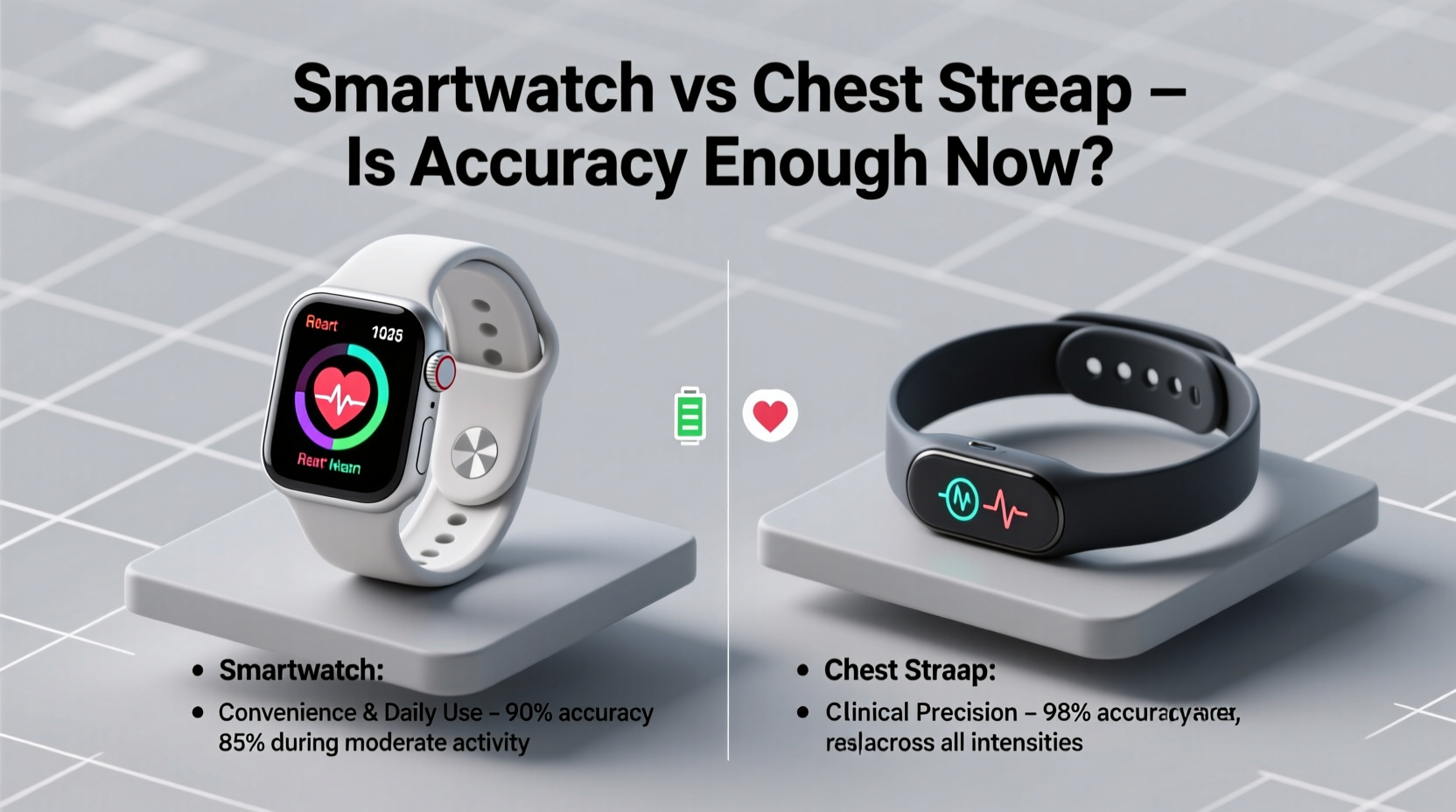
Chest straps rely on electrical signals. They use electrodes to detect the tiny electrical impulses generated by the heart with every beat—essentially functioning like a simplified ECG. This method captures millisecond-level timing between beats, enabling highly accurate measurement of both resting heart rate and rapid fluctuations during intense intervals.
Smartwatches, on the other hand, use optical sensors. These emit light into the skin and detect variations in blood volume under the wrist. Because the signal must pass through layers of tissue and bone, it's more prone to motion artifacts, ambient light interference, and inconsistent contact due to sweat or movement.
Despite these challenges, recent improvements in algorithms, multi-wavelength LEDs (green, red, infrared), and motion compensation have significantly narrowed the gap. For casual users and steady-state cardio, modern smartwatches often perform within ±5 bpm of chest straps. But when intensity spikes or grip changes (e.g., weightlifting, cycling), discrepancies can widen.
“Optical sensors have made huge strides, but they still struggle with dynamic efforts. If you're doing HIIT or zone-based training, a chest strap remains the most reliable tool.” — Dr. Lena Torres, Exercise Physiologist at Stanford Sports Medicine
Accuracy Comparison: Real-World Scenarios
To understand the practical differences, consider three common workout types:
| Workout Type | Smartwatch Accuracy | Chest Strap Accuracy | Notes |
|---|---|---|---|
| Jogging (steady pace) | High | Very High | Minimal lag; consistent readings after warm-up |
| HIIT / Interval Training | Moderate to Low | Very High | Smartwatches lag during rapid HR changes by 5–10 seconds |
| Weightlifting | Poor | Very High | Arm movement disrupts optical signal; chest strap unaffected |
| Cycling (on bike handlebars) | Low to Moderate | Very High | Reduced blood flow in cold hands; gloves worsen signal |
| Resting / Sleep Tracking | High | Very High | Both excellent for overnight trends and HRV analysis |
The table shows a clear pattern: smartwatches perform best during rhythmic, low-to-moderate intensity activities with stable wrist positioning. Chest straps maintain high fidelity across all conditions because they’re less affected by limb movement or peripheral circulation issues.
Tip: For better optical readings, wear your smartwatch snugly—about one finger width above the wrist bone—and avoid over-tightening which restricts blood flow.When Smartwatches Fall Short: Key Limitations
While convenience is undeniable, there are specific scenarios where smartwatches fail to match chest strap reliability:
- Lag in response time: Optical sensors average data over several seconds, making them poor at capturing instantaneous heart rate spikes or drops.
- Skin tone and tattoos: Some studies suggest darker skin pigmentation or wrist tattoos can interfere with light absorption, reducing accuracy.
- Cold environments: Reduced peripheral circulation in cold weather diminishes signal strength.
- Non-rhythmic movements: Activities like boxing, kettlebell swings, or resistance training cause arm motion that distorts readings.
A 2023 study published in the *Journal of Medical Internet Research* tested eight popular smartwatches against medical-grade chest straps across 120 participants. During sprint intervals, average deviation reached 18 bpm, with some devices missing peak heart rates entirely. In contrast, chest straps maintained sub-3 bpm error throughout.
Hybrid Approach: Best of Both Worlds?
You don’t necessarily have to choose one or the other. Many fitness platforms—including Garmin Connect, Polar Flow, and Strava—support external Bluetooth heart rate monitors while using the smartwatch as a display and GPS tracker.
This hybrid setup lets you enjoy the full interface, notifications, and long-term tracking of a smartwatch while relying on a chest strap for precise biometrics. Devices like the Polar H10 or Garmin HRM-Pro+ even offer advanced metrics such as running dynamics and VO₂ max estimation, which require chest-based ECG-quality input.
If you already own a chest strap, pairing it with your smartwatch via ANT+ or Bluetooth turns your wearable into a true performance hub—without sacrificing comfort during daily wear.
Step-by-Step: Pairing a Chest Strap with Your Smartwatch
- Ensure your chest strap is charged (if rechargeable) or has a fresh battery.
- Moisten the electrodes slightly with water for better conductivity.
- Turn on the chest strap and position it snugly below the pectoral muscles.
- On your smartwatch, go to Settings → Sensors or Connected Devices.
- Select “Heart Rate Monitor” and search for available devices.
- Choose your chest strap from the list (e.g., “Polar H10”) and confirm pairing.
- Start a workout—the watch will now use the chest strap data instead of its optical sensor.
Who Should Still Use a Chest Strap?
Not everyone needs lab-grade accuracy. Here’s a checklist to help determine if a chest strap is worth the extra investment and effort:
- ✅ You train with heart rate zones (e.g., Zone 2 endurance, lactate threshold).
- ✅ You do high-intensity interval training regularly.
- ✅ You track heart rate variability (HRV) for recovery insights.
- ✅ You notice inconsistencies in your smartwatch readings during hard efforts.
- ✅ You’re an endurance athlete preparing for races or structured programs.
If most of these apply, a chest strap should be part of your toolkit. For general wellness tracking, walking, yoga, or occasional jogging, a smartwatch alone is sufficient.
FAQ
Can I trust my Apple Watch or Garmin for heart rate during a marathon?
Yes, for pacing and trend analysis—but expect minor inaccuracies during surges or temperature shifts. For race-day precision, especially if you're following strict heart rate zones, a chest strap is recommended.
Do newer smartwatches fix past accuracy issues?
Yes. Models released since 2022—like the Garmin Forerunner 955, Apple Watch Series 8+, and Samsung Galaxy Watch 6—feature improved optics, dual-frequency GPS, and AI-driven noise filtering. They’re noticeably better than early-generation wearables, though physics still limits optical sensing under stress.
Are optical sensors safe for continuous monitoring?
Absolutely. The LEDs used are low-power and non-ionizing. Continuous monitoring poses no known health risks and is widely used in clinical settings for ambulatory patients.
Conclusion
The smartwatch has come remarkably close to matching the chest strap for everyday heart rate tracking. For lifestyle fitness, sleep analysis, and moderate cardio, today’s devices are “good enough”—and their seamless integration makes them ideal for long-term adherence.
But when precision matters—during intense training, structured programs, or competitive events—the chest strap still holds a decisive edge. Rather than viewing them as competitors, think of them as complementary tools: the smartwatch for convenience and continuity, the chest strap for accuracy and insight.
🚀 Ready to optimize your training? Test your smartwatch against a chest strap in your next HIIT session. Notice the delay? That gap might be costing you precision. Share your findings in the comments and help others decide what works best.