
Sleep is no longer a passive state we simply endure—it's a metric to optimize. With the rise of health-tracking wearables, millions now rely on their smartwatches to analyze how long they slept, how deeply, and whether they woke up too often. But behind the sleek graphs and colorful breakdowns lies a critical question: Are these devices actually measuring sleep with medical-grade precision, or are they delivering educated guesses dressed up as scientific insight?
The truth sits somewhere in between. While modern smartwatches use increasingly sophisticated sensors and algorithms, they still fall short of clinical polysomnography—the gold standard for sleep analysis. Understanding the gap between consumer tech and clinical tools is essential for anyone using sleep data to improve their health.
How Smartwatches Track Sleep: The Science Behind the Sensors
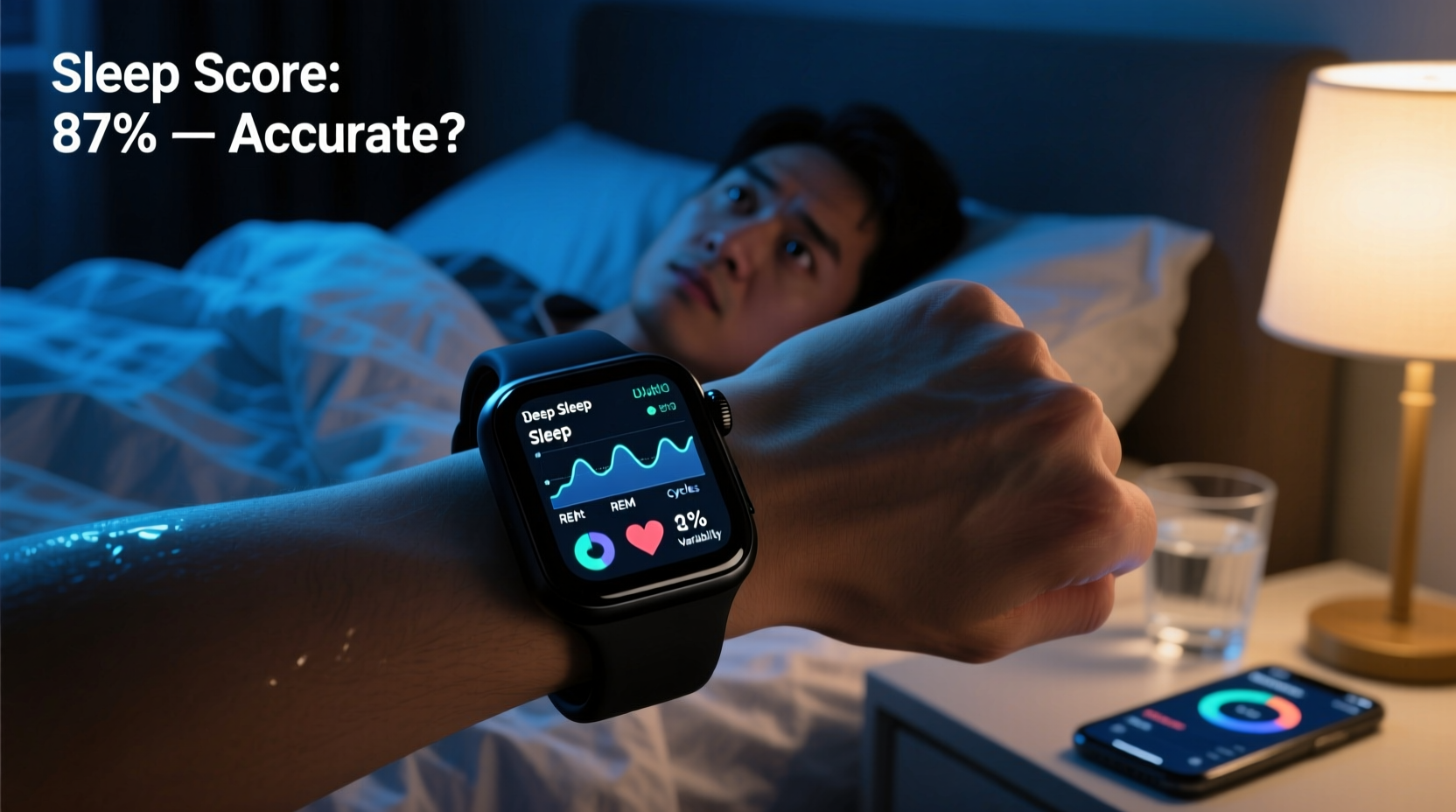
Smartwatches don’t directly observe brain waves like EEG machines do. Instead, they infer sleep stages using indirect biometrics collected through built-in sensors:
- Accelerometer: Detects movement to distinguish between wakefulness and rest.
- Heart rate monitor (PPG): Measures heart rate variability (HRV), which tends to increase during deep sleep.
- SpO2 sensor: Tracks blood oxygen levels, useful for detecting potential breathing disruptions like apnea.
- Body temperature sensors (on select models): Monitor subtle thermal changes linked to circadian rhythms.
These inputs feed into proprietary algorithms—often machine learning models trained on limited datasets—that estimate when you fell asleep, how long you stayed in light, deep, or REM sleep, and when you stirred or woke up.
For example, if your watch detects low movement, reduced heart rate, and higher HRV over an extended period, it may classify that window as deep sleep. But this inference isn't definitive. A person lying still while reading in bed could be misclassified as asleep. Conversely, someone who moves frequently during deep sleep might be labeled as restless or awake.
“Consumer wearables provide valuable trend data, but they should not replace diagnostic tools. They’re best used for identifying patterns, not making clinical decisions.” — Dr. Rebecca Robbins, Sleep Scientist at Harvard Medical School
Accuracy Compared to Clinical Standards
In a laboratory setting, sleep staging is performed via polysomnography (PSG), which records brain activity (EEG), eye movements (EOG), muscle tone (EMG), heart rhythm, and breathing effort. This comprehensive data allows sleep specialists to precisely identify each stage of sleep.
Studies comparing smartwatch data to PSG results reveal mixed outcomes:
| Device/Study | Agreement with PSG (%) | Best At Detecting | Limited In |
|---|---|---|---|
| FDA-cleared Oura Ring (2021 study) | ~85% for sleep duration | Total sleep time, sleep onset | REM sleep accuracy (~70%) |
| Fitbit Charge 5 (peer-reviewed trial) | ~80–84% | Deep sleep phases | Differentiating REM from light sleep |
| Apple Watch Series 8 (independent review) | ~75% overall | Movement-based wake detection | Overestimates deep sleep by 15–20 min avg. |
| Garmin Venu 3 (user-reported vs. diary) | ~70% correlation | Sleep consistency tracking | Poor in individuals with insomnia |
The consensus across research is clear: most devices are reasonably accurate at estimating total sleep time and distinguishing broad sleep-wake cycles. However, they struggle with finer distinctions—especially REM and light sleep classification—where error margins can exceed 20%.
Tip: Use your smartwatch to spot trends over weeks, not to diagnose sleep disorders. A single night’s “poor sleep” score may reflect algorithmic noise more than reality.Why Algorithms Can’t Replace Sleep Labs
The core limitation of smartwatch sleep tracking lies not in hardware, but in methodology. Unlike PSG, wearables lack direct neurological input. Without EEG signals, no device can definitively confirm when REM sleep begins or ends.
Additionally, algorithm training introduces bias. Most models are developed using data from healthy adults under controlled conditions. When applied to older adults, shift workers, or people with sleep disorders, accuracy declines significantly.
Consider this scenario:
Mini Case Study: The Insomniac Who Slept Fine
Sarah, a 38-year-old marketing executive, has struggled with insomnia for years. She wears a premium smartwatch that consistently reports she gets 7 hours of “good quality” sleep per night, including 1.5 hours of deep sleep. Yet, she feels exhausted every morning and scores poorly on cognitive tests.
She undergoes a sleep study. The results shock her: she averages only 5 hours of actual sleep, with frequent micro-arousals and minimal deep sleep. Her watch mistook prolonged periods of quiet wakefulness—lying still in bed—as sleep. The discrepancy arises because the device interpreted low movement and stable heart rate as indicators of rest, ignoring subjective alertness and brainwave data.
This case illustrates a key flaw: smartwatches measure physiology, not perception. If you're awake but motionless, the algorithm may log it as sleep. And if you're in REM sleep but experience elevated heart rate due to a dream, it might misclassify the phase entirely.
Improving the Reliability of Your Sleep Data
You don’t need a lab to benefit from sleep tracking—but you do need to use the data wisely. Follow these steps to get more meaningful insights:
- Calibrate with self-reporting: Keep a simple sleep journal for a week. Note bedtime, wake time, perceived sleep quality, and morning energy. Compare entries with your watch’s report.
- Wear the device consistently: Accuracy improves when algorithms learn your personal baselines over time.
- Charge before bedtime: Avoid gaps in data due to battery drain. Aim for at least 80% charge before sleeping.
- Enable SpO2 monitoring (if available): This adds value in detecting breathing irregularities, though it shouldn’t be used alone to diagnose sleep apnea.
- Avoid relying on third-party apps: Stick to manufacturer software, which is optimized for the device’s sensor suite and calibration.
“Think of your smartwatch like a weather station in your backyard. It gives you localized trends, but it won’t predict a hurricane like a meteorologist would.” — Dr. Michael Grandner, Director of the Sleep and Health Research Program at the University of Arizona
Checklist: How to Use Your Smartwatch Sleep Data Effectively
- ✅ Track sleep over 2–4 weeks to identify patterns
- ✅ Cross-reference with how you feel during the day
- ✅ Look for consistency in bedtime and wake time
- ❌ Don’t panic over one night of “low deep sleep”
- ❌ Avoid changing habits based on isolated metrics
- ✅ Consult a doctor if data shows chronic disruptions (e.g., frequent awakenings + daytime fatigue)
When to Trust—and When to Doubt—Your Watch
Smartwatch sleep tracking excels in specific contexts:
- Habit formation: Seeing consistent bedtimes visualized encourages better routines.
- Lifestyle experiments: Testing the impact of caffeine, exercise, or screen time on sleep duration.
- Long-term trend spotting: Identifying gradual improvements or deteriorations in sleep hygiene.
However, it fails in high-stakes scenarios:
- Diagnosing sleep disorders: Apnea, narcolepsy, or parasomnias require professional evaluation.
- Monitoring treatment efficacy: CPAP therapy adjustments should be guided by clinical data, not watch metrics.
- Children or elderly users: Physiological differences reduce algorithm accuracy.
One growing concern is \"orthosomnia\"—a condition where individuals become anxious about achieving perfect sleep scores, leading to increased stress and ironically, worse sleep. The pursuit of optimal data can undermine the very goal it seeks to support.
Frequently Asked Questions
Can my smartwatch detect sleep apnea?
Some watches, like the Apple Watch with its FDA-cleared AFib and sleep apnea notifications (via third-party apps like SleepWatch), can flag potential breathing disruptions using SpO2 and heart rate data. However, these are screening tools—not diagnostic. A positive indication should prompt a visit to a sleep specialist for confirmation via PSG or home sleep test.
Why does my watch say I got deep sleep when I feel unrested?
This disconnect often occurs because physiological markers (low heart rate, stillness) suggest deep sleep, but external factors—like noise, light, or stress—may have prevented true restorative rest. Additionally, the algorithm may misclassify long periods of light sleep as deep sleep due to signal interpretation limits.
Are some brands more accurate than others?
Yes. Devices designed with sleep as a primary focus—such as the Oura Ring and certain Fitbit models—tend to outperform general-purpose smartwatches. They often use multi-night averaging, advanced algorithms, and longer sensor sampling intervals to improve accuracy. That said, even top-tier wearables remain within the 70–85% agreement range with PSG.
Conclusion: Data Is Insight, Not Diagnosis
Smartwatch sleep tracking is neither pure science nor complete guesswork—it exists in a gray zone of probabilistic estimation. For the average user seeking to understand their nightly rest, these devices offer unprecedented access to personalized feedback. They can highlight irregularities, reinforce good habits, and spark curiosity about sleep health.
But they are not replacements for medical expertise. The numbers on your wrist should inform, not dictate, your choices. Use them to notice trends, ask questions, and initiate conversations with healthcare providers—not to self-diagnose or obsess over perfection.
If your watch shows you’re sleeping less than 6 hours most nights and you’re constantly tired, that’s a signal worth acting on. But if it says you missed deep sleep once because you watched a late movie, don’t lose sleep over it.
🚀 Take control of your sleep health: Review a month of your sleep data, look for patterns, and pair insights with how you feel. Then, share your observations with a doctor if needed. Knowledge is powerful—but wisdom lies in knowing what the data can—and cannot—tell you.