In an age where wearable tech is no longer a novelty but a lifestyle staple, the debate between smart rings and smart watches has gained real traction. Both promise health tracking, activity monitoring, and seamless connectivity—but they deliver these features in vastly different forms. The central question isn't just about functionality; it's about how much screen time you're willing to wear on your body. Is a glowing display on your wrist necessary for productivity and wellness, or can subtlety win with a discreet ring that tracks everything without demanding attention?
This isn’t merely a battle of gadgets—it’s a reflection of shifting priorities in personal technology. As users grow more conscious of digital overload, many are re-evaluating whether constant notifications and screen interaction enhance their lives or detract from them. Let’s explore what each device offers, who benefits most from which, and whether you truly need a screen on your finger—or anywhere near your hand at all.
The Rise of the Smart Ring: Minimalism Meets Metrics
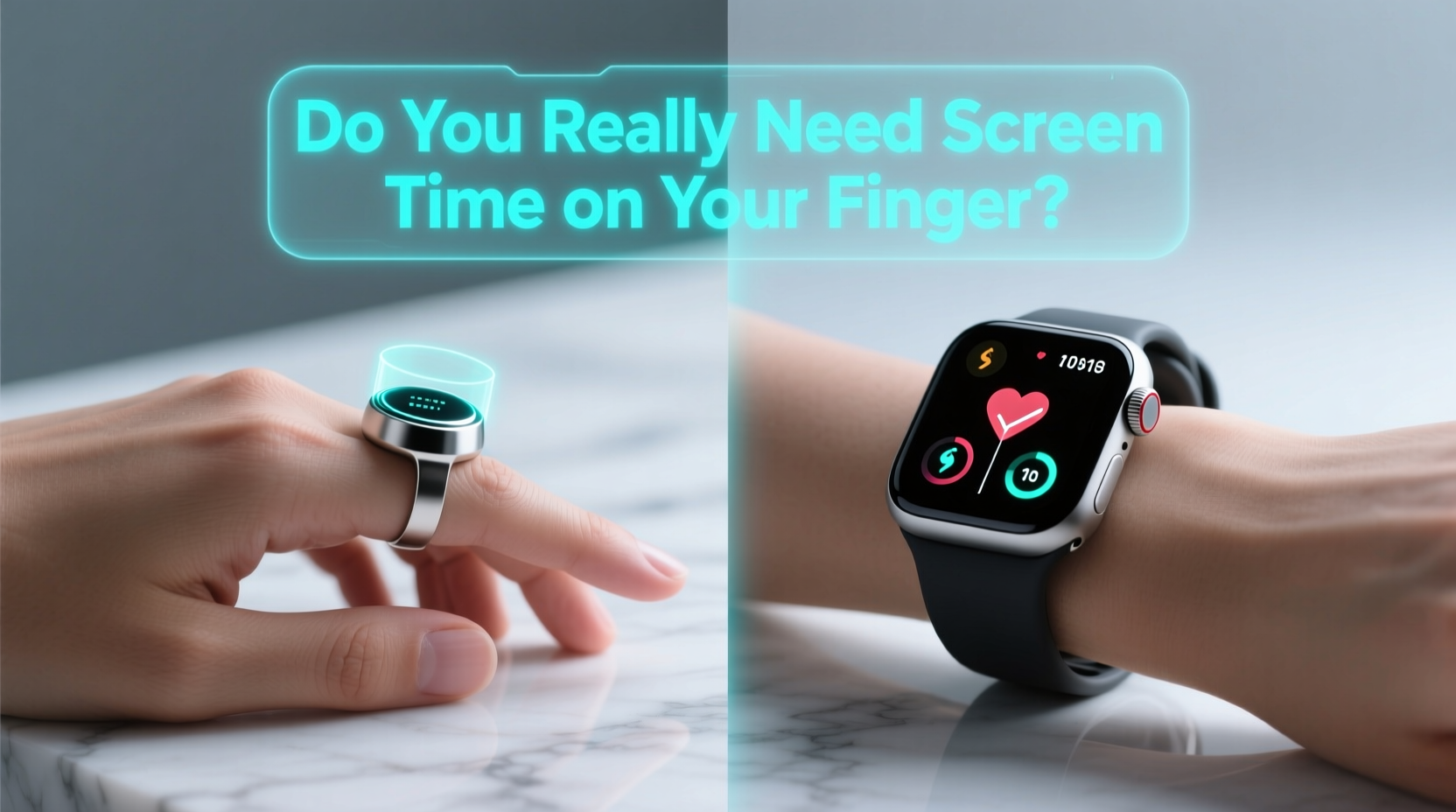
Smart rings represent a new frontier in wearable design—small, unobtrusive, and often mistaken for fashion accessories. Devices like the Oura Ring, Ultrahuman Ring Air, and Samsung Galaxy Ring have entered the market with promises of advanced biometrics packed into a tiny band. Unlike smartwatches, most smart rings lack screens entirely, relying instead on companion apps for data visualization.
What makes smart rings compelling is their ability to run 24/7 with minimal user interaction. They track sleep stages, heart rate variability (HRV), body temperature, blood oxygen levels, and even recovery metrics—all while being worn during showers, workouts, and sleep. Because they sit snugly on the finger, which has a rich network of capillaries, some argue they offer more consistent physiological readings than wrist-based sensors.
Tip: For accurate long-term health trends, consistency matters more than precision. A smart ring worn nightly provides better insights than a watch used sporadically.But there are trade-offs. No screen means no glanceable notifications, no voice assistant access, and no way to control music directly. You’re dependent on your phone for feedback. That might sound limiting, but for digital minimalists, it’s a feature, not a flaw.
Smart Watches: Powerhouse Wearables with a Price
Smartwatches—led by Apple Watch, Samsung Galaxy Watch, and Garmin’s fitness-focused models—offer comprehensive ecosystems. With full-color displays, touch interfaces, app stores, GPS, ECG sensors, and speaker/microphone combos, they function almost like smartphones strapped to your wrist.
You can reply to messages, take calls, navigate cities, monitor stress, and even pay for coffee without pulling out your phone. For professionals, athletes, and tech enthusiasts, this level of integration is invaluable. The immediate feedback loop—vibrations, visual alerts, haptic cues—keeps users informed and responsive.
However, that convenience comes at a cost. Battery life typically lasts one to two days, requiring nightly charging rituals. The screen itself becomes a distraction magnet. Studies show that frequent glancing at wearable notifications increases cognitive load and reduces focus. According to Dr. Cal Newport, author of *Digital Minimalism*, “Every time your wrist buzzes, you pay a mental tax—even if you don’t check the message.”
“The goal shouldn’t be constant connection, but meaningful engagement.” — Dr. Cal Newport, Computer Science Professor & Digital Minimalism Advocate
Moreover, smartwatches tend to be bulkier, less comfortable for sleep, and more conspicuous than rings. While they excel as tools for active use cases, they may not align with lifestyles aiming for reduced screen exposure.
Comparing Core Features: Ring vs Watch
| Feature | Smart Ring | Smart Watch |
|---|---|---|
| Battery Life | 5–7 days | 1–2 days |
| Sleep Tracking Accuracy | High (stable finger placement) | Moderate (movement affects sensor) |
| Notifications | Limited haptics only | Full text/audio alerts, replies |
| Fitness Tracking | Basic steps, HR, recovery | Advanced GPS, VO₂ max, workout modes |
| User Interface | App-only, no screen | Touchscreen + crown/buttons |
| Water Resistance | Swim-proof (most models) | Swim & dive-ready (select models) |
| Daily Wear Comfort | Excellent (lightweight, low profile) | Good (can feel heavy over time) |
| Price Range | $300–$700 | $250–$900+ |
This comparison highlights a fundamental divergence: smart rings optimize for passive, continuous health insight with minimal intrusion, while smart watches prioritize interactivity and real-time utility. Neither is universally superior—the best choice depends on individual needs and values.
Real-World Use Case: Two Professionals, Two Choices
Consider Sarah, a corporate lawyer working 70-hour weeks. She struggles with insomnia and chronic fatigue. Her doctor recommends monitoring her recovery patterns. She chooses the Oura Ring because it doesn’t disrupt her sleep with vibrations or bright lights. Each morning, she checks her readiness score in the app and adjusts her schedule accordingly. Over three months, she improves her deep sleep by 22% simply by going to bed earlier when her ring indicates low recovery.
Then there’s James, a field engineer who travels weekly. He uses an Apple Watch Ultra for navigation, voice memos, emergency SOS, and flight updates. His job requires rapid responses, and he relies on wrist-based alerts when his hands are occupied. The screen allows him to confirm tasks, view schematics, and log hours without fumbling for his phone in noisy environments.
Both achieve their goals—one through quiet awareness, the other through active responsiveness. Their devices reflect their work rhythms and personal boundaries with technology.
Do You Really Need Screen Time on Your Finger?
The core issue isn’t technical capability—it’s intentionality. Screens demand attention. Even small ones trigger dopamine-driven checking behaviors. A 2023 University of Pennsylvania study found that participants who switched from smartwatches to screenless trackers reported lower anxiety and improved mindfulness throughout the day.
If your goal is holistic well-being—better sleep, sustained energy, long-term health trends—a smart ring may serve you better. It collects rich data without becoming a distraction. You review insights deliberately, not reactively. This aligns with the philosophy of “awareness without interruption.”
On the other hand, if your lifestyle demands constant coordination—managing teams, navigating transit, logging activities on the go—a smartwatch’s screen enhances efficiency. The key is ensuring that screen time serves purpose, not habit. Ask yourself: Are you using the device, or is it using you?
Tip: Try turning off non-essential notifications for one week. If you don’t miss them, consider downgrading to a screenless tracker.Step-by-Step Guide: Choosing the Right Device for You
- Define Your Primary Goal: Are you focused on health optimization, fitness performance, productivity, or convenience?
- Assess Your Tech Habits: How often do you check your phone? Do you respond to messages immediately, or can you batch-check later?
- Evaluate Daily Routines: Do you need GPS, voice commands, or mobile payments during the day?
- Test Sleep Compatibility: Can you comfortably wear a watch to bed? Or does any wrist pressure disrupt your rest?
- Consider Long-Term Use: Which device will you actually wear every day—not just for a week, but six months from now?
- Try Before You Buy: Rent or borrow both types for a few days. Track how each affects your focus and routine.
- Review Data Access Preferences: Do you want instant feedback or prefer scheduled check-ins via an app?
This process helps move beyond marketing hype and toward a decision rooted in actual behavior and needs.
Checklist: Smart Ring or Smart Watch?
- ✅ I value sleep tracking accuracy → Lean toward smart ring
- ✅ I hate charging devices daily → Smart ring wins
- ✅ I want to reduce screen time → Choose screenless ring
- ✅ I need GPS, calls, or voice assistant → Smart watch required
- ✅ I work out frequently with varied routines → Smart watch offers deeper analytics
- ✅ I prefer subtle, jewelry-like wearables → Smart ring fits better
- ✅ I rely on quick notifications at work → Smart watch may be essential
FAQ
Can a smart ring replace a smartwatch completely?
For health-focused users who don’t rely on real-time interactions, yes—many find smart rings sufficient. However, if you depend on navigation, messaging, or voice tools during the day, a smartwatch remains more functional. Some users opt to wear both: a ring for health and a watch for tasks.
Are smart rings accurate enough for medical insights?
While not medical devices, top-tier smart rings provide clinically relevant data trends—especially in HRV, resting heart rate, and temperature deviation. Doctors increasingly use this data as supplementary evidence for conditions like hormonal imbalances or early illness detection. Always consult a healthcare provider before making medical decisions based on wearables.
Is battery life really better on smart rings?
Absolutely. Most smart rings last 5–7 days on a single charge due to minimal power draw (no screen, fewer radios). In contrast, smartwatches with always-on displays and LTE connectivity often require daily charging, disrupting continuity in data collection.
Conclusion: Less Might Be More
The evolution of wearable tech doesn’t have to mean more screens, more alerts, and more interruptions. Sometimes, the most powerful tools are the ones that stay out of the way. A smart ring proves that meaningful data doesn’t need flashy visuals or constant pings to be valuable. By removing the screen, it removes temptation—allowing users to engage with their health intentionally, not impulsively.
That said, dismissing smartwatches would ignore their undeniable utility for specific roles and routines. The future of wearables may not lie in choosing one over the other, but in understanding when to use each. Perhaps the wisest approach is selective adoption: leveraging a smart ring for foundational health insights and reserving the watch for high-intensity, task-heavy periods.
Ultimately, the question isn’t whether you need screen time on your finger—it’s whether that screen serves you. Technology should enhance life, not dominate it. Whether you choose a silent ring or a responsive watch, let your decision be guided by clarity of purpose, not fear of missing out.
🚀 Ready to rethink your relationship with wearable tech? Start by auditing your current device usage for one week. Note every time you check your wrist—not because you need to, but because you can. Then ask: Was that moment useful, or just habitual? Share your findings in the comments below.