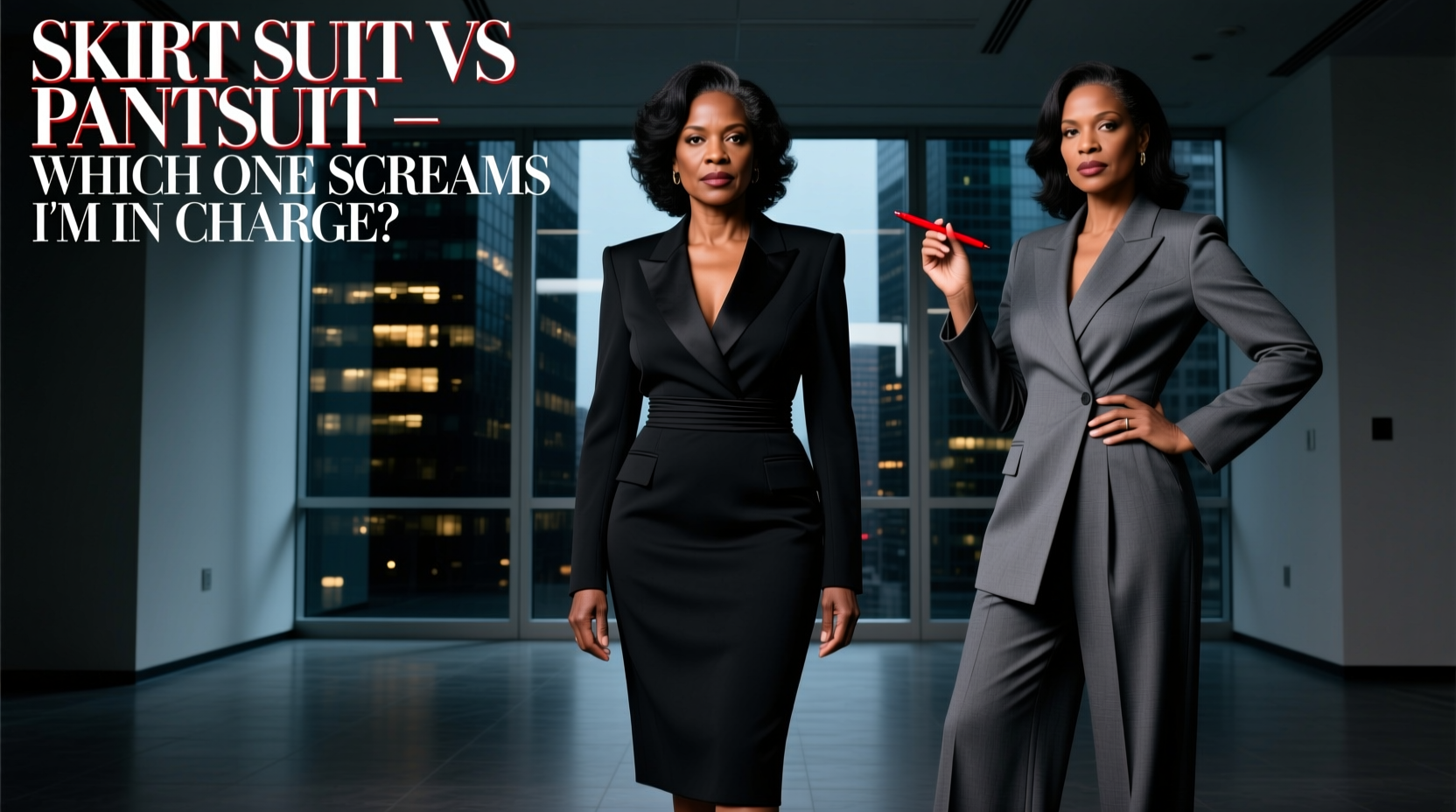
In boardrooms, courtrooms, and global summits, how a leader dresses often shapes how they’re perceived—before they even speak. The skirt suit and the pantsuit are two iconic ensembles that have defined professional women’s fashion for decades. Both carry weight, but only one consistently commands attention with the unspoken declaration: “I’m in charge.” To understand which outfit delivers that message most effectively, we must look beyond fabric and cut to cultural context, historical evolution, and psychological impact.
The Power of Perception: Clothing as Nonverbal Authority
Clothing is not just about comfort or aesthetics—it’s a communication tool. Research from social psychology shows that people form judgments about competence, dominance, and trustworthiness within seconds of seeing someone. In professional environments, this first impression can influence hiring decisions, promotions, and leadership opportunities.
A 2015 study published in *Social Psychological and Personality Science* found that individuals wearing formal attire were perceived as more powerful and capable of abstract thinking. When applied to gendered clothing, the dynamics shift. Women navigating male-dominated spaces often face a bias where traditionally feminine attire is seen as less authoritative. This places the skirt suit—a tailored ensemble with a matching skirt—in a complex position.
“Power dressing isn’t about looking aggressive. It’s about removing ambiguity. A strong silhouette tells others you belong at the table.” — Dr. Lena Peterson, Organizational Psychologist
Historical Context: How Each Suit Rose to Prominence
The modern skirt suit emerged in the early 20th century as a way for women to enter the workforce with dignity and professionalism. Designers like Coco Chanel reimagined women’s tailoring, blending elegance with practicality. By the 1980s, the skirt suit became synonymous with corporate femininity—sharp shoulders, knee-length skirts, and coordinated blazers worn by executives and politicians alike.
The pantsuit, however, carried a more radical legacy. Originally considered inappropriate for women in formal settings, it gained legitimacy through defiance. Katharine Hepburn wore trousers on screen in the 1930s, challenging norms. In politics, Eleanor Roosevelt and Indira Gandhi embraced wide-leg suits long before they were mainstream. But it was Shirley Chisholm’s bold purple pantsuit during her 1972 presidential campaign that cemented its symbolic power.
Fast forward to 2016, when Hillary Clinton wore a white pantsuit during her acceptance speech at the Democratic National Convention—a tribute to the suffragettes and a declaration of feminist legacy. That single image sparked global conversation about what it means for a woman to claim space, literally and figuratively.
Tip: Choose cuts that emphasize structure—defined shoulders, nipped waist, clean lines—to project confidence regardless of skirt or pant.Comparing Impact: Skirt Suit vs Pantsuit
To assess which outfit “screams I’m in charge,” consider four key factors: authority signaling, mobility, inclusivity, and cultural resonance.
| Factor | Skirt Suit | Pantsuit |
|---|---|---|
| Authority Signaling | Perceived as polished and professional; may be misread as traditional or conservative. | Strong association with leadership, rebellion, and modernity; widely interpreted as assertive. |
| Mobility & Functionality | Limited range of motion; sitting, standing, and walking require more attention. | Full freedom of movement; supports dynamic presence in high-pressure settings. |
| Inclusivity | Fits narrow body standards; less adaptable for diverse shapes and sizes. | More versatile across body types; easier to tailor for comfort and proportion. |
| Cultural Symbolism | Tied to mid-century corporate femininity; risks appearing outdated in progressive spaces. | Linked to feminist milestones and political power; carries historical weight. |
The data suggests the pantsuit holds stronger symbolic capital when it comes to projecting unambiguous authority. Its design breaks from traditional gendered expectations, signaling both capability and resistance to conformity.
Real Example: The CEO Who Switched Her Signature Look
Sarah Lin, CEO of a tech startup in Austin, Texas, built her brand around tailored skirt suits during her rise in finance. Polished and precise, she was praised for her “elegant professionalism.” But after being passed over for a partner role twice, she consulted an executive image coach.
“They said I looked ‘ready to assist,’ not ‘ready to lead,’” Sarah recalls. She transitioned to structured navy and charcoal pantsuits, opting for double-breasted blazers and straight-leg trousers. Within six months, she secured a board seat and raised $12 million in funding. “The moment I walked into the pitch meeting in my black Tom Ford pantsuit, the room shifted. People leaned forward. They listened differently.”
The Psychology of Power Dressing
It’s not just about how others see you—it’s how you feel. Known as “enclothed cognition,” this phenomenon describes how clothing influences mental state. Wearing garments associated with competence (like a well-fitted suit) enhances focus, confidence, and risk tolerance.
Pantsuits, historically linked to trailblazing women, activate a sense of agency. They free the body from constraints—both physical and symbolic. There’s no concern about crossing legs appropriately or adjusting hemlines. This autonomy translates into posture: shoulders back, stride longer, voice firmer.
In contrast, while skirt suits can be empowering, they often come with behavioral expectations—sit with knees together, walk with small steps—that subtly reinforce passivity. These micro-movements, repeated daily, can erode the internal sense of command over time.
Step-by-Step Guide: Building a Commanding Wardrobe
- Assess your environment. In highly traditional industries (law, banking), a skirt suit might still signal respectability. In innovation-driven or egalitarian cultures, lean toward pantsuits.
- Invest in fit. A poorly tailored suit undermines authority. Visit a reputable tailor and prioritize shoulder alignment and waist suppression.
- Choose commanding colors. Navy, charcoal, and black project seriousness. White conveys clarity and moral authority (see: Clinton, Kamala Harris).
- Pair with minimal accessories. Avoid dainty jewelry. Opt for bold watches, structured bags, and closed-toe heels or polished oxfords.
- Practice presence. Wear your suit with purposeful movement. Stand tall, make eye contact, and speak with measured pauses.
Checklist: Does Your Outfit Say “I’m in Charge”?
- ✅ Silhouette is clean and structured—not frilly or overly decorative
- ✅ Jacket fits snugly across shoulders and closes without pulling
- ✅ Trousers or skirt hit at a professional length (ankle or knee)
- ✅ Color is neutral or boldly symbolic (e.g., white for statement moments)
- ✅ Shoes are polished and stable (low block heels or flats acceptable)
- ✅ You feel physically comfortable and mentally dominant in the outfit
FAQ
Can a skirt suit ever project the same level of authority as a pantsuit?
Yes—but it requires careful styling. Pair a high-waisted, knee-length pencil skirt with a sharply tailored blazer and minimalist footwear. Avoid fabrics with shine or embellishments. However, in most contemporary contexts, the pantsuit still carries greater symbolic force.
Are pantsuits appropriate for all industries?
Increasingly, yes. Even in conservative fields, women in leadership roles—from federal judges to senior partners—are choosing pantsuits without penalty. If in doubt, observe the highest-ranking women in your organization and mirror their choices with slight elevation.
Does wearing a pantsuit make me seem less feminine?
Authority and femininity are not mutually exclusive. Many women combine a pantsuit with subtle feminine touches—a silk scarf, pearl studs, or red lipstick—without diluting power. True professionalism lies in authenticity, not performance of gender norms.
Conclusion: Claim Your Space with Intention
The question isn’t whether a skirt suit or pantsuit looks professional. It’s which one makes you feel unstoppable—and signals to others that you belong in command. History, psychology, and real-world outcomes point to the pantsuit as the stronger symbol of autonomous leadership. It represents evolution, functionality, and defiance of outdated constraints.
That doesn’t mean abandoning the skirt suit entirely. Context matters. But if you’re stepping into a negotiation, leading a team, or making a career-defining move, choose the outfit that removes doubt—not just from others, but from yourself.
🚀 Ready to redefine your professional presence? Audit your work wardrobe this week. Replace one skirt suit with a well-tailored pantsuit and notice how your posture, voice, and reception change. Power begins with perception—yours and everyone else’s.