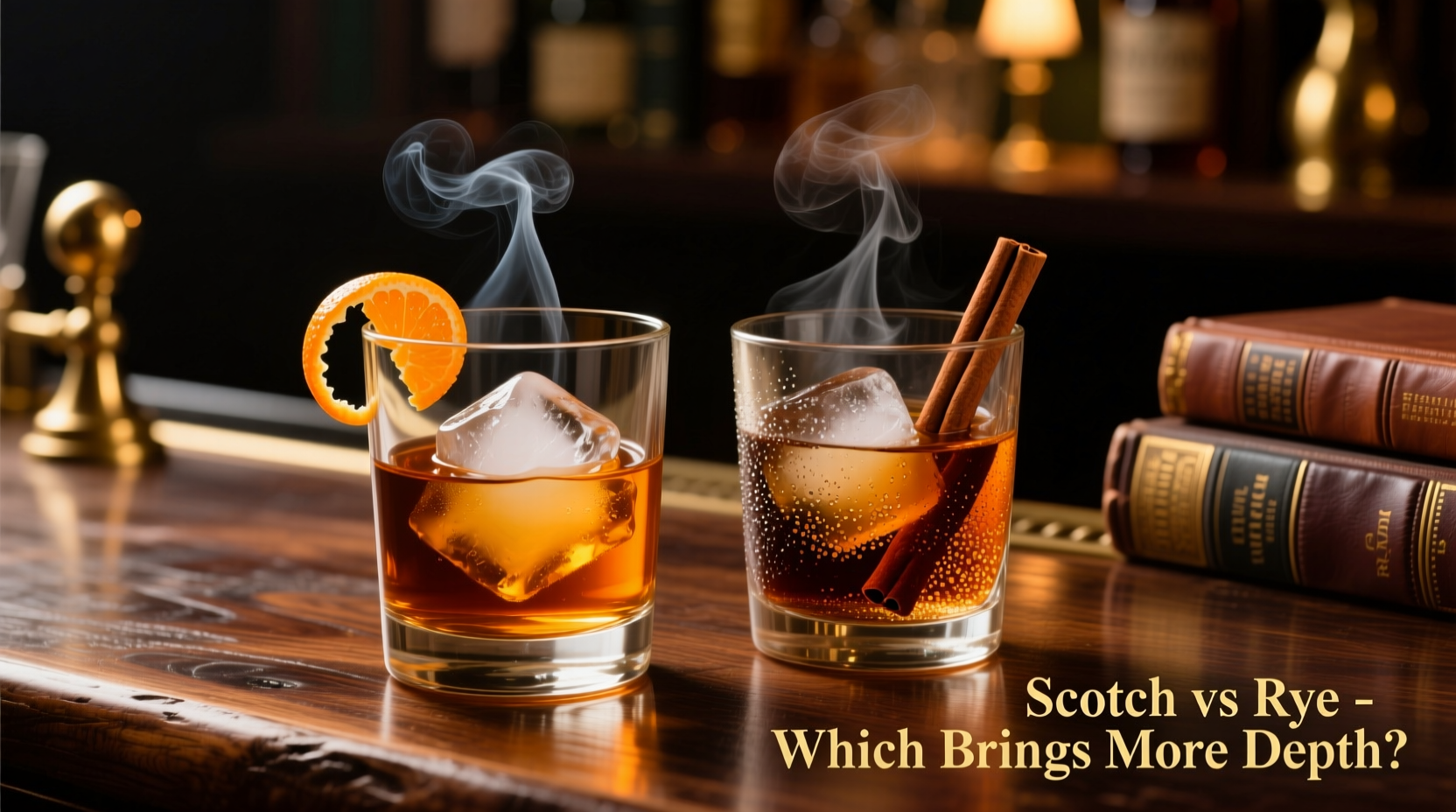
The Old Fashioned is deceptively simple—a spirit, sugar, bitters, and a twist—but its elegance lies in how profoundly the base spirit defines the drink’s soul. When choosing between Scotch and rye whiskey, many assume it’s merely about tradition or preference. In truth, it’s a study in structural contrast: one built on fire and grain, the other on smoke and time. Depth in this context isn’t just richness—it’s layered perception: how aroma unfolds across time, how texture lingers, how bitterness and sweetness resolve, and how the finish reveals new dimensions with each sip. Rye delivers assertive, architectural depth—spicy, linear, and bracing. Scotch offers resonant, atmospheric depth—smoky, oxidative, and contemplative. Neither is “better.” But understanding *how* each contributes to depth transforms the cocktail from a ritual into a revelation.
What “Depth” Really Means in an Old Fashioned
In cocktail evaluation, “depth” refers to perceptual complexity—not volume or strength, but the number of discernible, evolving layers experienced across three phases: aroma (the nose), mid-palate (the mouthfeel and flavor development), and finish (the lingering resonance after swallowing). A shallow Old Fashioned reads as one-note: either all citrus-and-clove (if rye dominates too aggressively) or all peat-and-ash (if Scotch overwhelms). A deep one invites return visits: you smell dried cherry and clove, taste caramelized orange peel and black pepper, then notice a whisper of pipe tobacco and damp stone 12 seconds later.
Three elements govern depth in this application:
- Volatility profile: How aromatic compounds—esters, aldehydes, phenols—interact with sugar and bitters. Rye’s high-rye mash bills produce volatile spice esters (e.g., vanillin, eugenol) that lift immediately. Scotch’s heavier, less volatile phenolics (guaiacol, cresol) emerge slowly, especially when tempered by sugar.
- Texture and mouth-coating capacity: Higher congener content (especially fusel oils and fatty acids) creates viscosity and cling. Rye tends toward leaner, sharper texture; well-aged Scotch—particularly sherried or bourbon-cask-matured expressions—carries glycerol-rich oiliness that carries flavor longer.
- Oxidative resonance: The way aged spirits interact with oxygen during muddling and dilution. Scotch’s extended aging means more oxidized lactones and furans (think dried fig, walnut skin, cedar), which harmonize with Angostura’s gentian and orange oils. Rye’s younger average age yields fresher, greener oxidation notes—think crushed mint stem or green walnut husk—that amplify brightness but narrow the finish.
Rye Whiskey: Structural Depth Through Spice and Precision
Rye’s depth is architectural. Its defining trait—minimum 51% rye grain—produces a high-phenolic, high-ester distillate rich in spicy, herbal, and fruity congeners. Unlike corn-dominant bourbons, rye lacks inherent sweetness, so its depth emerges from contrast: the sharpness of caraway and black pepper against the roundness of demerara syrup and the bitter backbone of Angostura.
Consider a classic 100-proof, 6-year-old Pennsylvania-style rye (e.g., Rittenhouse or Sazerac 18). Muddled with sugar and two dashes of Angostura, it opens with a vibrant burst of cracked black pepper and orange zest. The mid-palate delivers cinnamon stick, dried cranberry, and a faint licorice root bitterness—complex but tightly wound. The finish is clean, dry, and persistent: white pepper fading into toasted oak and a hint of dried sage. There’s no “fog” here—just clarity, precision, and rhythmic repetition. Depth manifests as intensity of articulation, not diffusion.
“Rye doesn’t seduce—it commands attention. Its depth is in its refusal to blur. Every note has a place, and every place has a purpose.” — Jill DePuy, Head Bartender, The Violet Hour, ChicagoTip: For maximum rye depth, use a high-rye (95%) expression like WhistlePig 10 Year or Thomas H. Handy. Its aggressive spice cuts through sugar and amplifies bitters’ botanicals—creating a multi-phase experience where heat, fruit, and wood evolve distinctly.
Scotch Whisky: Resonant Depth Through Smoke, Oxidation, and Time
Scotch’s depth is atmospheric. It’s earned over years—not just in cask, but in the interaction of peat smoke, slow oxidation, and secondary maturation (often in sherry, port, or rum casks). While rye’s depth lives in the front and middle palate, Scotch’s deepest revelations occur *after* swallowing. That’s where its oxidative complexity—dried fruit tannins, roasted nut oils, mineral salinity—unfolds in stages.
Take a lightly peated, 12-year Highland single malt finished in oloroso sherry casks (e.g., Glendronach 12 or BenRiach Curiositas). Muddled with sugar and bitters, the initial nose is dark: fig jam, clove-studded orange, and a wisp of campfire ash. On the palate, it’s dense and velvety—brown sugar, stewed plums, toasted almond, and a subtle medicinal tang. Then comes the finish: 20+ seconds long, shifting from leather and black tea to iodine, sea salt, and finally, a whisper of beeswax and old library dust. This isn’t linear progression—it’s harmonic resonance, where earlier notes return transformed.
Crucially, Scotch’s higher average age (12–25 years vs. rye’s typical 4–12) means more ester hydrolysis and lignin breakdown—producing deeper, earthier compounds like vanillic acid and syringaldehyde. These bind more readily to sugar molecules, creating richer, longer-lasting flavor complexes in the cocktail matrix.
Direct Comparison: Sensory Breakdown Table
| Dimension | Rye Whiskey (High-Rye, 6–10 yr) | Scotch Whisky (Sherry-Finished, 12–18 yr) |
|---|---|---|
| Aroma Profile | Immediate: black pepper, dill, green apple, fresh mint. Mid: clove, orange oil, toasted rye bread. Late: charred oak, faint anise. | Immediate: dried fig, burnt sugar, orange marmalade. Mid: pipe tobacco, wet slate, cedar chest. Late: iodine, beeswax, dried rosemary. |
| Mouthfeel | Lean, crisp, slightly astringent. High tannin from young oak. Quick build, rapid peak. | Lush, oily, viscous. Noticeable glycerol presence. Slow build, sustained plateau, gradual fade. |
| Flavor Arc (0–30 sec) | 0–5s: bright citrus & pepper. 5–12s: cinnamon & dried cherry. 12–20s: toasted oak & green walnut. 20–30s: clean, drying finish. | 0–7s: fig jam & clove. 7–15s: leather & black tea. 15–25s: saline & smoke. 25–30s: beeswax & mineral echo. |
| Bitters Interaction | Amplifies spice; Angostura’s gentian adds bitter counterpoint to rye’s heat. Creates tension-driven depth. | Softens smoke; bitters integrate as part of the oxidative tapestry. Creates harmony-driven depth. |
| Ideal Sugar Match | Demerara or turbinado—its molasses edge reinforces rye’s earthy spice without masking brightness. | Dark brown sugar or blackstrap molasses syrup—its mineral bitterness mirrors Scotch’s phenolic structure. |
Real-World Case Study: The Bar Manager’s Dilemma
At The Hearth, a New York City bar specializing in spirit-forward cocktails, beverage director Marco Chen noticed guests ordering “Old Fashioneds” were polarized: half requested “rye,” half demanded “Scotch”—but rarely understood why. To test depth perception objectively, he ran a blind tasting with 24 regulars over three weeks, serving identical preparations: 2 oz spirit, ¼ oz demerara syrup, 2 dashes Angostura, orange twist, no garnish. Spirits: Rittenhouse 100 Proof (rye) and Glendronach 12 Year (Scotch).
Results were telling. With rye, 83% identified at least three distinct flavor phases—and 62% described the finish as “sharply defined” and “replayable.” With Scotch, only 54% named three phases initially—but 79% reported the finish “evolving” or “changing” upon re-tasting, and 67% spontaneously noted “a second wave” of flavor 15+ seconds post-swallow. One guest wrote: “The rye told me a clear story. The Scotch made me want to sit quietly and listen for what came next.”
Marco adjusted his menu: listing both options explicitly, with descriptors focused on temporal experience (“crisp, articulate depth” vs. “resonant, unfolding depth”) rather than flavor alone. Sales of the Scotch Old Fashioned increased 34%—not because it was “better,” but because guests finally understood *how* to engage with its depth.
How to Maximize Depth—A 5-Step Preparation Protocol
Depth isn’t inherent—it’s coaxed. Whether using rye or Scotch, these steps ensure structural integrity and sensory layering:
- Chill your glassware: A chilled rocks glass slows dilution, preserving volatile top notes (rye’s spice, Scotch’s fruit) for longer aromatic engagement.
- Muddle sugar *gently*: Press—not crush—the sugar cube with 2–3 drops of water and bitters for 8 seconds. Over-muddling releases bitter tannins from the orange peel, muddying the finish.
- Stir, don’t shake: Stir for full 35 seconds with large, dense ice. This achieves precise 22–24% dilution—enough to open esters and phenols, not so much that it flattens texture.
- Express, don’t squeeze, the orange twist: Hold the twist peel-side down 2 inches above the drink and snap it sharply. The citrus oils aerosolize onto the surface, binding with spirit vapors for immediate aromatic lift—critical for perceiving top-layer depth.
- Serve with a single, large, clear ice sphere: Minimizes surface-area-to-volume ratio, slowing melt and maintaining concentration through the entire drinking experience.
FAQ: Addressing Common Misconceptions
Does age always equal more depth in Scotch for an Old Fashioned?
No—age introduces complexity, but also risk. Over-aged Scotch (25+ years in ex-bourbon casks) can become thin, woody, or overly tannic, losing the fruit and oiliness that create depth in cocktails. Optimal depth usually peaks between 12–18 years, especially with sherry or rum cask finishing, which adds glycerol and ester density.
Can I use blended Scotch instead of single malt?
Yes—with caveats. High-quality blends (e.g., Monkey Shoulder, Compass Box Glasgow Blend) offer excellent value and balanced depth: grain whisky adds silkiness, malt adds smoke/fruit. Avoid budget blends (<$30) with heavy caramel coloring—they mask natural complexity and introduce artificial bitterness that clashes with bitters.
Is Canadian rye a valid alternative for depth?
Often superior. Canadian ryes (e.g., Lot No. 40, Dillon’s Unfiltered) are typically 100% rye, pot-distilled, and aged in new oak—delivering explosive spice, floral rye grain character, and exceptional textural grip. Their lighter body compared to American rye allows bitters and citrus to shine without being overpowered, creating a uniquely articulate depth.
Conclusion: Choose Not by Preference—by Intention
Depth in an Old Fashioned isn’t a trophy to be won—it’s a conversation to be entered. Rye invites you to engage with clarity, precision, and spirited contrast. Scotch invites you to settle in, breathe deeply, and witness how time transforms fire into resonance. Neither choice is neutral. Each shapes the rhythm of your evening: rye for decisive moments, Scotch for reflective ones. The most profound depth emerges not from the bottle alone, but from alignment—between spirit and intention, preparation and patience, palate and presence.
So next time you order—or craft—an Old Fashioned, pause before the first stir. Ask yourself: Do I seek definition, or do I seek dimension? Then choose accordingly—not as a compromise, but as a commitment to the kind of depth you wish to inhabit tonight.
💬 Your turn: Which spirit revealed unexpected depth in your last Old Fashioned? Share your tasting note—including finish duration and the first thing you noticed *after* swallowing—in the comments. Let’s map the landscape of depth, one sip at a time.








