For drinkers who crave smoke—not as a fleeting accent, but as a resonant, layered, and deeply expressive core—the choice between Scotch and Japanese whisky isn’t about prestige or price. It’s about intentionality. Smoke in whisky is never accidental. It’s the fingerprint of terroir, tradition, and technical control—woven into barley, kiln, still, and cask. Yet the two categories approach that signature charred, medicinal, oceanic, or incense-like quality in fundamentally different ways. One builds smoke into its DNA; the other treats it as a refined compositional element. Understanding that distinction is essential—not to declare a winner, but to match your palate’s specific hunger for smoke with the bottle most likely to satisfy it.
The Origins of Smoke: Peat, Process, and Philosophy
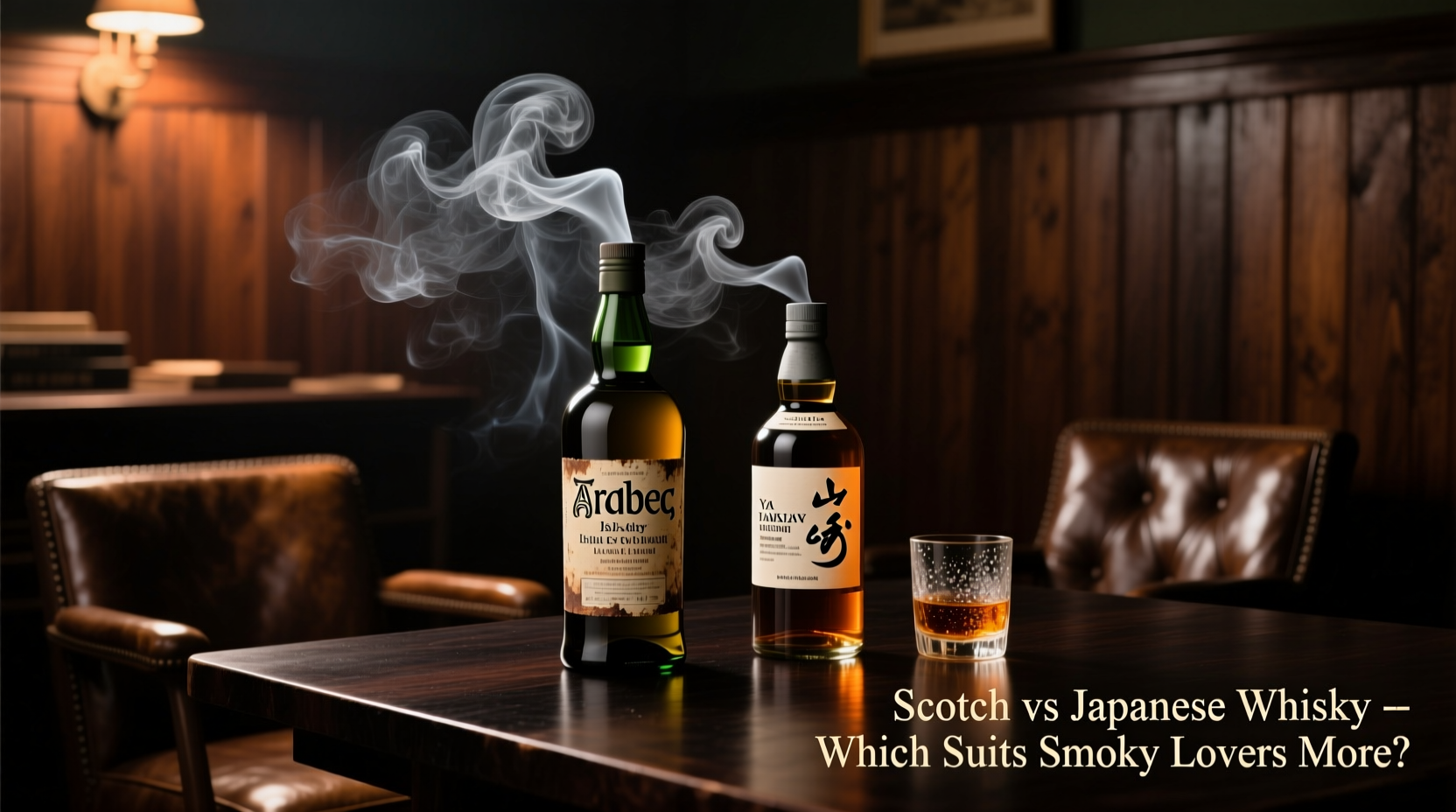
Smoke in whisky begins with peat—the partially decayed organic matter harvested from bogs. When dried and burned, peat releases aromatic compounds like guaiacol, cresol, and syringol. These phenols bind to malted barley during kilning, forming the foundation of smoky character. But how much peat is used—and how it’s applied—varies dramatically.
In Scotland, particularly on Islay, peat is not just fuel—it’s heritage. Distilleries like Laphroaig, Ardbeg, and Caol Ila source local peat cut within miles of the distillery. The composition varies: coastal peat absorbs sea salt and kelp, lending iodine and brine; inland moorland peat contributes earthier, woodsmoke notes. Peating levels are measured in parts per million (ppm) of phenols in the malt. While unpeated malts sit near 0–5 ppm, heavily peated Islay whiskies routinely hit 30–55 ppm—and some experimental batches exceed 100 ppm.
Japanese whisky takes a markedly different path. Peat was historically scarce and imported—often from Scotland or Ireland—making it expensive and logistically complex. As a result, most early Japanese distilleries (like Yamazaki and Hakushu) used minimal or zero peat. When smoke entered the category, it did so deliberately and sparingly: not as a regional signature, but as one tonal option among many. Hakushu’s “Heavily Peated” expression, for example, uses Scottish peat and clocks in around 35 ppm—comparable to mid-range Islay—but it’s framed by delicate fruit and green tea notes rather than dominating them. The philosophy is integration, not assertion.
Tip: Don’t equate high ppm with “better smoke.” A 50-ppm Islay may feel more intensely smoky than a 40-ppm Japanese whisky simply because its distillation and maturation emphasize phenolic intensity—while the Japanese version layers smoke over floral or citrus top notes.Tasting Reality: How Smoke Manifests on the Palate
Lab numbers tell only part of the story. What matters is how smoke translates in the glass—and how it evolves across nose, palate, and finish. Here, structural differences become decisive.
Scotch—especially Islay single malts—tends toward bold, linear smoke expression. Think of Ardbeg Uigeadail: waves of tar, seaweed, smoked bacon, and antiseptic lift immediately on the nose, then deepen into medicinal warmth and charred oak on the palate. The smoke isn’t background texture; it’s the lead instrument, supported by robust alcohol strength (often cask-strength or high ABV) and long maturation in active ex-bourbon or sherry casks that reinforce rather than mute phenolics.
Japanese whisky, even at comparable ppm, often delivers smoke with greater diffusion and nuance. Consider Chichibu’s “The Peated” or Mars Shinshu’s “Peaty & Salty.” You’ll detect campfire ash, roasted chestnut, and dried plum alongside the smoke—not instead of it. This stems from several factors: lighter distillation cuts (retaining more fruity esters), frequent use of mizunara oak (which imparts sandalwood and coconut, softening phenolic edges), and precise blending that balances peated and unpeated components. The result is smoke you discover, not one that announces itself with volume.
“Peat in Japan isn’t about replicating Islay—it’s about finding where smoke belongs in our own sensory language. We ask: what does smoke taste like next to yuzu? Next to mountain spring water? Next to the quiet hum of a Kyoto temple garden?” — Ichiro Akuto, Founder, Chichibu Distillery
Comparative Profile Table: Key Differences for Smoky Whisky Seekers
| Characteristic | Classic Islay Scotch (e.g., Laphroaig, Ardbeg) | Japanese Peated Whisky (e.g., Chichibu, Mars Shinshu, Hakushu) |
|---|---|---|
| Peat Source | Local, hand-cut, coastal or moorland bogs (variable mineral/salt content) | Mostly imported (Scottish/Irish); increasingly domestic (Hokkaido, Kyushu)—still limited scale |
| Typical Peating Level (ppm) | 30–55+ ppm (some experimental releases >100 ppm) | 15–40 ppm (rarely exceeds 45 ppm; emphasis on balance over intensity) |
| Distillation Style | Shorter fermentation, heavier spirit cuts, higher still charge—maximizes phenolic retention | Longer fermentation (up to 120+ hours), lighter cuts, lower still charge—preserves esters and delicacy |
| Cask Influence | Ex-bourbon (brightens smoke), ex-sherry (adds dried fruit/weight), virgin oak (intensifies spice) | Mizunara (adds incense, coconut), Japanese oak (subtle tannin), careful ex-bourbon/sherry—used to complement, not dominate |
| Typical Smoke Profile | Medicinal, tarry, briny, burnt heather, diesel, smoked meat | Charred rice cracker, roasted barley, cedar smoke, plum skin, incense ash, grilled miso |
A Real-World Case Study: Two Bottles, One Smoky Craving
Consider Kenji Tanaka, a Tokyo-based architect and long-time whisky enthusiast. For years, he loved Ardbeg Corryvreckan—its explosive peat, black pepper heat, and lingering iodine finish felt like an elemental experience. But after moving to Hokkaido, he began noticing subtle smokiness in local foods: grilled salmon over cherry wood, aged miso fermented in clay pots, even the damp-earth scent after rain in birch forests. He wondered: could whisky reflect that kind of smoke?
He tried Chichibu “The Peated” 2017—a 38-ppm malt matured in a mix of ex-bourbon, sherry, and mizunara casks. At first sip, it surprised him. No medicinal punch. Instead: a whisper of bonfire embers, then bright yuzu zest, followed by roasted chestnut and a finish of dried persimmon and sandalwood. The smoke wasn’t front-and-center—it was the quiet resonance beneath everything else. Over three months, he revisited it alongside Laphroaig 10 Year Old. He didn’t abandon Islay; he gained vocabulary. “Scotch taught me to recognize smoke,” he told us. “Chichibu taught me to listen to its timbre.”
This isn’t about preference shifting—it’s about palate expansion. Smoky flavor lovers aren’t monolithic. Some seek visceral impact. Others crave complexity where smoke converses with fruit, spice, or umami. Both exist—but they live in different stylistic universes.
Your Smoky Whisky Roadmap: A Step-by-Step Selection Guide
If you’re drawn to smoke but unsure where to begin—or whether to go deeper into Scotch or explore Japanese expressions—follow this practical, taste-led sequence:
- Clarify your smoke archetype. Do you love the sharp, cleansing bite of antiseptic and sea spray (Islay)? Or the warm, enveloping aroma of a hearth fire with dried fruit nearby (Japanese)? Keep a tasting journal for one month: note every smoky whisky you try, rating intensity (1–10) and descriptors (medicinal, woody, salty, sweet, etc.). Patterns will emerge.
- Start with accessible benchmarks. For Scotch: Laphroaig 10 Year Old (bold, classic Islay) or Benromach Peat Smoke (lighter, Speyside-style, ~15 ppm). For Japanese: Hakushu Heavily Peated (balanced, fruit-forward) or Mars Shinshu Peaty & Salty (coastal, elegant, 25 ppm).
- Compare side-by-side at the same strength. Add water to both to 46% ABV. Nose each blind. Ask: Which feels more integrated? Which has longer persistence? Which makes you want to sip again immediately?
- Explore maturation effects. Try a peated whisky finished in sherry cask (e.g., Kilchoman Sanaig) versus one finished in mizunara (e.g., Chichibu Mizunara Peated). Note how the cask reshapes the smoke—adding richness versus adding aromatic lift.
- Trust context, not category. Not all Islay is equally smoky (Bunnahabhain is famously unpeated), and not all Japanese is subtle (some Chichibu single casks push 60+ ppm). Read the label, research the distillery’s peating policy, and consult trusted reviewers who describe phenolic texture—not just “smoky.”
FAQ: Smoky Whisky Questions Answered
Does age always mellow smoke?
No—age affects smoke unpredictably. In active casks (especially first-fill bourbon or sherry), phenolics can integrate and soften over 12–15 years. But in refill casks or cool, damp warehouses (common in Scotland), smoke can remain startlingly vibrant—even at 25 years. Conversely, some young Japanese peated whiskies (under 5 years) develop remarkable harmony due to precise cask selection and climate-controlled maturation.
Can I find truly smoky Japanese whisky outside Japan?
Yes—but availability is selective. Chichibu, Mars Shinshu, and some Yoichi (Nikka) releases appear regularly in specialist markets (UK, US, Germany, Singapore). Look for independent bottlers like Elixir Distillers’ “Elements of Islay”-style Japanese series, or Japanese-exclusive labels released internationally via auctions (e.g., Whisky Live Tokyo bottlings). Avoid generic “Japanese blended” labels—they rarely contain meaningful peated malt.
Why do some peated whiskies taste “salty” or “briny”?
True salinity comes from coastal peat—rich in decomposed seaweed, salt crystals, and marine microbes. When burned, these impart chlorophyll derivatives and halogenated compounds that register on the palate as saline, oyster shell, or wet stone. It’s not added salt; it’s terroir captured in smoke. Islay distilleries near the sea (Lagavulin, Caol Ila) express this most vividly. Japanese distilleries like Mars Shinshu (in Nagano, far inland) achieve salinity through cask influence (sea-salted sherry casks) or fermentation chemistry—not peat origin.
Conclusion: Smoke Is a Conversation—Not a Statement
Choosing between Scotch and Japanese whisky for smoky flavor isn’t about choosing sides. It’s about recognizing that smoke wears different dialects. Islay Scotch speaks in declarative, elemental tones—of wind, salt, and ancient earth. Japanese peated whisky speaks in lyrical, interwoven phrases—where smoke is one voice in a quiet, resonant ensemble. Neither is superior. Each reflects a culture’s relationship to land, craft, and restraint.
If your palate thrives on immediacy, power, and the unmistakable tang of coastal peat, Islay remains unparalleled. If you savor discovery—if you want smoke that unfolds slowly, revealing layers of fruit, spice, and wood alongside its core ember—you’ll find profound satisfaction in the thoughtful, precise expressions emerging from Japan’s distilleries.
Don’t chase the highest ppm. Chase the most honest expression. Taste widely. Take notes. Let your own mouth be the final authority—not geography, not reputation, not price tag. The best smoky whisky isn’t the one everyone praises. It’s the one that makes you pause, inhale deeply, and say, “Yes—that’s exactly the kind of smoke I needed today.”
💬 Found your perfect smoky match? Share your go-to bottle—and why it resonates—in the comments. Your insight might guide another smoky seeker toward their next unforgettable dram.