When it comes to holiday lighting or year-round landscape enhancement, outlining a tree can transform your outdoor space into a striking focal point. Two popular choices—rope lights and mini string lights—offer distinct advantages, but they differ significantly in appearance, performance, and ease of use. Choosing between them isn’t just about preference; it’s about matching the light type to your tree’s size, shape, and the aesthetic you want to achieve.
Rope lights consist of small LEDs encased in a flexible plastic tube, creating a continuous band of illumination. Mini string lights are individual bulbs spaced evenly along a wire, offering a more traditional twinkle effect. While both can outline a tree, their effectiveness depends on several factors including coverage, visibility, weather resistance, and installation effort.
Brightness and Light Coverage
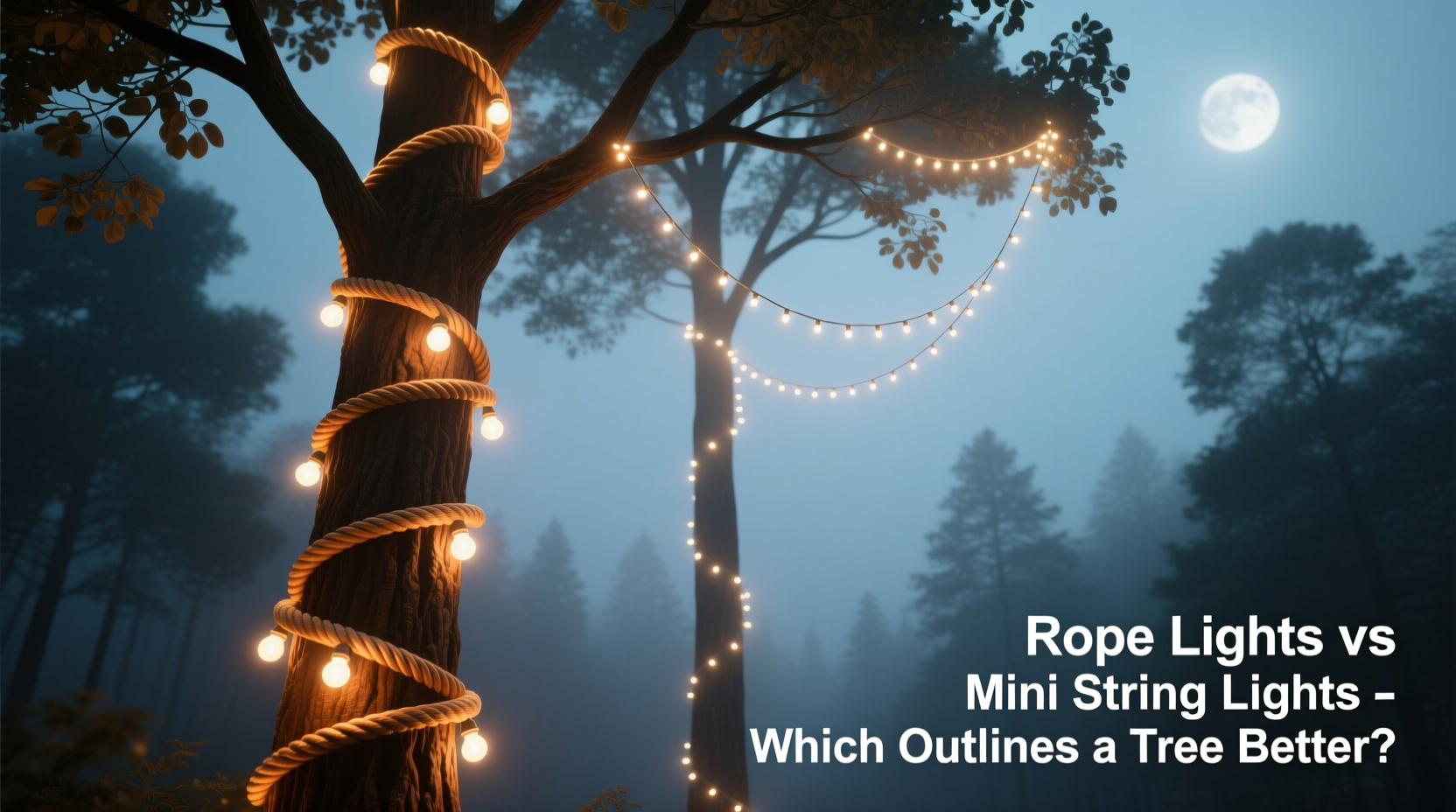
The most immediate difference between rope lights and mini string lights lies in how they distribute light. Rope lights emit a steady, even glow along their entire length. This makes them ideal for outlining the trunk and major branches with clean, defined lines. Because the light source is continuous, shadows are minimized, and the overall effect is smooth and professional—especially effective when viewed from a distance or at night.
Mini string lights, by contrast, produce discrete points of light. While charming and festive, this creates a dotted-line effect when used to outline a tree. The gaps between bulbs mean parts of the silhouette may be lost, particularly if the spacing is wide (typically 4 to 6 inches). On large trees, this can result in an inconsistent or fragmented look unless multiple strands are layered.
Tip: For maximum visibility in urban or well-lit areas, choose rope lights—they provide uninterrupted illumination that stands out against ambient light.However, mini string lights have a higher perceived brightness per bulb due to their concentrated light output. If sparkle and ambiance are priorities over crisp definition, mini lights win. They reflect off leaves and bark, creating dynamic flicker effects that many associate with classic holiday charm.
Durability and Weather Resistance
Outdoor lighting must withstand rain, wind, temperature fluctuations, and UV exposure. Rope lights generally excel here. Their sealed PVC or silicone jackets protect internal wiring and LEDs from moisture and debris. Most outdoor-rated rope lights are rated IP65 or higher, meaning they’re dust-tight and protected against low-pressure water jets. This makes them suitable for long-term installation, even in regions with harsh winters or humid summers.
Mini string lights vary widely in build quality. Lower-end sets use thin insulation and exposed sockets, making them vulnerable to cracking, short-circuiting, or corrosion over time. However, commercial-grade mini lights designed for permanent outdoor use (often labeled “commercial” or “pro series”) feature thicker wires, shatterproof bulbs, and better sealing. Even then, connections between bulbs remain weak points compared to the monolithic structure of rope lights.
“Rope lights are engineered for contouring architectural features—trees included. Their durability allows for semi-permanent setups without seasonal removal.” — Marcus Lin, Outdoor Lighting Designer
If you plan to leave your tree lights up year-round, rope lights are the safer investment. They resist wear from birds, squirrels, and branch movement better than delicate string light strands. Mini lights, while repairable if one bulb fails, require more maintenance over time and are typically treated as seasonal décor.
Installation and Flexibility
How easy is it to wrap or outline a tree? This depends heavily on the light type’s flexibility, weight, and attachment method.
Rope lights are stiffer than string lights due to their tubular construction. While modern versions are pliable enough to bend around moderate curves, tight turns or intricate branching patterns can be challenging. Attempting to force them around sharp angles may cause kinking or cracking. Additionally, rope lights are heavier, so securing them requires robust clips or ties—especially on tall trees where sagging becomes an issue.
Mini string lights are lightweight and highly flexible. They drape naturally over complex shapes and conform easily to irregular branches. Installers can weave them through foliage for a deeper glow or tightly follow contours without risk of damage. This adaptability makes them better suited for ornamental trees with fine branching, like Japanese maples or weeping cherries.
That said, rope lights offer fewer connection points. A single run can span 16 to 50 feet, reducing the need for extension cords or multiple power sources. Mini string lights often come in 25-foot strands, requiring daisy-chaining for larger trees—which increases electrical load and potential failure points.
Step-by-Step Guide: Outlining a Medium-Sized Oak Tree (20 ft tall)
- Assess the tree’s shape: Identify the main trunk and primary branches that define its silhouette.
- Choose your light type: For bold, clean lines—use rope lights. For a twinkling, textured effect—use mini string lights.
- Measure required length: Estimate 1.5x the tree’s height for vertical coverage plus horizontal branches. For a 20-ft tree, aim for 30–40 feet of lighting.
- Prepare mounting hardware: Use UV-resistant zip ties or plastic clips. Avoid metal staples that can damage wires.
- Start at the base: Secure the starting end near ground level. Work upward slowly, maintaining consistent tension.
- Follow the outline: Trace the trunk and branch tips, avoiding deep burial in foliage unless diffused lighting is desired.
- Test before finalizing: Plug in mid-installation to check for dark spots or uneven spacing.
- Secure loose sections: Fasten every 12–18 inches to prevent swaying in wind.
- Connect to power: Use a GFCI-protected outdoor outlet and cover connections with waterproof caps.
Visual Impact and Aesthetic Appeal
The ultimate goal of tree outlining is visual impact. Here, personal taste plays a role—but design principles can guide the decision.
Rope lights create a modern, architectural look. They emphasize form and structure, making them ideal for formal gardens, commercial properties, or contemporary homes. The continuous line draws the eye smoothly around the tree, highlighting its natural geometry. Colored rope lights (such as warm white, blue, or red) maintain uniform saturation without hotspots.
Mini string lights evoke nostalgia and whimsy. Their scattered sparkle mimics stars nestled in the canopy, perfect for residential yards, patios, or festive displays. When lit, they produce depth and dimension, especially when partially hidden among leaves. Multicolor mini lights add vibrancy, while cool or warm white options offer elegance.
Consider context: A large evergreen in a front yard may benefit from the strong definition of rope lights. A smaller deciduous tree in a backyard seating area might shine brighter with the cozy ambiance of mini strings.
Comparison Table: Rope Lights vs Mini String Lights for Tree Outlining
| Feature | Rope Lights | Mini String Lights |
|---|---|---|
| Light Output | Continuous, even glow | Discrete points of light |
| Coverage Accuracy | Excellent for clean outlines | Fair to good; may appear fragmented |
| Durability | High (sealed housing) | Moderate to high (varies by model) |
| Weather Resistance | Superior (IP65+ common) | Good (if outdoor-rated) |
| Flexibility | Moderate (can kink) | High (drapes easily) |
| Installation Ease | Moderate (heavier, needs support) | Easy (lightweight, flexible) |
| Lifespan | 30,000–50,000 hours | 20,000–40,000 hours |
| Aesthetic Style | Modern, clean, architectural | Traditional, festive, whimsical |
| Best For | Tall trees, permanent installs, bold statements | Smaller trees, seasonal décor, ambient lighting |
Real-World Example: Lighting the Heritage Maple at Willow Creek Park
In 2022, the city of Ashland undertook a project to highlight a historic 40-foot sugar maple in Willow Creek Park. The goal was to preserve the tree’s majestic form while adding safe, energy-efficient lighting for evening visitors.
The landscape team tested both rope and mini string lights. Initial trials with mini lights revealed poor silhouette definition—the 6-inch spacing caused breaks in the outline, especially on the upper crown. Wind also caused noticeable sway, reducing visual cohesion.
They switched to 48-foot warm white rope lights with UV-stabilized casing. Installed along the trunk and primary limbs using stainless steel clips, the lights delivered a seamless glow that emphasized the tree’s symmetry. After six months of continuous use—including winter snow and spring rains—no failures were reported. Feedback from residents praised the “elegant, museum-like” presentation.
This case underscores a key principle: for large, prominent trees where clarity and longevity matter, rope lights are often the superior technical choice.
Checklist: Choosing the Right Lights for Your Tree
- ☐ Measure the total length needed for full outline coverage
- ☐ Determine whether you want a continuous line or sparkling effect
- ☐ Check the IP rating—must be at least IP65 for outdoor use
- ☐ Consider whether lights will be seasonal or permanent
- ☐ Evaluate tree height and branch complexity
- ☐ Choose color temperature (warm white = cozy, cool white = modern)
- ☐ Verify power source proximity and GFCI protection
- ☐ Purchase extra clips or ties for secure mounting
- ☐ Test lights before installation to catch dead sections
- ☐ Plan for storage (if seasonal) in a dry, rodent-free container
Frequently Asked Questions
Can I use indoor rope lights outdoors?
No. Indoor rope lights lack proper sealing and UV protection. Exposure to moisture can lead to electrical hazards or premature failure. Always use lights rated for outdoor use.
Do mini string lights consume more energy than rope lights?
Generally, no. Both types use LED technology and are energy-efficient. A 25-foot strand of mini lights uses about 4–6 watts; a comparable rope light section uses 7–10 watts. The difference is minimal, but rope lights often cover more area per watt due to continuous output.
Which is easier to hide during the day?
Mini string lights are less visible when off because of their thin wire and small bulbs. Rope lights, being thicker and more opaque, remain noticeable even in daylight unless painted to match bark or concealed within crevices.
Final Recommendation
For cleanly outlining a tree’s shape, **rope lights are superior**. They deliver unmatched continuity, durability, and professional appearance, especially on large or architecturally significant trees. Their sealed construction ensures long-term reliability, and their even glow maximizes visibility in all conditions.
Mini string lights remain a strong contender when atmosphere and tradition matter more than precision. They’re easier to install on complex forms, more affordable for temporary setups, and beloved for their nostalgic sparkle.
The best approach may be hybrid: use rope lights to define the trunk and main branches, then layer mini string lights within the canopy for depth and brilliance. This combines structural clarity with enchanting detail.
💬 Have you outlined a tree with rope or mini lights? Share your experience, photos, or tips in the comments below—your insight could help others light up their landscapes with confidence!








