Choosing between an opal and a diamond necklace isn’t just about budget—it’s a decision shaped by personal taste, lifestyle, and long-term value. Diamonds have long reigned as the symbol of luxury and permanence, prized for their brilliance and hardness. Yet opals, with their mesmerizing play-of-color and ethereal glow, offer a unique beauty that no other gemstone can replicate. As more people seek individuality in their jewelry, the debate intensifies: Is the dazzling sparkle of a diamond truly worth its premium price tag compared to the enchanting allure of an opal?
This comparison goes beyond aesthetics. It touches on durability, maintenance, emotional resonance, and investment potential. Understanding the strengths and limitations of each gem helps you make a decision aligned not just with your wallet, but with how you live, wear, and value your jewelry.
The Science of Sparkle: How Light Interacts with Opal and Diamond
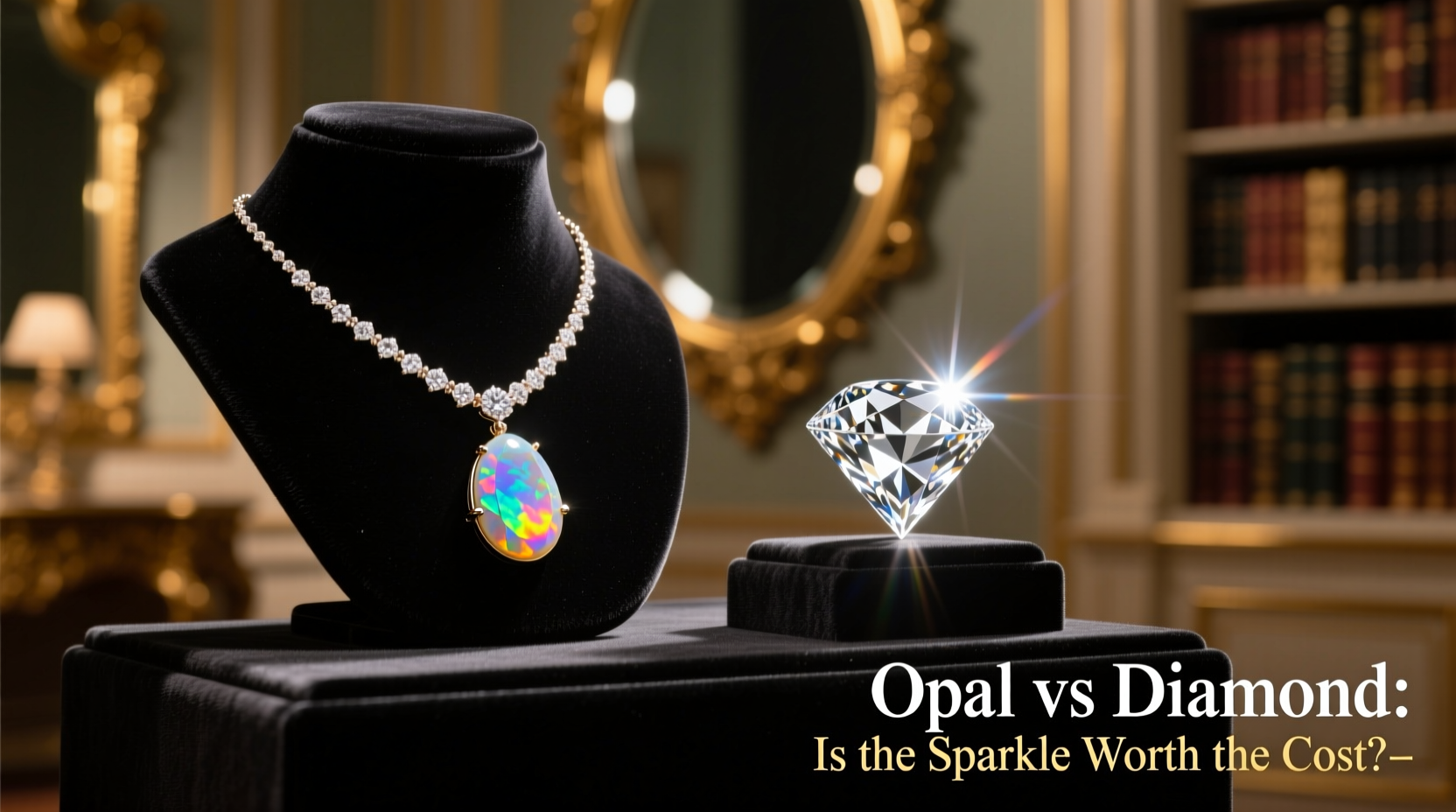
Diamonds are renowned for their fire and brilliance—qualities rooted in their physical structure. With a refractive index of 2.42, diamonds bend light more sharply than most gemstones, creating intense flashes of white light (brilliance) and colorful dispersion (fire). Their cubic crystal lattice allows for exceptional light return when cut precisely, making them appear to “sparkle from within.” This optical performance is consistent across lighting conditions, whether under sunlight or evening chandeliers.
Opals, in contrast, don’t sparkle—they shimmer. Their magic lies in diffraction. Microscopic silica spheres within the stone diffract light into spectral colors, producing a phenomenon known as \"play-of-color.\" No two opals display the same pattern; some flash red and green, others shift from blue to purple. This dynamic effect feels alive, changing as the stone moves. However, opals lack the sharp scintillation of diamonds. In low light, they can appear dull or milky, especially common in lower-grade material.
Tip: If you love dramatic sparkle in all lighting, diamonds excel. For artistic, ever-changing color effects, opals deliver unmatched visual intrigue.Durability and Practical Wear: Which Gem Stands the Test of Time?
A diamond ranks 10 on the Mohs hardness scale—the hardest natural substance on Earth. This makes it highly resistant to scratches, chips, and everyday abrasion. A diamond necklace can be worn daily, even in active environments, with minimal risk of damage. It requires little more than occasional cleaning to maintain its luster.
Opals, however, score between 5.5 and 6.5 on the Mohs scale, making them significantly softer and more fragile. They also contain 3% to 20% water, which means prolonged exposure to heat or dry environments can cause cracking—a condition known as \"crazing.\" Sudden temperature changes or impacts may fracture the stone. While beautiful, opals are better suited for occasional wear or protective settings.
“Opals are like fine art—you admire them closely, protect them carefully. Diamonds are built to endure.” — Dr. Lena Moreau, Gemologist & Curator, American Mineralogical Society
Cost Comparison: Breaking Down Value Beyond Price Tags
Diamonds command high prices due to scarcity, mining costs, certification standards, and market demand. A one-carat, G-color, VS1-clarity round brilliant diamond pendant might retail between $6,000 and $10,000. Even smaller accent stones add up quickly.
Opals vary widely in value based on origin, color pattern, and clarity. Ethiopian hydrophane opals may cost $50–$200 per carat, while top-tier Australian black opals with vivid red flash can exceed $10,000 per carat. Still, most opal necklaces fall well below comparable diamond pieces.
But value isn’t only financial. Emotional and aesthetic worth matter. An opal may carry deep personal meaning—its shifting colors mirroring moods or memories. A diamond may represent legacy, passed down through generations. Resale value favors diamonds, which retain 50–70% of retail value in the secondary market. Most opals, unless museum-grade, depreciate significantly after purchase.
| Feature | Diamond Necklace | Opal Necklace |
|---|---|---|
| Average Price (1 ct) | $6,000–$12,000 | $200–$5,000 |
| Mohs Hardness | 10 | 5.5–6.5 |
| Light Performance | Brilliance & Fire | Play-of-Color |
| Durability | Excellent (daily wear) | Fair (occasional wear) |
| Resale Value | High | Low to Moderate |
| Lifespan (with care) | Generational | Decades (if protected) |
Real-Life Decision: Choosing Based on Lifestyle
Consider Sarah, a 34-year-old architect who wanted a meaningful pendant for her anniversary. She loved the idea of an opal—its rainbow hues reminded her of coastal sunsets during childhood vacations. But her job involved site visits, sketching, and frequent hand use. After consulting a jeweler, she chose a diamond solitaire in a platinum bezel setting. “I realized I’d worry too much about damaging an opal,” she said. “The diamond feels like peace of mind.”
In contrast, Mark gifted his partner a boulder opal pendant set in gold. She worked in a quiet library, rarely exposed to harsh conditions. The opal became a conversation piece, admired during meetings and social events. “It’s not about toughness,” he explained. “It’s about what makes her light up when she wears it.”
Your lifestyle should guide your choice. Active professionals, parents, or travelers benefit from diamond resilience. Those seeking expressive, artistic jewelry for special occasions may find opals deeply rewarding.
Care and Maintenance: Long-Term Commitments
Diamonds are low-maintenance. Clean them monthly with warm water, mild soap, and a soft brush. Ultrasonic cleaners are generally safe unless the setting is delicate. Store separately to avoid scratching other jewelry.
Opals require more attention:
- Avoid prolonged sun exposure or dry heating systems.
- Remove during household chores, swimming, or exercise.
- Store in a padded box with a damp cloth if kept long-term.
- Never use steam or ultrasonic cleaners.
Step-by-Step Guide: Choosing Your Ideal Necklace
- Define your purpose: Is it for daily wear, a gift, or a collector’s piece?
- Assess your lifestyle: Do you lead an active life or prefer formal settings?
- Set a realistic budget: Include insurance and future maintenance.
- Evaluate aesthetic preferences: Do you crave steady sparkle or shifting color?
- Consult a certified gemologist: Get clarity on quality, treatment, and origin.
- Try before you buy: Observe both stones in natural and indoor lighting.
- Review long-term value: Consider resale, inheritance, and emotional significance.
Frequently Asked Questions
Can opals be as valuable as diamonds?
Rare, high-quality opals—especially black opals from Lightning Ridge, Australia—can rival or exceed the price per carat of fine diamonds. However, such specimens are uncommon. Most opals are more affordable, but they typically do not appreciate in value like diamonds.
Are lab-grown diamonds a better alternative to opals?
Lab-grown diamonds offer the same physical properties as mined diamonds at 30–40% lower cost. They provide superior durability and sparkle compared to opals and may be a balanced choice for those wanting brilliance without the premium price. However, they lack the organic uniqueness of opals.
Can I wear an opal necklace every day?
With caution, yes—but not recommended for high-impact activities. Choose a protective mounting (like a bezel), avoid extreme temperatures, and remove it during chores. Daily wear shortens an opal’s lifespan compared to occasional use.
Final Thoughts: Sparkle Isn’t Everything
The sparkle of a diamond is undeniably impressive—a timeless radiance that commands attention. But worth is more than optics. It includes how a piece fits your life, how it makes you feel, and how well it endures. Diamonds win in durability, prestige, and investment. Opals win in originality, emotion, and artistic expression.
If you prioritize longevity, status, and effortless elegance, a diamond necklace justifies its cost. If you value individuality, color-play, and a deeper connection to nature’s artistry, an opal offers rewards no amount of sparkle can match.
💬 What matters most to you in a necklace—timeless sparkle or unique beauty? Share your thoughts and experiences with opals and diamonds in the comments.