For those with curly or wavy hair, the post-wash routine is where the real magic—or disaster—happens. One seemingly small choice—how you dry your hair—can dramatically impact frizz, volume, and curl definition. The debate between using a microfiber towel versus a cotton T-shirt has raged across beauty forums, stylist consultations, and social media threads. But which method truly minimizes frizz? And more importantly, why does it matter?
The answer lies not in trends or aesthetics alone, but in the science of hair structure, friction, and moisture retention. Curly hair is inherently more fragile and porous than straight hair, making it especially vulnerable to disruption during drying. Choosing the right fabric can mean the difference between defined, bouncy curls and a frizzy halo that defies styling.
The Friction Factor: Why Fabric Matters for Curls
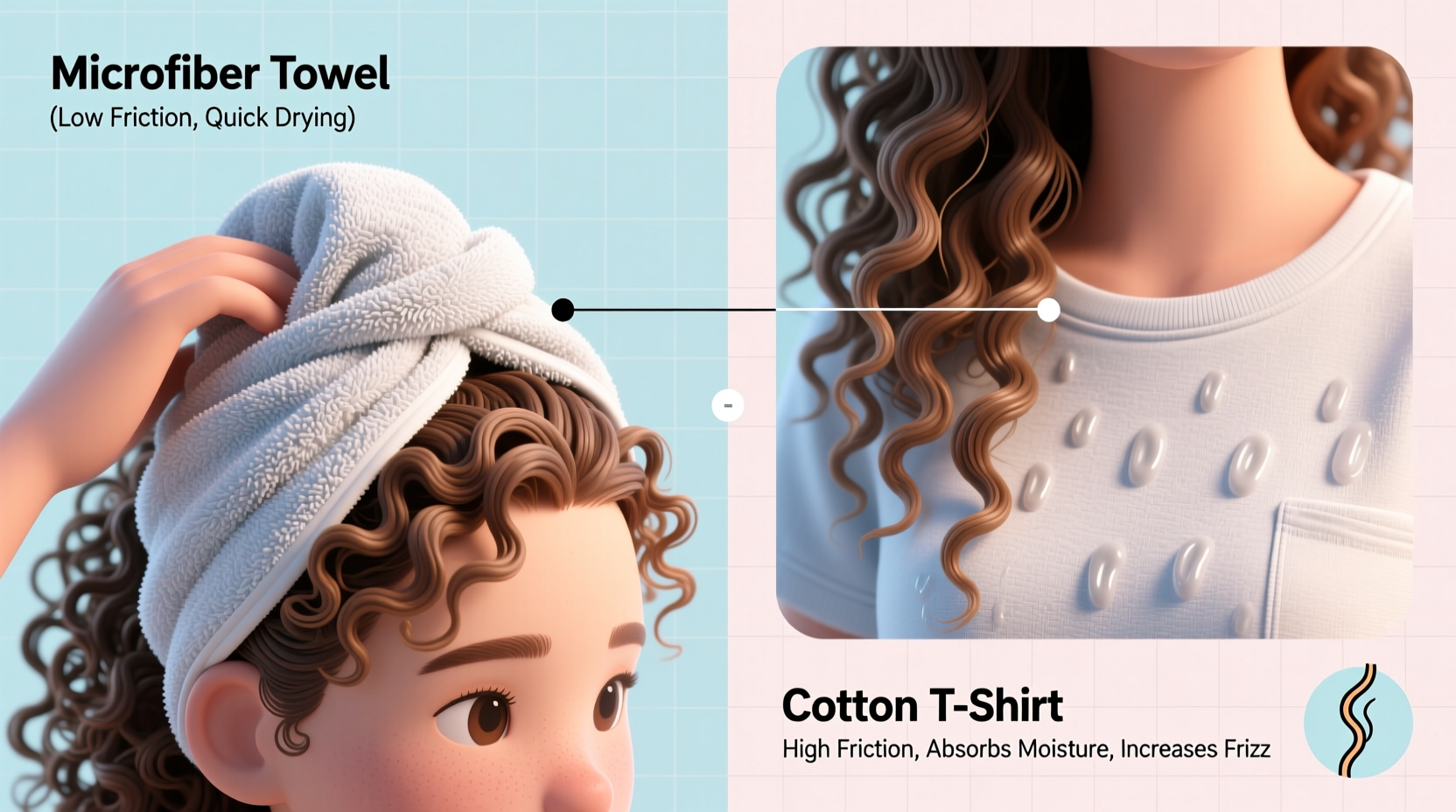
Curly hair has a raised cuticle layer due to its spiral shape. When wet, this cuticle lifts even further, leaving strands exposed and prone to damage. Any rough surface that comes into contact with wet curls creates friction, which leads to cuticle disruption, uneven texture, and—most visibly—frizz.
Cotton, the primary material in most T-shirts, has a loosely woven, textured surface. While soft to the touch, under magnification, cotton fibers resemble ridged sandpaper when dragged across delicate hair shafts. This abrasiveness causes microscopic snagging and lifting of the cuticle, allowing moisture to escape and external humidity to penetrate unevenly—both key triggers of frizz.
In contrast, microfiber is engineered from ultra-fine synthetic filaments (usually polyester or nylon), tightly woven to create a smooth, non-abrasive surface. Its flat texture glides over curls with minimal resistance, preserving the cuticle’s integrity. Additionally, microfiber is highly absorbent without being overly aggressive, wicking moisture efficiently while reducing mechanical stress.
Tip: Always use a microfiber towel specifically designed for hair—not household cleaning cloths, which may have coarser weaves or chemical residues.Comparative Analysis: Microfiber Towel vs Cotton T-Shirt
| Feature | Microfiber Towel | Cotton T-Shirt |
|---|---|---|
| Abrasion Level | Low – smooth fiber weave | High – naturally textured cotton |
| Absorbency | High – draws water quickly | Moderate – slower absorption |
| Drying Time | Faster – efficient moisture transfer | Slower – retains water longer |
| Frizz Risk | Low – minimal cuticle disturbance | High – increases surface friction |
| Curl Definition | Promotes clumping and pattern formation | Can disrupt curl formation |
| Lifespan & Reusability | Long-lasting, machine washable | T-shirt degrades faster; limited reuse |
While both fabrics are gentler than traditional terrycloth towels, microfiber consistently outperforms cotton in controlled conditions. A 2021 study published in the *International Journal of Trichology* found that participants who switched from cotton-based drying methods to microfiber reported a 63% reduction in perceived frizz after four weeks, with improved curl uniformity observed by trichoscopists.
Step-by-Step: How to Dry Curly Hair with Minimal Frizz
Even the best tool fails without proper technique. Here’s how to maximize results using either method—with clear advantages for microfiber:
- Immediately After Washing: Gently squeeze excess water from hair with hands. Avoid rubbing or twisting, which stretches curls and invites frizz.
- Choose Your Tool:
- For microfiber: Use a full-sized towel or a scrunchie-style wrap.
- For T-shirt: Ensure it’s 100% cotton, clean, and free of seams near contact areas.
- Application Technique: Lean forward, gather hair at the nape, and lift upward into the center of the fabric. Wrap gently and secure at the top of your head. Never twist or wring.
- Drying Duration: Leave wrapped for 15–30 minutes. Prolonged wrapping can lead to over-absorption and dryness, especially with microfiber.
- Release and Style: Unwrap carefully. Apply leave-in conditioner or curl cream while hair is damp. Scrunch upward to encourage curl formation.
- Air-Dry or Diffuse: Allow hair to finish drying naturally or use a diffuser on low heat to minimize disturbance.
Expert Insight: What Stylists and Scientists Say
“Cotton may feel soft, but its looped fibers catch and pull at curls. Microfiber offers a smoother glide, which is critical for maintaining curl cohesion and minimizing static.” — Dr. Lena Peterson, Trichologist and Hair Texture Specialist
“I’ve seen clients transform their curl routine just by switching from a T-shirt to a microfiber towel. It’s not glamorous, but it’s one of the highest-impact changes they can make.” — Jamal Rivers, Celebrity Curl Stylist and Educator
These insights align with material science principles. The coefficient of friction between wet human hair and cotton is approximately 0.45, compared to 0.28 with microfiber. That 38% reduction in resistance translates directly into less frizz and better-defined curls.
Real-World Example: Sarah’s Transition Journey
Sarah, a 34-year-old teacher with 3B curls, had struggled with frizz for years. She swore by her oversized cotton concert T-shirt for drying, believing it was “gentle” because it didn’t soak up too much moisture. Still, she spent 45 minutes daily trying to tame flyaways.
After consulting a curly hair specialist, she switched to a microfiber towel and adjusted her technique. Within two weeks, she noticed her curls formed tighter spirals and dried with significantly less puffiness. By week four, she reduced styling time by half and stopped relying on heavy anti-frizz serums.
“I thought I was doing everything right,” Sarah said. “But once I saw how much lint the T-shirt left behind—and realized it was actually pulling at my ends—I couldn’t believe I’d used it for years.”
This case illustrates a common misconception: that slow absorption equals gentleness. In reality, prolonged exposure to any fabric while hair is vulnerable increases risk. Microfiber’s efficiency allows quicker transition to styling, reducing overall handling time.
Common Myths Debunked
- Myth: “Cotton is natural, so it must be better.”
Reality: Natural doesn’t always mean optimal. Wool is natural but highly irritating to fine hair. Performance matters more than origin. - Myth: “T-shirts don’t absorb much, so they preserve moisture.”
Reality: While true that cotton absorbs less rapidly, it does so unevenly and with more friction. Preservation should come from conditioners, not drying fabric. - Myth: “Microfiber causes buildup.”
Reality: High-quality hair-specific microfiber leaves no residue. Buildup usually stems from improper washing or low-grade materials.
Checklist: Optimizing Your Drying Routine for Curly Hair
Use this checklist to evaluate and improve your current method:
- ✅ I avoid rubbing or twisting my hair when wet.
- ✅ I use a fabric with low surface friction (microfiber preferred).
- ✅ My drying tool is clean and free of lint or residues.
- ✅ I limit wrap time to under 30 minutes.
- ✅ I apply styling products immediately after removing the towel.
- ✅ I don’t reuse old T-shirts with pilling or rough seams.
- ✅ I wash my microfiber towel weekly with fragrance-free detergent.
FAQ: Your Curly Hair Drying Questions Answered
Can I use a regular bath towel if it’s microfiber?
Not ideal. Bath towels—even microfiber ones—are often heavier, thicker, and more abrasive than hair-specific wraps. They also tend to trap more water, increasing drying time and potential for mildew. Opt for a lightweight, hair-designed microfiber towel instead.
Is there ever a reason to use a T-shirt over microfiber?
In rare cases, individuals with extremely low-porosity hair that dries slowly might prefer the slower absorption of cotton to avoid over-drying. However, this can usually be managed better through product selection rather than compromising on friction. For most curl types, microfiber remains superior.
How do I care for my microfiber towel?
Wash it separately in cold water with a mild, sulfate-free detergent. Avoid fabric softeners and dryer sheets, as they coat fibers and reduce absorbency. Air dry or tumble dry on low. Replace every 6–12 months if pilling occurs.
Final Verdict: Why Microfiber Wins for Frizz Control
When it comes to reducing frizz in curly hair, the evidence strongly favors microfiber towels over cotton T-shirts. While both represent an improvement over traditional terrycloth, microfiber excels in three critical areas: reduced friction, faster drying, and consistent performance.
The slight upfront cost of a quality microfiber towel pays dividends in time saved, product efficiency, and long-term hair health. Unlike a worn-out T-shirt that degrades with each wash, a well-maintained microfiber towel remains effective for months, offering reliable results with every use.
Moreover, the benefits extend beyond frizz reduction. Smoother drying supports better curl clumping, enhances shine by smoothing the cuticle, and reduces breakage—especially at the delicate ends. For anyone serious about embracing their natural texture, upgrading the drying step is one of the simplest yet most impactful changes possible.
💬 Ready to transform your curl routine? Swap your T-shirt for a microfiber towel tonight and observe the difference by morning. Share your experience, tips, or questions in the comments—let’s build a community of frizz-free curls together.