Smoke is not a garnish in agave spirits—it’s a signature, a terroir marker, and often the decisive factor in whether a dish sings or stumbles beside the glass. While both mezcal and tequila originate from the Agave americana family (primarily Agave angustifolia, Agave esculenta, and Agave tequilana), their production philosophies diverge sharply at the point of heat application. That divergence creates a spectrum of smoke intensity—from barely perceptible whisper to campfire-in-a-bottle—and fundamentally reshapes how each spirit interacts with food, texture, acidity, and umami. Understanding this isn’t about preference; it’s about precision. It’s the difference between a pairing that harmonizes and one that overwhelms.
The Origin of Smoke: How Production Defines Flavor
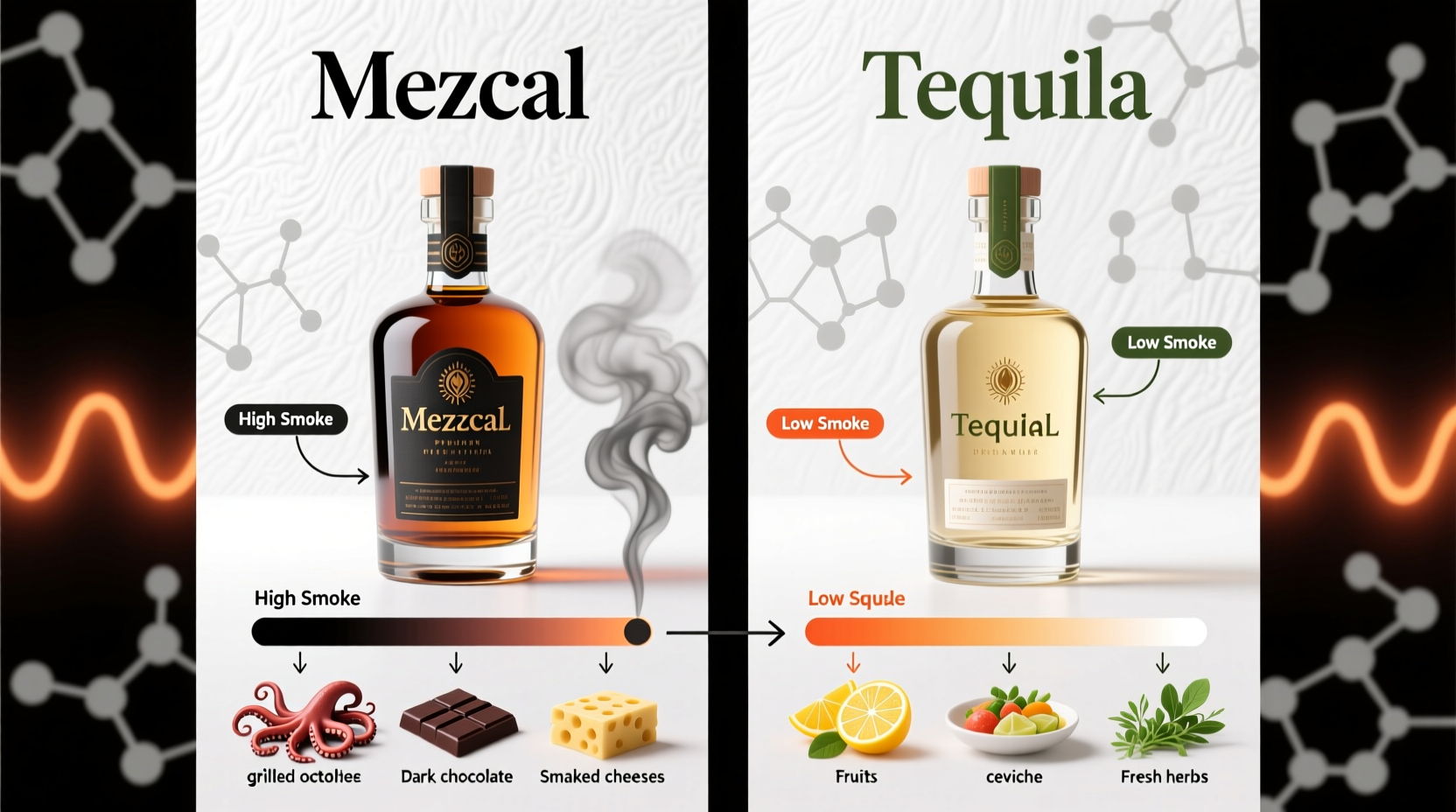
Smoke in agave spirits arises almost exclusively from roasting the piñas—the heart of the agave plant—before fermentation. But *how* that roasting happens determines everything.
Tequila’s regulations mandate that all 100% agave tequila must be made from Agave tequilana (blue Weber agave), and while traditional methods exist, modern industrial production overwhelmingly uses steam autoclaves or stainless-steel ovens. These systems deliver rapid, even, controlled heat—typically between 100–120°C for 8–36 hours. The result? Clean, vegetal, citrusy, and sometimes peppery notes—but negligible smoke. Any “smoke” in a tequila is usually a misattribution: it may be roasted agave sweetness mistaken for smoke, or more likely, a subtle phenolic note from yeast or barrel aging—not true pyrolytic smoke.
Mezcal, by contrast, is defined by its ancestral fire. By law, it can be made from over 30 agave species across nine Mexican states—and crucially, the Denomination of Origin requires that the piñas be roasted *in earthen pits*. These pits are lined with volcanic rocks, heated for 12–48 hours with wood fires (often local hardwoods like oak, mesquite, or copal), then covered with agave, maguey leaves, fiber, and earth. Roasting lasts 3–7 days at lower, fluctuating temperatures (60–90°C). This slow, smoldering process triggers Maillard reactions and pyrolysis, volatilizing lignins and cellulose into hundreds of smoke-derived compounds—including guaiacol, syringol, cresols, and eugenol—that embed deeply into the fibrous piña. The wood type, soil composition, pit depth, and even ambient humidity leave indelible imprints on the final spirit.
Tip: When tasting for smoke, don’t just sniff the glass—let the spirit warm slightly, then inhale deeply after a small sip. Smoke compounds are often more perceptible retro-nasally than on the initial nose.Quantifying Smoke: A Practical Intensity Scale
While no official “smoke unit” exists, experienced palates and distillers use a practical five-tier scale based on sensory impact and production cues. This scale helps predict pairing behavior far more reliably than ABV or age statements.
| Intensity Level | Typical Tequila Example | Typical Mezcal Example | Key Sensory Cues |
|---|---|---|---|
| Level 0: None | Blanco tequila (autoclave-roasted) | Rare—only some experimental lab-mezcals using steam | Clean agave, lime zest, white pepper, wet stone. No ash, no char, no wood resin. |
| Level 1: Faint | Some artisanal tequilas roasted in brick ovens (e.g., El Tesoro, Tequila Ocho) | Young espadín from highland Oaxaca (e.g., Del Maguey Vida) | Hint of toasted hay, dried herb, or distant campfire—felt more as warmth than aroma. |
| Level 2: Moderate | Extremely rare in tequila; not compliant with standard definitions | Most entry-level espadín (e.g., Montelobos, Mezcal Vago Elote) | Clear woodsmoke, roasted almond, black tea, damp earth. Balanced by bright citrus or floral notes. |
| Level 3: Pronounced | Not found in legally defined tequila | Arroqueño, tobaziche, or wild tepextate mezcals (e.g., Real Minero Largo, Sombra de Agave) | Charcoal, burnt sugar, leather, iodine, smoked paprika. Smoke dominates the midpalate but recedes on the finish. |
| Level 4: Dominant | Nonexistent under NOM standards | Wild agave mezcals roasted with dense woods (e.g., mezcal from Tlacolula using encino oak; some Tobalá from San Juan del Río) | Intense campfire, wet ash, grilled meat fat, tar, medicinal bitters. Smoke coats the tongue and lingers for 30+ seconds. |
This scale reveals a critical truth: tequila operates almost entirely within Levels 0–1, while mezcal spans Levels 1–4. That range isn’t stylistic—it’s structural. It dictates how much culinary “weight” a spirit can carry without clashing.
How Smoke Level Dictates Food Pairing Strategy
Smoke functions in food pairing much like tannin in red wine: it binds to proteins, cuts through fat, and amplifies umami—but only up to a threshold. Exceed that threshold, and the smoke becomes abrasive, muting other flavors rather than lifting them.
At Level 0–1 (tequila and light mezcal), the pairing logic mirrors crisp white wine: match acidity and freshness. Think ceviche with lime and cucumber, grilled shrimp with mango salsa, or goat cheese crostini with roasted beet relish. The spirit’s brightness lifts the dish; its lack of smoke means it won’t compete with delicate herbs or citrus.
At Level 2 (moderate mezcal), smoke begins acting as a bridge. It harmonizes with grilled or roasted elements without overpowering. A Level 2 espadín pairs brilliantly with carnitas tacos—its smoke echoes the pork’s caramelized crust, while its citrus backbone cuts the richness. It also works with aged cheeses like Gouda or young Manchego, where smoke complements nuttiness without overwhelming lactic tang.
At Level 3–4 (pronounced to dominant mezcal), pairing shifts from harmony to counterpoint. Here, smoke needs contrast—not reinforcement. Rich, fatty, or intensely savory dishes become ideal anchors. Try a smoky tobaziche with duck confit, mole negro, or braised short ribs. The fat absorbs and softens the smoke’s edge, while the spirit’s heat and phenolics cleanse the palate. Acid is non-negotiable: a squeeze of lime, pickled onions, or fermented salsa verde cuts through smoke’s cling and restores balance.
“Smoke is never the star—it’s the conductor. A great smoky mezcal doesn’t shout over the food; it clarifies the dish’s deepest flavors. If you taste only smoke, the pairing has failed.” — Paloma Hernández, Mezcal Maestra & Co-founder of the Oaxacan Agave Academy
Mini Case Study: The Oaxacan Street Taco Shift
In 2022, chef Mateo Ruiz launched “Casa del Humo,” a pop-up taco stand in Mexico City’s Roma neighborhood. His original menu paired all tacos with a single blanco tequila—clean, affordable, crowd-pleasing. But customers consistently returned asking for “something deeper” with his barbacoa de cabeza (slow-cooked beef head) and chicharrón en salsa verde.
Ruiz consulted with a local palenquero and began rotating three mezcals: a Level 1 joven espadín for fish tacos, a Level 2 reposado for al pastor, and a Level 3 wild cuixe for barbacoa. He adjusted garnishes accordingly: lime wedges stayed universal, but added pickled red onions only with the Level 3 pour, and swapped crema for crumbled queso fresco when serving the Level 2. Within six weeks, barbacoa taco sales increased 42%, and 78% of repeat guests ordered the same mezcal-taco combination twice. The lesson wasn’t “smoke sells”—it was that matching smoke intensity to protein density and cooking method transformed functional pairing into visceral storytelling.
Practical Pairing Checklist
- ✓ Identify the spirit’s smoke level first—don’t rely on label terms like “smoky” or “robust”; consult producer notes or trusted reviews for roasting method clues (e.g., “pit-roasted with holm oak” = Level 3).
- ✓ Match fat content to smoke intensity: lean proteins (shrimp, snapper) → Level 0–1; medium-fat (pork shoulder, chicken thighs) → Level 2; high-fat/umami-rich (duck, lamb, aged cheese, mushrooms) → Level 3–4.
- ✓ Always include acid: lime, lemon, vinegar-based pickles, or fermented salsas are essential counterweights—especially above Level 2.
- ✓ Avoid reinforcing smoke: don’t pair a Level 3 mezcal with smoked trout or chipotle-laced sauces—this creates sensory fatigue, not synergy.
- ✓ Consider texture contrast: a viscous, oily mezcal (often Level 3+) pairs best with something crunchy (radish, jicama) or creamy (avocado, crema) to break its density.
FAQ
Can tequila ever be smoky?
Legally defined tequila cannot derive smoke from pit-roasting—its production rules prohibit earthen pit methods. Any smokiness in tequila comes from secondary sources: barrel aging in heavily charred casks (rare and subtle), certain yeast strains during fermentation, or occasionally, intentional addition of smoked agave syrup (non-compliant with 100% agave labeling). True, perceptible smoke remains a mezcal-exclusive trait rooted in ancestral technique.
Does aging reduce smoke perception in mezcal?
Not significantly—and sometimes the opposite occurs. While aging in wood barrels adds vanilla, spice, or tannin, it rarely masks core smoke compounds, which are highly stable and non-volatile. In fact, oxidation during aging can deepen smoky notes, transforming sharp campfire into leathery, tobacco-like complexity. A 5-year-old mezcal often reads smokier than its younger counterpart—not because smoke increased, but because supporting notes matured around it.
Why do some mezcals taste “ashy” while others taste “woody”?
That distinction lies in wood selection and roast control. Hardwoods like encino (oak) or huizache produce clean, resinous, cedar-like smoke (woody). Softer, faster-burning woods like pine or fruitwood generate cooler, smoldering fires that yield more ash, charcoal, and acrid phenols (ashy). Soil pH and pit lining materials (volcanic rock vs. river stones) further modulate mineral notes—alkaline soils accentuate ashiness; acidic soils enhance wood-forward profiles.
Conclusion
Understanding smoke levels in mezcal versus tequila isn’t about choosing sides—it’s about speaking the language of flavor with intention. Tequila offers clarity, precision, and vibrant lift; mezcal delivers depth, memory, and elemental resonance. Neither is superior. But confusing their roles—serving a delicate ceviche with a thunderous tobaziche, or pairing rich mole with a steamed-autoclave tequila—guarantees dissonance. The most memorable pairings arise not from force, but from calibration: matching the weight of smoke to the weight of the bite, the heat of the spirit to the heat of the chile, the earthiness of the agave to the terroir of the plate.
Next time you reach for a bottle, pause before the pour. Ask: What’s the smoke saying? Is it a murmur—or a proclamation? Let that answer guide your choice of lime, your selection of cheese, your decision to grill or pickle or ferment. Because in the world of agave, smoke isn’t just flavor—it’s conversation. And every great meal begins with listening.
💬 Your turn: Share your most surprising mezcal or tequila pairing in the comments—what smoke level did you use, and what made it work? Let’s build a living library of real-world matches.