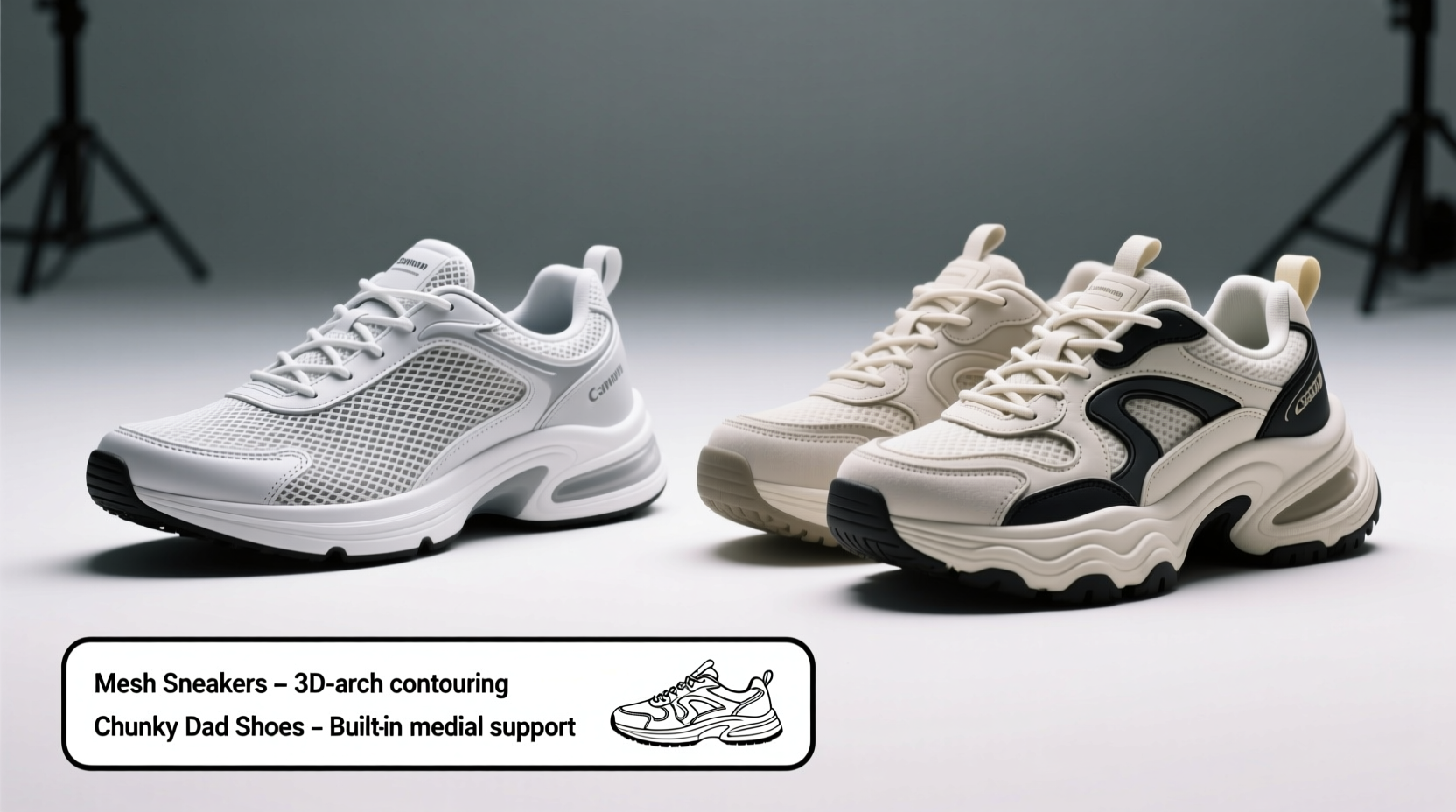
For many people, choosing the right footwear isn’t just about style—it’s about sustainability. Whether you're on your feet all day at work, walking through a city, or standing in line at the grocery store, arch support can make the difference between feeling energized and battling foot fatigue by mid-afternoon. Two popular categories dominate casual footwear today: lightweight mesh sneakers and bulky \"dad\" shoes. While both have their fans, they differ significantly in construction, cushioning, and biomechanical support. Understanding these differences is key to making a choice that benefits your feet in the long run.
The Anatomy of Arch Support
Before comparing shoe types, it's important to understand what arch support actually means. The arch of the foot—the curved structure along the inner sole—acts as a natural shock absorber. When this arch collapses too much (overpronation) or doesn't flex enough (underpronation), discomfort, plantar fasciitis, or even knee and back pain can follow. Proper arch support helps maintain the foot’s natural alignment, distributing weight evenly across the heel, ball, and toes.
Effective arch support involves three components:
- Midsole density: Firm enough to resist collapse but soft enough to absorb impact.
- Contoured footbed: Matches the shape of the arch rather than offering a flat base.
- Heel counter stability: A rigid structure around the heel prevents excessive inward rolling.
How mesh sneakers and chunky dad shoes deliver on these elements varies widely based on design philosophy and materials used.
Mechanics of Mesh Sneakers: Lightweight by Design
Much like performance running shoes, modern mesh sneakers prioritize breathability and minimalism. Their uppers are typically made from engineered knit or thin synthetic mesh, reducing weight and improving airflow. This makes them ideal for warm weather or activities requiring agility.
However, when it comes to structural support, most mesh sneakers fall short unless specifically designed with orthopedic features. Many rely on soft EVA foam midsoles and flat insoles, which compress quickly under prolonged use. While brands like Adidas Ultraboost or Nike React models incorporate some degree of arch contouring, standard fashion-focused mesh sneakers often lack deep heel cups or medial post support.
Tip: If you're considering a mesh sneaker for all-day wear, check whether it has a molded EVA footbed or removable insole compatible with custom orthotics.One major drawback of ultra-light designs is instability during lateral movements. Because the upper offers little rigidity, the foot may shift inside the shoe over time, forcing muscles in the arch and ankle to compensate. This added strain can lead to fatigue, especially for those with flat feet or existing overpronation issues.
Chunky Dad Shoes: Built for Cushion, Not Always for Support
Dad shoes—characterized by thick soles, exaggerated proportions, and retro aesthetics—rose to fame partly due to endorsements from celebrities and streetwear culture. But beyond the hype, their construction offers notable advantages in cushioning and durability.
Brands like New Balance (e.g., 990 series), Hoka One One, and even Balenciaga’s Triple S integrate multi-layered midsoles combining firm and soft foams. These layers work together to absorb impact while maintaining a stable platform. More importantly, many dad shoes feature built-in arch contours, deeper heel counters, and stiffer shanks (a supportive insert between outsole and insole) that prevent twisting.
“Thicker soles don’t automatically mean better support, but when engineered correctly, they allow for strategic placement of stabilizing materials where lightweight shoes simply can’t fit them.” — Dr. Lena Patel, Podiatrist & Gait Analyst
That said, not all dad shoes are created equal. Fashion-driven versions often exaggerate bulk without functional engineering. For example, some luxury “dad-style” silhouettes use foam that feels plush initially but breaks down rapidly, offering no real resistance to arch collapse. True supportive models tend to come from athletic or orthopedic-leaning brands rather than pure fashion labels.
Comparative Breakdown: Key Features Side-by-Side
| Feature | Mesh Sneakers | Chunky Dad Shoes |
|---|---|---|
| Arch Contour Depth | Low to moderate; often flat | Moderate to high; commonly contoured |
| Midsole Stability | Low; prone to compression | High; dual-density foam common |
| Upper Support | Minimal; flexible mesh | Moderate to high; overlays and structured panels |
| Long-Term Durability | 6–12 months with daily use | 12–24 months depending on model |
| Best For | Casual walks, warm climates, light activity | All-day standing, walking, mild overpronation |
This table reveals a clear pattern: while mesh sneakers win in breathability and aesthetic versatility, dad shoes generally provide superior structural integrity. However, the decision ultimately depends on individual needs—not just foot type, but also lifestyle demands.
Real-World Scenario: Office Worker vs. Retail Associate
Consider two individuals with different daily routines:
- Sarah, an office worker: She walks to work (15 minutes), sits at a desk for eight hours, then commutes home. Her primary concern is transition comfort and style. A well-cushioned mesh sneaker with slight arch contouring—like the Allbirds Tree Runners—meets her needs without excess bulk.
- James, a retail associate: He stands for ten hours a day, constantly moving between fitting rooms and registers. His feet ache by 3 PM, especially along the arches. After switching to New Balance 990v5s—a true dad shoe with medical-grade support—he reported a 70% reduction in foot fatigue within a week.
This contrast illustrates that function must follow form. James needed biomechanical reinforcement; Sarah valued discretion and ventilation. Neither was wrong—but their footwear choices had to align with physical demand.
Expert Tips for Maximizing Arch Support
Regardless of shoe style, there are ways to enhance arch support and extend comfort throughout the day. These actionable strategies apply to any wearer:
Tip: Rotate between two pairs of shoes weekly. This allows each pair to decompress fully, preserving midsole resilience and preventing permanent foam collapse.- Replace worn-out shoes every 300–500 miles of walking, even if they look fine externally.
- Use aftermarket insoles such as Superfeet Green or Powerstep Pinnacle if your preferred shoes lack built-in support.
- Avoid going barefoot indoors on hard floors—slip-on supportive clogs or recovery sandals help maintain arch tone.
- Stretch calves and plantar fascia daily to reduce tension pulling on the arch.
Step-by-Step Guide to Choosing the Right Shoe
Selecting between mesh sneakers and chunky dad shoes shouldn’t be arbitrary. Follow this process to ensure lasting comfort:
- Assess Your Daily Foot Load: Are you sitting, walking, or standing most of the day? High-impact roles favor supportive builds.
- Know Your Foot Type: Wet test your foot (step on paper with wet soles). Flat arches need motion control; high arches benefit from cushioning.
- Try Before You Buy: Walk on an inclined surface in-store. Feel for heel slippage, arch cradling, and toe box room.
- Check the Insole: Press your thumb into the footbed. It should resist deep indentation, especially under the arch.
- Research the Model: Look beyond marketing. Read podiatrist reviews or forums like Reddit’s r/Runners or r/Footwear.
This method removes guesswork and focuses on measurable outcomes: stability, endurance, and alignment.
FAQ: Common Questions About Arch Support in Casual Shoes
Can I add orthotics to either type of shoe?
Yes, but mesh sneakers often have non-removable insoles or shallow interiors, limiting space. Chunky dad shoes typically offer deeper wells and removable inserts, making them more orthotic-friendly.
Do chunky shoes cause ankle instability because of their height?
Not necessarily. While elevated soles change proprioception slightly, well-designed dad shoes include extended heel counters and wider bases that improve balance. Poorly made imitations may wobble, but reputable athletic models are tested for stability.
Are mesh sneakers bad for flat feet?
Most are not ideal. Without medial posts or dual-density foam, they fail to correct overpronation. People with flat feet should opt for stability-focused models or choose supportive dad shoes instead.
Final Verdict: Which Offers Better All-Day Arch Support?
After evaluating construction, real-world performance, and expert input, the answer becomes clear: **chunky dad shoes generally provide better arch support for all-day wear**—but only when they’re built with functional intent.
Fashion-forward dad shoes lacking internal structure won’t deliver the same benefits as performance-oriented ones from brands like Brooks, ASICS, New Balance, or Hoka. Meanwhile, a select few advanced mesh sneakers (e.g., On Cloudmonster, Saucony Endorphin Shift) now bridge the gap with engineered footbeds and responsive foam.
Ultimately, prioritize engineering over aesthetics. A shoe that looks sleek but collapses under pressure does more harm than good. Conversely, a bulky silhouette that supports proper gait mechanics can protect your feet for years.
“The best shoe isn’t the one that turns heads—it’s the one that lets you walk another 10,000 steps without thinking about your feet.” — Dr. Arjun Mehta, Sports Medicine Specialist
Take Action Today for Healthier Feet Tomorrow
Your feet carry you through life—one step at a time. Don’t let outdated trends or convenience dictate your comfort. Take a close look at your current rotation. Are your go-to shoes truly supporting your arches, or just masking discomfort until the end of the day?
Start by testing your favorite pair: press into the arch area. Does it hold its shape? Try walking upstairs. Do your heels stay locked in place? If not, it’s time to explore better-engineered options.
💬 Have a favorite supportive shoe that defies expectations? Share your recommendation in the comments below—your insight could help someone finally find relief.








