Choosing the right bag isn’t just about style or capacity—it’s about how it carries. Whether you're commuting to work, walking across campus, or navigating a busy city, how your bag distributes weight directly affects your posture, energy levels, and long-term physical comfort. Two popular options—mesh backpacks and padded totes—are frequently compared for their portability and load-bearing design. But when it comes to actual weight distribution, one clearly outperforms the other in most scenarios.
This article dives into the biomechanics, materials, and structural design behind mesh backpacks and padded totes to help you make an informed decision based on function, not fashion. We’ll examine how each bag type handles stress on the body, who benefits most from each design, and what real-world factors influence performance.
Anatomy of Weight Distribution: Why It Matters
Carrying weight improperly can lead to chronic strain, especially in the shoulders, neck, and lower back. The human body is designed to carry loads efficiently when weight is balanced symmetrically and close to the center of gravity. This is why backpacks, in general, are considered more ergonomic than single-strap bags.
The spine functions best when external loads are distributed evenly across both sides. When weight is carried on one side—such as with a shoulder tote—the torso compensates by leaning, leading to muscle imbalances over time. Studies from the American Physical Therapy Association show that uneven loading increases the risk of postural deviations, particularly in individuals who carry bags daily.
Weight distribution effectiveness depends on several key factors:
- Load placement: How close the weight is to the back and centered over the hips.
- Strap design: Width, padding, adjustability, and whether straps engage multiple anchor points.
- Back panel support: Whether the bag includes structure or ventilation to stabilize the load.
- Center of gravity: Where the bulk of the contents sits relative to the wearer’s body.
Understanding these elements helps clarify why certain bag types perform better under load.
Mechanics of the Mesh Backpack
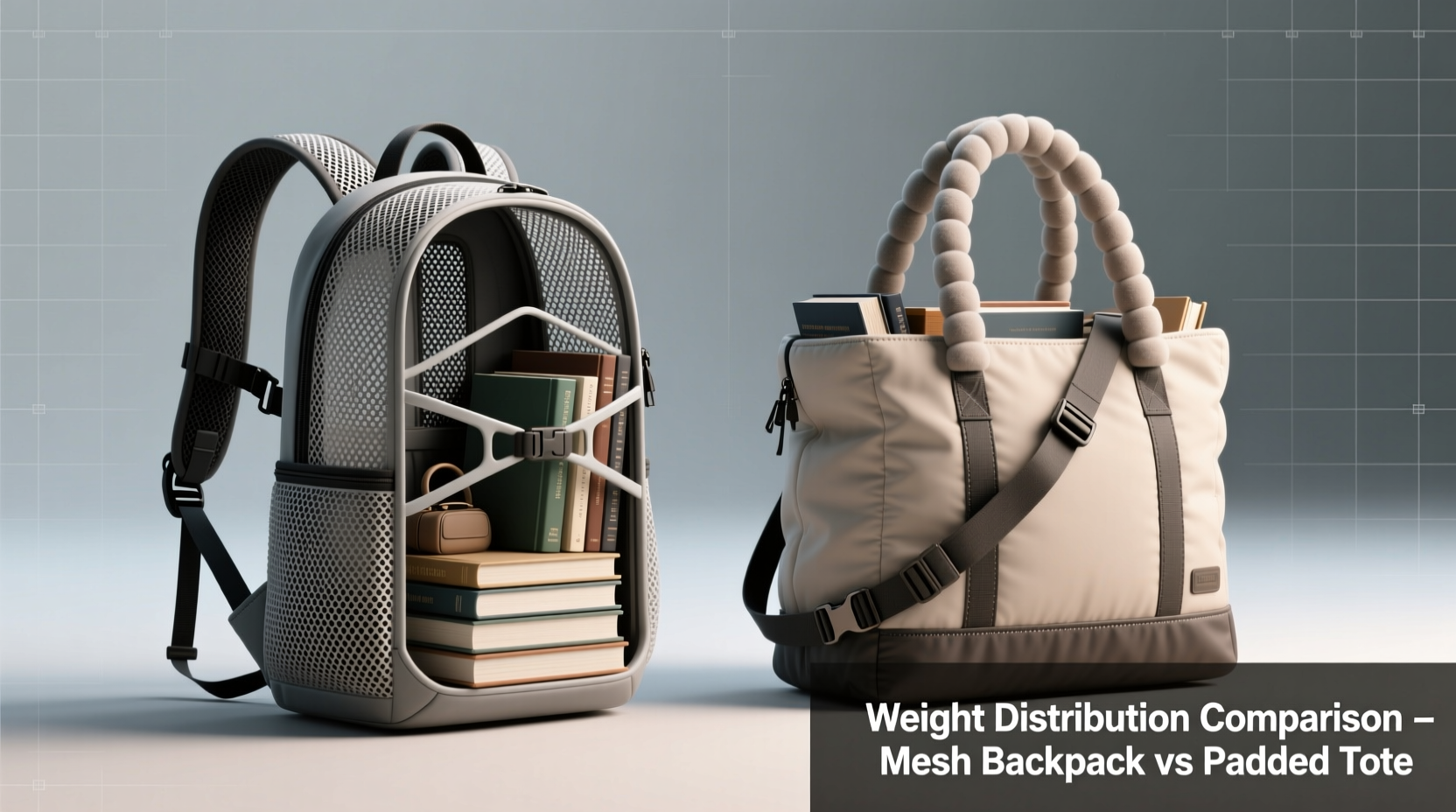
A mesh backpack typically features lightweight construction with breathable mesh fabric on the back panel and shoulder straps. These bags are common among students, travelers, and urban commuters due to their ventilation and reduced weight.
Despite their minimalist appearance, many mesh backpacks are engineered for optimal weight transfer. Dual shoulder straps allow even load distribution across both shoulders, minimizing unilateral strain. Most models include adjustable sternum and hip straps, which play a crucial role in stabilizing heavier loads.
The mesh material itself does not bear the weight—structural integrity comes from internal frames, padded compartments, and reinforced stitching. However, the open-weave back panel enhances airflow, reducing sweat buildup during extended wear. This makes mesh backpacks ideal for warm climates or active use.
From an ergonomic standpoint, the design encourages proper posture. Because the bag sits flush against the upper back, the center of gravity remains aligned with the spine. High-quality mesh backpacks often feature:
- Padded, contoured shoulder straps
- Sternum straps to reduce shoulder fatigue
- Hip belts to transfer up to 80% of the load to the pelvis
- Compartments that keep weight centered
Design and Limitations of the Padded Tote
Padded totes have gained popularity for their professional appearance and ease of access. Often made from canvas, nylon, or leather, they feature a single wide strap or dual shorter handles. Some include modest padding in the shoulder strap to improve comfort.
While padding adds cushioning, it doesn’t solve the fundamental flaw: asymmetrical weight distribution. Even with a wide, padded strap, the entire load rests on one shoulder. Over time, this creates muscular imbalance, especially if the bag exceeds 10–15% of the user’s body weight—the recommended maximum for shoulder-carrying according to orthopedic guidelines.
Another issue is swing effect. As you walk, the tote swings away from the body, increasing leverage and strain. This motion forces the spine to compensate, often resulting in lateral tilting and increased disc pressure. Unlike backpacks, totes lack stabilization systems like chest or hip belts.
Additionally, tote designs often place heavier items (like laptops or books) toward the bottom, lowering the center of gravity and pulling the shoulder down further. Without a structured back panel, the bag doesn’t conform to the body, making it harder to maintain balance.
“Even with padding, a single-strap tote cannot match the spinal alignment support of a well-fitted backpack.” — Dr. Lena Patel, Physical Therapist & Ergonomics Consultant
Comparative Analysis: Key Differences in Weight Handling
To illustrate the differences clearly, here's a side-by-side comparison of mesh backpacks and padded totes across critical performance categories:
| Feature | Mesh Backpack | Padded Tote |
|---|---|---|
| Weight Distribution | Evenly split across both shoulders; can transfer load to hips via belt | Concentrated on one shoulder; no load transfer option |
| Posture Support | Encourages upright alignment; keeps spine neutral | Promotes leaning and spinal deviation over time |
| Ventilation | High—breathable mesh reduces heat and moisture | Low—solid fabric traps heat against the body |
| Load Capacity | High—designed for 15–30 lbs with proper support | Moderate—comfort drops sharply above 10 lbs |
| Stabilization Features | Sternum strap, hip belt, adjustable fit | None—relies solely on strap friction |
| Best For | Commuting, travel, students, outdoor use | Light loads, short trips, professional settings |
The data shows that while padded totes offer convenience and aesthetic appeal, they fall short in functional support. Mesh backpacks excel in environments requiring endurance, mobility, and heavier loads.
Real-World Use Case: Commuter Comparison
Consider two professionals commuting 45 minutes each way via public transit and walking.
Sarah uses a padded tote carrying her laptop (4 lbs), notebook (2 lbs), water bottle (1.5 lbs), and personal items. Total weight: ~9 lbs. She reports frequent right shoulder soreness, occasional neck stiffness, and habitually shifts the bag between shoulders.
James uses a mesh backpack with similar contents. His bag includes padded shoulder straps, a sternum clip, and a lightly padded hip belt. He adjusts the straps so the bag sits high and tight against his back. After six months of daily use, he experiences no pain and finds the backpack easy to manage, even when standing in crowded trains.
After switching to a backpack following a physiotherapist’s advice, Sarah notices immediate relief from shoulder tension. Her posture improves, and she feels less fatigued at the end of the day.
This scenario reflects a common pattern: even moderate loads become problematic when carried asymmetrically over time. The mesh backpack’s ability to distribute weight efficiently makes a measurable difference in daily comfort and long-term musculoskeletal health.
When a Padded Tote Might Be Acceptable
It’s important to acknowledge that padded totes aren’t universally impractical. They serve specific needs well:
- Short-duration use: Carrying light items for brief periods (e.g., lunch, gym clothes).
- Professional environments: Some workplaces favor the polished look of a tote over a backpack.
- Easy access: Totes open widely, allowing quick retrieval of items without removing the bag.
For these situations, choosing a tote with a crossbody strap (worn diagonally across the torso) can significantly improve weight distribution. A longer strap allows the bag to sit at hip level, closer to the body’s center of mass, reducing shoulder strain.
Still, users should limit tote weight and avoid daily reliance if carrying more than 5–7 pounds. Rotating between different carrying methods can also prevent overuse injuries.
Action Plan: Choosing the Right Bag for Your Lifestyle
If your priority is effective weight distribution, follow this step-by-step guide to make the best choice:
- Assess your typical load: Weigh your daily essentials. If total exceeds 10 lbs, a backpack is strongly recommended.
- Evaluate your commute: Long walks, stairs, or crowded transport favor backpacks for stability.
- Check for ergonomic features: Look for adjustable straps, chest clips, and hip support in backpacks.
- Try before you buy: Load the bag with your usual items and walk around the store for a few minutes.
- Alternate when possible: If you must use a tote, switch shoulders frequently and take breaks.
Frequently Asked Questions
Can a padded tote ever distribute weight as well as a backpack?
No. Due to its single-shoulder design, a tote cannot achieve symmetrical load distribution. Even with padding, it places uneven stress on one side of the body, increasing the risk of postural issues over time.
Are mesh backpacks durable enough for daily use?
Yes, provided they are from reputable brands with reinforced stitching and structural support. While the mesh panel is breathable, the load-bearing components are typically high-density polyester or nylon with internal framing. Avoid ultra-light models if carrying heavy loads regularly.
What’s the maximum safe weight for a tote bag?
Experts recommend keeping tote loads under 10% of your body weight—ideally no more than 7–8 pounds for most adults. Exceeding this threshold significantly increases the risk of shoulder, neck, and back strain.
Final Recommendation: Prioritize Function Over Form
When comparing mesh backpacks and padded totes for weight distribution, the evidence overwhelmingly favors the backpack. Its bilateral support, proximity to the spine, and advanced stabilization features make it the superior choice for anyone carrying more than light personal items.
Padded totes have their place—especially in formal or low-load scenarios—but they should not be the default option for daily commuting or active lifestyles. Investing in a well-designed mesh backpack pays dividends in comfort, posture, and long-term physical wellness.
If your current tote is causing discomfort, consider transitioning to a sleek, professional-looking backpack with minimal branding. Many modern designs blend functionality with sophistication, proving that you don’t have to sacrifice style for support.
🚀 Ready to reduce shoulder strain and improve your daily carry? Evaluate your current bag using the checklist above and make the switch if needed. Your body will thank you within days.