
In an era where smartwatches dominate with vibrant OLED displays and bright LED backlights, one might assume that traditional glow-in-the-dark watches have faded into obscurity. Yet, luminous dials continue to hold their ground—especially among outdoor enthusiasts, military personnel, and dive watch aficionados. But are they actually better than LED-equipped timepieces in 2024? The answer isn’t as simple as brightness versus battery life. It depends on use case, environment, longevity, and personal preference.
This article breaks down the key differences between luminous dial watches and LED-backlit watches, evaluates their performance in real-world scenarios, and helps you decide which technology truly shines when it matters most.
How Luminous Dials Work: The Science Behind the Glow
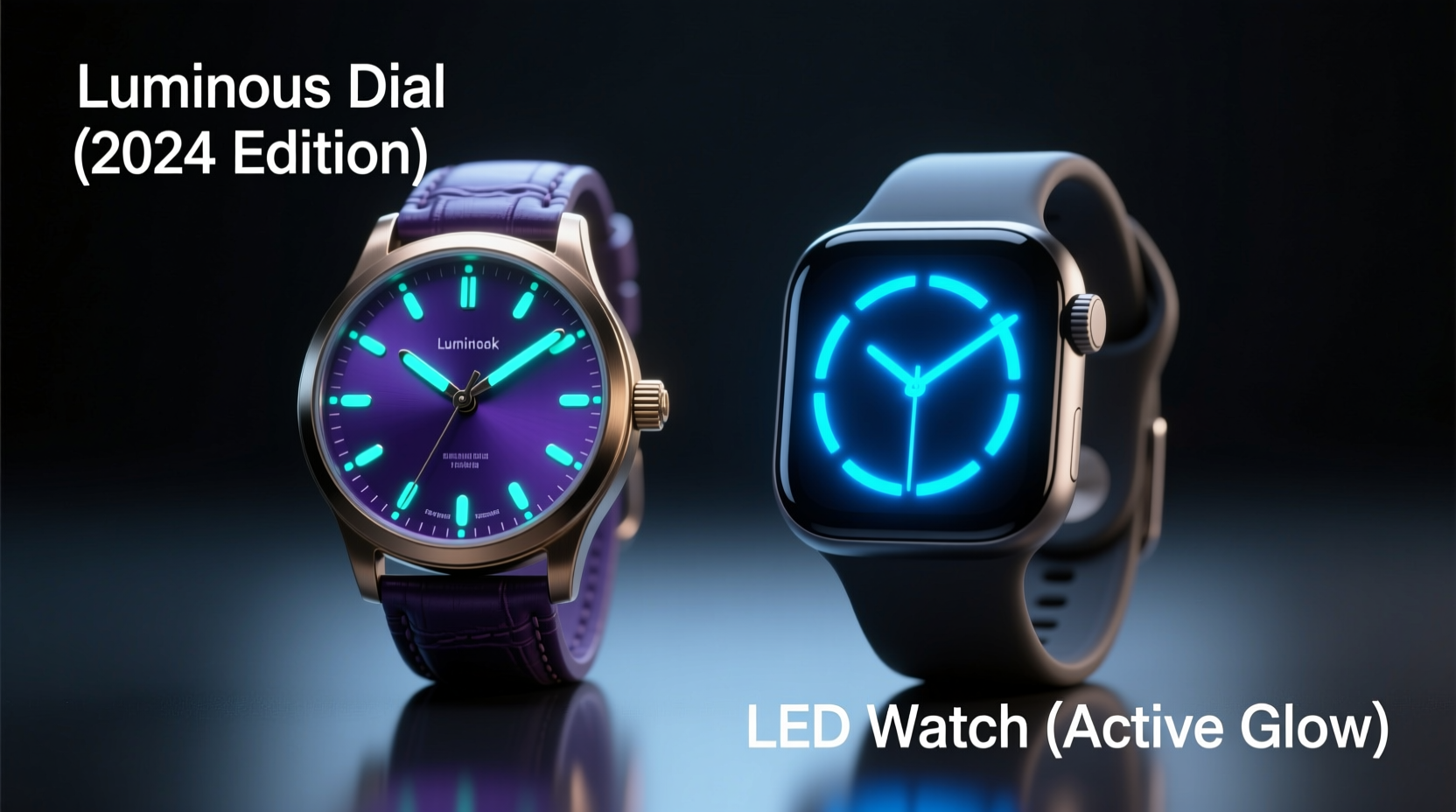
Luminous dials rely on photoluminescent materials—typically Super-LumiNova or tritium gas tubes—that absorb ambient light and re-emit it slowly in darkness. Unlike older radium-based paints (which were radioactive and dangerous), modern lume compounds are non-toxic and safe for everyday wear.
Super-LumiNova is charged by exposure to natural or artificial light. Once activated, it glows brightly for a few hours before gradually fading. Tritium-based illumination, found in brands like Ball Watch Co. and Luminox, uses self-powered micro-tubes filled with tritium gas that emit a constant glow for up to 25 years without needing external charging.
Tip: To maximize lume performance, expose your watch to direct sunlight or strong indoor lighting for 2–3 minutes before entering dark environments.The passive nature of luminous dials makes them ideal for situations where discretion and uninterrupted visibility are crucial—like night operations, camping, or reading the time without disturbing a sleeping partner.
LED Backlight Technology: Brightness on Demand
LED (Light Emitting Diode) backlights are active illumination systems. When activated—usually via button press—they flood the watch face with intense white or blue light, making all markers clearly visible even in total darkness.
Commonly found in digital watches, hybrid analog-digital models, and many smartwatches, LED lighting offers instant readability. However, this convenience comes at a cost: power consumption. Each activation drains battery life, which can be significant over time, especially on non-rechargeable models.
Moreover, the sudden burst of light can be disruptive in low-light settings. Astronomers, night drivers, and soldiers often avoid LED-lit devices because they compromise night vision. As Dr. Alan Weiss, a sleep and circadian rhythm specialist, notes:
“Exposure to bright LED light at night suppresses melatonin and can disrupt both orientation and alertness. For nighttime usability, subtle, continuous glow sources like lume are far more effective.” — Dr. Alan Weiss, Sleep Researcher
Performance Comparison: Luminous Dial vs LED Watch
| Feature | Luminous Dial | LED Backlit Watch |
|---|---|---|
| Visibility Duration | Glows continuously for 4–8 hrs (Super-LumiNova); up to 25 yrs (tritium) | Only during button press (typically 3–10 seconds) |
| Brightness Peak | Moderate initial glow, fades over time | Very high brightness instantly |
| Battery Impact | None (passive system) | Significant with frequent use |
| Night Vision Friendly | Yes – emits soft, diffuse light | No – harsh light disrupts adaptation |
| Durability | High (no moving parts or electronics) | Lower (dependent on circuitry and switches) |
| Long-Term Maintenance | Minimal; tritium lasts decades | May require battery replacement or backlight repair |
Real-World Use Case: Night Hiking in the Rockies
Consider Mark, an experienced hiker preparing for a pre-dawn summit attempt on Colorado’s Mount Elbert. He wears a dive watch with Super-LumiNova hands and markers, while his companion uses a rugged digital watch with an LED backlight.
At 3:45 AM, deep in the alpine forest with no moonlight, Mark checks his time effortlessly—his watch glows steadily, allowing him to read it without fumbling or using a flashlight. His companion presses the light button repeatedly, each flash momentarily blinding him and disrupting his night vision. After 30 minutes, the digital watch’s battery level drops noticeably due to repeated backlight use.
By sunrise, both watches function normally—but Mark’s required zero interaction, preserved his visual adaptation, and consumed no extra energy. This scenario illustrates why many outdoor professionals still favor luminous dials despite technological advances in LED systems.
Which Is Better in 2024? Context Matters Most
There is no universal “better” option between luminous dials and LED watches. The choice hinges on your lifestyle, environment, and priorities:
- Choose luminous dials if: You value passive readability, operate in complete darkness frequently, prioritize battery efficiency, or need discreet time checks.
- Choose LED backlights if: You prefer instant clarity, use your watch intermittently at night, rely on digital features, or don’t mind occasional battery drain.
Hybrid solutions are also emerging. Some modern watches combine luminous hands with optional LED illumination—giving users the best of both worlds. Citizen’s Promaster Skyhawk and certain Casio G-Shock models offer this dual approach, ensuring long-term glow plus on-demand brightness.
Checklist: Choosing the Right Night-Readable Watch
- Assess how often you need to read the time in darkness.
- Determine whether continuous glow or momentary brightness suits your needs.
- Consider battery longevity and charging frequency.
- Evaluate environmental conditions (e.g., underwater, extreme cold).
- Look for ISO-certified luminescence standards (e.g., ISO 3159 for pilot watches).
- Test real-world lume performance—don’t rely solely on marketing claims.
- Prioritize tritium or high-grade Super-LumiNova if reliability is critical.
Future Trends: Where Watch Illumination Is Headed
In 2024, innovation continues in both domains. Micro-LED arrays are becoming more energy-efficient, enabling longer backlight durations. Meanwhile, new generations of photoluminescent materials like LumiBrite (used by Seiko) offer faster charging and extended afterglow—some lasting over 12 hours.
Additionally, smart integration is rising. Some luxury watches now feature motion-activated LEDs that illuminate only when the wrist is tilted, reducing unnecessary power draw. Others use ambient light sensors to adjust display intensity automatically.
Yet, despite these advancements, the fundamental advantage of passive luminescence remains unmatched in mission-critical applications. As one Navy SEAL veteran shared:
“I’ve used everything from early G-Shocks to Swiss mechanicals. In real ops, nothing beats a fully charged lume dial. No buttons, no noise, no delay. Just glance and go.” — Ret. Lt. James R., U.S. Naval Special Warfare
Frequently Asked Questions
Do luminous watches need to be charged?
Yes, but not electrically. Photoluminescent materials like Super-LumiNova require exposure to light (sunlight or artificial) to \"charge\" their glow. Tritium-based lume does not require charging—it emits constant light through radioactive decay (safe and regulated).
Is LED better for people with poor eyesight?
Sometimes. The high contrast and brightness of LED backlights can help those with visual impairments see digits more clearly. However, prolonged glare may cause discomfort. A balanced solution includes large luminous markers combined with adjustable backlighting.
Can I replace degraded lume on my watch?
Yes, but it requires professional servicing. Over time, lume can yellow or lose intensity. Re-luming involves removing hands and applying fresh compound—a delicate process best handled by a qualified watchmaker.
Final Verdict: Glow-in-the-Dark Watches Still Shine in 2024
Despite rapid advancements in digital display technology, glow-in-the-dark watches remain not just relevant, but superior in specific contexts. Their ability to provide silent, continuous, energy-free visibility gives them a distinct edge over LED alternatives in low-light endurance scenarios.
For everyday users, a well-lumed watch offers peace of mind without complexity. For adventurers, professionals, and minimalists, it’s often the only logical choice. While LED watches excel in functionality and versatility, they can’t match the elegance, reliability, and practicality of a properly illuminated analog dial.
In 2024, the question isn’t whether luminous dials are obsolete—it’s whether we’ve forgotten how valuable subtlety and simplicity can be.
🚀 Ready to upgrade your timepiece? Evaluate your nightly habits and choose a watch that works silently—whether it glows all night or lights up on command. Share your favorite night-readable watch model in the comments below!