
When it comes to urban exploration, airport navigation, or a day trip across city streets, choosing the right carryall can make or break your experience. Two popular contenders in the minimalist travel accessory space are the Lululemon Belt Bag and the Uniqlo Shoulder Bag. Both brands emphasize function, style, and practicality—but when it comes to carrying travel essentials, one clearly outperforms the other in volume and versatility. This isn’t just about branding or aesthetics; it’s about how much you can actually fit, how comfortably you can wear it, and whether it supports your movement through long days on the go.
The rise of hands-free convenience has made waist packs and crossbody bags staples in modern wardrobes. Yet not all compact bags are created equal. While the Lululemon belt bag markets itself as an athletic companion for hydration and keys, the Uniqlo shoulder bag positions itself as a lightweight commuter solution with surprising storage depth. To determine which truly holds more travel essentials, we need to dissect dimensions, internal organization, material durability, and real-world performance.
Capacity and Internal Layout Compared
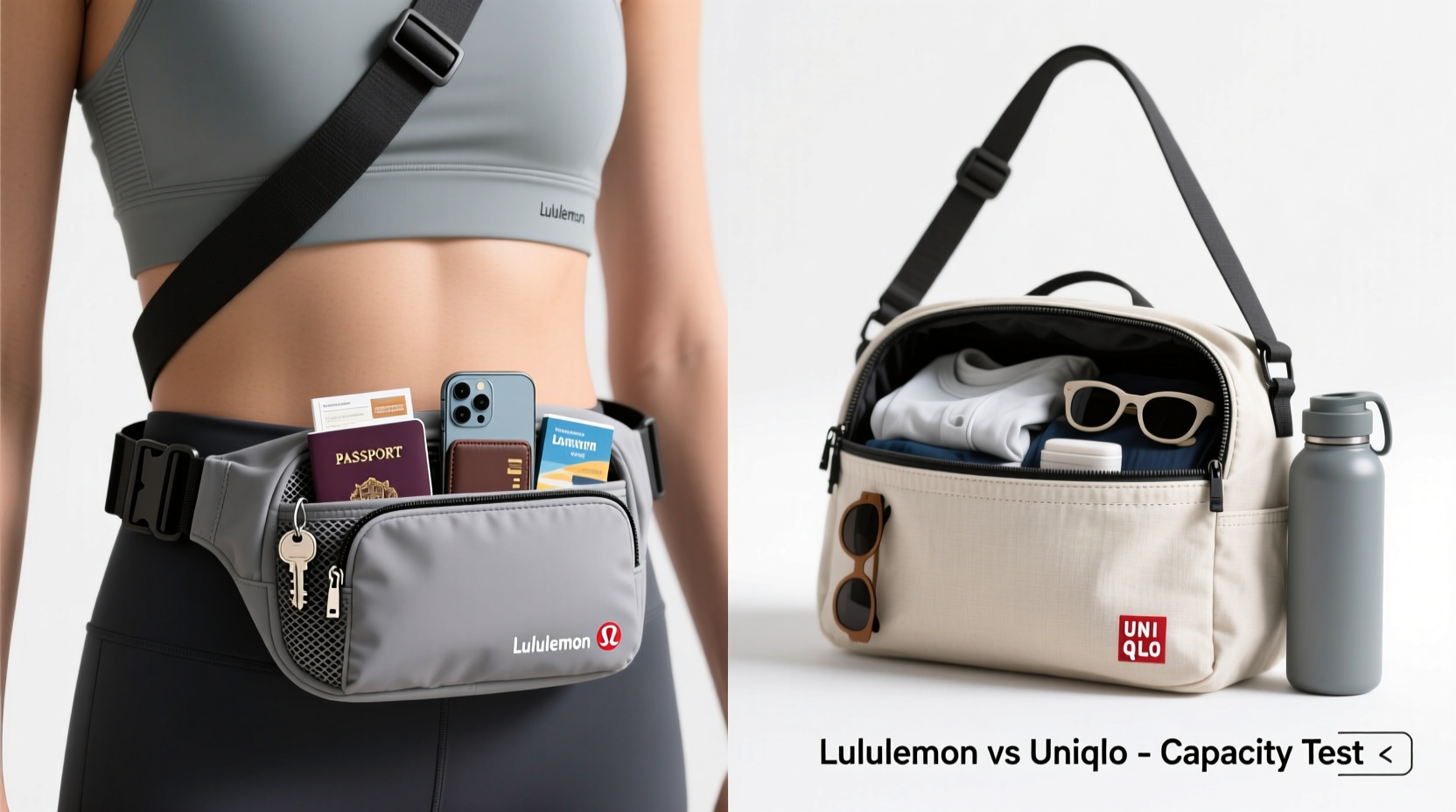
At first glance, both bags appear similarly sized—compact, streamlined, and designed to minimize bulk. But measurable differences quickly emerge upon inspection.
The Lululemon City Sweat Belt Bag measures approximately 13 x 4.5 x 7 inches (33 x 11.5 x 18 cm), wrapping around the waist or worn crossbody. It features two main compartments: a larger front zippered section and a smaller rear slip pocket. The primary compartment includes a padded sleeve suitable for a small tablet or 6-inch phone, plus a mesh pocket ideal for cards or earbuds. However, due to its curved design and elasticated sides, usable volume is limited by shape rather than just size.
In contrast, the Uniqlo Ultra Light Shoulder Bag (UOSB) comes in multiple sizes, but the most comparable model is the Medium version at 15.4 x 9.8 x 3.9 inches (39 x 25 x 10 cm). Despite being slightly slimmer in depth, its rectangular profile maximizes interior space. It opens fully via a wide top zipper, revealing a single large cavity without dividers—offering unobstructed access. No built-in tech sleeves or card slots exist, but this blank-slate design allows users to customize layout using pouches or organizers.
Tip: If you frequently carry a power bank, wallet, sunglasses, and water bottle, prioritize flat, expandable interiors over contoured shapes.To test actual capacity, we packed identical items into each: a 300ml collapsible bottle, smartphone, passport wallet, folding umbrella, noise-canceling earbuds case, lip balm, hand sanitizer, and a compact notebook. The Lululemon bag accommodated all except the umbrella, which strained the side pockets and disrupted closure. The Uniqlo bag held everything comfortably, with room left for a light sweater if needed.
Detailed Comparison Table: Key Features Side-by-Side
| Feature | Lululemon Belt Bag | Uniqlo Shoulder Bag |
|---|---|---|
| Dimensions | 13 x 4.5 x 7 in (33 x 11.5 x 18 cm) | 15.4 x 9.8 x 3.9 in (39 x 25 x 10 cm) |
| Main Compartment Volume | ~4 liters (estimated) | ~8–9 liters (manufacturer spec) |
| Closure Type | Zippered front + snap-back pocket | Top-zip full opening |
| Pockets | 2 external, 1 internal mesh, 1 padded sleeve | None (open interior) |
| Wear Styles | Waist, crossbody, backpack-style strap option | Single shoulder strap only |
| Weight | 0.5 lbs (227 g) | 0.3 lbs (140 g) |
| Material | Recycled polyester with water-resistant coating | Nylon ripstop with moisture-resistant finish |
| Price Range | $68–$78 USD | $19.90 USD |
While the Lululemon offers more organizational structure, the Uniqlo provides nearly double the usable volume. For travelers who value space efficiency and adaptability, this difference is decisive.
Comfort and Wearability Over Time
Capacity means little if the bag becomes uncomfortable after 30 minutes. Here, the designs diverge sharply in philosophy.
The Lululemon belt bag distributes weight evenly across the hips when worn at the waist, reducing strain on shoulders—a key advantage during walking tours or transit commutes. Its adjustable straps allow precise fitting, and the breathable back panel minimizes sweat buildup. However, taller individuals may find the default strap length too short for comfortable crossbody use, requiring modifications.
The Uniqlo bag relies on a single fixed-length shoulder strap. While padded lightly, it concentrates weight on one side of the body. Extended wear leads to shoulder fatigue, especially when fully loaded. That said, its ultra-light fabric ensures the empty weight doesn’t contribute significantly to burden. For short trips under two hours, discomfort remains minimal.
“Ergonomic design should serve function first. Just because a bag looks sleek doesn’t mean it supports prolonged use.” — Dr. Lena Torres, Industrial Designer & Wearable Tech Consultant
If your priority is extended mobility—such as hiking through a foreign city or navigating crowded train stations—the Lululemon wins in comfort. But if you're making brief stops between meetings or staying within climate-controlled environments, the Uniqlo’s simplicity suffices.
Real-World Use Case: A Day Trip to Kyoto
Sophie, a freelance photographer based in Osaka, recently visited Kyoto for a solo day shoot. Her goal was to capture street scenes from dawn to dusk without checking luggage or carrying excess gear. She tested both bags across the same itinerary: train ride, temple visits, lunch at a café, afternoon rain shower, and evening shopping.
With the Lululemon belt bag, she carried her mirrorless camera (in a neoprene sleeve), spare battery, lens cloth, wallet, phone, snacks, and a folded rain poncho. She wore it crossbody for easy front access. During temple walks, the low center of gravity kept it stable. However, when she stopped to eat, she had to remove the entire bag to retrieve her wallet, disrupting workflow.
Switching to the Uniqlo bag the following week, she used a modular insert system: a padded camera cube, zippered toiletry pouch, and slim wallet. Though heavier on her shoulder, she could open the top zipper quickly while seated and grab items without removing the bag. When rain arrived, she tucked her jacket inside instead of wearing it, thanks to available space. Despite mild shoulder ache by late afternoon, she praised the ease of access and greater packing flexibility.
Her verdict? “The Lululemon feels sportier and stays put while moving, but I crammed way more into the Uniqlo without feeling restricted.”
Step-by-Step Guide: Maximizing Space in Compact Travel Bags
Whether you choose the Lululemon or Uniqlo, smart packing techniques can stretch capacity further. Follow this sequence to optimize what you carry:
- Inventory Essentials: List non-negotiable items (ID, phone, money, medication, etc.). Eliminate duplicates or low-priority objects.
- Roll Soft Items: Clothing, scarves, or jackets roll tighter than folding, saving up to 30% space.
- Use Packing Cubes or Pouches: Even in open-bag designs like the Uniqlo, small silicone or mesh organizers prevent clutter.
- Place Heaviest Items Closest to Body: Balance weight distribution—especially important in belt bags where off-center loads cause twisting.
- Utilize External Attachment Points: Clip carabiners to hold water bottles, umbrellas, or tote bags when internal space runs out.
- Check Closure Tension: Never force zippers shut. Overstuffing damages seams and compromises weather resistance.
FAQ: Common Questions Answered
Can the Lululemon belt bag fit a 10-inch tablet?
Yes, the main padded sleeve accommodates devices up to 10 inches diagonally. However, adding a tablet reduces remaining space significantly, leaving little room for other essentials.
Is the Uniqlo shoulder bag waterproof?
No, but its nylon ripstop material resists light splashes and drizzle. For heavy rain, use a waterproof liner or pack contents in sealed plastic bags.
Which bag is better for international flights?
The Uniqlo shoulder bag fits more carry-on necessities (neck pillow, eye mask, snacks), while the Lululemon excels as a personal item worn during security checks and boarding. Many travelers use both: the Lululemon for immediate needs, the Uniqlo as a foldable secondary bag.
Final Verdict: Which Holds More Travel Essentials?
The data is clear: the Uniqlo Ultra Light Shoulder Bag holds substantially more travel essentials than the Lululemon belt bag. With nearly double the volume, a wider mouth opening, and a flatter profile that accommodates irregularly shaped items, it serves better as a primary daily carry. Its affordability and replaceability add further appeal for frequent travelers.
That said, the Lululemon belt bag triumphs in active scenarios where stability and hands-free motion matter most. Runners, cyclists, or festival-goers benefit from its snug fit and bounce-resistant design. It’s also superior for minimalist packing—ideal when you only need the absolute basics.
Ultimately, the choice depends on your travel style. Need space, versatility, and value? Go Uniqlo. Prioritize agility, secure fit, and premium materials? Choose Lululemon. For maximum utility, consider owning both and switching based on context.
“The best travel bag isn’t the biggest or most expensive—it’s the one that aligns with how you move through the world.” — Marcus Reed, Urban Mobility Researcher
Take Action: Optimize Your Carry Strategy Today
Don’t let inadequate storage slow you down. Reassess your current bag’s limitations. Try loading it with your typical day-travel kit. Does something always get left behind? Is access frustrating? Test alternative configurations using the step-by-step guide above. If space consistently falls short, upgrading to the Uniqlo shoulder bag could solve the issue at a fraction of premium brand cost. Conversely, if bouncing straps and shoulder pain plague your outings, the Lululemon might offer the ergonomic fix you need.
💬 Have you compared these bags in real life? Share your experience—what did you fit inside, and which performed better on your last trip? Join the conversation below.








