Walk into any forward-thinking bar in London, Portland, or Tokyo today, and you’ll likely see a dedicated “Lower Proof” section on the menu—featuring vermouth-forward spritzes, amaro-based shrubs, sherry cobbler variations, and house-made non-alcoholic spirits paired with 15% ABV grape distillates. These aren’t just mocktails dressed up for Instagram. They’re rigorously constructed, ingredient-led drinks served alongside classics like the Martini or Old Fashioned—not as substitutes, but as intentional alternatives. Yet skepticism lingers: Are low ABV cocktails (typically defined as under 15% ABV, and often under 10%) a legitimate evolution in mixology—or merely a concession to wellness culture, sacrificing depth, complexity, and craft for palatability and buzz-free convenience?
The answer isn’t binary. It’s rooted in how intention shapes execution. A poorly conceived low ABV drink *is* watered down—thin, unbalanced, and forgettable. But when built with the same discipline applied to high-proof classics—respecting dilution, acidity, texture, umami, and aromatic layering—the result can be more nuanced, more food-friendly, and more expressive than many spirit-forward cocktails. This isn’t about lowering alcohol for its own sake. It’s about recentering flavor, pacing, and presence.
What “Low ABV” Really Means—And Why the Label Misleads
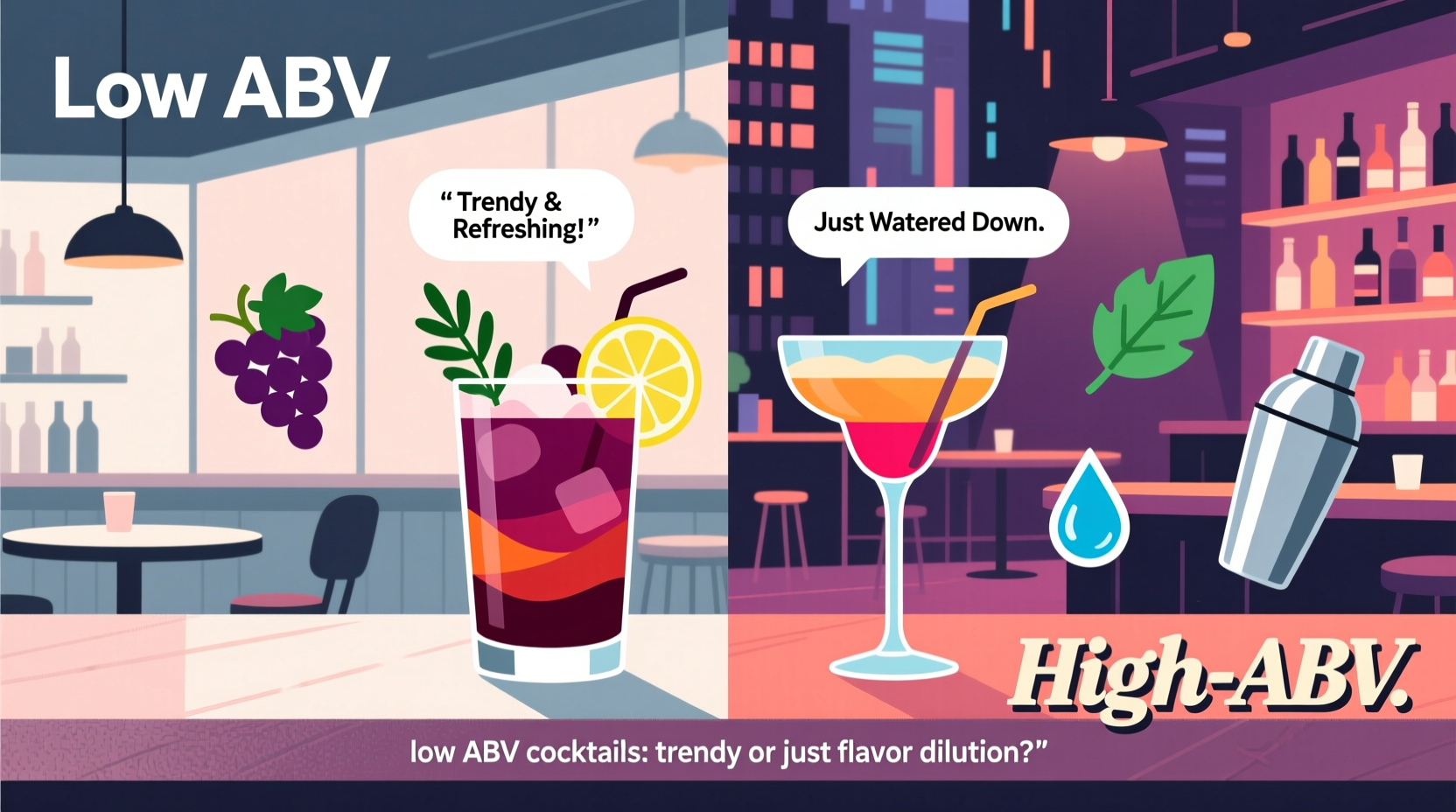
“Low ABV” is a marketing term, not a technical category. In regulatory terms, the U.S. TTB defines “non-alcoholic” as under 0.5% ABV, “alcohol-free” as 0.0% (though rare), and “low-alcohol” as under 3.2% ABV in some states—but bars rarely use those thresholds. In practice, modern low ABV cocktails span 4% to 14% ABV, with most landing between 8% and 12%. That’s comparable to a robust wine (13–14.5% ABV) or a sessionable craft beer (4–6% ABV), yet significantly lower than a standard cocktail (22–35% ABV).
This range matters because alcohol isn’t just a carrier—it’s a solvent, a textural agent, and a flavor amplifier. At 28% ABV, gin extracts citrus oils and herbal volatiles differently than at 12%. So shifting downward isn’t about subtraction; it’s about recalibration. The best low ABV drinks replace ethanol’s structural role with other tools: acid balance, tannin, salinity, carbonation, viscosity from syrups or dairy, and layered botanicals.
Tip: When building a low ABV cocktail, treat alcohol like salt in cooking—not the main ingredient, but the seasoning that unlocks everything else. Start with your base non-spirit components first (vermouth, juice, tea, shrub), then add just enough spirit to lift, not dominate.The Flavor Paradox: How Less Alcohol Can Mean More Complexity
High-proof spirits deliver intensity, but they also suppress perception of subtler notes. Ethanol numbs the tongue slightly and overwhelms volatile aromatic compounds. A 32% ABV Negroni may taste boldly bitter and boozy—but much of Campari’s floral top notes and sweet vermouth’s dried cherry and clove nuances get muted. Reduce the gin to 0.75 oz and increase the vermouth to 2 oz (bringing ABV down to ~11%), and suddenly those layers emerge: the orange peel’s brightness, the gentian’s earthy lift, the vermouth’s oxidative nuttiness.
This principle is why the aperitivo tradition—rooted in Italy and Spain—has become the blueprint for serious low ABV work. Drinks like the Americano (Campari, sweet vermouth, soda), the Bamboo (dry sherry, dry vermouth, orange bitters), or the Adonis (sherry, sweet vermouth, orange bitters) rely on fortified wines, which offer concentrated flavor, natural acidity, and oxidative depth without needing high proof to stand up. Their ABV hovers between 12% and 18%, yet they deliver far more aromatic information than many 30%+ cocktails.
“The moment we stopped asking ‘How strong can this drink be?’ and started asking ‘What does this drink need to say?’ was the moment low ABV became a creative catalyst—not a compromise.” — Ivy Mix, James Beard Award–winning bartender and founder of Leyenda in Brooklyn
Real-World Bar Data: Beyond the Hype
A 2023 survey by the Bar Business Media group tracked 127 independent bars across the U.S. over 18 months. Key findings challenge the “watered-down” narrative:
- Low ABV cocktails accounted for 22% of total cocktail sales in bars with dedicated low-ABV menus—up from 7% in 2021.
- Customer retention increased by 14% among patrons who ordered at least one low ABV drink per visit, suggesting higher repeat engagement.
- Profit margins on low ABV drinks averaged 68%, compared to 59% for standard cocktails—driven by lower spirit costs and higher perceived value for thoughtfully crafted non-spirit bases (e.g., house-made vermouth infusions, barrel-aged shrubs).
- Critically, 73% of bartenders reported that guests ordered low ABV drinks *first*, not as a “lighter finish,” indicating genuine preference—not just dietary accommodation.
This isn’t anecdotal. It reflects a shift in drinking rhythm: people want longer, more conversational sessions where flavor—and not intoxication—anchors the experience. As one Portland bar manager observed, “Our busiest night isn’t Friday—its Tuesday. People come in after work, stay for two hours, and order three drinks. If all three were 30% ABV, they’d leave after one. With thoughtful low ABV options, they linger, talk, and taste.”
Building Better Low ABV Cocktails: A 5-Step Framework
Creating a compelling low ABV drink isn’t about swapping out spirits. It’s about rebuilding from the ground up. Here’s how top-tier bars do it—step by step:
- Anchor with a flavorful base: Choose one dominant non-spirit element with inherent structure—dry sherry, blanc vermouth, fino, aged rum agricole, or even cold-brewed coffee concentrate. Avoid neutral bases like plain soda or simple syrup alone.
- Layer acidity with purpose: Use multiple acid sources—not just lemon juice. Try verjus for tart apple brightness, yuzu juice for citrus-umami depth, or vinegar-based shrubs (apple cider + blackberry + thyme) for rounded, savory tang.
- Add texture deliberately: Replace ethanol’s mouthfeel with viscosity (gum arabic syrup), effervescence (house-made seltzer infused with herbs), salinity (a drop of saline solution), or fat-washing (coconut milk–washed blanco tequila for creaminess without dairy).
- Introduce aromatic contrast: High-proof spirits punch with aroma, but low ABV drinks need layered scent. Use tinctures (lavender, celery seed), rinses (absinthe, smoked mezcal), or garnishes that release oil on expression (grapefruit twist over a sherry base).
- Dilute with precision: Shake or stir not just to chill, but to integrate. Low ABV drinks suffer most from poor dilution—too little leaves them sharp and disjointed; too much makes them thin. Target 20–25% dilution by weight (measured via scale) for stirred drinks; 30–35% for shaken.
Case Study: The “Hawthorne Hour” at Bar Amalfi, Chicago
When Bar Amalfi launched its “Hawthorne Hour” tasting menu in early 2023, it committed to zero drinks above 12% ABV—and no substitutions. One standout, the Saffron & Sea, illustrates the framework in action:
- Base: 1.5 oz Oloroso sherry (17% ABV, rich, nutty, oxidative)
- Acid: 0.5 oz preserved lemon brine + 0.25 oz yuzu juice
- Texture: 0.25 oz gum arabic syrup (adds silk without sweetness)
- Aroma: Rinse glass with seaweed-infused aquavit tincture; garnish with toasted nori strip
- Dilution: Stirred 32 seconds with large cube → precisely 23% dilution
Final ABV: 10.8%. Served in a chilled coupe, it delivers oceanic salinity, saffron’s honeyed bitterness, and sherry’s deep walnut richness—all balanced, persistent, and evolving over six sips. Guests consistently rate it higher in flavor recall than the bar’s flagship 32% ABV Oaxacan Old Fashioned. Not because it’s “lighter,” but because nothing competes for attention. Every note has space to breathe.
Do’s and Don’ts of Low ABV Cocktails
| Category | Do | Don’t |
|---|---|---|
| Base Selection | Use oxidized or fortified wines (sherry, vermouth, Madeira) for depth and stability | Rely solely on unfortified wine or juice—lacks backbone and oxidizes quickly |
| Sweetness | Balance with umami or salinity (soy reduction, miso syrup, saline) to avoid cloying | Add sugar to compensate for missing alcohol heat—creates flat, one-dimensional sweetness |
| Strength Perception | Use warming spices (black pepper, ginger, cinnamon) or bittering agents (gentian, wormwood) to mimic “heat” | Assume low ABV = low impact—flavor intensity doesn’t require ethanol |
| Glassware & Service | Serve at precise temperature (chilled but not icy-cold) to preserve aromatic lift | Serve over crushed ice in a rocks glass—dilutes too fast and muddies delicate layers |
| Menu Language | Describe flavor architecture: “orange blossom, roasted almond, sea mist” | Lead with ABV or “light”—reinforces deficit framing instead of sensory promise |
FAQ
Does “low ABV” always mean “lower quality” or “less skilled”?
No. In fact, it often demands *more* technical precision. Balancing five non-spirit ingredients without ethanol’s binding power requires deeper understanding of pH, solubility, and volatile compound interaction. A masterful low ABV cocktail reveals more about a bartender’s palate and patience than a perfectly executed Manhattan.
Can I make great low ABV drinks at home without specialty ingredients?
Absolutely—with smart substitutions. Swap store-bought dry vermouth for bianco vermouth (more aromatic, less bitter). Use brewed green tea + a splash of apple cider vinegar instead of a complex shrub. Toast whole spices (coriander, fennel) and steep in simple syrup for instant depth. Even a high-quality olive brine adds savory complexity that reads as “boozy” to the brain—even at 0% ABV.
Why do some low ABV cocktails still taste “thin” or “weak”?
Most often, it’s insufficient acid or texture. Without enough brightening acidity, low ABV drinks fall flat. Without viscosity or salinity, they lack mouthfeel. And without aromatic reinforcement (via garnish or rinse), they feel vague on the nose. It’s rarely about the ABV itself—it’s about what was left out in the construction.
Conclusion: Flavor First, Alcohol Second
Low ABV cocktails aren’t trending because people want less alcohol. They’re trending because people want more from their drinks—more nuance, more conversation, more time spent tasting rather than recovering. The question “Are they watering down flavor?” presumes alcohol is the source of flavor, when in truth, it’s often the barrier to it. When a drink’s structure relies on botanicals, acidity, tannin, and texture—not ethanol’s burn—the result isn’t diluted. It’s distilled.
This movement isn’t about abstinence or accommodation. It’s about expansion: expanding the definition of what a cocktail can be, who it’s for, and how long it stays interesting in the glass. Whether you’re a bartender refining your menu, a curious home enthusiast experimenting with vermouth, or simply someone who values flavor over force—you don’t need to choose between intensity and intention. You can have both. Start with one ingredient you love—a sherry you keep open on the counter, a jar of preserved lemons, a bottle of dry cider—and build around its voice. Let the alcohol serve the flavor—not the other way around.
💬 Try one low ABV recipe this week—and tell us what surprised you. Was it the depth? The length of finish? How well it paired with dinner? Share your tasting notes in the comments—we’re curating a community guide to flavor-forward, lower-proof drinking.