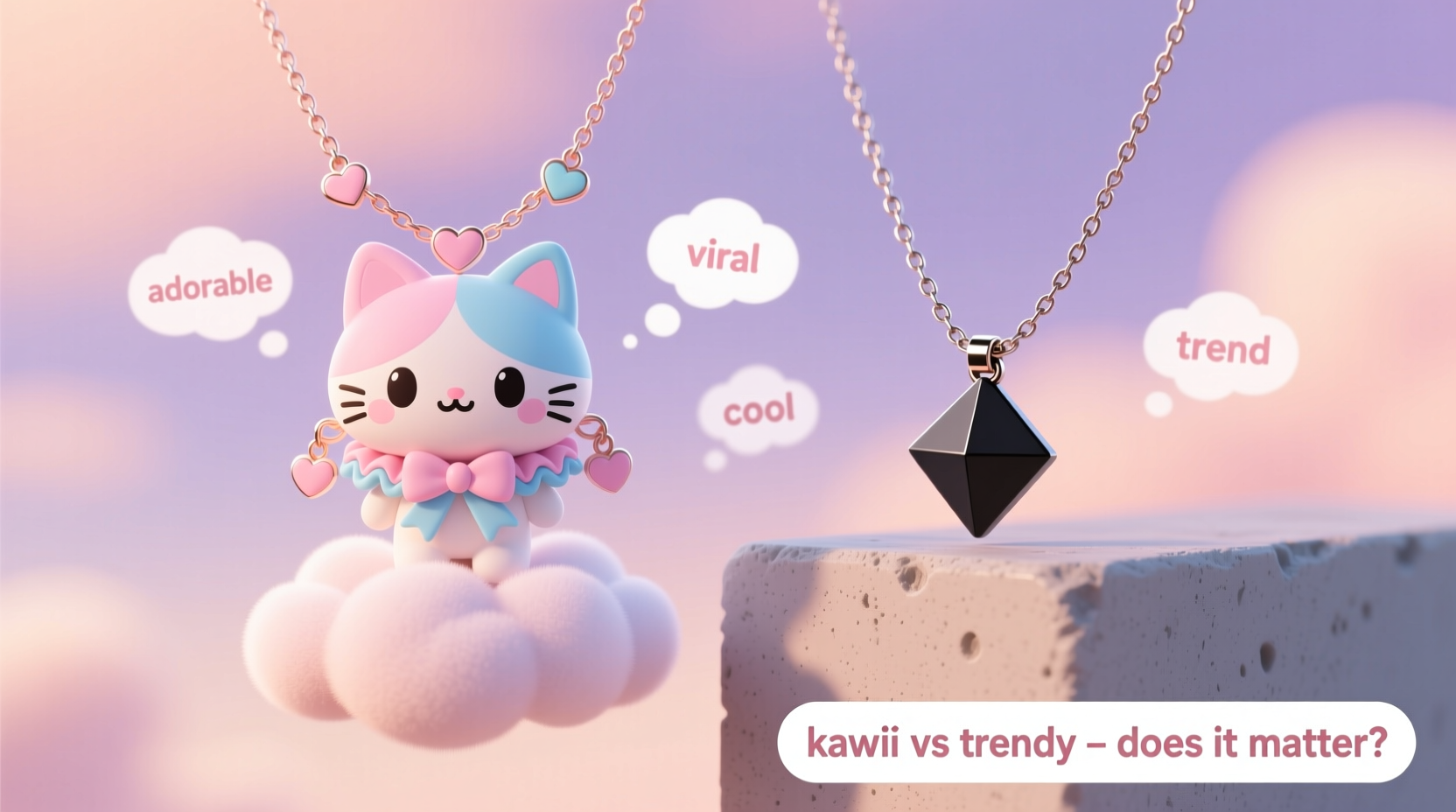
In a world where fast fashion cycles spin faster than ever, accessories like necklaces have become key tools for self-expression. Two dominant aesthetics—kawaii and \"trendy\"—frequently collide on social media, retail shelves, and street style. One celebrates childlike whimsy with pastel charms and smiling faces; the other favors minimalist geometrics, sleek metals, and Instagram-approved minimalism. But beneath the surface, a real question emerges: do consumers genuinely distinguish between kawaii and trendy necklaces, or is the separation just another clever marketing strategy designed to fragment tastes and drive sales?
The answer isn’t simple. While some wearers choose pieces purely based on aesthetics, others are deeply invested in the cultural narratives each style represents. Understanding this distinction requires unpacking the origins of kawaii culture, the mechanics of trend cycles, and how identity plays into personal style.
What Exactly Is Kawaii Culture?
Kawaii, a Japanese term meaning \"cute,\" transcends mere appearance. It's a cultural phenomenon rooted in post-war Japan that evolved from a social behavior—politeness, humility, childlike innocence—into a full-fledged aesthetic movement. In fashion, kawaii manifests through oversized bows, pastel colors, cartoonish characters, and playful motifs like stars, clouds, and animals with exaggerated eyes.
Kawaii jewelry, particularly necklaces, often features enamel charms, chibi-style figures, or phrases written in kana. Brands like 66 Basics, Atelier PuuPuu, and Mameshiba by Bancho Sarayashiki cater to this niche, drawing fans not just for their look but for their emotional resonance. For many, wearing kawaii isn’t frivolous—it’s an act of resistance against rigid adult norms, a reclamation of joy, or a nod to subcultures like Lolita, Decora, or Fairy Kei.
“Kawaii is not just visual—it’s emotional armor. When someone wears a necklace with a tiny smiling cloud, they’re often signaling more than taste. They’re sharing a worldview.” — Dr. Aiko Tanaka, Cultural Anthropologist, Waseda University
Trendy Necklaces: The Algorithmic Aesthetic
Contrast this with “trendy” necklaces—the kind you see on influencer flat lays and Zara mannequins. These typically feature delicate chains, small pendants (like initials, moons, or abstract shapes), and a monochromatic palette. The goal is versatility: something that looks good layered, pairs easily with a white tee, and photographs well under soft lighting.
This style thrives on algorithm-driven platforms like TikTok and Pinterest, where trends emerge, peak, and fade within months. Unlike kawaii, which carries cultural depth, trendy jewelry often prioritizes function over narrative. It’s less about what the piece means and more about how it fits into a curated feed or capsule wardrobe.
Brands like Mejuri, Monica Vinader, and & Other Stories dominate this space by promoting “everyday luxury”—minimalist designs marketed as timeless, though in practice, they shift seasonally to match emerging micro-trends.
Tip: If your necklace disappears from Instagram ads after three months, it was never meant to be timeless—it was trendy.Is the Difference Real—or Just Marketing Smoke?
On one hand, kawaii and trendy necklaces serve different purposes and appeal to distinct identities. Kawaii leans into individuality, nostalgia, and subcultural belonging. Trendy jewelry aligns with mainstream fashion, accessibility, and social conformity. But brands increasingly blur these lines, repackaging kawaii elements as “playful minimalism” or selling “cute” motifs on dainty chains to broaden appeal.
Consider how major retailers now offer “smiling sun” pendants or heart-shaped lockets—but in brushed gold and understated sizes. These items borrow kawaii’s visual language while stripping away its context, making them palatable to audiences who might otherwise avoid anything too “childish.” This selective appropriation suggests that marketers don’t believe most consumers care about authenticity—they care about perception.
In focus groups conducted by TrendRadar Insights (2023), only 22% of respondents under 30 could define “kawaii” beyond “cute stuff,” yet 68% expressed interest in buying products labeled as such. This disconnect reveals a key insight: the label matters more than the origin. As long as a product feels fresh and socially acceptable, the cultural backstory becomes secondary.
A Closer Look: Comparing Design, Audience, and Longevity
| Feature | Kawaii Necklaces | Trendy Necklaces |
|---|---|---|
| Design Language | Playful, colorful, character-driven | Minimalist, sleek, neutral |
| Target Audience | Niche communities, subculture enthusiasts | Broad consumer base, fashion-conscious generalists |
| Lifespan | Years (for dedicated wearers) | Months to 1–2 seasons |
| Cultural Roots | Japanese pop culture, youth rebellion | Western minimalism, influencer economy |
| Pricing Range | $15–$80 (independent brands) | $30–$200 (mass-market to premium) |
The table underscores a fundamental tension: kawaii often resists commodification, while trendy design relies on it. Yet both are vulnerable to dilution when co-opted by fast fashion.
Real Example: How One Influencer Navigated the Divide
Sophie Chen, a lifestyle creator with 420K TikTok followers, built her brand around “soft girl” aesthetics—a hybrid of kawaii cuteness and trendy minimalism. She initially wore bold Decora-style necklaces stacked with plush charms. After a brand partnership with a mainstream jewelry line, she shifted to dainty layered chains with subtle heart pendants.
“I didn’t change my taste—I adapted to what gets engagement,” she admitted in a 2023 podcast interview. “My audience loved the kawaii look, but brands wouldn’t sponsor it. Once I ‘toned it down,’ collaboration requests exploded.”
Her experience illustrates how market forces can reshape personal expression. What began as authentic affiliation became a strategic pivot—proof that for many, the line between kawaii and trendy isn’t about belief, but visibility.
How to Choose With Intention: A Checklist
If you're tired of buying necklaces based on algorithms or fleeting impulses, use this checklist to make more intentional choices:
- Ask why you’re drawn to the piece: Is it because it resonates emotionally, or because you saw it everywhere last week?
- Research the brand: Does it credit kawaii culture respectfully, or just mine its visuals?
- Consider longevity: Will you still want to wear this in six months, or is it a momentary mood?
- Evaluate craftsmanship: Are materials durable, or is it clearly disposable fashion?
- Listen to your inner voice: Does the necklace feel like *you*, or like a costume for a persona?
FAQ: Common Questions About Kawaii vs. Trendy Jewelry
Can a necklace be both kawaii and trendy?
Yes—but it often depends on presentation. A tiny strawberry charm on a chunky enamel chain reads as authentically kawaii. The same strawberry on a thin silver chain styled with other minimal pieces may be marketed as “trendy cute.” Context shapes perception.
Does caring about kawaii culture mean I can’t wear trendy jewelry?
Not at all. Many people blend styles. The key is awareness. If you appreciate kawaii as a culture rather than just a trend, you’re less likely to contribute to its superficial exploitation.
Are kawaii necklaces taken seriously in fashion circles?
Slowly gaining ground. Designers like Junko Shimada and collaborations between Sanrio and high-end labels (e.g., Comme des Garçons x Hello Kitty) have elevated kawaii aesthetics. Still, it’s often pigeonholed as “fun” rather than “fashion-forward” in Western media.
Conclusion: Beyond the Hype, Find Your Why
The debate over kawaii versus trendy necklaces isn’t really about necklaces at all. It’s about authenticity in an age of mass reproduction and digital performance. Marketing will always try to categorize, segment, and sell us back our desires. But personal style doesn’t have to follow the script.
Whether you’re drawn to a glittery Pikachu pendant or a barely-there bar necklace, the most important question isn’t whether it’s kawaii or trendy—it’s whether it reflects something true about you. When you wear something because it sparks joy, tells a story, or connects you to a community, you step outside the trend cycle entirely.
🚀 Your style is your statement. Next time you reach for a necklace, ask yourself: Am I wearing this because I love it—or because someone told me to? Share your thoughts and favorite pieces in the comments below.








