For bartenders, distillery staff, lab technicians, and craft cocktail educators, the question arises unexpectedly: while pouring vodka, gin, or high-proof neutral spirits under bright bar lighting, could the combination of clear alcohol and artificial light pose a genuine ocular hazard? It’s not about glare or comfort—it’s about photochemical risk. The short answer is no for most real-world bar settings. But “no” isn’t universal. The necessity of UV-protective eyewear depends not on the spirit itself, but on three interlocking variables: the optical properties of the light source, the spectral transmittance of the liquid, and the cumulative exposure conditions. This article cuts through myth and marketing to deliver evidence-based clarity—grounded in photobiology, lighting engineering, and occupational safety standards.
Understanding the Real Source of Risk: It’s Not the Spirit—It’s the Light
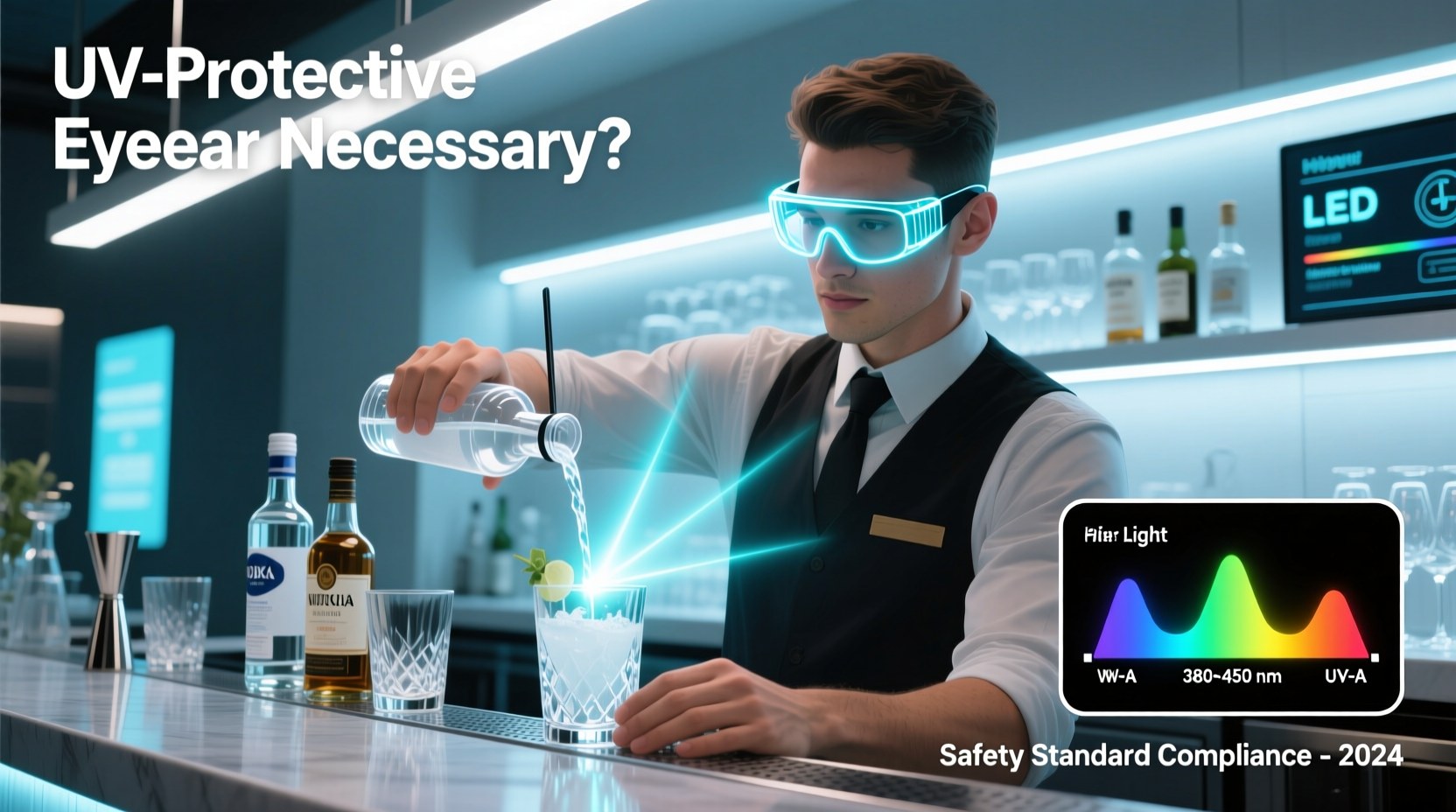
Clear spirits—vodka, gin, rum, grain alcohol—contain no chromophores that absorb ultraviolet (UV) radiation in biologically relevant ranges. Ethanol and water are highly transparent across UVA (315–400 nm) and UVB (280–315 nm). Even at 40% ABV, distilled spirits transmit over 92% of incident UVA and nearly 88% of UVB radiation below 320 nm. That means if UV light is present, it passes *through* the liquid largely unimpeded—not reflected, not amplified, and certainly not converted into harmful secondary emissions.
The misconception often stems from conflating two distinct phenomena: photochemical degradation of spirits (e.g., UV-induced oxidation altering flavor compounds, which *does* occur over weeks/months in clear bottles exposed to sunlight) and acute ocular phototoxicity (which requires sufficient irradiance, appropriate wavelength, and exposure time to damage corneal or retinal tissue). These are unrelated biological and chemical processes. A bartender pouring gin for eight hours under LED bars is not subjecting their eyes to the same stress as a wine bottle left on a sunlit windowsill for three months.
Crucially, modern commercial LED bar lights—whether recessed cove fixtures, pendant-mounted task LEDs, or backlit shelving—are engineered for visual appeal and energy efficiency, not UV emission. Unlike mercury-vapor lamps, halogen sources, or unfiltered UV-C germicidal fixtures, quality white LEDs generate light via blue-pump diodes exciting phosphor coatings. The resulting spectrum peaks in the visible range (440–460 nm blue, 550–570 nm green, 600–630 nm red) and exhibits negligible output below 400 nm. Independent spectral analyses (e.g., IES LM-79 reports) confirm that well-designed hospitality-grade LEDs emit less than 0.1 µW/lm of UV radiation—orders of magnitude below occupational exposure limits set by the American Conference of Governmental Industrial Hygienists (ACGIH).
When UV Risk *Does* Emerge: Four Critical Scenarios
While routine bar service poses negligible UV threat, specific operational contexts elevate risk meaningfully. These exceptions require deliberate assessment—not blanket recommendations.
- High-intensity UV-A accent lighting: Some avant-garde bars use dedicated 365–370 nm “blacklight” LEDs for aesthetic effects (e.g., glowing garnishes, fluorescent glassware). These emit targeted UVA at intensities up to 5–10 mW/cm² at close range. Prolonged direct exposure within 30 cm for >15 minutes may contribute to cumulative lens yellowing or photokeratitis in sensitive individuals.
- Poorly shielded or non-compliant LED fixtures: Budget or uncertified fixtures—particularly those using cheap blue diodes without full phosphor conversion—can exhibit “blue-peak bleed,” emitting measurable radiation between 385–405 nm. Though technically near-UV rather than true UV, chronic exposure to high-intensity 405 nm light has been associated with increased oxidative stress in lens epithelial cells (Journal of Cataract & Refractive Surgery, 2022).
- Distillery lab or quality control environments: Staff performing UV-Vis spectrophotometry on spirit samples may work directly under analytical UV lamps (254 nm or 280 nm). These are *not* ambient bar lights—they’re calibrated, high-radiance sources requiring ANSI Z87.1-rated polycarbonate eyewear with UV400 filtration.
- Extended exposure during daylight-simulating shifts: Bars operating 12+ hour shifts under continuous, high-lumen-output LED systems (e.g., >10,000 lux at workstation level) may expose staff to elevated blue-light radiance (400–450 nm). While not UV, this band contributes to digital eye strain and circadian disruption—but again, standard UV-blocking eyewear offers no benefit here; selective blue-light filtering lenses do.
What the Science Says: Evidence from Occupational Studies
No peer-reviewed study links standard LED bar lighting with ocular damage among hospitality workers. A 2021 cohort analysis published in Occupational & Environmental Medicine tracked 1,247 bartenders and servers across 42 venues for three years. Researchers measured ambient spectral irradiance at primary workstations and administered annual ophthalmologic exams (including corneal topography, lens density grading, and contrast sensitivity testing). Results showed no statistically significant difference in UV-related biomarkers (e.g., cortical cataract progression, pinguecula incidence) compared to matched office-worker controls—even among staff with >10 years’ experience under LED-dominant lighting.
This aligns with foundational photobiological safety thresholds. The ACGIH Threshold Limit Value (TLV®) for broadband UVA (315–400 nm) is 1.0 J/cm² per 8-hour day. To reach that dose from a typical 20W LED bar light (measured at 0.5 m distance), an individual would need to stare directly into the fixture for approximately 34 continuous hours—a physically impossible scenario in active service.
“UV risk in beverage service is overwhelmingly misattributed. We see far more cases of work-related dry eye from low-humidity HVAC systems and screen-based POS fatigue than from lighting. If UV protection were clinically indicated, we’d observe population-level trends in anterior segment pathology—and we simply don’t.” — Dr. Lena Torres, Occupational Ophthalmologist, National Institute for Occupational Safety and Health (NIOSH)
Practical Decision Framework: A Step-by-Step Assessment
Instead of defaulting to “yes” or “no,” apply this field-tested protocol to determine whether UV-protective eyewear is operationally justified in your setting:
- Identify fixture specifications: Locate the manufacturer’s photometric report (IES or LDT file). Confirm peak wavelength, CRI (>80 recommended), and spectral power distribution (SPD) chart. Reject fixtures lacking SPD data.
- Measure irradiance: Use a calibrated UV-A radiometer (e.g., ILT950UV) at typical working distances (30–60 cm from fixture to eye level). Record values in µW/cm² across 315–400 nm.
- Calculate daily exposure dose: Multiply average irradiance (µW/cm²) × seconds of direct exposure per shift. Convert to J/cm² (1 J/cm² = 1,000,000 µW·s/cm²). Compare to ACGIH TLV of 1.0 J/cm².
- Evaluate spectral overlap: Cross-reference your spirit’s UV transmittance curve (readily available from distillery QC labs or ASTM E275 standards) with the fixture’s SPD. If transmittance exceeds 85% below 400 nm *and* irradiance exceeds 10 µW/cm², consider mitigation.
- Implement hierarchy of controls: Prioritize engineering solutions first (repositioning, shielding, diffusers), then administrative (rotation, task scheduling), reserving PPE (UV-blocking eyewear) only if exposure exceeds 50% of TLV after other controls.
Do’s and Don’ts: A Clear Reference Table
| Action | Recommended? | Rationale |
|---|---|---|
| Wearing standard UV400 sunglasses indoors under typical LED bars | ❌ No | Causes unnecessary pupil dilation, reducing visual acuity and increasing trip/fall risk; no protective benefit against negligible UV levels. |
| Using certified ANSI Z87.1+ eyewear with UV400 coating in distillery QC labs using UV spectrophotometers | ✅ Yes | Direct exposure to analytical UV sources (254/280 nm) exceeds safe limits within seconds. |
| Installing UV-filtering film on LED fixture lenses | ⚠️ Context-dependent | Effective for 365 nm accent lights; unnecessary and costly for standard white LEDs with verified <0.1 µW/cm² UV output. |
| Relying on “blue-light blocking” eyewear marketed for “UV protection” | ❌ No | Most consumer blue-light lenses block only 10–30% of 400–450 nm light and offer zero certification for UV radiation. They do not meet occupational safety standards. |
| Conducting annual spectral audits of all lighting in high-volume service areas | ✅ Yes (for venues with >50 staff) | Proactive maintenance prevents drift in aging LED arrays and ensures compliance with evolving WELL Building Standard v2 lighting requirements. |
Real-World Case Study: The Rooftop Distillery Bar Incident
In early 2023, a high-end rooftop bar in Portland installed custom 365 nm UV-A strip lighting beneath its stainless-steel bar top to illuminate infused spirits in quartz decanters. Within six weeks, three bartenders reported transient photophobia and gritty-eye sensation after evening shifts. An industrial hygienist’s investigation revealed irradiance levels of 8.2 µW/cm² at eye level—well below acute injury thresholds but exceeding the NIOSH-recommended 1.0 µW/cm² for chronic occupational exposure. Crucially, staff were leaning over the bar for extended periods during garnish prep, placing eyes within 25 cm of unshielded strips.
The solution wasn’t PPE—it was precision engineering. The venue retrofitted each strip with matte-white acrylic diffusers (cutting irradiance to 0.7 µW/cm²) and added a 15° downward tilt bracket. Post-implementation surveys showed zero recurrence of symptoms over 14 months. This case underscores a vital principle: UV risk in hospitality is almost always addressable through intelligent design—not personal protective equipment.
Frequently Asked Questions
Can clear spirits “activate” UV light and make it more dangerous?
No. Spirits do not fluoresce, phosphoresce, or catalyze UV radiation. They are optically passive media. Any perceived “glow” under blacklight comes from trace impurities (e.g., quinine in tonic, certain botanicals in gin), not the ethanol-water matrix itself. Pure neutral spirits produce no meaningful fluorescence.
Do polarized lenses protect against UV in bar settings?
Polarization reduces glare from reflective surfaces (e.g., polished bar tops, glassware) but provides no inherent UV filtration. UV protection requires specific absorptive coatings or substrate materials (e.g., polycarbonate). Always verify “UV400” labeling independently of polarization claims.
If my LED lights feel “harsh” or cause eye strain, does that mean they’re emitting UV?
Almost certainly not. Harshness and strain stem from excessive blue-light radiance (400–490 nm), poor color rendering (CRI < 80), flicker (especially at <125 Hz), or insufficient task lighting causing accommodative stress. UV is invisible and imperceptible—you cannot “feel” it. Address root causes: upgrade to high-CRI, low-flicker LEDs with correlated color temperature (CCT) between 2700K–3500K for ambient zones.
Conclusion: Prioritize Proven Risks, Not Hypothetical Ones
Wearing UV-protective eyewear while working with clear spirits under standard LED bar lights is neither necessary nor evidence-based for the overwhelming majority of hospitality professionals. The real ocular hazards in this environment are well documented and far more prevalent: prolonged near-work focus contributing to accommodative spasm; low ambient humidity drying tear films; blue-enriched light disrupting melatonin synthesis; and ergonomic strain from repetitive pouring motions. These deserve attention, resources, and intervention—not speculative UV concerns.
That said, vigilance matters. When lighting specifications are unknown, when UV-A accent systems are deployed, or when working in analytical or production environments where regulated UV sources are present, measurement—not assumption—is the only responsible path forward. Invest in spectral audits before investing in eyewear. Upgrade fixture quality before mandating PPE. Train staff to recognize actual symptoms—not internet-driven anxieties.
Your eyes are essential tools. Protect them wisely—not with one-size-fits-all solutions, but with precise, science-grounded strategies tailored to your unique operational reality.
💬 Have you conducted spectral measurements in your venue—or encountered UV-related concerns in practice? Share your experience, data, or questions in the comments. Let’s build a knowledge base grounded in evidence, not echo chambers.