
For fans of Japanese animation, the debate between watching anime with subtitles or in dubbed form is more than just a matter of preference—it’s a question of authenticity, comprehension, and emotional connection. While dubbing has grown increasingly sophisticated over the years, many purists argue that subtitled anime offers a more accurate experience. But is this always true? And what exactly do we mean by \"accuracy\"? This article explores the nuances of language, tone, timing, and cultural context to determine whether subbed anime truly preserves the original intent better than its dubbed counterparts.
The Core of Accuracy: What Does It Mean?
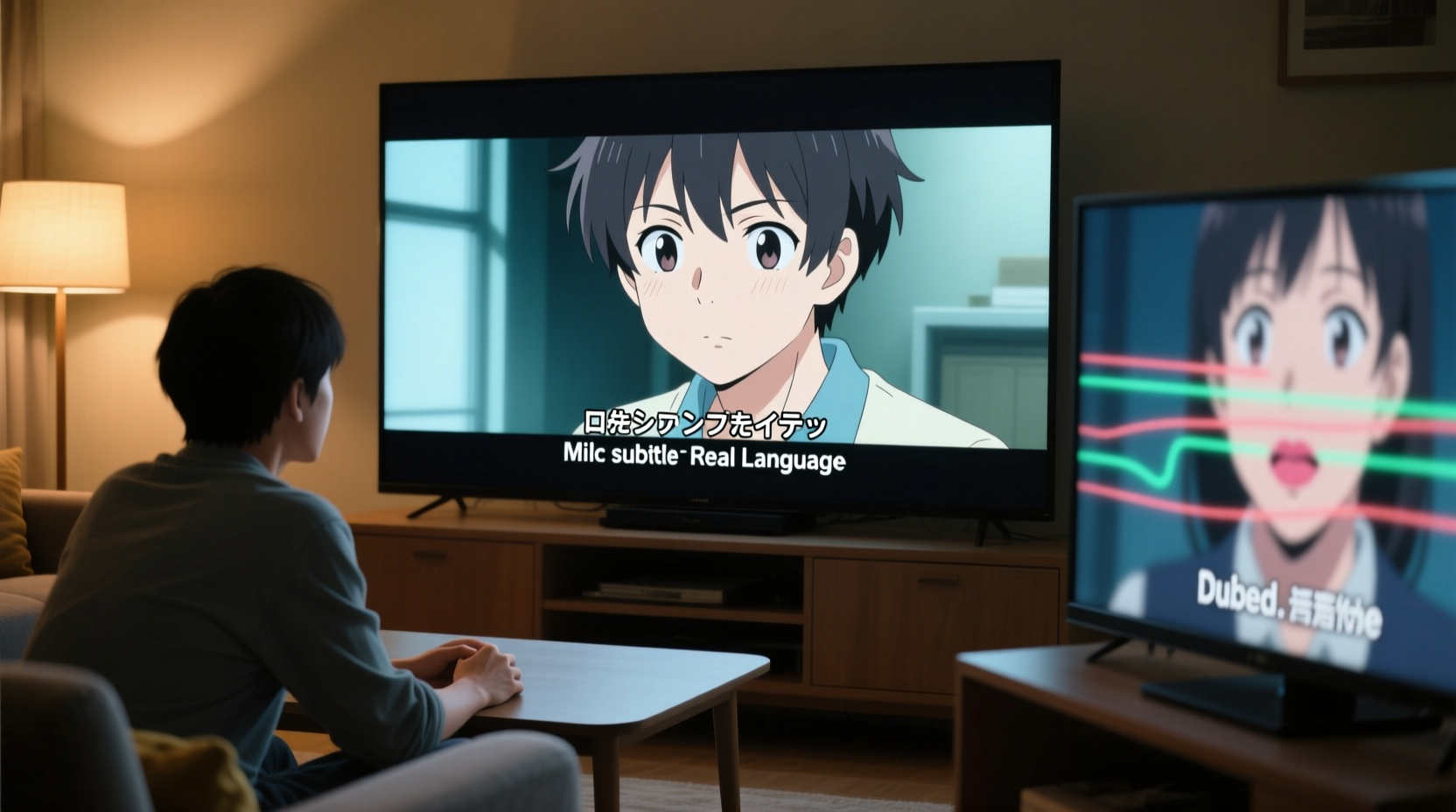
When discussing accuracy in anime translation, it's essential to define what we're measuring. Accuracy can refer to:
- Linguistic precision: How closely the dialogue matches the original Japanese script.
- Tonal fidelity: Whether the emotion, humor, or seriousness of a scene is preserved.
- Cultural nuance: The retention of honorifics, idioms, wordplay, and social context.
- Timing and pacing: How well the translated version aligns with character lip movements and scene rhythm.
Subtitles naturally have an advantage in linguistic precision because they are direct translations of the script, often preserving sentence structure and specific terminology. Dubbing, on the other hand, must adapt dialogue to fit lip-sync requirements and Western speech patterns, which can lead to rephrasing or omission.
“Translation isn’t just about words—it’s about intent. A good subtitle captures meaning; a good dub makes you forget you’re watching something foreign.” — Dr. Naomi Tanaka, Linguist and Anime Localization Researcher
Why Subtitles Often Win on Literal Accuracy
Subtitled anime maintains a closer link to the original audio track. Viewers hear the authentic performances of Japanese voice actors—whose delivery is crafted in tandem with the animation process—and read a written translation that attempts to mirror the source material as faithfully as possible.
Key advantages of subtitles include:
- Preservation of honorifics: Terms like \"-san\", \"-kun\", and \"-chan\" convey social hierarchy and intimacy. These are usually lost in dubbing but may be explained or retained in subtitles.
- Retention of wordplay: Puns, homophones, and culturally specific jokes are difficult to translate audibly without breaking immersion. Subtitles can use footnotes or creative phrasing to preserve them.
- No lip-sync constraints: Translators aren’t forced to match syllables or mouth movements, allowing for more faithful renditions of complex lines.
- Access to raw emotion: The original vocal inflections—hesitations, sighs, laughter—remain intact, giving viewers a fuller emotional context.
The Strengths and Limitations of Dubbing
Dubbing is not inherently inaccurate—it’s a different kind of art. Professional dubs produced by studios like Crunchyroll, Funimation, and Sentai Filmworks involve teams of translators, ADR (Automated Dialogue Replacement) directors, and voice actors who work to balance fidelity with natural-sounding dialogue.
However, compromises are inevitable. Consider these common challenges:
- Lip-sync adaptation: English phrases often require more or fewer syllables than Japanese ones. To maintain visual coherence, lines are shortened, reordered, or paraphrased.
- Cultural localization: References to school festivals, seasonal customs, or regional dialects may be simplified or replaced to aid viewer understanding.
- Voice actor interpretation: While talented, English VAs interpret roles differently than their Japanese counterparts, potentially altering character tone.
That said, high-quality dubs can enhance accessibility. For viewers with reading difficulties, ADHD, or those watching casually, dubs reduce cognitive load and allow deeper focus on visuals and music.
A Real Example: “Cowboy Bebop” – Two Worlds, One Show
The 2001 English dub of Cowboy Bebop is widely regarded as one of the best anime dubs ever made. The cast—including Steve Blum as Spike Spiegel—delivered performances so iconic that they shaped how Western audiences perceived the characters. Yet, even this celebrated dub made changes: some philosophical monologues were condensed, and slang was added to give the crew a “cool” American edge.
In contrast, the subtitled version retains more of the existential musings and poetic phrasing from the original. For instance, Spike’s line about memories being “like smoke” is more elaborate in Japanese and slightly truncated in the dub to fit pacing.
This doesn’t make the dub “wrong”—it makes it adapted. But for viewers seeking the creators’ exact message, the sub holds closer to the source.
Comparative Analysis: Subs vs. Dubs Across Key Metrics
| Metric | Subtitled Version | Dubbed Version |
|---|---|---|
| Linguistic Accuracy | High – Direct translation with minimal alteration | Moderate – Adapted for speech flow and sync |
| Cultural Nuance Retention | High – Honorifics, idioms, and context often preserved | Low to Moderate – Frequently localized or omitted |
| Emotional Delivery | Original voice acting with authentic intonation | Reinterpreted performance; may vary in tone |
| Accessibility | Requires reading ability and focus | Easier for passive viewing and multitasking |
| Immersion | High for purists; split attention between image and text | Seamless audio-visual integration |
| Wordplay & Puns | Often annotated or creatively translated | Rarely preserved due to timing constraints |
When Dubbing Surpasses Subtitles in Effectiveness
Ironically, there are cases where dubbing provides a more accurate *emotional* or *narrative* experience than subtitles—even if it sacrifices literal fidelity.
Consider comedic timing. A joke delivered through rapid-fire banter loses impact if viewers must read subtitles before laughing. A skilled dub team can rework the punchline to land naturally in English, preserving the intended humor even if the words change.
Similarly, children’s anime like Pokémon or Yu-Gi-Oh! benefit from dubbing because young audiences may struggle with reading speed. In these cases, clarity and engagement outweigh strict accuracy.
“In localization, sometimes you have to change the words to keep the soul.” — Michael Sinterniklaas, ADR Director (My Hero Academia, Attack on Titan)
How to Choose: A Practical Checklist
Whether subs or dubs are “better” depends on your goals. Use this checklist to decide which format suits your needs:
- ☐ I want to understand the original dialogue as closely as possible → Choose Subs
- ☐ I’m learning Japanese or analyzing themes → Choose Subs
- ☐ I watch while doing other tasks (e.g., eating, folding laundry) → Choose Dub
- ☐ I find reading subtitles distracting or tiring → Choose Dub
- ☐ I care deeply about voice performance and tone → Try both and compare
- ☐ The anime relies heavily on wordplay or cultural references → Choose Subs
- ☐ I’m introducing someone new to anime → Dub may be more accessible
Step-by-Step Guide to Evaluating Translation Quality
If you're serious about understanding accuracy in anime, follow this method to critically assess both subbed and dubbed versions:
- Select a key scene – Choose a moment rich in dialogue, emotion, or cultural context (e.g., a dramatic confrontation or a comedic exchange).
- Watch it with subtitles – Note how the translation reads. Are honorifics used? Are explanations provided for unfamiliar terms?
- Replay with dub – Listen for changes in wording, tone, and timing. Does the English feel natural? Is anything missing?
- Compare with romanized Japanese (optional) – Look up the original lines online to see how both versions diverge from the source.
- Evaluate emotional impact – Which version made you feel the scene more deeply? Was it due to voice, words, or delivery?
- Consult fan forums or reviews – See if others noticed similar discrepancies or praised particular translation choices.
This process helps you move beyond preference and develop a nuanced understanding of how translation shapes storytelling.
Frequently Asked Questions
Do subtitles always reflect the exact words spoken in Japanese?
No—not always. While subtitles aim for accuracy, they still involve interpretation. Some phrases are untranslatable, and space or time limits may force simplification. However, they are generally much closer to the original than dubs, which face additional constraints like lip-syncing.
Are modern anime dubs becoming more accurate?
Yes. Thanks to tighter collaboration between Japanese studios and Western licensors, modern dubs often use scripts approved by original creators. Series like Attack on Titan and Jujutsu Kaisen feature dubs that strive for tonal and narrative fidelity, even retaining some Japanese terms like “senpai” or “cursed energy.” Still, adaptations for speech rhythm remain necessary.
Can I trust fan-made subtitles (fansubs) for accuracy?
Fansubs vary widely in quality. Early fansubs were often rushed and inconsistent, but today’s top groups (like Horizon or Shiina) employ professional-level translation standards, including glossaries and cultural notes. However, they may lack official oversight and can include editorial commentary. For research, compare multiple sources—including official releases.
Conclusion: Accuracy Isn’t Everything—But It Matters
Yes, watching anime with subtitles is generally more accurate than watching dubbed versions—especially when it comes to preserving linguistic detail, cultural context, and the original vocal performance. If your goal is to experience the anime as its creators intended, subtitles are the superior choice.
But accuracy isn't the only measure of value. Dubbing transforms anime into a different kind of art—one optimized for auditory immersion and broad accessibility. A powerful dub can deepen emotional resonance, especially for viewers who connect more with voice than text.
The most informed fans don’t choose one over the other—they engage with both. By comparing sub and dub versions, you gain a richer appreciation of the craft behind anime and the complexities of cross-cultural storytelling.
💬 Have a favorite anime where the sub or dub changed your perception of a character? Share your thoughts in the comments and join the conversation about what it means to truly “understand” a show.