
In the past decade, tiki bars have multiplied across cities from Portland to Berlin, Tokyo to Lisbon. Vintage glassware sells out at auctions. Craft rums command premium shelf space. Instagram feeds overflow with flaming garnishes and hand-carved ice. Yet beneath the bamboo thatch and paper umbrellas lies a more nuanced question: Is this revival merely a nostalgic retreat—a cocktail-fueled sigh against inflation, political fatigue, and algorithmic burnout? Or does it signal something richer: a maturing palate, a renewed reverence for technical precision, and a sincere engagement with the layered history and craft behind every Mai Tai, Navy Grog, or Jet Pilot?
The answer is neither simple nor binary. The tiki renaissance operates on parallel tracks—emotional and intellectual, performative and pedagogical. To understand it fully, we must move beyond caricature: not just “tiki as kitsch” versus “tiki as canon,” but tiki as a living, contested, and deeply human cultural artifact—one that invites both refuge and rigor.
The Escapist Impulse: Why Tiki Feels Like a Lifeline
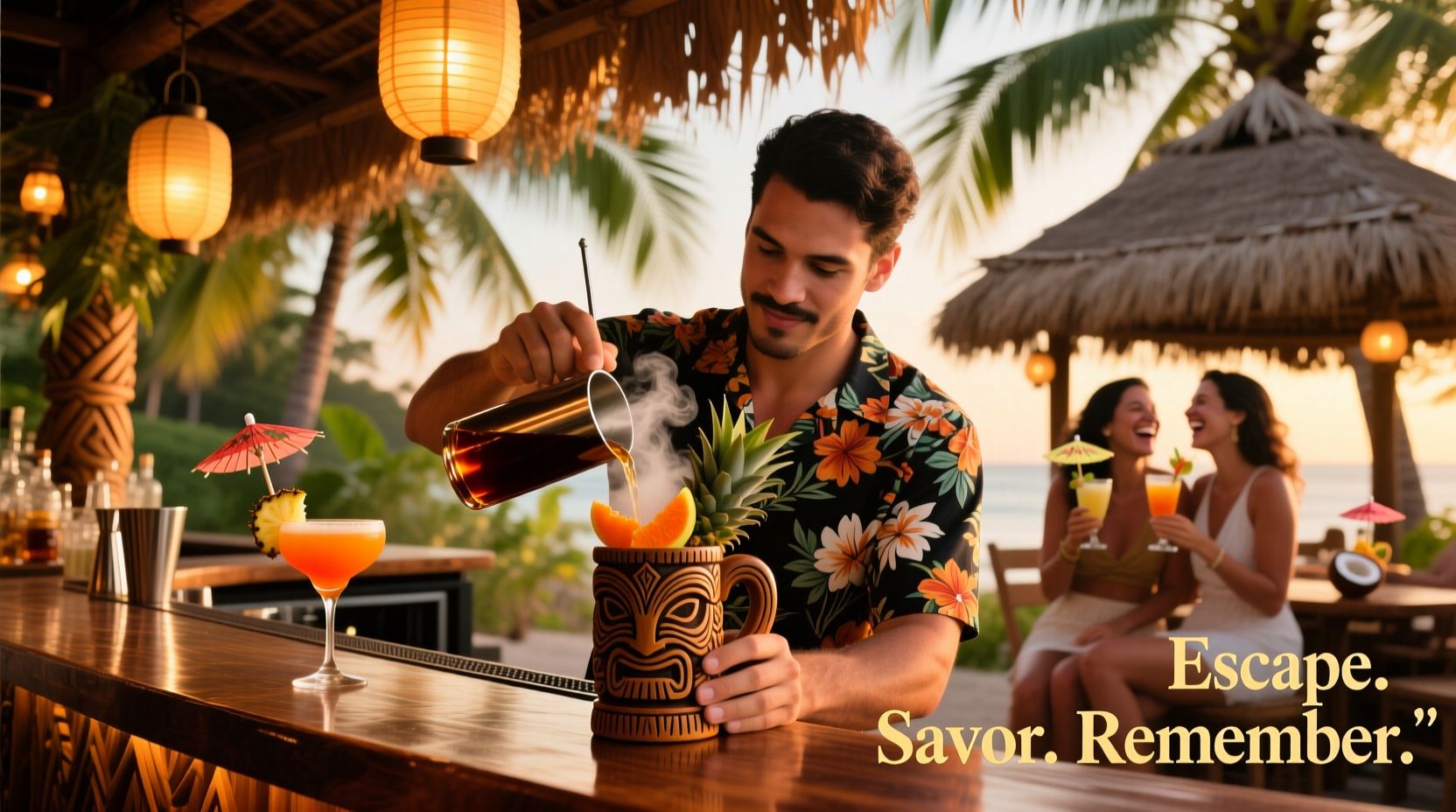
Escapism isn’t inherently shallow—it’s a psychological necessity. When daily reality feels compressed by urgency, surveillance, and volatility, tiki offers sensory relief through deliberate excess: tropical scents, vivid hues, tactile textures (crushed ice, carved fruit), and ritualized service. This isn’t passive consumption; it’s embodied world-building.
Consider the timing. The most pronounced tiki resurgence began in earnest around 2012–2014—coinciding with post-financial-crisis austerity, rising geopolitical instability, and the early, disorienting phase of social media saturation. A 2022 study published in Journal of Consumer Culture found that patrons of newly opened tiki bars reported significantly higher self-reported levels of “temporal displacement” and “affective restoration” than those visiting minimalist cocktail lounges—even when controlling for alcohol intake.
This escape is curated, not accidental. It relies on what anthropologist Victor Turner called “liminal space”: a threshold zone where ordinary rules suspend. The tiki bar’s dim lighting, dense foliage, and lack of clocks aren’t design oversights—they’re intentional architecture of release. As bartender and historian Shannon Mustipher observes:
“Tiki doesn’t ask you to solve anything. It asks you to taste, to pause, to let your shoulders drop. In that surrender, there’s dignity—not denial.” — Shannon Mustipher, author of Rum: A Global History
Yet this very comfort risks flattening tiki’s origins—erasing its roots in mid-century American imperialism, racial caricature, and the commercial appropriation of Polynesian, Melanesian, and Indigenous cultures. The escapist frame, if left unexamined, can replicate those same erasures: treating tiki as a fantasy island rather than a contested archipelago of real histories and living traditions.
The Craft Counterpoint: Layering as Discipline, Not Decoration
Parallel to—and often within—the same venues—is a rigorous, almost scholarly devotion to technique. Modern tiki isn’t about dumping three rums and shaking blindly. It’s about understanding ester profiles in Jamaican pot stills, calibrating acid balance between lime and grapefruit, mastering the “float” technique for precise spirit layering, and respecting the structural role of orgeat, falernum, and pimento dram—not as flavor accents, but as binding agents in a harmonic system.
This isn’t novelty. It’s applied chemistry, historical reconstruction, and cross-cultural translation. Consider the Mai Tai: often mischaracterized as a simple rum-and-orange-juice riff, the original 1944 Trader Vic recipe uses exactly two rums (Jamaican dark for funk, Martinique agricole for grassy brightness), fresh-squeezed lime, orgeat, and orange curaçao—each ingredient calibrated to highlight, not mask, the others. Deviate by 5ml of orgeat or swap in a blended Puerto Rican rum, and the entire equilibrium collapses.
Tip: When building a tiki drink, treat each modifier like a voice in a choir—ask not “What does this add?” but “What does this *allow* the others to express?”A Real-World Case Study: The Kaimana Beach Club Transformation
In 2017, Honolulu’s Kaimana Beach Club—a decades-old, family-run tiki bar facing closure amid rising rents and shifting tourism patterns—underwent an unexpected pivot. Owner Leilani Kealoha didn’t chase Instagram virality. Instead, she partnered with local historians, Hawaiian language educators, and master distillers to reimagine her menu.
She retired the plastic hula girls and neon torches—not out of shame, but clarity. Her new “Mālama Mai Tai” uses only Hawaiian-grown sugarcane rum (Kō Hana), hand-pressed lilikoi (passionfruit) instead of generic lime, and orgeat made from locally milled macadamia nuts. Each drink includes a QR code linking to oral histories from Native Hawaiian elders about land stewardship and ocean navigation—themes subtly echoed in the drink’s naming and presentation.
Revenue increased 37% year-over-year. More tellingly, 62% of new customers cited “learning something meaningful” as their primary reason for returning. The bar didn’t abandon escapism—it deepened it: offering refuge rooted in place, history, and respect, rather than borrowed fantasy. As Kealoha told Pacific Monthly: “People don’t want to escape Hawaii. They want to understand it—through taste, story, and care.”
Do’s and Don’ts: Navigating the Tiki Revival with Integrity
Appreciation requires intention. Below is a practical framework for engaging with tiki beyond surface aesthetics—whether you’re a home enthusiast, bar owner, or curious patron.
| Action | Do | Don’t |
|---|---|---|
| Ingredient Sourcing | Seek out small-batch rums with transparent provenance (e.g., Foursquare, Worthy Park, Rhum J.M.). Prioritize producers who invest in local communities and sustainable agriculture. | Default to mass-market “tiki rums” with artificial coloring or flavorings labeled vaguely as “Caribbean blend.” |
| Cultural Reference | Attribute recipes to their creators (e.g., “Donn Beach’s 1934 Zombie”) and acknowledge colonial context in staff training materials. | Use Polynesian motifs without explanation—or worse, as punchline decor (e.g., “Tiki Idol” cocktail names paired with cartoonish carvings). |
| Technique Focus | Dedicate time to mastering one foundational skill per month: dry shaking for froth, layering with back-of-spoon technique, or making house orgeat from scratch. | Treat tiki as “easy party drinks”—skipping fresh citrus, using bottled juices, or ignoring dilution control. |
| Guest Engagement | Offer brief, warm context: “This falernum comes from Barbados, where it’s been made with ginger, lime, and almond since the 1800s.” | Overwhelm guests with jargon (“This is a 1:1:1:½ ratio with 20-second dry shake and 8-second wet shake”). |
Step-by-Step: Building Your First Thoughtful Tiki Drink at Home
Forget complexity. Start with structure. The following sequence applies to any classic tiki template—Navy Grog, Jet Pilot, or Three Dots and a Dash—and trains your palate for intentionality.
- Choose one base spirit—not three. Begin with a single high-ester Jamaican rum (e.g., Smith & Cross) or a clean agricole (e.g., Clement VSOP). Taste it neat first. Note its weight, funk, and finish.
- Select one fresh citrus. Lime is standard, but try yuzu or calamansi for brightness. Juice it yourself—no exceptions. Measure precisely (most classics use 0.75 oz).
- Add one sweetener with texture. Orgeat (almond + rosewater) adds silk; falernum (ginger + clove + lime) adds spice and grip. Avoid simple syrup—it lacks dimension.
- Introduce one aromatic modifier. Pimento dram (allspice-infused rum) or velvet falernum provides depth without sweetness. Use sparingly: 0.25 oz max.
- Shake with ice—then double-strain. Use crushed ice for serving (it chills fast without over-diluting), but shake with large cubes to control melt. Strain into a chilled glass with fresh crushed ice.
- Taste before garnishing. Adjust with a drop of citrus or sweetener *only if needed*. Then garnish meaningfully: a lime wheel expresses acidity; toasted coconut evokes terroir; a single mint sprig signals freshness—not clutter.
FAQ: Clarifying Common Misconceptions
Isn’t tiki inherently appropriative? Can it ever be ethical?
Yes, tiki’s origins are inseparable from mid-century American exoticism and racist caricature. But ethics evolve through accountability—not erasure. Ethical tiki today centers collaboration: hiring Indigenous and Pacific Islander staff in leadership roles, sharing profits with cultural preservation nonprofits, crediting source traditions transparently, and refusing caricature in branding or service. Appropriation becomes appreciation only when power, credit, and benefit flow equitably.
Do I need expensive gear or rare rums to make authentic tiki?
No. Authenticity resides in intention and balance—not scarcity. A well-made Mai Tai with accessible Jamaican rum (Appleton Estate Signature), fresh lime, quality orgeat (Small Hand Foods), and proper dilution will outperform a “rare rum flight” shaken haphazardly. Start with three bottles: a funky rum, a grassy rum, and a light column-still rum. Master them before expanding.
Why does layering matter so much in tiki—more than in other cocktails?
Layering isn’t visual theater. It’s functional stratification: heavier syrups sink to coat the tongue first; volatile citrus oils rise to hit the nose immediately; lighter spirits float to deliver clean finish. This creates a dynamic, evolving experience across sips—what tiki historian Jeff “Beachbum” Berry calls “the arc of flavor.” Without layering, tiki collapses into a monolithic, cloying slurry.
Conclusion: Choose Your Current
The tiki resurgence isn’t pulling us in one direction—it’s presenting a fork in the river. One current carries us toward soothing, surface-level escape: bright colors, easy sweetness, and the comforting illusion of distance. The other pulls us deeper—into history’s complexities, into the discipline of craft, into relationships with people and places too often reduced to backdrop.
You don’t have to choose exclusively. You can sip a perfectly balanced Navy Grog while learning about the labor behind its Demerara sugar. You can enjoy a flaming presentation and still ask who carved the torch—and whether they were paid fairly. The most compelling tiki spaces today do both: they offer sanctuary *and* scholarship, joy *and* justice, indulgence *and* inquiry.
Your next step isn’t about perfection—it’s about presence. Next time you order or pour a tiki drink, pause for ten seconds before the first sip. Taste it slowly. Ask: What story is this telling? Whose hands shaped it? What world does it invite me into—and how am I showing up within it?
💬 Share your own tiki moment—where escapism met insight. Did a drink spark curiosity about rum history? Did a bar’s ethos shift your perspective? Comment below and help deepen the conversation beyond the umbrella.








