
For fans of Japanese storytelling, the debate between reading manga and watching anime is more than just preference—it's about time, immersion, and depth. While both formats originate from the same creative well, they deliver the experience in fundamentally different ways. One critical factor that often shapes this decision is speed: how quickly can you consume a story? On the surface, manga appears faster—after all, you’re not waiting for weekly episodes or seasonal breaks. But the reality is more nuanced. The answer depends on reading speed, pacing, production delays, and personal engagement.
Understanding the trade-offs between manga and anime isn’t just about efficiency; it’s about aligning your consumption method with your goals—whether that’s catching up before a new season, diving deep into lore, or simply enjoying a story at your own pace.
Speed Comparison: Manga vs. Anime
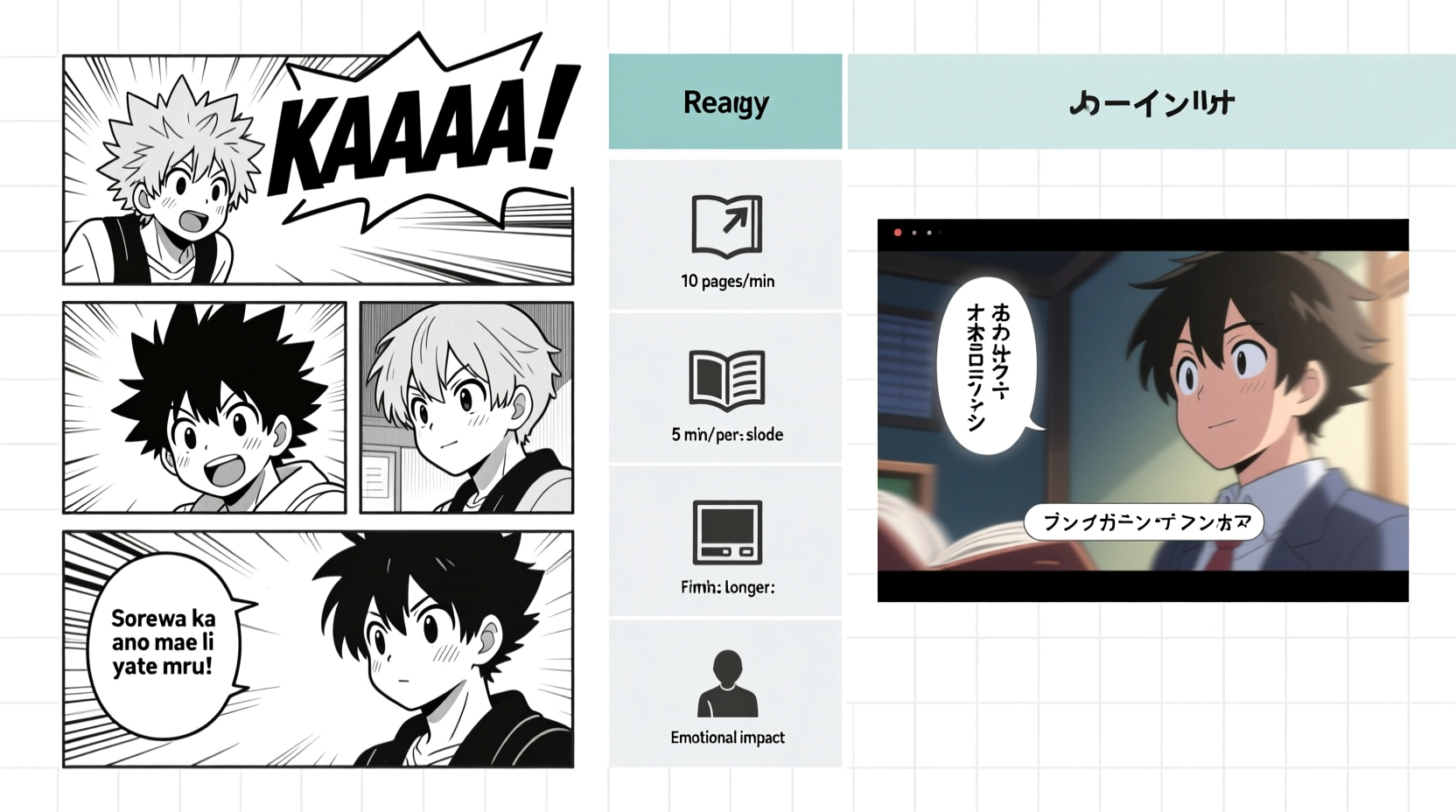
At first glance, manga wins the race. A typical manga chapter ranges from 15 to 40 pages and can be read in 10 to 30 minutes, depending on the reader’s speed and the complexity of artwork and dialogue. In contrast, an anime episode lasts 20–24 minutes (excluding openings and endings), and production schedules often limit releases to one per week.
Consider a long-running series like *My Hero Academia*. By 2024, it had over 400 manga chapters—equivalent to roughly 67 hours of reading at 10 minutes per chapter. The anime, meanwhile, covers about half that content across four seasons, taking years to adapt what readers consumed in months.
This gap arises because anime production is labor-intensive. A single 24-minute episode can take hundreds of artists months to animate, while a manga artist and assistant team may produce a chapter in a week. As a result, anime adaptations almost always lag behind their source material.
Tip: If you want to avoid spoilers and stay ahead of anime releases, start reading the manga early—especially for popular series.Pros of Reading Manga for Speed and Depth
- Faster access to full story arcs: Readers can binge entire sagas without waiting for animation.
- No filler episodes: Manga follows the original narrative directly, avoiding extended recaps or side stories added in anime to delay adaptation.
- Greater narrative detail: Internal monologues, subtle expressions, and background details are often preserved better in manga than in condensed anime scripts.
- Immediate availability: New chapters are often released simultaneously worldwide via digital platforms, reducing wait times.
- Cost-effective pacing: Buying a volume or using a subscription service allows bulk access at lower cost per hour of content.
Additionally, manga allows readers to control their pace. You can skim action-heavy panels or linger on emotional close-ups. This autonomy enhances comprehension and emotional investment, especially in complex plots like those in *Chainsaw Man* or *Jujutsu Kaisen*.
“Manga gives you the raw blueprint of the story. Everything the creator intended is there—from timing to thought processes—without intermediaries.” — Hiro Tanaka, manga editor at Kodansha USA
Advantages of Watching Anime: Immersion and Accessibility
While slower in delivery, anime offers unique strengths that manga cannot replicate. The primary advantage is sensory immersion. Voice acting, music, sound effects, and fluid animation elevate emotional impact. A silent panel in manga showing a character crying becomes a powerful moment when paired with voice tremors and a swelling score.
Anime also lowers the barrier to entry. Not everyone enjoys reading dense visual narratives, especially beginners unfamiliar with Japanese panel flow (right to left). For casual viewers, sitting back and absorbing a story through audiovisual media is more accessible and less mentally taxing.
Moreover, anime can enhance understanding. Complex fight choreography in series like *Demon Slayer* is easier to follow when animated rather than interpreted from static frames. Timing, motion, and spatial relationships become intuitive.
Some anime even improve upon the source material. Studio MAPPA’s adaptation of *Attack on Titan* introduced dynamic camera angles and pacing changes that heightened tension beyond the original panels.
When Anime Falls Behind: The Adaptation Lag Problem
One major downside of anime is its inevitable delay. Most ongoing series face a “canon catch-up” phase where studios run out of published material. This leads to filler arcs, extended recaps, or outright hiatuses.
For example, *Boruto: Naruto Next Generations* has relied heavily on filler content because the manga storyline progresses faster than the anime can adapt it. Fans eager for plot development must turn to manga to stay current.
This creates a hybrid viewing pattern: watch the anime when available, then switch to manga during dry spells. While effective, it disrupts continuity and requires juggling formats.
Comparative Breakdown: Manga vs. Anime by Key Factors
| Factor | Manga | Anime |
|---|---|---|
| Consumption Speed | Fast (chapters in minutes) | Slow (episodes weekly) |
| Narrative Fidelity | High (original source) | Variable (edits, filler) |
| Sensory Engagement | Moderate (visual + imagination) | High (sound, motion, voice) |
| Accessibility | Moderate (requires reading skill) | High (passive viewing) |
| Availability of Content | Immediate (digital releases) | Delayed (seasonal production) |
| Cost Over Time | Lower (bulk volumes, subscriptions) | Higher (streaming subs, Blu-rays) |
Real Example: How One Fan Stayed Ahead of the Curve
Take the case of Alex Rivera, a college student and longtime fan of *Spy x Family*. When Season 2 aired in late 2023, he noticed the anime was only covering material from Volume 8, while the manga had already reached Volume 12. Wanting to know what happened to Anya’s school mission and Bond’s precognitive visions, Alex began reading two chapters per day.
In under three weeks, he finished the remaining arc—over 100 pages of content—before the next anime season was announced. He didn’t just avoid spoilers; he gained deeper insight into Loid’s internal conflict and Yor’s past, elements only briefly touched on in the anime.
“Reading gave me context I wouldn’t have gotten otherwise,” Alex said. “And when Season 3 drops, I’ll already know the big twists—but I’ll still watch for the animation and music.”
This hybrid approach—manga for speed and depth, anime for spectacle—is becoming increasingly common among dedicated fans.
Step-by-Step Guide: Choosing Your Format Strategically
Instead of treating manga and anime as rivals, consider integrating both based on your goals. Follow this timeline to maximize enjoyment and efficiency:
- Identify your priority: Are you seeking quick plot progression or immersive experience?
- Check the adaptation gap: Look up how many manga chapters remain unadapted. Sites like MyAnimeList or AniChart.net provide comparisons.
- Start with anime if new to the series: Visual introduction helps with character recognition and tone.
- Switch to manga if behind: Read from the point the anime leaves off to catch up.
- Return to anime for key arcs: Major battles or emotional scenes often receive superior treatment in animation.
- Use manga as reference: Revisit panels to clarify confusing anime moments or missed details.
This method balances speed with sensory richness, ensuring you don’t miss out on either format’s strengths.
Tips for Maximizing Manga Reading Efficiency
Tip: Use digital manga apps with night mode and adjustable panel views to reduce eye strain during long reading sessions.- Read during commutes or downtime—manga is highly portable via smartphones and tablets.
- Adjust your reading speed: Skim action sequences, slow down for dialogue-heavy or emotional scenes.
- Keep a list of characters and terms if the series is lore-heavy (e.g., *One Piece*).
- Join online communities to discuss theories and clarify confusing plot points.
- Set weekly chapter goals to maintain momentum without burnout.
Common Misconceptions About Manga Speed
It’s easy to assume that because manga is text-based, it’s always faster. But several factors can slow down reading:
- Dense artwork: Series like *Vinland Saga* or *Blame!* feature intricate backgrounds that demand attention.
- Translation quality: Poorly localized dialogue or awkward phrasing can hinder comprehension.
- Panel layout: Non-linear storytelling (e.g., flashbacks within action scenes) requires rereading.
Conversely, some anime episodes fly by due to fast pacing or minimal dialogue, making them quicker to absorb despite longer runtime.
FAQ: Common Questions About Manga vs. Anime Consumption
Can I read manga as fast as I watch anime?
Yes, in most cases. The average reader completes a chapter in less time than an episode lasts. However, comprehension and enjoyment matter more than pure speed. Rushing through manga may cause you to miss visual cues or emotional nuances.
Does reading manga ruin the surprise when watching anime?
It can, but many fans rewatch anime specifically because they know the outcome. Foreknowledge often enhances appreciation of foreshadowing, voice acting choices, and musical cues. Some even prefer this layered experience.
Are there series better experienced in anime form?
Absolutely. Shows like *Death Note* benefit from suspenseful pacing and voice performances. Similarly, *Cowboy Bebop* relies heavily on jazz soundtrack and cinematic direction—elements absent in manga. Always consider the medium’s strengths when choosing.
Final Thoughts: It’s Not Either/Or—It’s Both/And
The question isn’t whether manga is faster than anime—it clearly is in terms of content delivery. But speed alone shouldn’t dictate your choice. Each format serves a different purpose. Manga excels in narrative fidelity and efficiency. Anime triumphs in emotional resonance and accessibility.
The smartest fans don’t pick sides—they leverage both. They read ahead to satisfy curiosity, then return to anime to relish the artistry. They understand that the journey matters as much as the destination.
🚀 Ready to optimize your anime experience? Start with the latest manga volume of your favorite series and see how much further ahead you can get. Then, share your thoughts—do you prefer the speed of manga or the spectacle of anime?








