A well-chosen scarf can elevate an outfit from simple to sophisticated in seconds. But too often, what begins as a fashion-forward accent ends up looking like a tangled, shapeless bundle around the neck. The key to wearing a scarf with elegance lies not just in the fabric or color, but in how you style it. Avoiding bulk and maintaining a clean silhouette requires thoughtful selection, precise draping, and attention to proportion. Whether you're dressing for winter warmth or adding flair to a spring ensemble, mastering the art of the non-bulky scarf ensures you look polished, not padded.
Select the Right Fabric and Weight
The foundation of a sleek scarf look starts with choosing the right material. Heavy wool or oversized knit scarves may be cozy, but they’re prone to creating volume that overwhelms your frame—especially if you're petite or favor minimalist silhouettes. Instead, opt for fabrics that drape smoothly and add texture without mass.
- Silk: Lightweight, smooth, and naturally fluid. Ideal for layering under coats or adding subtle sheen to blazers.
- Cashmere (lightweight weave): Offers warmth without weight when finely knitted. Look for blends labeled “2-ply” rather than thick 6-ply versions.
- Modal or viscose blends: Affordable alternatives that mimic silk’s drape while resisting wrinkles.
- Fine merino wool: Provides insulation at a fraction of the bulk compared to traditional wool.
Scarves over 70 inches in length tend to invite excess looping, which leads to cluttered appearances. For most body types, a 50–60 inch square or rectangular scarf offers enough fabric to style creatively without overwhelming the neckline.
Mastery of Minimalist Knots and Drapes
The way you tie a scarf dramatically affects its final appearance. Complex knots may seem chic in theory, but they often result in lumps at the front or sides. Focus on techniques that secure the scarf without adding focal points where you don’t want them.
Step-by-Step: The Parisian Drape
- Fold a large square scarf diagonally into a triangle.
- Lay it around your neck with the long edge facing forward and the point hanging down your back.
- Bring both ends forward over your shoulders.
- Tie a single loose knot just below the collarbone.
- Adjust so the knot sits slightly off-center for asymmetry.
This method keeps volume distributed across the shoulders rather than concentrated at the throat. It works especially well with printed silk, allowing the pattern to flow naturally.
The Infinity Slide
For cold weather, an infinity scarf is convenient—but it's easy to let it collapse into a doughnut-like roll. To avoid this:
- Wear it as a cowl first, then gently pull one loop upward to create a double-layered drape.
- Twist one loop once before reconnecting it—this creates a figure-eight that lies flatter against the chest.
- Ensure the inner loop rests snugly at the base of your neck; the outer loop should fall loosely over your jacket or sweater.
Balance Proportions with Your Outfit
A scarf doesn’t exist in isolation. Its impact depends on the cut and structure of the clothing beneath it. A common mistake is pairing a voluminous scarf with already-full layers like turtlenecks or puffer jackets, resulting in a top-heavy profile.
| Outfit Type | Recommended Scarf Style | Why It Works |
|---|---|---|
| Blazer + T-shirt | Thin silk ascot or narrow rectangle | Adds polish without competing with structured shoulders |
| Coat with high collar | No scarf, or very thin wrap worn underneath | Prevents vertical stacking of collars |
| Crewneck sweater | Medium-width cashmere, draped loosely | Complements soft lines without adding density |
| Sheath dress | Long, flowing scarf tied in a low bow at back | Extends line downward, elongating the torso |
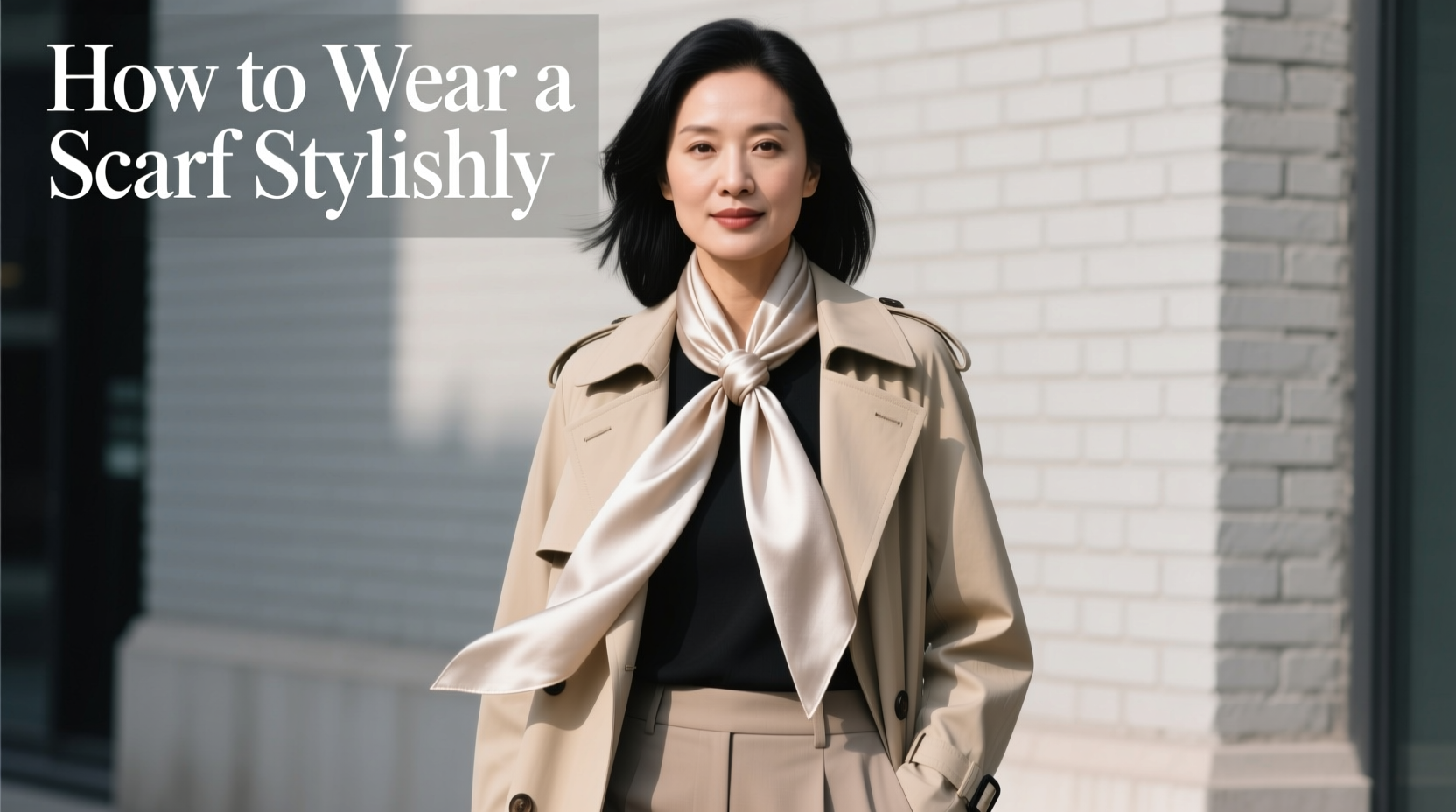
When wearing tailored outerwear—like a trench coat or wool pea coat—consider letting the scarf end hang straight down the front instead of wrapping it tightly. This maintains the garment’s clean lines and avoids distorting the lapels.
“Elegance is often about subtraction. A scarf should enhance, not dominate. Choose movement over mass.” — Clara Moreau, Stylist & Former Fashion Editor, *Vogue Paris*
Avoid Common Styling Mistakes
Even experienced dressers fall into habits that sabotage a streamlined look. Recognizing these pitfalls is half the battle.
Don’t Pull Too Tight
A scarf cinched tightly around the neck draws attention to constriction and can bunch up fabric unflatteringly. Leave room for natural drape—about two fingers’ width between skin and fabric.
Avoid Over-Tucking Into Coats
Shoving your scarf inside your coat adds hidden layers that puff out at the chest. If wind protection is needed, tuck only one end lightly, leaving the rest visible and free-flowing.
Don’t Mix Too Many Textures
Pairing a fuzzy scarf with a cable-knit sweater or shearling collar creates visual noise. Stick to one textured element per upper-body zone.
Tip: Use steam, not ironing, on wrinkled scarves—especially silk. Hang in the bathroom during a hot shower to relax creases gently.Real-World Example: Olivia’s Office-to-Dinner Transition
Olivia, a 32-year-old marketing consultant, struggled with looking professional during winter commutes without arriving at work looking like she’d battled a snowstorm. Her usual routine involved wrapping a thick knit scarf three times around her neck, leading to static, frizz, and a disheveled appearance by 9 a.m.
She switched to a lightweight, sand-colored cashmere blend (60 inches long, 12 inches wide) and adopted the “single-loop drape”: placing the scarf around her neck, pulling one end slightly longer, and letting both hang straight down under her wool coat. At the office, she removed her coat to reveal a clean, intentional look that paired perfectly with her tailored blouse.
For evening events, she re-styled it by bringing both ends forward, crossing them once at the chest, and letting them fall freely—a variation known as the “cross-front drape.” No knots, no bulk, just effortless refinement.
The change took less than 30 seconds each morning and transformed her entire presence. Colleagues began asking where she bought her “designer” accessory—proof that simplicity often reads as luxury.
Essential Checklist for a Polished Scarf Look
✅ Scarf Styling Checklist
- Choose a lightweight fabric appropriate for the season
- Match scarf scale to your body frame (narrower for petite builds)
- Drape or tie so the focal point enhances your face—not your clavicle
- Ensure layers don’t compete (e.g., scarf vs. coat collar)
- Keep ends even or intentionally asymmetrical—never haphazard
- Secure with minimal knots; avoid bulky loops near the chin
- Steam or air out between wears to maintain shape
Frequently Asked Questions
Can I wear a scarf with a high-neck top without looking bulky?
Yes, but choose a very thin fabric like silk or fine modal. Drape it loosely around your shoulders like a shawl rather than wrapping it around your neck. Alternatively, skip the scarf and use a lightweight poncho with open sides for a similar effect.
How do I stop my scarf from slipping off my shoulders?
Use a small safety pin discreetly on the inside corner to anchor it to your blouse or jacket lining. Alternatively, opt for scarves with a slight grip—textured weaves like bouclé or ribbed knits stay in place better than slippery satin.
Is there a universal scarf size for avoiding bulk?
For most adults, a rectangular scarf measuring 60–70 inches long and 8–12 inches wide provides versatility without excess. Square scarves work best at 22x22 inches or smaller. Larger sizes require more advanced folding techniques to manage volume.
Final Thoughts: Less Is More
Wearing a scarf stylishly isn’t about mastering complicated knots or following fleeting trends. It’s about intentionality—selecting the right piece, positioning it thoughtfully, and respecting the overall balance of your outfit. A truly elegant scarf disappears into the harmony of your look, enhancing your style without demanding attention.
Start by auditing your current collection. Set aside the overstuffed knits and overly long wraps for casual weekends. Bring forward the lighter, finer pieces that drape with grace. Practice one new technique per week until it feels natural. Soon, you’ll reach for your scarf not just for warmth, but as a quiet signature of sophistication.
💬 What’s your go-to scarf style for staying sleek all day? Share your favorite trick or knot in the comments—your insight might inspire someone else to ditch the bulk for good.