A flask necklace—once relegated to frat parties, vintage costume boxes, or ironic hipster accessories—has quietly undergone a sophisticated renaissance. No longer just a novelty item or a relic of Prohibition-era rebellion, today’s flask necklaces are crafted in minimalist stainless steel, brushed gold, matte ceramic, and even ethically sourced reclaimed brass. They appear on runways from Paris to Seoul, styled by editorial stylists and worn by actors, designers, and architects who value function fused with quiet intentionality. Yet many hesitate to adopt one, fearing it will read as kitschy, overly literal, or stuck in a 2009 “college bar crawl” aesthetic. The truth is simpler: the flask necklace isn’t outdated—it’s been waiting for thoughtful curation.
Its longevity hinges not on the object itself, but on how it’s integrated into personal style: proportion, material harmony, context awareness, and narrative intention. When treated as a deliberate accessory—not a prop—the flask necklace becomes a quiet statement of self-reliance, understated utility, and tactile elegance. This article cuts through nostalgia and gimmickry to deliver actionable, contemporary strategies for wearing a flask necklace with authenticity and polish.
1. Prioritize Material Integrity Over Novelty
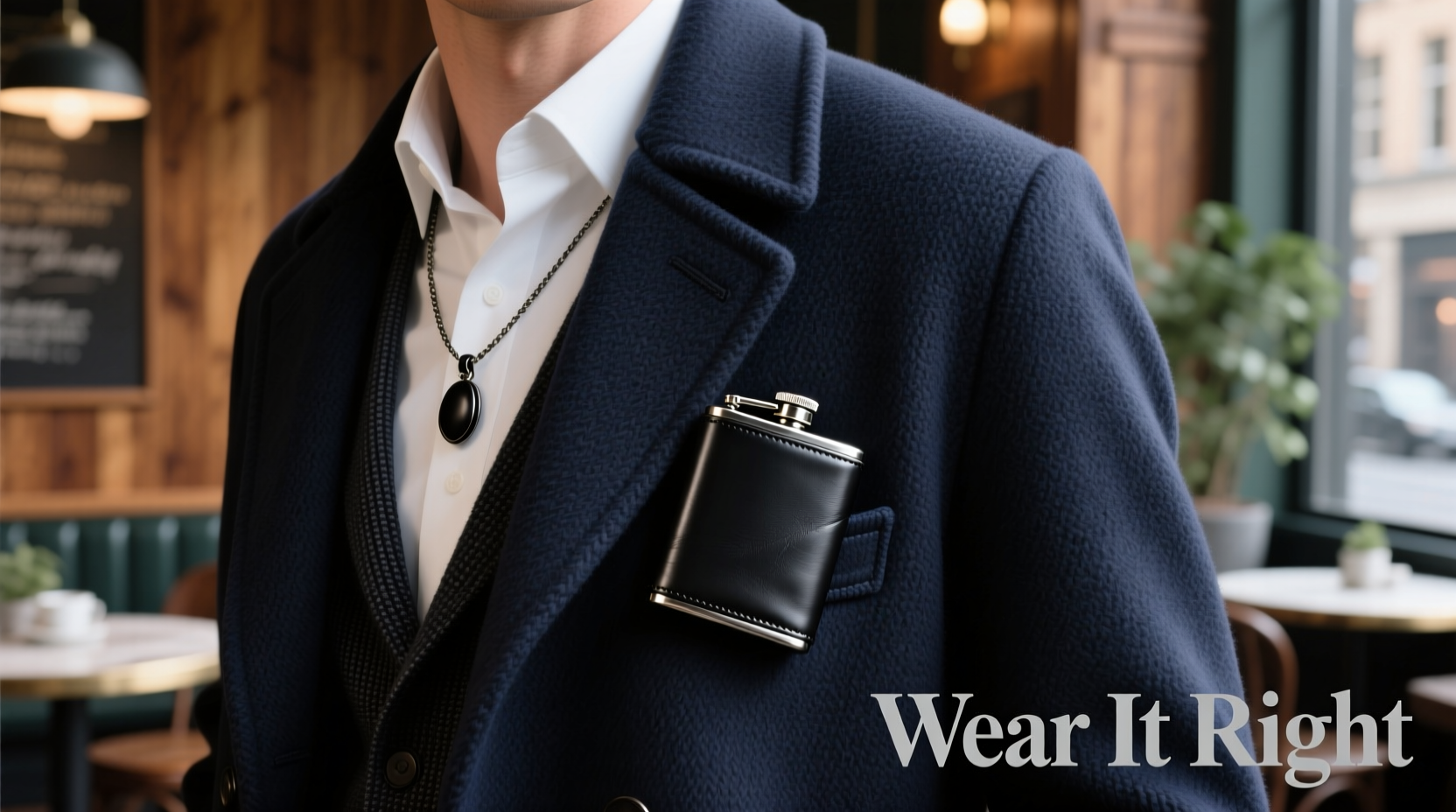
The single most common reason a flask necklace looks dated is mismatched or low-grade materials. A shiny, chrome-plated flask dangling from a flimsy chain reads like a souvenir keychain—not a considered accessory. Modern wearers gravitate toward finishes that age gracefully and align with their existing jewelry wardrobe: brushed matte metals, satin-finish titanium, frosted glass vials, or hand-polished walnut caps. These materials invite touch, develop patina, and avoid the “plastic sheen” that signals disposability.
Consider your current jewelry collection. If you wear mostly 14k gold-fill chains, a warm-toned brass flask with a leather cord anchor will integrate seamlessly. If your aesthetic leans industrial—think raw silver rings and oxidized cufflinks—a matte black ceramic flask with a gunmetal clasp reads cohesively. Avoid anything with cartoonish engravings, oversized logos, or plastic components unless that’s an intentional, high-concept choice (e.g., a conceptual art piece worn during a gallery opening).
Tip: Test material harmony by holding your flask necklace next to your most-worn necklace or watch face under natural light. If tones clash or one appears noticeably cheaper, reconsider the finish.2. Master the Proportion Principle: Scale, Chain, and Placement
A flask necklace fails when its visual weight overwhelms the neckline—or disappears entirely beneath layers. The solution lies in calibrated proportion. Flask size should relate directly to your frame, neckline depth, and layering strategy.
For petite frames or delicate collarbones, choose a micro-flask (under 30ml) on a fine, 1.2mm–1.5mm chain. It sits just below the clavicle, acting like a subtle pendant rather than a statement. For broader shoulders or V-neck silhouettes, a mid-size flask (40–50ml) with a 1.8mm–2.2mm cable or box chain balances volume without dominating. Oversized flasks (60ml+) work only with strong, clean lines—think a tailored turtleneck or structured blazer—and require a heavier chain (2.5mm+) to avoid looking top-heavy.
| Neckline Type | Recommended Flask Size | Ideal Chain Style & Length | Rationale |
|---|---|---|---|
| V-neck or deep scoop | 40–50ml | 2.0mm box chain, 18–20\" | Flask rests at sternum, anchoring the vertical line without competing with fabric drape. |
| Turtleneck or high crew | 25–35ml | 1.3mm rope chain, 16\" | Subtle presence above collar; avoids bulk against knit texture. |
| Off-shoulder or halter | 30–40ml | 1.5mm trace chain, 17\" | Complements exposed shoulders without drawing attention away from neckline architecture. |
| Layered necklaces | 20–30ml | 1.2mm delicate chain, 16\" | Sits as the shortest layer; choose a flask with minimal surface detail to avoid visual clutter. |
3. Contextual Styling: When and Where It Works Best
A flask necklace is not a universal accessory. Its success depends heavily on social context, activity, and cultural nuance. Wearing one to a formal gala or corporate board meeting—unless part of a curated avant-garde look—risks misreading. But at a weekend farmers’ market, a rooftop jazz night, a hiking trailhead, or even a creative studio meeting? It signals grounded confidence and pragmatic charm.
Styling must also respond to environment. In urban settings, lean into sleek, architectural pairings: a matte titanium flask with a charcoal wool turtleneck and wide-leg trousers. At outdoor gatherings, embrace organic textures—linen shirts, unbleached cotton vests, or waxed canvas jackets—with a walnut-capped stainless flask. Avoid pairing with overly sporty gear (like performance running tops) unless the flask is clearly part of a functional kit (e.g., hydration-focused trail use), as the contrast can feel jarring.
“Accessories gain meaning through alignment—not just aesthetics, but intention. A flask necklace worn while sketching in a café carries different weight than one worn at a wine tasting. The object doesn’t change; our relationship to it does.” — Lena Dubois, Curator of Contemporary Adornment, Museum of Craft & Design
4. The Layering Framework: Integrating Without Overloading
Modern jewelry trends favor layered necklaces—but adding a flask to the mix requires discipline. Treat the flask as the *anchor*, not the accent. That means: one flask + zero to two complementary pieces max. Never layer multiple flasks, and avoid pairing with other utilitarian pendants (compasses, mini tools, or bottle openers) unless executing a deliberate “maker’s toolkit” theme.
Successful layering follows this sequence: Anchor (flask) → Texture (e.g., a thin beaded choker or hammered disc) → Length variation (a longer, delicate chain ending just below the sternum). All chains must share metal tone and finish. A polished gold flask demands gold chains—not mixed metals—even if they’re all “warm-toned.” Consistency in finish creates cohesion; inconsistency reads as accidental, not curated.
Step-by-Step: Building a Balanced Flask Necklace Stack
- Select your flask based on size and material (see Section 1 & 2).
- Choose a base chain matching metal tone and thickness appropriate for your frame.
- Add one textural element: a 14\" beaded choker in onyx or matte black agate, or a 15\" hammered gold disc (12mm diameter max).
- Add one longer layer: a 22\" fine chain with a tiny geometric pendant (triangle or crescent) no larger than 6mm.
- Test movement: Tilt your head side-to-side. The flask should remain centered; other pieces should flow around it—not tangle or obscure it.
- Edit ruthlessly: Remove any piece that competes for visual space or dilutes the flask’s presence.
5. Real-World Integration: A Mini Case Study
Mira, 34, is a sustainable textile designer based in Portland. She owns a small-batch ceramic flask necklace—hand-thrown, glazed in deep indigo, with a matte brass cap and 1.6mm recycled brass chain. For years, she kept it in a drawer, associating it with “costume jewelry” energy. Last spring, she began experimenting after noticing similar pieces in editorials for Monocle and System Magazine.
Her breakthrough came not with a new purchase, but with a shift in framing: she stopped thinking of it as “the flask necklace” and started seeing it as “my indigo vessel.” She paired it with a handwoven linen shirt, raw-hem wide-leg trousers, and minimalist leather sandals—no other jewelry. The ceramic’s weight felt grounding; its color echoed the indigo-dyed silk scarf draped loosely over her shoulder. Later, she added a second layer: a 14\" oxidized silver chain with a single raw sapphire chip (3mm). The cool blue tones harmonized; the textures—matte ceramic, nubby linen, smooth stone—created quiet rhythm.
She now wears it weekly—not as a conversation starter about alcohol, but as a tactile reminder of craft, containment, and calm intention. Clients have complimented its “quiet authority.” No one asks what’s inside. They notice how it completes her silhouette.
6. Do’s and Don’ts: A Practical Checklist
- ✅ DO choose a flask with a secure, screw-top closure—no flip-top lids or rubber gaskets that degrade visibly.
- ✅ DO clean the exterior weekly with a soft microfiber cloth; rinse interior with warm water and air-dry fully before refilling.
- ✅ DO match flask cap material to chain metal (e.g., brass cap + brass chain), not just color.
- ✅ DO store flat or hanging separately—never tangled with other necklaces—to prevent scratches on matte finishes.
- ❌ DON’T wear with loud prints or busy patterns that compete for focal attention.
- ❌ DON’T fill with anything beyond room-temp spirits, infused water, or herbal tea—avoid sugary mixers or citrus juices that corrode interiors.
- ❌ DON’T treat it as purely functional—refill discreetly, not at the dinner table or in professional meetings.
- ❌ DON’T layer with more than two additional pieces; restraint is non-negotiable.
7. FAQ: Addressing Common Concerns
Is it socially acceptable to wear a flask necklace in professional environments?
Yes—if approached with discretion and design consciousness. In creative fields (architecture, design, publishing), a refined, minimalist flask necklace reads as part of a considered personal uniform—similar to wearing artisanal eyewear or hand-stitched shoes. Avoid overt branding, flashy finishes, or visible liquid. Opt for opaque ceramic or brushed metal, and keep it empty during work hours unless used for non-alcoholic purposes (e.g., herbal infusion for focus). When in doubt, test it during low-stakes internal meetings first.
What’s the best way to clean a stainless steel flask necklace without dulling the finish?
Use distilled water and a lint-free microfiber cloth. For stubborn smudges, add one drop of pH-neutral dish soap to the cloth—never submerge the entire piece, and never use abrasive cleaners, vinegar, or baking soda, which can etch brushed surfaces. Dry immediately with a second clean cloth. For deeply textured caps, use a soft-bristled toothbrush (dedicated to jewelry) dipped only in water.
Can men wear flask necklaces fashionably too?
Absolutely—and increasingly do. Men’s styling benefits from even greater restraint: choose larger-scale flasks (45–60ml) in gunmetal, matte black, or raw bronze, paired with thicker chains (2.2–2.5mm) and earth-toned layers (waxed cotton cord, leather wrap). Avoid anything resembling collegiate paraphernalia. Think of it as the heir to the pocket watch chain—functional, weighted, and quietly authoritative.
Conclusion
A flask necklace isn’t inherently dated. It’s a tool—an object—that gains meaning through how we hold it, where we place it, and why we choose it. When stripped of irony and anchored in material honesty, proportion, and contextual awareness, it transforms from novelty into nuance. It speaks to self-sufficiency without shouting; to utility without sacrificing beauty; to tradition without leaning on cliché.
You don’t need to overhaul your wardrobe or adopt a new persona. Start small: select one flask that feels right in your hand—not just in your eye. Pair it with the neckline you wear most often. Observe how it moves with you, how light catches its curve, how it settles against your skin. Refine, edit, repeat. Fashion evolves not through radical shifts, but through repeated, intentional choices made with care.
💬 Your turn: Share how you’ve reimagined a “dated” accessory in your own wardrobe—or tag someone who wears a flask necklace with effortless cool. Let’s normalize thoughtful utility, one intentional pendant at a time.








