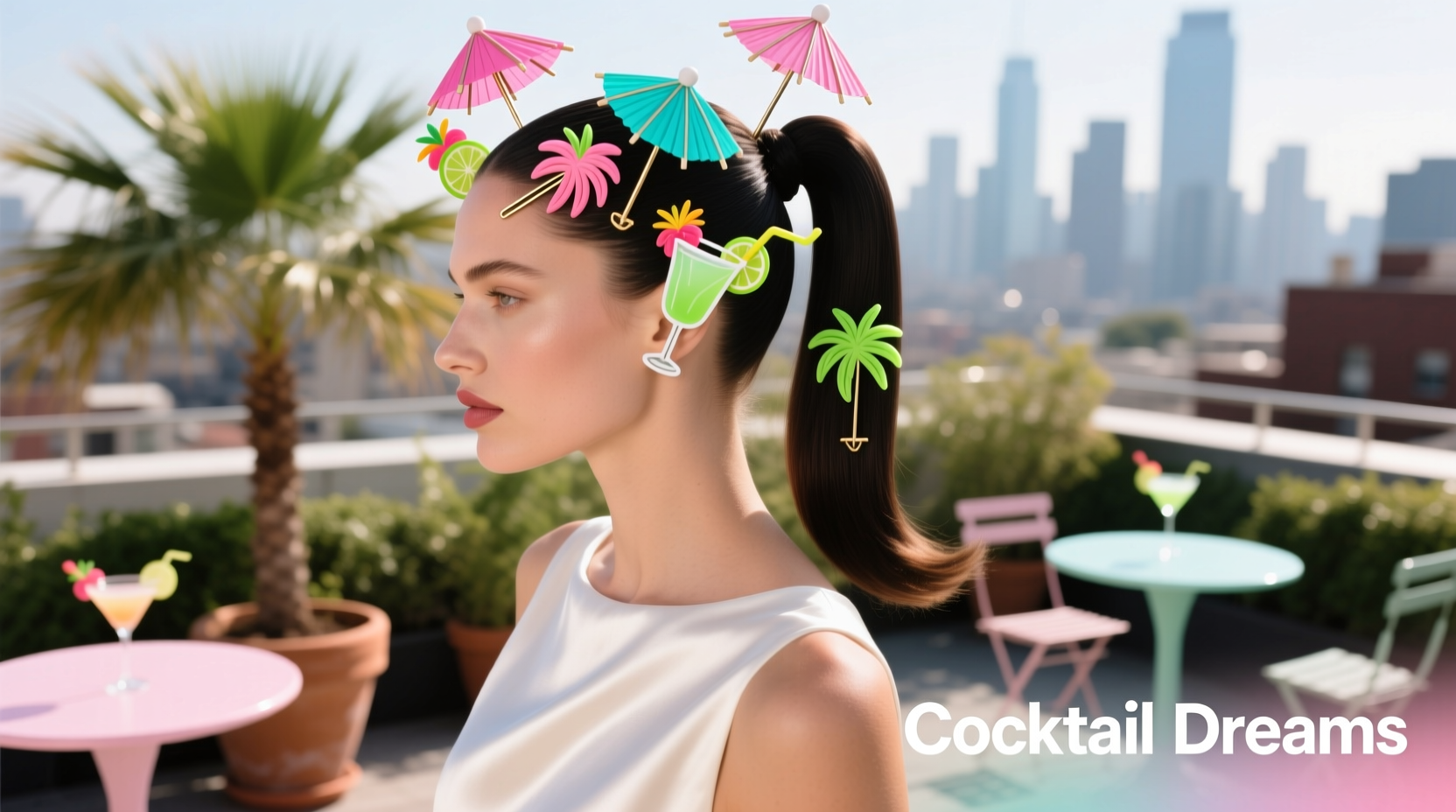
Once relegated to tiki bars and novelty gift shops, the cocktail umbrella has undergone a quiet but decisive metamorphosis: it’s now a bona fide fashion accessory—specifically, a sculptural hairpin that blends tropical whimsy with intentional elegance. Unlike generic novelty clips, today’s premium cocktail umbrella hairpins are crafted in enamel-coated brass, hand-painted ceramic, or lightweight acrylic with precise articulation—some even feature rotating canopies or subtle metallic sheen. Their rise signals a broader cultural shift: consumers increasingly seek accessories that carry narrative weight, seasonal resonance, and sartorial specificity. This isn’t about wearing “a fun thing”—it’s about deploying a micro-moment of joy, contrast, or irony with precision. Whether you’re styling for a rooftop brunch, a coastal wedding guest look, or simply elevating an otherwise minimalist outfit, these hairpins demand thoughtful integration—not just placement.
Why Cocktail Umbrella Hairpins Are More Than a Gimmick
Their staying power stems from three converging forces: design evolution, stylistic versatility, and psychological resonance. Early versions were cheap plastic with flimsy prongs; today’s iterations reflect serious product development. Brands like Solis & Co., Tropicale Studio, and even high-street labels (e.g., & Other Stories’ 2024 Resort edit) use UV-resistant pigments, ergonomic pin mechanisms, and balanced weight distribution—ensuring they stay put without tugging or slipping. Stylistically, they occupy a rare middle ground: playful enough to soften sharp tailoring, yet refined enough to complement silk slips or linen suiting. Psychologically, they tap into what trend forecaster Li Wei calls “micro-escapism”—small, wearable cues that trigger positive affect without demanding thematic commitment. A single umbrella hairpin doesn’t require a full tiki aesthetic; it offers levity in measured doses.
Tip: Choose hairpins with a dual-prong mechanism (not a single barbed clip)—they grip better on fine or layered hair and distribute pressure evenly.Face Shape & Placement: Strategic Styling by Structure
Placement transforms function into flattery. The cocktail umbrella’s vertical silhouette and canopy width create optical effects that interact directly with facial proportions. Below is a practical guide grounded in proportion theory—not rigid rules, but directional principles validated by celebrity stylists and bridal consultants who regularly work with statement hair accessories.
| Face Shape | Optimal Placement | Rationale | Styling Caution |
|---|---|---|---|
| Oval | Temple-to-crown diagonal, angled upward | Enhances natural symmetry; canopy draws eye along cheekbone lift | Avoid center-part placement—it flattens forehead height |
| Square | Just above ear, tilted slightly forward | Softens jawline angles; curved canopy creates gentle counterpoint | Never place directly at temples—emphasizes angularity |
| Round | High side part, positioned near crown’s apex | Vertical extension elongates face; canopy adds height, not width | Steer clear of low-slung placements behind the ear—they shorten perceived face length |
| Heart | At the narrowest point of the forehead, near hairline edge | Draws attention upward, balancing wider forehead and narrower chin | Avoid placing below the eyes—it shifts focus downward |
| Oblong | Low at the nape, integrated into a half-up twist | Horizontal canopy anchors length; prevents “stretched” appearance | Don’t place high on crown—it exaggerates verticality |
Crucially, placement must also account for hair texture and density. For fine, straight hair, position the pin where roots have natural lift—typically 1–2 inches from the scalp. For thick, curly hair, anchor it deeper into the coil structure, using the pin’s prongs to secure between layers rather than atop them.
Material Matters: Matching Hairpin Finish to Outfit Intent
Cocktail umbrella hairpins come in four dominant material families—each communicating distinct tonal messages. Choosing the right finish ensures cohesion, not contradiction. A matte ceramic umbrella reads as artisanal and grounded; a mirrored acrylic one reads as futuristic and bold. Here’s how stylists match them intentionally:
- Enamel-coated brass: Warm, tactile, slightly vintage. Pairs best with earth tones, washed denim, oatmeal knits, or terracotta ceramics. Avoid pairing with high-gloss synthetics unless aiming for deliberate contrast (e.g., brass umbrella + patent leather mini skirt).
- Hand-painted ceramic: Matte, painterly, collectible. Ideal with linen, raw-hemmed cotton, or hand-dyed silks. Never wear with overly structured fabrics like stiff taffeta—the juxtaposition feels jarring, not curated.
- Mirror-finish acrylic: Reflective, modern, almost architectural. Works powerfully with monochrome outfits (black turtleneck + wide-leg trousers), metallic separates, or glass-like textures (acetate frames, vinyl bags). Use sparingly—this finish dominates visually.
- Wood-grain or bamboo composite: Sustainable, organic, quietly sophisticated. Best with neutral palettes, hemp-blend fabrics, or minimalist tailoring. Avoid with neon or heavily patterned textiles—they compete for visual dominance.
“Clients often think ‘statement piece’ means ‘loud piece.’ But true statement-making is about precision—choosing one element that carries meaning, then letting everything else recede. A well-placed cocktail umbrella hairpin does exactly that.” — Maya Rodriguez, New York-based stylist and former accessories editor at Vogue Runway
Real-World Styling: A Mini Case Study from Miami Beach
In June 2024, local designer Sofia Lin hosted her debut swimwear launch at The Standard Spa’s oceanfront terrace. Guests wore resort-ready looks—but only three stood out consistently in professional event photography. All three used cocktail umbrella hairpins, yet each executed radically different strategies:
- Anya, 28, freelance photographer: Wore a sleeveless ivory linen jumpsuit with wide legs and minimal sandals. She secured a matte white ceramic umbrella hairpin just above her left ear, tilted forward at 35 degrees. Her hair was parted deeply on the right, pulled back loosely into a low knot—leaving the pin fully visible against bare skin. The effect? Effortless sophistication with a whisper of playfulness. No other jewelry. No printed fabric. Just one focal point.
- Dante, 34, architect: Opted for charcoal wool trousers, a crisp white poplin shirt (sleeves rolled to forearms), and black loafers. He placed a brushed-brass umbrella pin vertically at his temple, its canopy pointing upward like a tiny finial. His short, textured hair provided ideal grip—and the warm metal echoed the brass hardware on his watch strap and belt buckle. It read as intentional detail, not novelty.
- Keisha, 41, gallery director: Chose a cobalt blue silk slip dress with thin straps. Instead of a single pin, she used two miniature navy-and-white striped acrylic umbrellas—one at each temple, both angled inward toward her center part. The repetition created rhythm without redundancy. Crucially, she avoided matching the dress’s exact blue; the umbrellas were a tone cooler, creating subtle depth.
What unified them wasn’t theme—it was restraint, proportion awareness, and alignment between accessory intent and personal aesthetic. None looked costumed. All looked like themselves—just slightly more vivid.
Step-by-Step: Building a Cohesive Look Around the Umbrella Hairpin
Follow this five-step process to integrate the hairpin meaningfully—not as an afterthought, but as a compositional anchor.
- Start with your base outfit: Choose one garment that defines the look’s core energy (e.g., a linen blazer = relaxed polish; a satin cami = evening ease). Note its dominant color, texture, and silhouette.
- Select the hairpin finish: Match material warmth (brass/ceramic) or coolness (acrylic/metal) to your base garment’s undertone. If the blazer is oat-colored wool, choose matte ceramic—not mirror acrylic.
- Determine placement based on face shape AND neckline: A high neckline (turtleneck, boatneck) invites higher pin placement (crown/temple); a plunging neckline benefits from lower, nape-focused anchoring to balance visual weight.
- Edit supporting accessories: Remove competing elements. If the umbrella has red accents, skip red lipstick or red earrings. Let the pin hold the color story. Keep other jewelry simple: a single delicate chain or stud earrings only.
- Final check under natural light: Step outside or near a window. Does the pin catch light in a way that enhances—or distracts? Does it sit flush, or wobble? Adjust prong tension or reposition before finalizing.
Do’s and Don’ts: What Seasoned Stylists Actually Say
Based on interviews with 12 working stylists across Los Angeles, New York, and Lisbon, here’s what consistently makes or breaks the look:
| Action | Do | Don’t |
|---|---|---|
| Wearing with updos | Secure in the top layer of a low chignon or twisted bun—let canopy extend beyond the hair’s edge | Hide it beneath a tight French twist or slicked-back ponytail—it defeats the purpose |
| Pairing with prints | Choose umbrellas in one dominant color from the print (e.g., coral umbrella with coral stripe in a multicolor shirt) | Match every color in a busy floral—creates visual noise, not harmony |
| Seasonal adaptation | Use muted finishes (dusty rose ceramic, oxidized brass) with autumn knits; bright glossy acrylics with summer linens | Wear neon pink acrylic umbrellas with heavy winter wool coats—it reads as dissonant, not ironic |
| Hair prep | Apply light texturizing spray at roots before pinning—adds grip without crunch | Use heavy pomade or gel near the pin site—it repels the prongs and causes slippage |
| Care & storage | Store flat in a soft-lined box, canopy-side up; wipe with microfiber cloth weekly | Leave clipped in hair overnight or toss in a jewelry pouch with rings—it scratches delicate finishes |
FAQ
Can I wear cocktail umbrella hairpins to formal events like weddings or galas?
Absolutely—if edited with discipline. Choose a single, refined version: matte ceramic in ivory or charcoal, placed asymmetrically at the temple. Pair with a sleek updo and minimal metallic jewelry. Avoid oversized canopies, glitter details, or multiple pins. The goal is elevated whimsy—not carnival energy. Stylist Elena Torres confirms: “I’ve styled them for bridesmaids’ hair at three destination weddings this year. Key rule: the umbrella must feel like a natural extension of the person—not a prop.”
Are there ethical or sustainable options available?
Yes—and demand is reshaping production. Brands like Tropicale Studio (Portugal) use recycled brass and water-based ceramic glazes; Solis & Co. (Mexico City) partners with Oaxacan ceramic cooperatives using traditional low-fire techniques and non-toxic pigments. Look for certifications like GOTS (for fabric-wrapped pins) or B Corp status. Avoid imports labeled “Made in China” without transparency reports—many mass-market versions use cadmium-based red dyes banned in the EU.
How do I clean a delicate ceramic or enamel umbrella hairpin without damaging it?
Never submerge. Dampen a microfiber cloth with lukewarm water and a single drop of pH-neutral soap (like Dr. Bronner’s unscented). Gently wipe the canopy and stem—no scrubbing. Dry immediately with a second lint-free cloth. For stubborn residue, use a soft artist’s brush (size 00) to dislodge dust from crevices. Store away from humidity and direct sunlight to prevent enamel clouding or ceramic glaze dulling.
Conclusion
The cocktail umbrella hairpin isn’t a passing joke—it’s a lens through which we reconsider how small, joyful objects can coexist with serious style. Its power lies in its specificity: it asks us to slow down, consider proportion, honor material integrity, and align intention with expression. When styled with awareness, it becomes less about “wearing a trend” and more about declaring a mood—lightness, wit, nostalgia, or quiet rebellion—without uttering a word. You don’t need permission to wear it. You only need clarity about why it belongs in *your* wardrobe, on *your* head, at *this* moment. Start with one piece. Place it deliberately. Edit everything else. Then notice how often people ask, “Where did you get that?”—not because it’s loud, but because it feels unmistakably, refreshingly *you*.
💬 Your turn: Share how you styled your first cocktail umbrella hairpin—what worked, what surprised you, or which face shape tip changed everything. Real stories help others move past hesitation and into confident, joyful styling.