The midi skirt—falling gracefully between the knee and ankle—is a wardrobe favorite for its elegance, versatility, and timeless appeal. Yet for many, especially those of shorter stature or anyone concerned with proportion, wearing a midi skirt can sometimes create the unintended effect of shortening the leg line. The good news? With thoughtful styling choices, this silhouette can actually elongate your frame and enhance your height. It’s not about avoiding the midi length—it’s about mastering it.
Styling a midi skirt to flatter your figure is less about your actual height and more about visual balance. Strategic combinations of fit, fabric, footwear, and waist placement can make all the difference. Whether you're 5'2\" or 5'8\", these techniques work universally because they manipulate perception, not just clothing.
Understand Proportions: The Key to Elongation
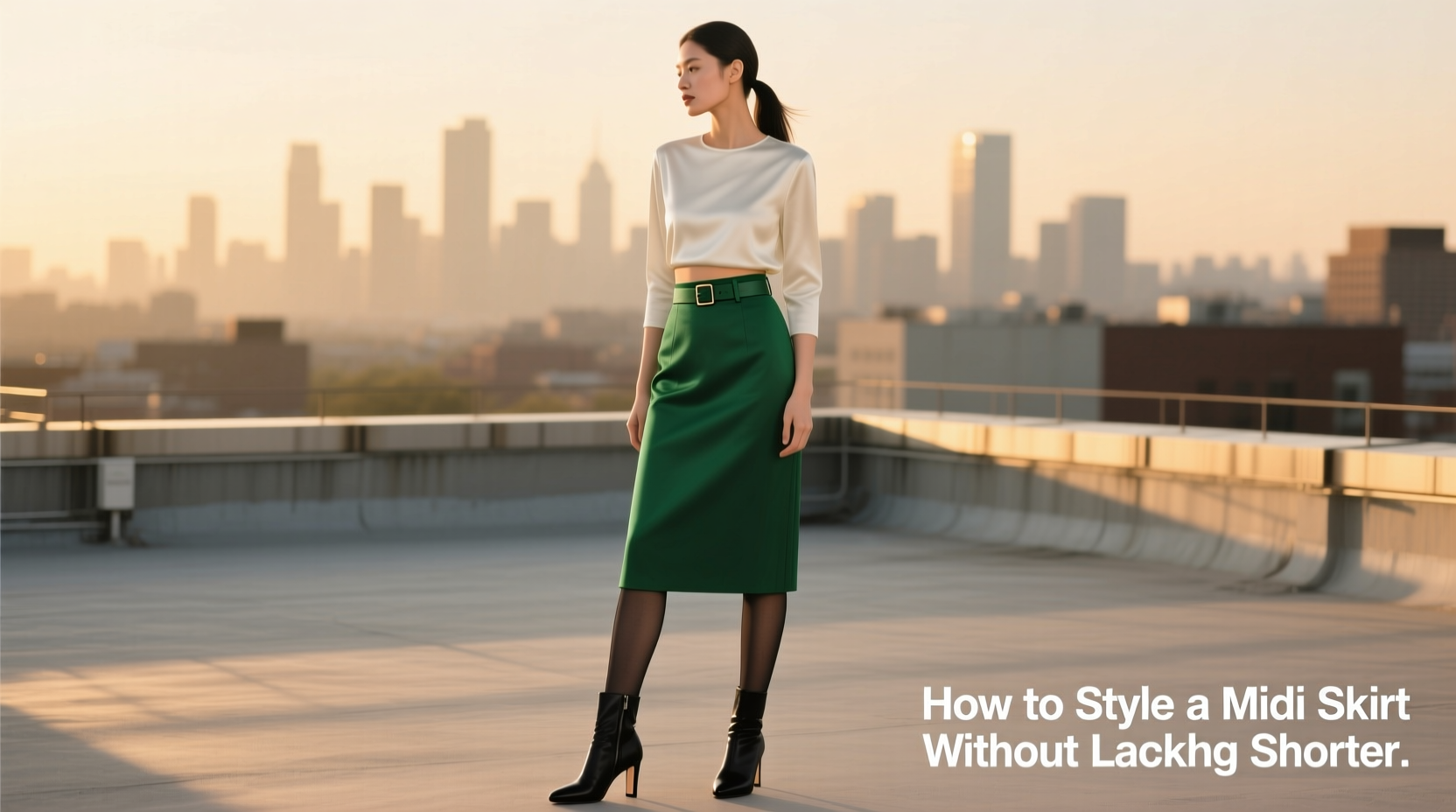
Proportion is the foundation of flattering fashion. A midi skirt covers more leg than a mini or even a knee-length skirt, which means the rest of your outfit must compensate by drawing the eye upward or creating a continuous vertical line. The goal is to avoid breaking your body into segmented parts—especially at mid-calf, where the hemline can visually chop off the lower half.
To maintain elongation, focus on two primary zones: the waist and the shoes. A well-defined waist creates an hourglass illusion and lifts the hips, while the right footwear extends the leg line seamlessly from the skirt's hem.
Tip: Always aim to wear your top tucked in or choose cropped styles that hit at or above the natural waist.Vertical lines also play a role. Opt for skirts with subtle front slits, center seams, or monochromatic outfits that guide the eye up and down rather than side-to-side. Horizontal elements like wide belts or boxy layers can disrupt flow and add width, which detracts from height.
Choose the Right Waistline and Fit
The placement of the waistband on a midi skirt dramatically affects how your body appears. High-waisted styles are almost always the best choice when aiming to look taller. They raise the hip line, shorten the torso slightly, and lengthen the leg visually—especially when paired with a tucked-in top.
Mid-rise or low-rise midi skirts tend to extend the upper body and cut the legs shorter, which can make even tall women appear more compact. For petite frames, high-waisted options are non-negotiable for maximizing perceived height.
Fabric and structure matter too. Stiffer fabrics like denim, wool blends, or structured cotton hold their shape and create clean lines, while overly voluminous materials can overwhelm a smaller frame. A-line or pencil midi skirts offer balanced volume, but avoid extreme fullness unless balanced with a fitted top.
“Elevating the waist is one of the most effective tools in fashion geometry. It shifts the eye and redefines proportion instantly.” — Lena Torres, Fashion Stylist & Body Image Consultant
Best Midi Skirt Silhouettes by Body Type
| Body Shape | Recommended Skirt Style | Why It Works |
|---|---|---|
| Petite (under 5'4\") | High-waisted, slim-fit or slight A-line | Maximizes leg length; avoids excess fabric that overwhelms |
| Hourglass | Pencil or bodycon midi | Highlights curves without adding bulk; maintains vertical continuity |
| Apple-shaped | A-line with high waist and fluid fabric | Draws attention to waist; flows over hips without clinging |
| Rectangle | Wrap-style or belted midi with defined waist | Creates curves; adds dimension where needed |
| Tall frames | Full maxi-midi or slit designs | Leverages height; adds drama without sacrificing proportion |
Footwear That Lengthens the Leg
No element impacts the appearance of height more than shoes. When wearing a midi skirt, your footwear either completes the elongation or interrupts it. The rule of thumb: the more skin visible between the hem and the shoe, the more your leg appears broken. To counteract this, minimize negative space.
Pointed-toe shoes are ideal—they extend the foot’s line and create a seamless transition from ankle to toe. Nude heels are particularly effective because they blend with your skin tone, making your leg appear longer. Even flat sandals with a pointed or open toe can preserve continuity better than closed, chunky styles.
If you prefer flats, opt for styles that expose the ankle—like mules, loafers, or slingbacks. Avoid ankle boots or shoes with horizontal straps across the foot, as they create a “stop” point that shortens the leg.
Tip: Match your shoe color to your skin tone or the skirt for a longer leg illusion.Heels aren’t mandatory, but if worn, keep them moderate (1.5 to 3 inches). Excessive height can distort posture and shift weight backward, affecting overall balance. Wedges and block heels work well for comfort, provided they have a sleek profile.
Master the Top-to-Skirt Ratio
The relationship between your top and skirt determines where the eye lands. A long, loose blouse over a midi skirt can obscure the waist and drown your frame, especially if you’re petite. Instead, prioritize tops that are either cropped or designed to be tucked.
Cropped sweaters, bodysuits, and fitted blouses that end at the natural waist help anchor the outfit and define the hip line. If you love longer tops, layer strategically: wear a tucked-in tank or camisole underneath and leave the outer layer slightly open to preserve waist definition.
Monochrome dressing is another powerful trick. Wearing the same color from head to toe—especially in darker or neutral tones—creates an unbroken vertical line. For example, a black turtleneck tucked into a black midi skirt with black ankle-strap heels makes the entire form appear taller and leaner.
When adding layers, keep them streamlined. A tailored blazer that hits at the hip or just below maintains proportion, while long, bulky coats can overwhelm. If wearing a coat, button it only at the top or leave it open entirely to preserve the waistline.
Step-by-Step Guide: Building a Height-Enhancing Midi Skirt Outfit
- Start with a high-waisted midi skirt in a structured or fluid fabric depending on your body shape.
- Select a top that ends at or above the waist—cropped, fitted, or easily tuckable.
- Tuck the top securely using a French tuck or full tuck; consider a waist chain or thin belt for added definition.
- Choose footwear that extends the leg line: pointed-toe flats, nude heels, or ankle-exposing styles.
- Add minimal accessories—avoid chunky necklaces or bags that hang below the hip, as they draw the eye downward.
- Consider a vertical layer, such as a long pendant or open-front cardigan, to guide the eye up and down.
Avoid These Common Styling Mistakes
- Wearing baggy tops untucked: This hides the waist and adds bulk to the upper body.
- Choosing mid-calf hemlines without breaks: Skirts that hit exactly at the widest part of the calf can make legs appear shorter. Look for styles with a front slit or asymmetrical hem to break up the line.
- Mixing heavy fabrics with oversized fits: Thick corduroy or pleated wool skirts in large volumes can drag down a small frame.
- Wearing socks or tights that contrast sharply with shoes: This creates segmentation. Opt for sheer or matching tones.
- Over-accessorizing the lower half: Belts below the hip, large pockets, or bottom-heavy patterns pull focus downward.
Do’s and Don’ts at a Glance
| Do | Don’t |
|---|---|
| Wear high-waisted skirts | Choose low-rise or undefined waists |
| Pair with pointed-toe shoes | Wear clunky ankle boots or round-toe flats |
| Tuck in or crop your top | Let long shirts hang loosely |
| Use nude or matching footwear | Wear shoes that contrast strongly with skin tone |
| Add a vertical element (long necklace, open coat) | Wear wide belts or bulky bags at the hip |
Real-Life Example: How Sarah Transformed Her Midi Skirt Game
Sarah, 5’3” and working in corporate marketing, loved the polished look of midi skirts but avoided them after receiving feedback that she “looked shorter” in them during client meetings. She wore a navy A-line midi with a loose white button-down and brown ankle boots that cut off her ankles.
After consulting a personal stylist, she made three changes: switched to a high-waisted version of the skirt, swapped the blouse for a black turtleneck bodysuit, and replaced the boots with pointed-toe nude pumps. The transformation was immediate. Colleagues commented on her “taller, more put-together presence,” and Sarah reported feeling more confident in her authority.
The key wasn’t changing her body—it was changing how her clothes framed it.
Frequently Asked Questions
Can I wear a midi skirt if I’m under 5'4\"?
Absolutely. The key is choosing high-waisted styles, pairing them with pointed-toe or nude footwear, and ensuring your top defines the waist. Avoid hemlines that hit exactly at the calf; instead, opt for skirts with a slight front slit or asymmetrical cut to maintain leg continuity.
Are sneakers ever appropriate with midi skirts for shorter women?
Yes, but with caution. Choose low-top sneakers in a color that matches your skirt or skin tone. Pair with cropped or rolled midi skirts that sit just above the ankle to reduce the gap between hem and shoe. Avoid bulky athletic sneakers, which add visual weight.
Should I avoid patterns on midi skirts if I’m short?
Not necessarily. Vertical stripes, subtle florals, or small all-over prints can work well. Avoid large, bold patterns that dominate the lower half. If in doubt, stick to solids in dark or neutral tones, which naturally slim and elongate.
Your Styling Checklist
- ✅ High-Waisted Skirt
- Ensures the waist is elevated for maximum leg length.
- ✅ Defined Waistline
- Top is tucked, cropped, or belted to highlight the narrowest part of your torso.
- ✅ Elongating Footwear
- Pointed toes, nude shades, or ankle-revealing styles to extend the leg.
- ✅ Minimal Break Between Hem and Shoe
- Avoid excessive exposure between skirt and shoe; aim for continuity.
- ✅ Balanced Proportions
- Top half isn’t oversized; layers are streamlined and purposeful.
- ✅ Vertical Emphasis
- Use monochrome dressing, long necklaces, or center seams to guide the eye up and down.
Final Thoughts: Own Your Style, Not Just Your Height
Styling a midi skirt without looking shorter than you are isn’t about conforming to outdated rules—it’s about understanding visual language and using it to your advantage. Fashion should empower, not limit. Whether you're petite or simply want to maximize your silhouette, these strategies allow you to wear what you love with confidence.
The midi skirt isn’t the problem; the styling approach is. With the right cuts, combinations, and awareness of proportion, this classic piece can become one of your most flattering assets. Experiment, observe what works for your body, and refine your choices over time.
🚀 Ready to rethink your midi skirt game? Try one new tip this week—swap your shoes, redefine your waist, or go monochrome—and notice the difference. Share your look or questions in the comments below!








