There’s a quiet sophistication in the ritual of sipping a perfectly crafted cocktail—the clink of ice, the citrus twist curling over the rim, the first aromatic lift before the first sip. But what if that experience could deepen further—not just through taste or temperature, but through scent? A well-chosen fragrance doesn’t compete with your drink; it converses with it. It extends the sensory narrative, anchoring memory, elevating mood, and subtly reinforcing personal identity. Selecting a fragrance that pairs with your signature cocktail isn’t about matching notes like a perfume lab experiment—it’s about understanding resonance: how volatility, warmth, texture, and emotional tone align across two distinct yet complementary sensory domains.
The Sensory Logic Behind Scent–Spirit Alignment
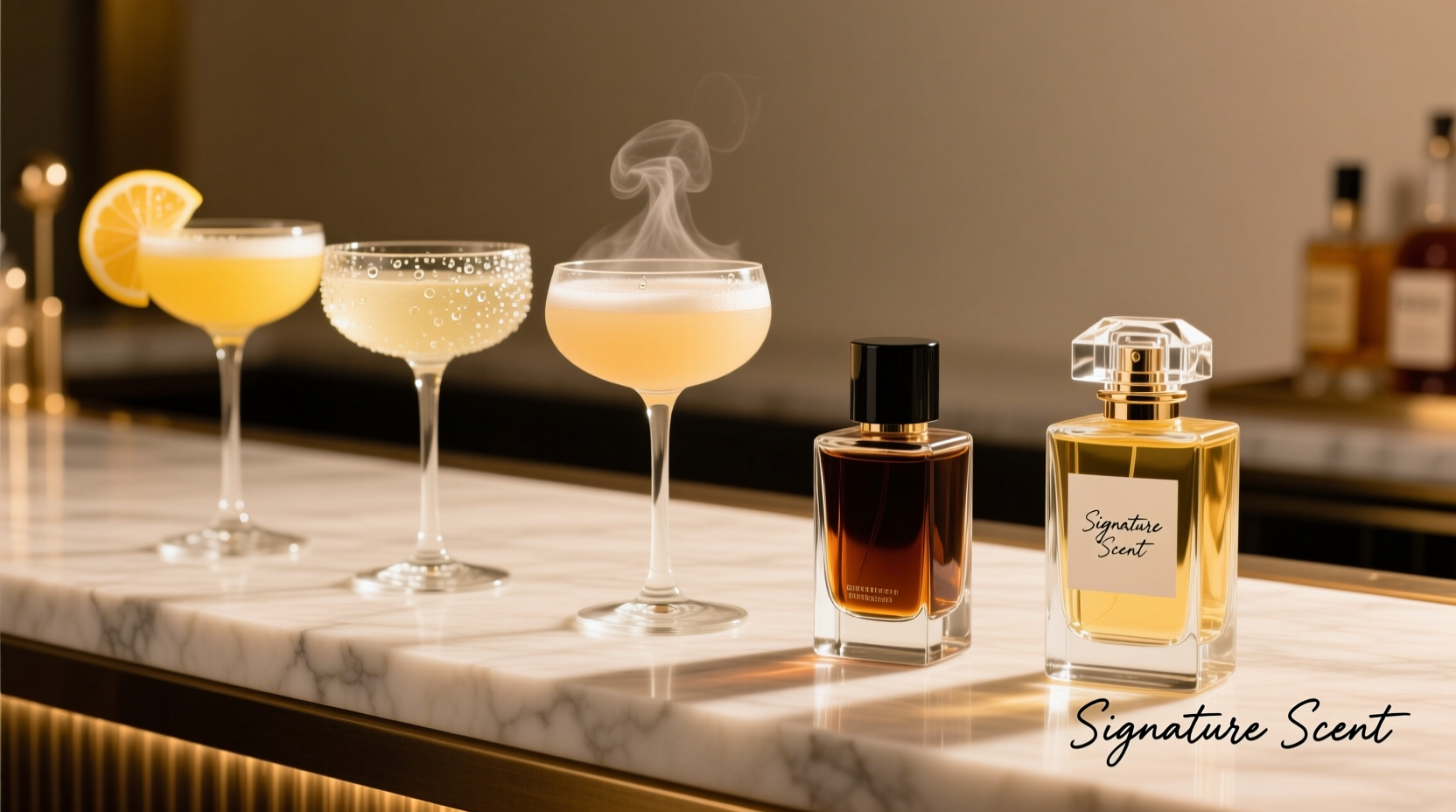
Fragrance and cocktails both operate on layered structures. A cocktail has a base spirit (e.g., gin, rum, tequila), modifiers (vermouth, bitters, syrups), and aromatic accents (citrus zest, herbs, smoke). Likewise, a fragrance unfolds in top, heart, and base notes—each with its own volatility and longevity. The pairing principle isn’t literal duplication (“I’m drinking a Negroni, so I’ll wear bergamot”), but harmonic alignment: shared olfactive families, complementary temperature profiles (cool vs. warm), and balanced intensity levels.
Consider volatility: top notes in fragrance—citrus, mint, green leaves—evaporate quickly, much like the volatile esters released from a chilled martini or a stirred Manhattan. These are ideal for drinks served up, where aroma is immediate and fleeting. Heart notes—lavender, rose, cardamom, or tobacco leaf—linger longer and suit stirred or aged spirits where complexity emerges mid-sip. Base notes—amber, vetiver, sandalwood, leather—anchor both fragrance and cocktail, especially those with barrel-aged components or rich modifiers like PX sherry or maple syrup.
“Scent and taste share 80% of their neural pathways. When fragrance and cocktail harmonize, they don’t just coexist—they reinforce each other’s emotional imprint.” — Dr. Rachel Kim, Olfactory Neuroscientist & Beverage Consultant, Columbia University
Step-by-Step: Building Your Signature Pairing
- Define your signature cocktail’s core character. Is it bright and effervescent (Aperol Spritz), herbaceous and dry (Gin & Tonic), smoky and brooding (Mezcal Old Fashioned), or rich and spiced (Rum Flip)? Write down three adjectives that capture its dominant sensory impression—not just flavor, but temperature, texture, and mood.
- Map its dominant aromatic molecules. Identify the primary volatile compounds you smell: limonene (citrus), linalool (floral/herbal), eugenol (clove/cinnamon), guaiacol (smoke), or vanillin (vanilla/baked spice). These appear in both spirits and perfumes.
- Assess your fragrance wardrobe by family—not just “floral” or “woody,” but subcategories. For example: “citrus” could mean zesty lemon (top-note dominant) or rounded bergamot (with lavender heart); “woody” might be clean cedar (dry, sharp) or creamy sandalwood (warm, milky).
- Test intensity alignment. Apply fragrance 30 minutes before serving your cocktail. Does the scent still register clearly at the moment you raise the glass? If it’s faded or overwhelming, adjust concentration (eau de toilette vs. parfum) or application method (pulse points only, not wrists rubbed together).
- Observe the evolution. Reassess at 20-minute intervals. Does the fragrance’s dry-down echo the cocktail’s finish? A bitter Campari-based drink may pair beautifully with a fragrance that dries down to tonka bean and oakmoss—a shared bitterness-to-earthy resolution.
Practical Pairing Framework: Matching Cocktails to Fragrance Families
Below is a curated reference table—not prescriptive rules, but evidence-based affinities drawn from professional mixology workshops and fragrance formulation labs. These pairings reflect repeated sensory testing across diverse demographics and environments (home bars, rooftop lounges, private tastings).
| Cocktail Profile | Signature Example | Recommended Fragrance Family | Rationale & Key Notes |
|---|---|---|---|
| Bright, Citrus-Forward, Effervescent | Aperol Spritz, French 75, Paloma | Green-Citrus Chypre | Combines tart grapefruit or yuzu top notes with galbanum (green stemmy freshness) and oakmoss base. Mirrors spritz’s effervescence without sweetness overload. Avoid gourmand citruses—they clash with dry vermouth or soda. |
| Herbaceous, Juniper-Dominant, Crisp | Dry Martini, Gin & Tonic, Southside | Botanical Fougère | Lavender, geranium, and coumarin (hay-like sweetness) complement gin’s botanicals without competing. The fougère structure—fresh top, herbal heart, woody-mossy base—mirrors a well-stirred martini’s progression from chill to depth. |
| Smoky, Earthy, Complex | Mezcal Old Fashioned, Penicillin, Smoked Maple Whiskey Sour | Leather-Amber Oriental | Leather accord (birch tar, cade oil) + amber resin + dried tobacco leaf. Matches mezcal’s phenolic smoke and whiskey’s charred oak. Avoid overly sweet ambers—they mute smoke’s austerity. |
| Spiced, Rich, Warm | Rum Flip, Spiced Dark & Stormy, Brandy Alexander | Vanillic-Tobacco Leather | Vanilla absolute, cured tobacco leaf, and suede leather. Captures baked spice, molasses depth, and creaminess without cloying. Skip powdery vanilla florals—they lack the rum’s tannic backbone. |
| Bitter, Herbal, Aperitif-Driven | Negroni, Boulevardier, Americano | Wormwood-Myrrh Chypre | Artemisia (wormwood), myrrh resin, and patchouli root. Honors Campari’s quinine bitterness and sweet vermouth’s dried fruit. Creates a sophisticated, slightly medicinal elegance—not medicinal in a clinical sense, but in the way old-world apothecaries blended herbs. |
Real-World Case Study: The “Midnight Paloma” Ritual
Sarah Chen, a sommelier and cocktail educator in Austin, developed her signature “Midnight Paloma” during a residency at a high-altitude agave distillery. It features reposado tequila, fresh grapefruit juice, a touch of saline, and a single black peppercorn gently muddled and floated on top. She wanted a fragrance that honored the drink’s duality: bright citrus cut with mineral salinity and slow-burn heat.
She tested six fragrances over three weeks. Early attempts—bright citrus colognes—felt thin and fleeting against the tequila’s viscosity. A heavy oriental overwhelmed the grapefruit’s nuance. What worked was Bois d’Argent by Serge Lutens: a composition built around silver birch (smoky, mineral), iris root (powdery-dry), and a whisper of honeyed amber. The birch echoed the salinity; the iris mirrored the grapefruit’s floral bitterness; the amber warmed the finish without masking pepper’s bite. At her monthly tasting salon, guests consistently described the experience as “cohesive”—noticing how the scent seemed to linger *within* the drink’s aroma rather than beside it.
Crucially, Sarah applies the fragrance only to her inner elbows and nape—never wrists—so the scent rises gently as she leans in to stir, never projecting over the glass. She serves the cocktail in a wide-rimmed coupe, allowing the fragrance to mingle with the grapefruit oil released upon garnish placement.
Your Personal Pairing Checklist
- ☑️ I’ve identified my cocktail’s dominant scent profile—not just taste, but volatility (how fast it releases aroma) and temperature impression (cool, warm, neutral).
- ☑️ I’ve assessed my fragrance collection by note structure (top/heart/base) and family subcategory—not just broad labels.
- ☑️ I’ve tested at least two candidate fragrances alongside my cocktail at the same time of day, same ambient temperature, and same glassware.
- ☑️ I’ve noted whether the fragrance enhances, distracts from, or flattens the cocktail’s aromatic complexity—especially during the finish.
- ☑️ I’ve confirmed the pairing works in social settings: does it read as intentional, not overpowering, when others are nearby?
FAQ: Clarifying Common Misconceptions
Can I wear the same fragrance with every cocktail I make?
No—and that’s by design. Just as you wouldn’t serve a delicate Champagne alongside a peated Islay Scotch, fragrance should reflect intentionality. A versatile “neutral” fragrance (e.g., a clean musk or sheer amber) may work across categories, but it sacrifices resonance. The most memorable pairings are specific: the juniper-lavender dialogue of a martini demands different architecture than the smoke-resin interplay of a mezcal sour.
Does alcohol in fragrance interfere with cocktail aromas?
Yes—but predictably. Ethanol carriers accelerate top-note release. A high-alcohol eau de toilette will project strongly for 5–8 minutes, then recede sharply—ideal for short, aromatic drinks like a Tom Collins. A low-alcohol parfum oil delivers slower, skin-close diffusion, better suited for long sips like an aged rum neat. Always match carrier volatility to your drink’s aromatic lifespan.
What if my signature cocktail changes seasonally?
That’s an opportunity—not a problem. Seasonal shifts naturally invite fragrance rotation: lighter citrus-green chypres for spring palomas; herbaceous fougeres for summer martinis; leathery ambers for autumn old fashioneds; and spicy vanillic leathers for winter flips. This rhythm deepens personal ritual and keeps sensory engagement fresh. Many professionals maintain a “cocktail calendar” noting both drink and fragrance pairings by month.
Conclusion: Where Identity Meets Intention
Selecting a fragrance that pairs with your signature cocktail is one of the most understated acts of self-curation available to us. It asks you to listen more closely—not just to what you drink, but to how you want to be perceived in the space between breath and sip. It’s not about luxury as status, but luxury as coherence: the alignment of gesture, aroma, and intention that makes a simple evening feel considered, grounded, and wholly yours.
This practice rewards patience. Start with one pairing. Observe how it changes across time, temperature, and context. Refine—not to achieve perfection, but to deepen recognition: of your own preferences, your evolving palate, and the subtle ways scent shapes memory before the first drop even touches your tongue.
💬 Your turn. Try one pairing this week—not to impress, but to notice. Then share your observation: What surprised you? Which note emerged unexpectedly? We’re building a living archive of real pairings—add yours in the comments.








