Minimalist dinner parties thrive on intentionality—not absence, but precision. Every element serves a purpose: clean lines, uncluttered surfaces, tactile authenticity. Among the most quietly powerful details is the napkin placement. Unlike traditional stemmed glass settings where napkins rest beside or beneath the plate, stemless wine glasses demand a different logic. Their low profile, wide rim, and lack of a foot or stem shift the visual weight of the place setting—making the napkin not just functional, but a sculptural anchor. Linen, with its natural drape, subtle texture, and quiet luminosity, is the only fabric that honors this aesthetic without competing. Yet folding it *around* the glass—not draped over, not tucked under, but cradled in deliberate geometry—requires understanding material behavior, proportion, and the psychology of negative space. This isn’t about ornate flourishes; it’s about restraint executed with confidence.
The Linen Advantage: Why Material Matters More Than You Think
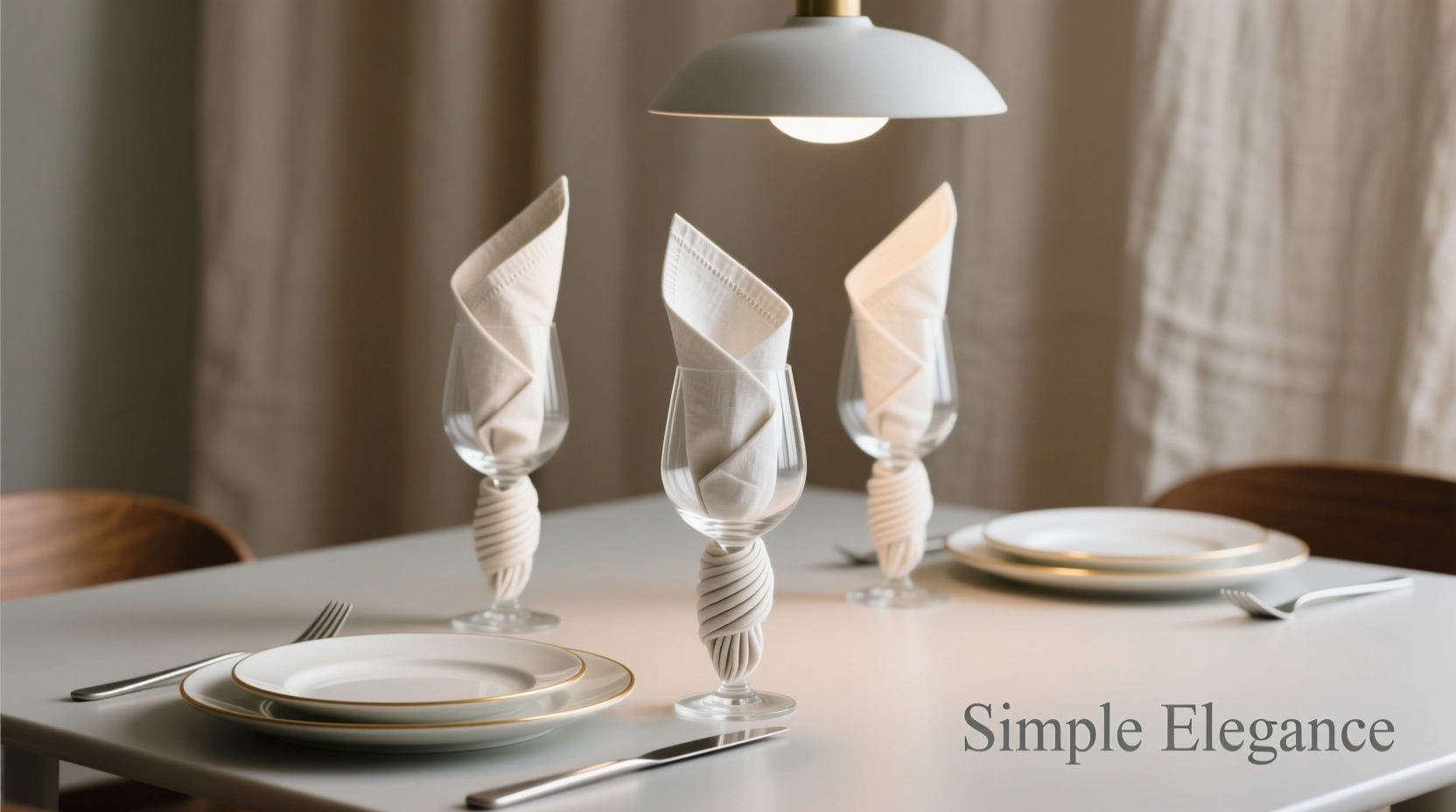
Linen isn’t merely “trendy” for minimalist tables—it’s structurally and sensorially essential. Woven from flax fibers, it possesses a unique combination of stiffness when crisp and softness when broken in, allowing it to hold folds without looking rigid or artificial. Cotton napkins slump; polyester resists creasing but lacks breathability and warmth; silk feels precious but impractical. Linen strikes the exact balance: substantial enough to stand upright when folded around a stemless glass, yet pliable enough to contour gently to the curve of the bowl.
Crucially, linen’s natural slubs (subtle irregularities in the yarn) catch light softly, adding depth without shine—aligning perfectly with minimalist principles that favor texture over gloss. Its ability to age gracefully also matters: slight wrinkles aren’t flaws here; they signal authenticity and use, reinforcing the human-centered ethos of the gathering. As textile curator and table-setting authority Anya Petrova observes:
“Minimalism in dining isn’t austerity—it’s curation. Linen napkins folded around stemless glasses work because they acknowledge the object’s form while elevating its presence through contrast: softness against hardness, organic texture against precise geometry, warmth against cool glass. It’s dialogue, not decoration.” — Anya Petrova, Curator, The Table & Thread Archive
Opt for 100% European linen (Belgian or French origin preferred) with a medium weight: 180–220 g/m². Lighter weights lack structure; heavier ones overwhelm the delicate scale of a stemless glass. Pre-wash and air-dry before first use—linen shrinks slightly and softens, ensuring your folds behave predictably and last through the evening.
The Stemless Glass Factor: Proportion, Placement, and Practicality
Stemless wine glasses vary significantly in height, bowl diameter, and base width. A successful napkin fold must respond to these variables—not impose a one-size-fits-all solution. Ignoring proportions is the most common cause of failure: a napkin that looks elegant on a 5-inch-tall glass may engulf a 4-inch tumbler or slip off a 6-inch vessel.
| Glass Height | Recommended Napkin Size (Square) | Fold Style Best Suited | Why It Works |
|---|---|---|---|
| 4.0–4.5 inches | 16 × 16 inches | Single-Point Wrap | Minimal fabric avoids bulk; single focal point echoes compact silhouette |
| 4.6–5.2 inches | 18 × 18 inches | Asymmetric Diagonal Fold | Creates vertical rhythm matching glass height; asymmetry prevents visual heaviness |
| 5.3–6.0 inches | 20 × 20 inches | Double-Loop Cradle | Extra fabric provides structural support; loops frame the bowl without obscuring it |
Note: Always measure your specific glasses—not manufacturer specs, but actual height from base to rim. Place the glass upright on your table surface and measure vertically. Also consider the rim thickness: thicker rims (common in artisanal glassware) require slightly looser folds to avoid tension-induced slipping. And never fold napkins around glasses that are chilled or damp—condensation weakens linen’s grip and invites mildew.
Tip: Test your fold with an empty glass first. If the napkin slides down within 30 seconds, it’s too loose. If the linen pulls taut and distorts the glass’s shape, it’s too tight. Aim for gentle, even contact along the lower third of the bowl.Four Refined Folding Techniques (Step-by-Step)
These methods prioritize ease, repeatability, and visual cohesion. Each takes under 45 seconds once practiced—and none require pins, glue, or hidden fasteners. They rely solely on linen’s memory and friction.
1. The Single-Point Wrap (Ideal for Compact Glasses)
- Lay the napkin flat, smooth side up. For a 16×16 inch napkin, bring two opposite corners together to form a triangle.
- With the long edge facing you, fold the right corner toward the center, aligning its tip with the triangle’s apex—creating a narrow, elongated diamond shape.
- Rotate the shape so the pointed end faces left. Gently wrap the longer left arm around the glass’s base, letting it meet the shorter right arm at the front.
- Slide the right arm behind the left, tucking its tip snugly into the small pocket formed where the arms overlap near the glass’s lower curve.
- Adjust so the single visible point rests centered on the front of the glass, 0.5 inches above the base.
2. The Asymmetric Diagonal Fold (Most Versatile)
- Start with a 18×18 inch napkin square. Fold diagonally once to form a large triangle.
- Rotate so the longest edge is horizontal. Fold the bottom right corner upward, aligning its raw edge with the top edge of the triangle—creating a trapezoid with a clean, angled front face.
- Position the glass upright at the center of the trapezoid’s long base. Lift the left and right sides simultaneously, drawing them upward and inward to meet behind the glass.
- Bring the top folded edge down over the glass’s bowl, stopping 1 inch below the rim. Tuck the raw edge neatly into the fold where the sides meet at the back.
- Fluff the front-facing diagonal edge—this is your sole visual accent. It should run from 10 o’clock to 4 o’clock on the glass.
3. The Double-Loop Cradle (For Taller, Fuller Bowls)
- Use a 20×20 inch napkin. Fold in half vertically, then in half horizontally—creating a 10×10 inch square.
- Unfold only the last horizontal fold, leaving a vertical rectangle (20×10 inches). Rotate so the long edge is horizontal.
- Starting 3 inches from the left end, make a small loop by bringing the top edge down and under itself, forming a 1.5-inch diameter circle. Pinch and hold.
- Repeat 4 inches to the right, creating a second identical loop. The remaining fabric between loops forms a gentle bridge.
- Place the glass upright so its base sits centered on the bridge. Drape the loops over the sides of the bowl, letting them settle naturally into soft U-shapes that cup the lower third of the glass.
- Adjust so both loops sit at equal height and the bridge fabric lies flat against the glass’s base.
4. The Minimalist Band (For Ultra-Modern Settings)
- Cut a 2-inch-wide strip from the selvedge edge of a pre-washed linen napkin (length: 24 inches). Hem both long edges by ¼ inch to prevent fraying.
- Wrap the band around the glass’s widest point—the equator of the bowl—overlapping ends by 0.75 inches.
- Secure with a single, nearly invisible stitch using thread matching the linen. Or, for true zero-sew elegance, use a tiny dot of food-safe, water-soluble adhesive applied only to the underside of the overlap.
- Ensure the band sits level and lies completely flat—no twisting or ruffling.
Real-World Execution: A Case Study from Portland
In March 2024, event designer Lena Cho hosted a 12-person spring dinner for local ceramicists and chefs. The brief: “Warm minimalism—no white-on-white, no floral, nothing that distracts from the handmade tableware.” Her stemless glasses were custom-blown, varying from 4.3 to 5.7 inches tall, with uneven bases and thick, tactile rims. Initial tests with standard 18×18 napkins failed—slipping, bunching, or looking like afterthoughts.
Cho adopted a hybrid approach: she measured each glass individually, grouped them by height, and assigned folds accordingly. The 4.3-inch tumblers received the Single-Point Wrap in oat-colored linen; the 5.1-inch bowls got the Asymmetric Diagonal in charcoal; the 5.7-inch vessels used the Double-Loop Cradle in undyed natural linen. She pre-folded all napkins 90 minutes before guests arrived, storing them upright in shallow cardboard trays lined with parchment—never stacked or compressed. At service, staff placed each pre-folded napkin-glass unit directly onto the charger plate with one motion.
The result? Guests consistently remarked on the “quiet confidence” of the table. No one asked how the napkins stayed put—they simply registered harmony. As one guest, potter Marcus Bell, noted afterward: “It felt like the napkins belonged to the glasses, not the other way around. Like they’d grown together.”
Essential Do’s and Don’ts
- Do iron napkins immediately after drying—while still slightly damp—for sharpest creases. Use medium heat and steam sparingly.
- Do fold napkins no more than 2 hours before service. Linen relaxes over time; freshness ensures optimal grip.
- Do group glasses by exact height before folding—differences of 0.2 inches affect stability.
- Don’t use starch. It creates artificial rigidity, causes cracking at folds, and attracts dust.
- Don’t fold over chilled glasses—even if dry. Temperature differential makes linen brittle and less pliable.
- Don’t mix fold styles on the same table unless intentionally contrasting for design narrative (e.g., host’s setting vs. guest settings).
FAQ
Can I use these folds with colored or patterned linen?
Yes—but with discipline. Solid, tonal colors (oat, slate, moss, terracotta) reinforce minimalism. Avoid busy prints or high-contrast patterns; they fracture visual calm. If using a subtle tone-on-tone weave (e.g., heathered grey), ensure the fold highlights texture—not motif. A bold stripe across the fold line will read as chaotic, not intentional.
How do I clean and store folded napkins between uses?
After use, rinse any stains immediately in cold water. Machine wash on gentle cycle with pH-neutral detergent—never bleach or fabric softener. Tumble dry on low until 80% dry, then finish with a steam iron on linen setting. Store folded napkins flat in a breathable cotton drawer liner, not plastic bins. Never hang folded napkins—they lose structural memory.
What if my guests need to remove the napkin mid-meal? Will it look messy?
A well-executed fold releases cleanly. The Single-Point and Asymmetric Diagonal unfold with one smooth motion, falling into a graceful drape beside the plate. The Double-Loop Cradle loosens naturally as the glass is lifted, leaving the napkin resting flat. The Minimalist Band detaches with a gentle tug. Practice removal during setup to confirm ease. If a fold resists or leaves creases on the glass, tighten or loosen the initial tension.
Conclusion: Where Simplicity Meets Intention
Folding linen napkins around stemless wine glasses isn’t a party trick—it’s an act of hospitality grounded in observation and respect. It asks you to notice the weight of the glass in your hand, the grain of the linen under your fingers, the way light falls across an unadorned surface. It rejects excess not out of scarcity, but out of abundance: abundance of attention, of care, of belief that beauty resides in honest function and quiet alignment.
Start small. Choose one glass from your collection. Wash and press one napkin. Try the Single-Point Wrap. Time yourself. Adjust. Repeat. Notice how the fabric behaves differently on Tuesday versus Thursday—humidity, temperature, even your own energy alter the outcome. That’s the point. Minimalism isn’t perfection; it’s presence. When your next dinner party arrives, your guests won’t analyze the fold—they’ll feel the calm it generates. They’ll sip their wine, set the glass down, and find the napkin exactly where it needs to be: supporting, not asserting; framing, not filling; there, but never in the way.
💬 Your turn. Fold one napkin today—not for guests, but for yourself. Then share your first attempt, your biggest insight, or your favorite linen source in the comments. Let’s build a quieter, more thoughtful table—together.