
Moissanite has emerged as one of the most compelling alternatives to diamond in modern engagement rings and fine jewelry. Known for its brilliance, durability, and affordability, it’s no surprise that brands like Gra Moissanite have gained popularity. But as consumers navigate options, a critical question arises: Is paying extra for a certified stone truly worth it? With non-certified moissanite often priced significantly lower, the decision isn’t always straightforward. This article breaks down the real differences between certified and non-certified Gra Moissanite, evaluates the value of certification, and helps you make an informed choice based on transparency, quality assurance, and long-term investment.
Understanding Moissanite Certification
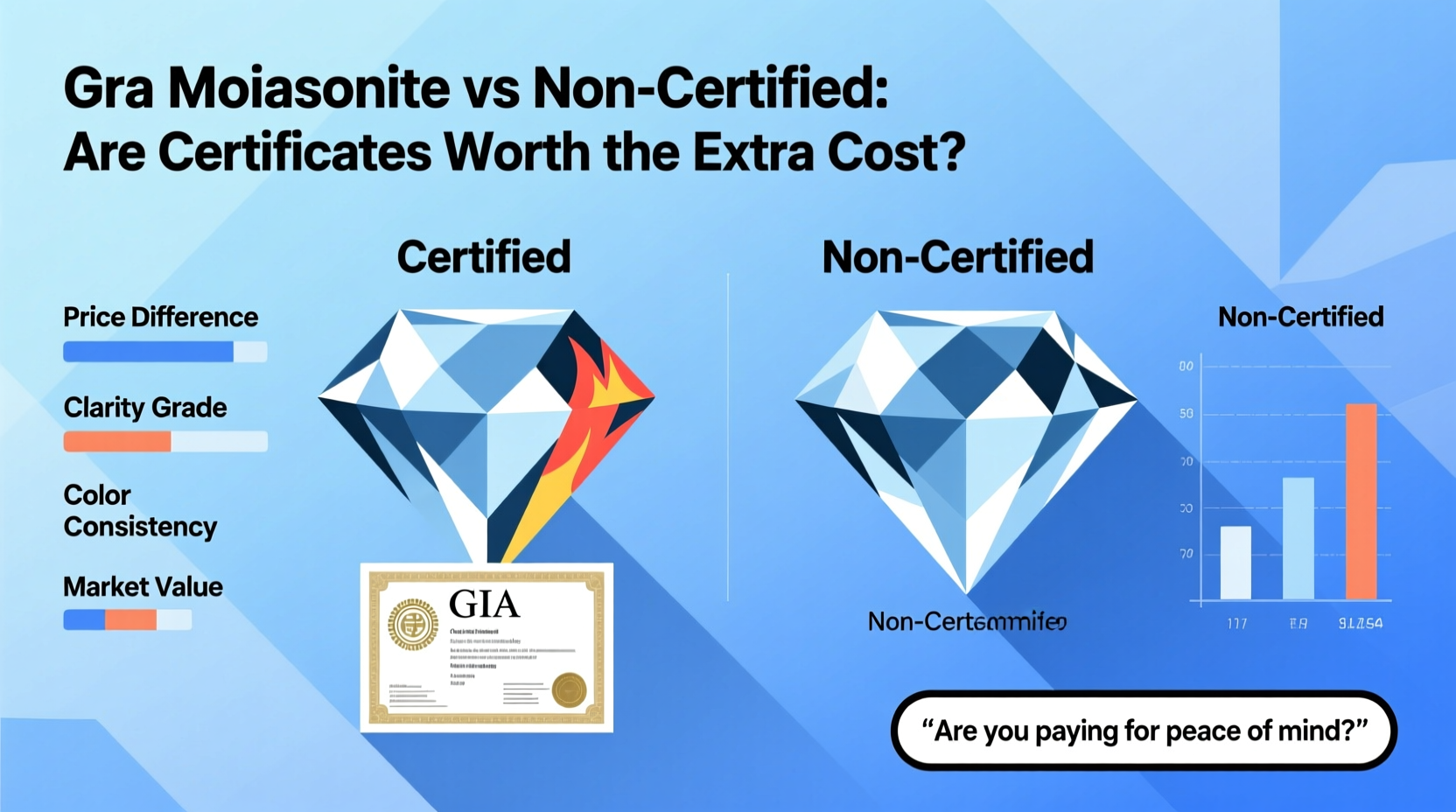
Certification in gemstones—whether diamonds or moissanite—serves as an independent evaluation of key characteristics such as cut, color, clarity, carat weight, and optical performance. For moissanite, certifications are typically issued by third-party labs like GCAL (Gem Certification & Assurance Lab), which specialize in testing lab-created gems. These reports offer detailed insights into the stone’s specifications and authenticity.
Gra Moissanite, known for its high-quality cuts and proprietary “superior brilliance” technology, often provides GCAL certification with select stones. However, not all Gra Moissanite products come with this documentation. The absence of certification doesn't necessarily mean a stone is low quality, but it does remove an objective layer of verification.
“Certification removes guesswork. When you’re investing hundreds—or even thousands—in a center stone, having a verified report gives peace of mind and protects against misrepresentation.” — Dr. Lena Patel, Gemologist and Lab-Grown Diamond Analyst
Key Differences: Certified vs Non-Certified Gra Moissanite
The primary distinction lies in verification, transparency, and resale value. Let’s examine the core aspects:
- Quality Assurance: Certified stones undergo rigorous testing for optical symmetry, refractive index, and fire dispersion. Non-certified stones may perform well, but there’s no standardized proof.
- Transparency: A certificate lists exact measurements, proportions, and any detectable inclusions. Without it, buyers rely solely on vendor descriptions.
- Pricing: Certified Gra Moissanite can cost 15–30% more than comparable non-certified versions due to lab fees and perceived value.
- Resale & Insurance: Insurers and jewelers often require certification to appraise or accept a stone for trade-in.
Comparison Table: Certified vs Non-Certified Gra Moissanite
| Feature | Certified Gra Moissanite | Non-Certified Gra Moissanite |
|---|---|---|
| Independent Quality Verification | Yes (via GCAL or similar) | No |
| Detailed Cut & Proportion Data | Full report available | Limited or vendor-reported only |
| Color Grade Accuracy | Lab-measured (e.g., D-E-F, G-H-I) | Based on visual comparison |
| Clarity Confirmation | Microscopic evaluation included | Assumed flawless unless stated |
| Insurance Acceptance | Widely accepted | May require additional appraisal |
| Resale Value | Higher, with documented proof | Lower; harder to verify claims |
| Average Price Premium | +15% to +30% | None |
When Certification Matters Most
Not every buyer needs a certified stone. The value of certification depends heavily on context. Here are scenarios where opting for a certified Gra Moissanite is strongly advised:
- You're making a significant investment – If your moissanite is 1 carat or larger, spending extra for certification ensures you’re getting what you pay for.
- You plan to insure the piece – Most insurers require third-party documentation to issue a policy above a certain value threshold.
- Future resale or upgrade is likely – Certified stones retain value better and are easier to authenticate in the secondhand market.
- You prioritize precision and performance – GCAL-certified stones often include optical symmetry reports, which correlate directly with light return and scintillation.
In contrast, non-certified stones may be perfectly suitable for fashion jewelry, smaller accent stones, or when budget constraints are tight and trust in the vendor is high.
Mini Case Study: Sarah’s Engagement Ring Decision
Sarah was choosing between two nearly identical 1.2-carat Gra Moissanite solitaire rings. One was $895 with GCAL certification; the other was $720 without. Both vendors had strong reviews, but only the certified option came with a full grading report showing ideal crown angles and zero blemishes under 10x magnification.
She chose the certified ring. Two years later, when upgrading to a larger setting, a local jeweler offered her $520 as trade-in credit—nearly 60% of the original price. The non-certified version from another customer was offered just $300 due to lack of verifiable specs. Sarah’s certification didn’t just validate quality—it preserved financial value.
Step-by-Step Guide: Evaluating Whether to Pay for Certification
Follow this process to determine if certification is worth the added cost for your situation:
- Define your budget – Decide how much you’re willing to spend on the center stone alone.
- Determine the stone size – Stones over 0.75 carats benefit more from certification.
- Check vendor reputation – Reputable sellers may offer consistent quality even without certification.
- Ask about lab details – Confirm if certification is from GCAL or another recognized body, not an in-house label.
- Review the report scope – Ensure it includes cut precision, color grade, and optical symmetry—not just carat weight.
- Consider future plans – Will you insure it? Might you resell? If yes, certification pays for itself over time.
- Compare total value – Factor in long-term benefits, not just upfront savings.
Frequently Asked Questions
Does all Gra Moissanite come with a certificate?
No. Gra Moissanite offers both certified and non-certified stones. Certification is usually optional and tied to higher-tier models or larger carat weights. Always confirm before purchase.
Can I get a non-certified stone graded later?
Yes, but it can cost $100–$200 and may not be feasible for mounted stones. Removal risks damage, and some labs won’t grade already-set moissanite. It’s better to buy certified if long-term verification is important.
Is non-certified moissanite lower quality?
Not inherently. Many non-certified stones are visually indistinguishable from certified ones. However, without testing, there’s no guarantee of optical precision or color consistency—especially across batches.
Final Checklist Before Buying
- ✅ Confirm whether the listing includes a GCAL or equivalent certificate
- ✅ Review the full certification report online before purchasing
- ✅ Verify the certificate number matches the physical report
- ✅ Compare prices of certified vs non-certified options from trusted vendors
- ✅ Consider insurance requirements for your region
- ✅ Assess your long-term intentions: keep, pass down, or resell?
Conclusion: Making the Smart Choice
The question isn’t whether certification is “worth it” in absolute terms—it’s whether it aligns with your priorities. For those seeking assurance, transparency, and lasting value, certified Gra Moissanite justifies the premium. It transforms a beautiful stone into a documented asset. For budget-conscious buyers focused on aesthetics rather than appraisal, a non-certified option from a reputable source can still deliver stunning results.
The key is intentionality. Don’t assume certification is marketing fluff, nor should you treat it as mandatory for every purchase. Evaluate your needs, do your research, and choose accordingly. In the world of moissanite, knowledge isn’t just power—it’s sparkle, security, and smart value.
💬 Have experience with certified or non-certified moissanite? Share your story in the comments to help others weigh their options with real-world insights.








