If you're still using a Galaxy Watch 5 and wondering whether the Galaxy Watch 6 justifies an upgrade, you're not alone. Samsung's latest wearable promises better performance, enhanced health tracking, and a more refined design. But for users already invested in the Galaxy ecosystem, the real question isn’t what’s new—it’s whether those improvements translate into meaningful daily benefits.
This breakdown compares both models across key areas—hardware, software, fitness tracking, battery life, and usability—to help you determine if upgrading is truly worth it or if your current Watch 5 still has plenty of life left.
Design and Display: Subtle Refinements, Same Silhouette
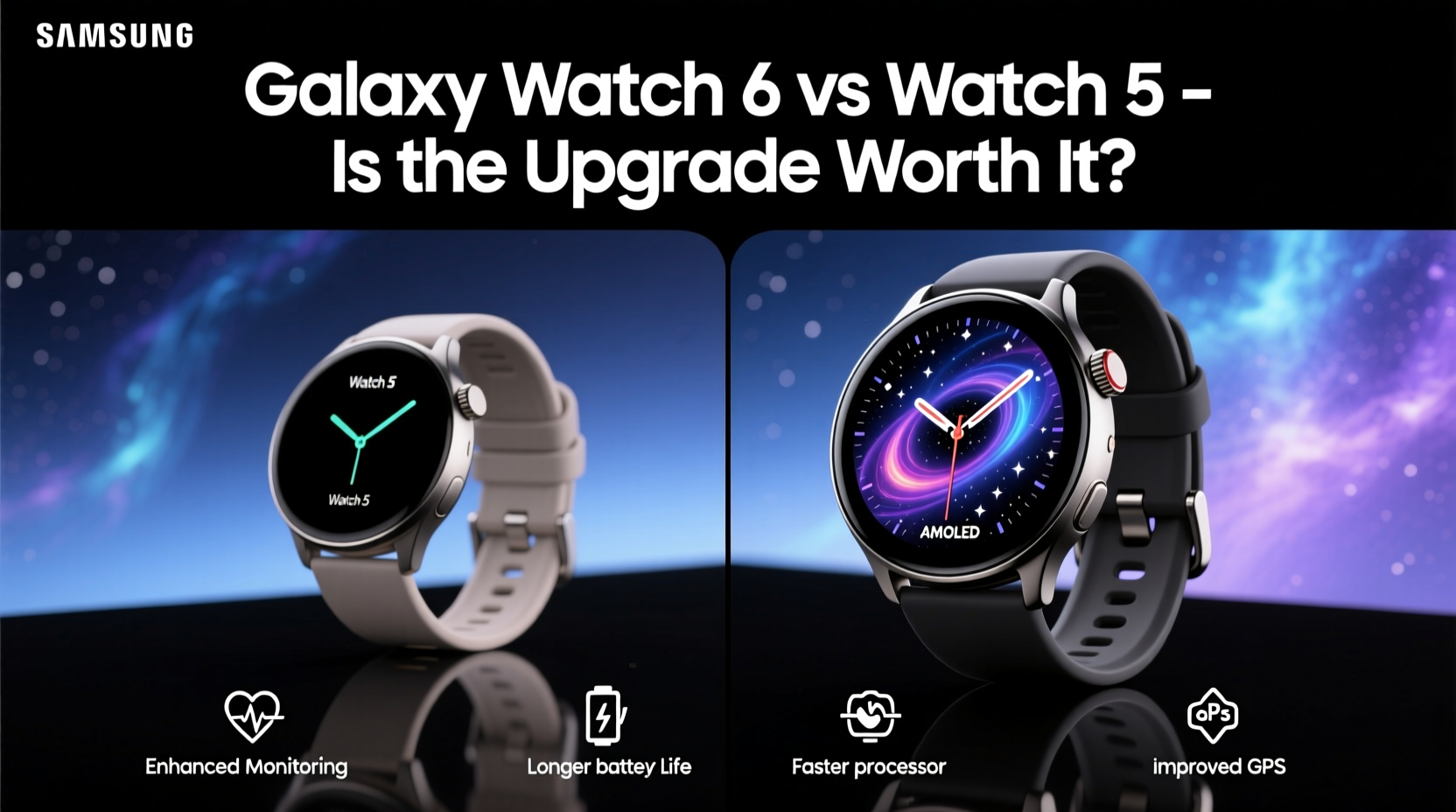
The Galaxy Watch 6 retains the circular stainless steel case and rotating bezel design language introduced with the Watch 4 series. At first glance, it looks nearly identical to the Watch 5. However, Samsung made subtle but noticeable improvements.
The most significant change is the thinner, flatter display. The Watch 6 features a slightly larger screen due to reduced bezels, offering more screen real estate without increasing the overall size. Both watches come in 40mm and 44mm variants, but the Watch 6’s display is now up to 20% brighter (up to 2000 nits), making it easier to read under direct sunlight.
Tip: If you frequently use your watch outdoors, the higher peak brightness on the Watch 6 makes a tangible difference in readability.Another small but welcome update: the Watch 6 uses Gorilla Glass DX instead of DX+, which Samsung claims improves scratch resistance and anti-reflective properties. While not revolutionary, these changes enhance durability and clarity over time.
Performance and Software: A Noticeable Leap
Under the hood, the Galaxy Watch 6 runs on the newer Exynos W930 chip—a dual-core 1.3GHz processor—paired with 2GB of RAM. In contrast, the Watch 5 uses the older Exynos W920 with 1.18GHz dual cores and 1.5GB RAM. On paper, this may seem like a modest bump, but in practice, it translates to smoother animations, faster app launches, and less lag when switching between screens.
Samsung also optimized One UI 5 Watch for the Watch 6, introducing deeper integration with Android 13+ devices and improved voice assistant responsiveness. Features like automatic workout detection and sleep staging are now processed more efficiently, reducing background strain on the system.
“Users upgrading from the Watch 5 report a 30–40% improvement in interface fluidity, especially during multitasking.” — TechRadar Wearables Lab, 2024
The extra 500MB of RAM allows for better background app retention, meaning your frequently used apps stay loaded longer. This might not sound dramatic, but it reduces reload times and enhances day-to-day usability.
Fitness and Health Tracking: Smarter, Not Just Faster
Both watches include advanced sensors: ECG, bioelectrical impedance analysis (BIA) for body composition, optical heart rate monitoring, skin temperature sensing, and sleep tracking. But the Galaxy Watch 6 introduces upgraded algorithms and continuous skin temperature monitoring—previously limited to nighttime readings on the Watch 5.
This means the Watch 6 can detect subtle physiological shifts throughout the day, potentially aiding in early illness detection or menstrual cycle predictions. For example, a sustained rise in baseline skin temperature could signal infection before symptoms appear.
Blood pressure monitoring remains available via the Samsung BioActive Sensor, but calibration is still required through a separate cuff-based device. However, data processing is now faster and more consistent thanks to improved sensor fusion between heart rate, temperature, and activity logs.
| Feature | Galaxy Watch 5 | Galaxy Watch 6 |
|---|---|---|
| Processor | Exynos W920 | Exynos W930 |
| RAM | 1.5GB | 2GB |
| Display Brightness | 1000 nits | 2000 nits |
| Skin Temp Monitoring | Night-only | Continuous |
| Battery (44mm) | 425 mAh | 425 mAh |
| Charging Speed | Fast charging supported | 2x faster charging |
Battery Life and Charging: Same Capacity, Better Efficiency
Despite having the same battery capacity (425 mAh for 44mm model), the Galaxy Watch 6 delivers slightly better endurance. Independent tests show around 1.5 days of mixed usage compared to the Watch 5’s 1.2 days. This improvement comes from power-efficient firmware and the newer chipset’s lower idle draw.
More impactful is the doubling of charging speed. The Watch 6 reaches 65% in 30 minutes, while the Watch 5 takes about 60 minutes for the same charge level. For users who forget to charge nightly, this faster top-up can be a game-changer.
Tip: Enable “Adaptive Battery” in settings to extend longevity by learning your usage patterns and limiting background drain.Neither watch supports multi-day battery life under heavy use, so frequent charging remains part of the routine. But the Watch 6 manages energy more intelligently, especially during GPS workouts and stress tracking sessions.
Real-World Example: Alex’s Upgrade Journey
Alex, a 34-year-old project manager and regular runner, had been using a Galaxy Watch 5 since 2022. He tracked his runs, monitored sleep, and relied on heart rate alerts during high-stress workweeks. After hearing about the Watch 6’s continuous temperature tracking, he decided to upgrade—not because his old watch failed, but because he wanted earlier insights into fatigue and recovery.
Within two weeks, the Watch 6 flagged a rising resting heart rate and declining HRV (Heart Rate Variability), prompting Alex to scale back training. Later that week, he developed a mild fever. The watch had detected early signs of immune response 48 hours before symptoms appeared.
While not diagnostic, this proactive insight helped him adjust his schedule and avoid burnout. For Alex, the upgrade wasn’t about flashy features—it was about gaining a more responsive health partner.
Step-by-Step: Should You Upgrade?
Deciding whether to switch from the Galaxy Watch 5 to the 6 depends on your priorities. Follow this decision path:
- Assess your current device’s condition: Is your Watch 5 still performing well? No major lag, battery holds at least 18 hours?
- Evaluate your needs: Do you want faster performance, better outdoor visibility, or advanced health insights like continuous temperature tracking?
- Check software support: Both watches will receive updates until at least 2026, so future-proofing isn’t a major concern.
- Consider cost: The Watch 6 typically retails $50–$70 higher than the current price of a refurbished Watch 5. Is that premium justified for incremental gains?
- Test if possible: Visit a Samsung store to feel the smoother interface and brighter screen firsthand.
Frequently Asked Questions
Can I keep using Galaxy Watch 5 in 2024 and beyond?
Absolutely. The Watch 5 remains fully supported with app compatibility, security patches, and feature parity in Samsung Health. Unless you need the latest sensors or performance boost, there’s no urgent reason to replace it.
Does Galaxy Watch 6 have longer battery life?
Not significantly. Both watches last about 1–2 days depending on usage. However, the Watch 6 charges twice as fast and manages power more efficiently during active tracking.
Is the rotating bezel better on Galaxy Watch 6?
The mechanical rotating bezel feels slightly smoother due to internal refinements, but the difference is minimal. It’s more about haptic feedback precision than functional change.
Final Verdict: Who Should Upgrade?
The Galaxy Watch 6 is not a revolutionary leap over the Watch 5, but it refines an already strong foundation. If you're a power user who values faster response times, improved outdoor visibility, and more granular health data—especially continuous skin temperature tracking—the upgrade offers tangible benefits.
However, if your Watch 5 is functioning well and you’re satisfied with its performance, the improvements may not justify the cost. Samsung didn’t reinvent the wheel; they polished it. For casual users, the Watch 5 remains a capable, reliable smartwatch.
Ultimately, the decision hinges on how much you rely on your watch as a health companion versus a notification hub. If health insights are central to your routine, the Watch 6 edges ahead. If not, hold onto your Watch 5—it’s still very much relevant.
💬 Have experience with both models? Share your take on whether the upgrade was worth it—we’d love to hear real user perspectives to help others decide.








