
Cartier is synonymous with timeless elegance, precision craftsmanship, and luxury status. From the iconic Santos to the elegant Tank and Ballon Bleu, a genuine Cartier timepiece is not just a watch—it’s a legacy. But with counterfeits becoming increasingly sophisticated, buyers must be vigilant. This guide delivers advanced, field-tested techniques to verify authenticity beyond surface-level checks. Whether you're purchasing pre-owned, inheriting a piece, or simply verifying ownership, these expert insights will protect your investment.
Analyze the Serial and Model Numbers with Precision
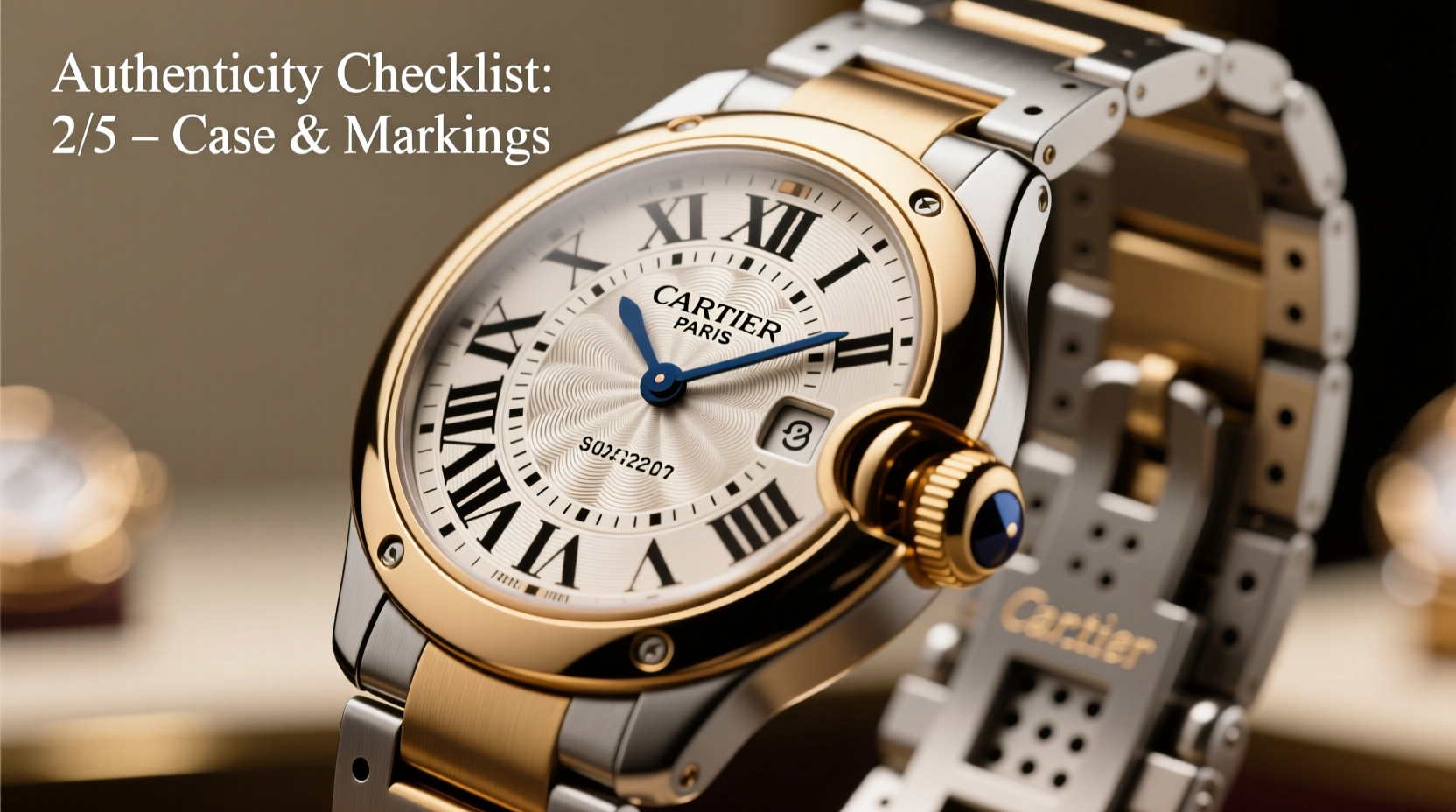
Every authentic Cartier watch has a unique serial number and model reference, typically engraved between the lugs at 6 o’clock. These numbers are critical for verification but often misread or misrepresented by counterfeiters.
Genuine Cartier serial numbers follow a specific format: six digits without letters, starting with “N” followed by five numerals (e.g., N123456). The model number, such as W2002857 for a Ballon Bleu, should match official Cartier databases. However, note that Cartier does not offer public online verification—only authorized dealers or boutiques can access internal systems.
Tip: Use a loupe to examine the engraving depth and clarity. Authentic numbers are deeply and cleanly laser-engraved; fake engravings often appear shallow, smudged, or too perfect.Avoid relying solely on third-party websites claiming to “decode” Cartier serials—many are outdated or inaccurate. Instead, bring the watch to an authorized service center for confirmation.
Inspect the Hallmarks and Stamps on Case Back
The case back holds vital clues. Genuine Cartier watches display precise hallmarks depending on the metal type. For example:
- Platinum models carry a “Pt950” stamp and a crab hallmark.
- 18k gold pieces are marked “750” and feature a dog’s head symbol.
- Stainless steel models may have “S” or “A” stamps near the serial.
These marks are micro-engraved with extreme precision. Counterfeits often place them incorrectly, use wrong fonts, or omit them entirely. Also, look for the “Swiss Made” inscription at the 6 o’clock position on the dial. On real Cartiers, it's discreetly printed in a serif font—never bold, oversized, or misaligned.
“More than half the fake Cartiers we see fail at hallmark accuracy. The stamps are either missing, misplaced, or lack depth.” — Antoine Morel, Senior Watch Authenticator, Geneva Time Bureau
Examine Movement and Functionality Like a Pro
While Cartier uses both in-house and modified Swiss movements (like ETA bases), the finishing and performance are unmistakable. Open-case-back models allow visual inspection, but even closed backs reveal clues through function.
First, check the second hand. On a genuine mechanical Cartier, it glides smoothly with minimal stutter. Quartz models tick once per second with crisp precision. Fakes often exhibit jittery motion due to low-grade movements.
Second, test crown operation. Authentic Cartier crowns screw down firmly (if applicable) and adjust time/date with refined resistance. Counterfeits frequently feel loose, gritty, or overly tight.
| Feature | Authentic Cartier | Common Fake Trait |
|---|---|---|
| Movement Finish | Perlage, Geneva stripes, engraved rotor | Bare, unadorned, generic rotor |
| Crown Engraving | Precise blue sapphire or cabochon set flush | Loose stone, off-center, plastic-like |
| Date Window Edge | Sharp, polished aperture with no halo | Fuzzy edge, light bleed around numeral |
| Hands Alignment | Perfect symmetry; hands meet at center | Off-center alignment, uneven gaps |
Verify Dial and Logo Details Under Magnification
The dial is where fakes most often falter. Start with the Cartier logo: it should be sharply printed with consistent letter spacing. The “C” and “R” have distinct curves—replicas frequently flatten or distort them.
Hour markers on models like the Tank Must or Santos are perfectly aligned and evenly filled. Roman numerals are elegantly proportioned. On the Ballon Bleu, the date window sits directly beneath the numeral “VI” and aligns precisely with the minute track.
Also inspect the printing quality. Genuine dials use multiple layers of lacquer and ink. Run a fingernail gently across the surface—if you feel raised text, it’s likely a fake. Authentic printing lies flush within the dial.
Tip: Shine a focused light at an angle. Real enamel dials reflect depth and subtle texture; counterfeit dials often look flat or glossy.Follow a Step-by-Step Authentication Checklist
Before finalizing a purchase or accepting a gift, conduct this systematic inspection:
- Check the box and papers: Original warranty card includes dealer stamp, date, and matching serial. No generic paperwork.
- Inspect case shape and finish: Edges are sharp, brushing and polishing are consistent. No tool marks or uneven lines.
- Test weight: Genuine precious metals feel substantial. A lightweight “gold” watch is almost certainly plated.
- Verify lug spacing and bracelet fit: Links align perfectly with lugs. Gaps or misalignment signal a replica bracelet.
- Observe lume behavior: Only some models have luminous hands. If present, it glows softly green—not bright white or blue.
- Listen to the movement: Mechanical ticks are quiet and even. Loud ticking or grinding sounds indicate poor mechanics.
- Consult an expert: When in doubt, schedule an appointment with a Cartier boutique or certified horologist.
Real Example: The Overpriced Replica That Fooled a Collector
Mark, a seasoned collector in London, purchased a “pre-owned” Cartier Pasha online for €6,000—below retail but with full box and papers. At first glance, everything seemed correct. The serial matched, the box was pristine, and the seller had glowing reviews.
However, upon taking it to a Cartier service center for battery replacement, the technician immediately flagged inconsistencies: the hallmarks were stamped too deeply, the movement was a generic Chinese quartz, and the crown wobbled slightly. Further investigation revealed the papers were forged using stolen dealer letterhead.
Mark lost nearly two years of research and trust. His mistake? Skipping an in-person inspection at an authorized location. This case underscores why documentation alone isn’t enough—even convincing ones can be faked.
Frequently Asked Questions
Can I verify a Cartier watch using only photos?
No. While high-resolution images can reveal obvious flaws (e.g., logo distortion, blurry printing), they cannot confirm engraving depth, material composition, or movement authenticity. Tactile and microscopic examination is essential.
Do all Cartier watches have a certificate of authenticity?
New watches come with a warranty card signed by the retailer, which serves as proof of authenticity. However, Cartier does not issue standalone certificates. Pre-owned pieces may lack papers—this doesn’t mean they’re fake, but verification becomes harder.
Is it safe to buy a Cartier watch from online marketplaces?
Proceed with caution. Platforms like Chrono24 offer buyer protection and authentication services, but many sellers operate outside official channels. Always request detailed photos, verify the serial number with a boutique beforehand if possible, and insist on third-party verification before payment.
Final Thoughts: Confidence Comes from Knowledge
Identifying a genuine Cartier watch goes beyond logos and price tags. It requires attention to metallurgy, typography, engineering, and provenance. The details matter—the depth of an engraving, the rhythm of a second hand, the placement of a hallmark. These are the silent signatures of authenticity.
Armed with these expert strategies, you’re no longer just buying a watch—you’re preserving a standard of excellence. Whether you're adding to your collection or passing down a family heirloom, take the time to verify, question, and learn. True luxury deserves nothing less.
💬 Have a Cartier watch you'd like help authenticating? Share your experience or questions in the comments—our community of collectors and experts is here to assist.