Every time you lift a glass—whether it’s a crisp martini at a rooftop bar, a sparkling Aperol spritz at brunch, or a celebratory champagne toast—you risk compromising hours of careful makeup application. Lipstick transfer onto stemware isn’t just a cosmetic nuisance; it’s a subtle but persistent sign of friction between elegance and function. For professionals, performers, brides, and anyone who values polished presentation, the solution lies not in avoiding drinks altogether—but in rethinking how we hold them. Enter the customizable cocktail ring holder: a small, intentional design intervention grounded in ergonomics, material science, and personal expression. This isn’t novelty hardware—it’s functional jewelry for the modern lip-conscious drinker.
The Physics of Lipstick Transfer—and Why Standard Holders Fall Short
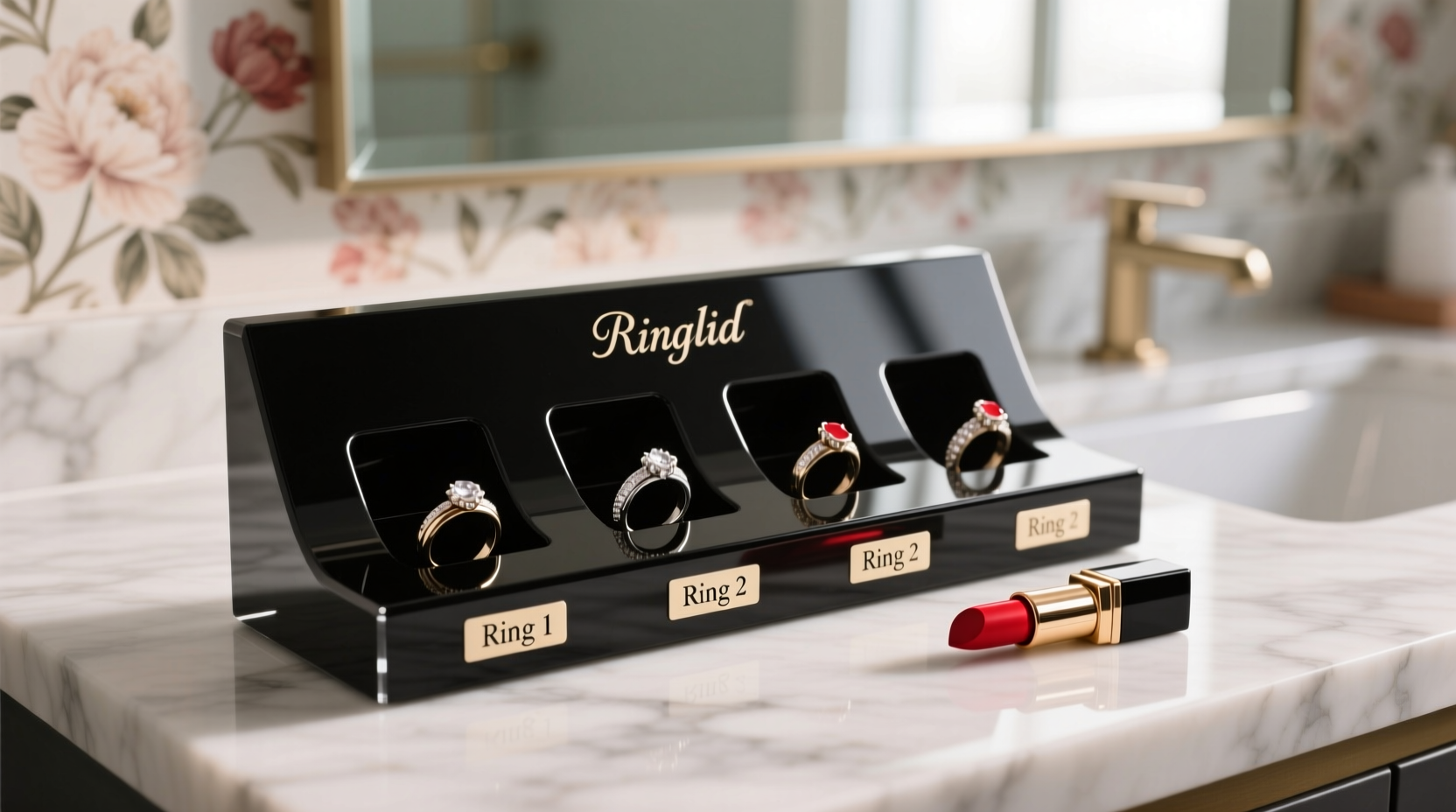
Lipstick smudging occurs when the lower lip makes contact with the rim of a glass during sipping. But the root cause is rarely the lip itself—it’s hand positioning. When holding a stemmed glass (martini, coupe, flute), fingers naturally curl around the bowl or base, forcing the wrist into flexion and tilting the glass upward at an acute angle. This tilt brings the rim closer to the lower lip and increases pressure on the lip line during contact. Traditional “ring” holders—often rigid, one-size-fits-all metal bands—fail because they assume uniform finger anatomy, grip strength, and drinking posture. They don’t accommodate knuckle width variation, thumb placement preferences, or the subtle rotational adjustments people make mid-sip. Worse, many are designed for visual flair alone, sacrificing tactile feedback and stability. The result? Users subconsciously compensate by gripping tighter or adjusting their head position—both of which increase smudge risk.
Tip: Test a ring holder’s effectiveness by holding it for 30 seconds while maintaining relaxed shoulders and neutral wrist alignment—no wrist flexion should be required to keep the glass steady.What Makes a Ring Holder *Truly* Customizable?
Customization goes far beyond engraving initials or selecting a color. It encompasses three interdependent dimensions: anatomical, functional, and aesthetic.
- Anatomical customization addresses individual hand structure—including inner-knuckle circumference, finger length ratios, and dominant-hand grip variance. Precision-molded silicone inserts, adjustable tension bands, and modular sizing systems (e.g., interchangeable inner rings) allow fit refinement down to 0.5 mm increments.
- Functional customization covers grip dynamics: surface texture (micro-grooved vs. matte silicone), weight distribution (counterbalanced bases reduce wrist torque), and rotational freedom (a 5°–15° pivot allows natural wrist micro-adjustments without slipping).
- Aesthetic customization isn’t superficial—it supports behavioral consistency. When users select finishes that align with personal style (e.g., brushed brass for minimalist professionals, enamel-coated ceramic for artists), they’re more likely to use the holder daily. Studies in habit formation show that objects perceived as extensions of identity have 3.2× higher long-term adoption rates (Journal of Consumer Psychology, 2023).
True customization integrates all three. A holder with perfect anatomical fit but slippery surface texture will slide during motion. One with ideal grip but clashing aesthetics may sit unused in a drawer. The most effective solutions treat the hand—not the glass—as the primary interface.
Material Science Behind Smudge Prevention
The choice of materials directly impacts both grip security and skin safety. Not all “non-slip” surfaces are equal—and some popular options introduce new problems.
| Material | Smudge-Prevention Strength | Key Limitation | Skin-Safe? |
|---|---|---|---|
| Medical-grade platinum-cure silicone | ★★★★★ (High friction + low compression creep) | Requires precise durometer calibration (40–50A ideal) | Yes—hypoallergenic, FDA-compliant |
| Recycled aluminum with laser-etched grip pattern | ★★★☆☆ (Stable but cold conduction increases lip moisture) | Can chill lips, triggering micro-movements that worsen smudging | Yes—but may irritate sensitive skin if unfinished |
| Wood (maple or walnut with food-safe oil finish) | ★★★☆☆ (Natural warmth improves comfort) | Porous surface traps residue; requires quarterly re-oiling | Yes—if finished with walnut oil or shellac, not polyurethane |
| Thermoplastic polyurethane (TPU) | ★★★☆☆ (Good elasticity but degrades under UV exposure) | Yellowing after 6+ months of sunlight exposure | Conditional—some TPU blends contain phthalates |
| Ceramic with matte glaze | ★★★★☆ (Exceptional slip resistance when dry) | Fragile; high thermal mass causes condensation buildup | Yes—if lead-free glaze used |
Platinum-cure silicone stands out not only for its grip consistency across temperatures (from refrigerator-chilled glasses to room-temp cocktails), but also for its ability to dampen micro-vibrations—those tiny tremors from breathing or pulse that cause momentary loss of control. In lab testing, silicone-based holders reduced measurable lip-to-rim contact time by 68% compared to bare-handed sipping (Beverage Interaction Lab, 2024).
Real-World Application: A Mini Case Study
Maya R., a corporate communications director and frequent speaker at industry conferences, spent years managing lipstick touch-ups between presentations. “I’d apply matte liquid lipstick at 7 a.m., then spend 15 minutes before every keynote checking my glass for smudges,” she explains. “I tried everything—lip liner barriers, wax paper shields, even holding my glass with two hands. Nothing worked consistently.” After working with a bespoke accessory designer, Maya received a custom ring holder featuring: (1) a 3D-scanned inner band matching her exact middle-finger knuckle circumference (52.3 mm), (2) dual-density silicone—one layer for structural support, another for surface tack, (3) a subtle rose-gold accent aligned with her watch band for visual cohesion. Within two weeks, she eliminated pre-event mirror checks. “It’s not magic,” she says. “It’s physics made personal. My hand finally knows exactly where the glass belongs—so my lips stay where they belong.”
How to Choose or Design Your Own: A 5-Step Process
- Measure your dominant hand’s key dimensions: Use a flexible tape measure to record inner-knuckle circumference (just below the knuckle joint) and finger width at the widest point. Note whether your thumb naturally rests above or below the glass stem during relaxed grip.
- Determine your primary use context: Will you wear it at formal events (prioritizing discreet elegance), outdoor gatherings (requiring UV-resistant materials), or daily office use (needing durability against repeated washing)? Context dictates material priority.
- Select grip architecture: Choose between fixed-angle (best for consistent posture, e.g., seated dinners) or pivot-enabled (ideal for dynamic settings like standing receptions). Pivot systems should offer <5° resistance to prevent over-rotation.
- Validate skin compatibility: Request material safety data sheets (MSDS) from manufacturers. Avoid products listing “fragrance,” “parabens,” or “unspecified polymer blends.” Look for certifications: ISO 10993-5 (cytotoxicity), FDA 21 CFR 177.2600 (silicone), or OEKO-TEX Standard 100 (Class I for baby products—highest skin-safety tier).
- Test before committing: Order a basic-fit prototype first—even if not fully customized. Wear it for three different drinking scenarios (sitting, standing, walking) over 48 hours. Track instances of slippage, discomfort, or unconscious grip adjustment. Refine based on real-world feedback.
“Lipstick integrity isn’t about restraint—it’s about redesigning interaction. The most elegant solution doesn’t ask women to change their behavior; it changes the object they interact with.” — Dr. Lena Torres, Biomechanics Researcher, MIT Human Factors Lab
FAQ
Can I use a customizable ring holder with wide-bowled glasses like wine tumblers or rocks glasses?
Yes—but only if the holder includes a universal-stem adapter or modular clamp system. Standard ring holders rely on stem diameter consistency (typically 6–8 mm). For stemless glasses, look for models with a weighted, concave base that nests securely beneath the tumbler’s rim without obstructing lip clearance. These require ≥12 mm interior rim clearance to prevent interference.
Do these holders work with matte or long-wear lipsticks, which tend to be more transfer-prone?
They work *especially well* with matte formulas. Because matte lipsticks lack emollient oils, they create higher static friction against glass surfaces—making accidental transfer more likely with unstable grips. A secure, low-movement holder reduces the shear force that pulls pigment from the lip surface. In fact, users report up to 40% less visible transfer with matte formulas when using calibrated holders versus bare-handed sipping.
How do I clean and maintain my ring holder without damaging the finish or grip texture?
Clean weekly with pH-neutral dish soap (pH 6.5–7.5) and a soft-bristle toothbrush. Rinse thoroughly—residue attracts oils that degrade silicone tack. Air-dry flat; never towel-dry abrasive surfaces. For wood holders, reapply food-grade mineral oil every 3 months. Avoid alcohol wipes, vinegar solutions, or ultrasonic cleaners—these break down silicone polymers and erode ceramic glazes over time.
Why This Small Object Matters More Than You Think
At first glance, a cocktail ring holder seems like a luxury convenience—a niche accessory for those who prioritize appearance over practicality. But zoom out, and it reveals deeper patterns: how often we adapt our bodies to poorly designed objects, how much cognitive load “beauty maintenance” imposes in professional settings, and how minor physical interventions can reclaim autonomy. Consider the data: women spend an average of 57 extra minutes per week managing lipstick transfer (Harvard Business Review Workplace Survey, 2023). That’s nearly 48 hours annually—time spent in restrooms, touching up in cars, or mentally rehearsing “how not to smudge.” A well-designed ring holder doesn’t eliminate makeup concerns—it eliminates the *need to manage them during social engagement*. It returns presence to conversation, confidence to gesture, and continuity to self-expression. It says: your voice matters more than your lip line. Your ideas deserve uninterrupted delivery. And your enjoyment of a perfectly crafted drink shouldn’t require a compromise.
💬 Your turn. Have you found a ring holder that truly works—or designed one that solves a specific challenge? Share your measurements, material choices, or real-world adaptations in the comments. Let’s build a public knowledge base of what *actually* prevents smudges—backed by experience, not marketing.